6 minNovember 11, 2026

Our tools monitor millions of native, push, pop, and TikTok advertising campaigns.
Get StartedAI search is usually discussed as an SEO problem. Marketers focus on declining click-through rates, AI Overviews, changing rankings, and the challenge of getting their pages cited in generated answers.
Those concerns matter, but they represent only part of the shift.
AI-powered search and assistants are also changing how buyers compare products, evaluate alternatives, and form opinions about brands. Before a potential customer visits a website or sees a retargeting ad, an AI-generated answer may already have introduced competitors, summarized product differences, and established a shortlist.
For performance marketers, that creates a new source of competitive intelligence.
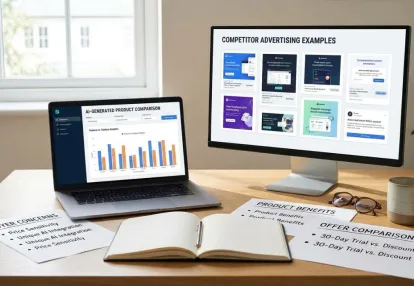
AI answers can reveal the questions, benefits, objections, and comparison criteria appearing in a category. Competitor advertising research can then show how advertisers are presenting offers around similar customer needs.
Neither source provides a complete picture of buyer behavior. AI-generated answers are not direct customer surveys, and visible competitor advertisements do not prove campaign profitability. But together, they can help marketers develop better research questions and more focused campaign hypotheses.
The opportunity is to connect what AI search says about a market with what advertisers are actually communicating—and use that information to make smarter creative, messaging, and landing-page decisions.
AI search has largely been framed around organic visibility.
Will AI Overviews reduce clicks? Will traditional rankings become less important? Which pages are being cited? How should brands adapt their content?
These are important questions. But performance marketers should also ask how AI-generated answers are changing the competitive environment in which their campaigns operate.
AI search is becoming an additional layer between brands and potential customers. It can summarize product features, compare alternatives, explain trade-offs, and influence which companies users consider before they visit a website.
That means AI search is not simply deciding whether a brand receives organic traffic. It may also influence how that brand is positioned against competitors.
Google's AI Overviews have expanded beyond simple informational explanations. They can appear in searches where users are researching products, evaluating options, and comparing solutions.
Semrush's research on AI Overviews reports their growing presence in tracked search results. The source draft cites a figure of more than half of queries tracked in Semrush Sensor, but the exact percentage, dataset, and reporting period should be checked before publication.
The more important development is how these answers can present several brands and product attributes together.
A user searching for the best project management platform for a small agency, for example, may receive a synthesized comparison of tools, features, pricing considerations, and use cases.
Even if the user does not immediately click through to a website, the answer may influence which brands they remember and which features they consider important.
MarTech's analysis of trust and AI search visibility discusses the changing role of trust and brand representation in AI-driven discovery.
For performance marketers, this creates an upstream competitive challenge. A brand may be competing for consideration before the user enters a conventional search or advertising funnel.
The change resembles what has already happened in paid media.
Advertising platforms increasingly automate audience selection, bidding, and creative delivery. Marketers provide objectives and inputs, while platform systems make more of the decisions about how campaigns are delivered.
MarTech's coverage of the AI performance shake-up explores how automation is changing performance across advertising channels.
AI search applies a similar pattern to discovery. Systems retrieve and summarize information, determine which sources to reference, and construct answers that influence how users interpret a category.
The difference is that marketers have limited visibility into the complete process.
You may see the final answer, its citations, and the brands it mentions. You generally cannot observe every internal retrieval step, prompt expansion, or ranking decision that produced it.
That organizational structure can create a blind spot.
The source draft cites a Semrush study reporting that 77% of marketers consider AI search part of SEO, while only 15% treat it as a distinct channel. It also reports that many marketers struggle to measure pipeline or revenue impact and still rely on manual checks.
These figures should be verified against the study's original methodology and publication date. See Semrush's research on the operational gap in AI SEO.
Regardless of the exact percentages, the underlying organizational question is worth considering.
If AI search is handled only as an SEO reporting task, other teams may miss its relevance to:
AI search can therefore contribute to brand, content, product marketing, and paid-media research.
Neil Patel's discussion of human-led SEO also emphasizes the importance of expertise and distinctive perspectives across emerging search surfaces.
For performance marketers, the implication is straightforward: organic visibility is only one part of the competitive picture. Understanding how AI systems describe your category and its brands can provide additional context for the media and creative decisions you make.
AI search changes more than the appearance of a search results page. It can change how users discover information, evaluate options, and decide what to investigate next.
Traditional search generally presents a list of links. Users choose which pages to visit and assemble their own understanding from the sources they find.
AI-powered search can synthesize information from multiple sources into a single answer. It may identify related aspects of a question, retrieve relevant information, and organize the result into a comparison or recommendation.
The exact process varies by system, but the result is a more mediated discovery experience.
Moz's analysis of the new rules of AI visibility discusses how visibility now involves more than traditional rankings and clicks. Brands also need to understand whether they are retrieved, accurately represented, cited, compared, or recommended in generated answers.
This creates three important changes for performance marketers.
In traditional search, marketers often evaluated visibility by asking whether a page appeared on the results page and where it ranked.
In AI search, a brand may appear inside the answer itself.
Consider a user asking:
“What is the best project management platform for a 10-person agency?”
An AI answer might provide a shortlist, describe the strengths of several products, and explain which tools are suitable for different requirements.
A brand may be:
A traditional ranking report may not capture all of these distinctions.
The challenge is to understand not only whether your website appears in the underlying search results, but also how your brand is represented in the generated answer.
When an AI answer resolves an informational question, a user may not need to visit several websites to understand the topic.
That can reduce the number of observable interactions in a traditional analytics journey.
The source references a Real FiG analysis reporting that informational searches may be affected differently from transactional searches as ChatGPT usage grows. Its discussion of this behavior is available in Real FiG's PPC analysis of ChatGPT and traditional search.
The draft's interpretation is that AI may absorb some early-stage research while transactional demand remains more resilient. Treat that as a reported observation, not a universal rule. The effect will depend on query type, category, audience, and the search experience.
For performance marketers, the important question is how much of the buying journey takes place before a user reaches an observable website or campaign interaction.
A buyer may already have expectations about pricing, features, or product suitability when they eventually click an ad.
That makes the pre-click discovery environment increasingly relevant to campaign messaging.
A brand may use different messages for different audiences. A premium product may also offer an entry-level option. A software company may serve both small businesses and enterprise customers.
Those differences are not necessarily contradictory.
But when a brand publishes inconsistent or poorly explained claims, AI systems may struggle to summarize its positioning accurately.
An enterprise AI search study discussed in Search Engine Journal's report on brand signals and AI search examines how conflicting positioning can create confusion in generated brand descriptions.
For example, a company that describes itself as both luxury-focused and budget-friendly without explaining its product tiers may receive generic or uncertain descriptions.
The solution is not to force every page to use identical language. It is to make the relationship between different products, audiences, and value propositions clear.
A brand should be able to explain:
Neil Patel's article on human-led SEO argues for maintaining original expertise and a clear point of view rather than relying on large volumes of generic AI-generated content.
That matters because a coherent brand story is easier for people to understand and easier for information systems to summarize consistently.
Taken together, these changes make AI search more than a new SERP layout.
It can influence:
This does not mean AI search controls every buying decision or that all users follow the same path. It means marketers should account for the possibility that more research and comparison happens before a traditional click.
The next step is to examine the answers themselves—not just count how often a brand appears.
Most marketers examine an AI answer and ask one question:
“Did our brand appear?”
That is a useful starting point, but it is not enough for competitive intelligence.
A better approach is to read the answer as a collection of clues about the user's possible needs, the system's interpretation of the question, and the criteria used to organize the response.
An AI answer is not a transparent record of the exact prompt trail or internal reasoning that produced it. You cannot reliably reconstruct every hidden query expansion, retrieval step, or ranking rule from the final output.
But you can analyze the visible structure and identify useful research hypotheses.
Look at the type of response the assistant provides.
Is it:
These response types can indicate different research needs.
For example, an answer listing the “top seven project management tools” is likely addressing a comparison or selection task. An answer explaining how to migrate from one platform to another is addressing an implementation problem.
Moz's analysis of AI visibility discusses how AI-driven experiences can move users into more conversational and agentic research flows.
For marketers, the useful question is what information the answer prioritizes and whether your existing content addresses those needs.
The headings, lists, and explanations can reveal how the assistant organized the problem.
For example:
These structures can help identify content opportunities.
If AI answers repeatedly discuss selection criteria but your website has no useful comparison guide, that may be a content gap worth addressing.
If the assistant repeatedly explains implementation steps but your product pages do not describe onboarding, your positioning may be missing an important part of the buying conversation.
The goal is not to copy the answer's structure blindly. It is to understand what information a useful response needs to provide.
The way brands appear in an answer can be more important than the number of mentions.
Record:
Repeated placement may indicate that a brand is consistently appearing in the answers you monitor. It is not proof of the model's internal confidence, nor does it establish that the brand is objectively the best choice.
Think of this as an observed positioning map, not a ranking formula.
AI answers can describe a brand using outdated, generic, or incomplete information.
The source draft cites the Semrush study on the operational gap in AI SEO as evidence that brands have concerns about inaccurate descriptions and unclear value propositions.
When you find a mismatch, investigate its possible causes.
Is the website unclear about the product's target audience? Are different pages using conflicting positioning? Are important product details missing? Does the brand rely on generic claims that could apply to almost any competitor?
These questions can lead to useful improvements in content, product documentation, and landing pages.
What does the answer leave out?
Suppose AI answers about financial software consistently discuss pricing and ease of use but rarely mention compliance, data residency, or channel-level attribution.
There are at least two possible explanations:
Neither explanation is proof of a market-wide demand gap.
But the omission can suggest a research opportunity. You can test whether those topics matter to customers through sales conversations, customer interviews, search data, and campaign experiments.
Neil Patel's discussion of human-led SEO highlights the value of original insight and firsthand expertise. Those qualities can help a brand produce more useful explanations than generic category content.
For each important AI answer, record:
Repeat the process using consistent prompts where possible. AI answers can vary with wording, location, personalization, model updates, and the information available at the time.
The result is not a complete view inside the AI system. It is a structured record of what the system presented in the answers you observed.
That record can become a useful input for competitor research.
AI search research and competitor advertising research are often handled by different teams.
SEO may monitor AI Overviews and citations, while paid-media teams study competitor advertisements, landing pages, and campaign creative.
Keeping those activities separate can mean missing useful connections.
The opportunity is to compare what AI answers emphasize with what competitors are visibly promoting in paid advertising.
AI answers can provide clues about questions, comparison criteria, and possible objections. Ad intelligence can show how advertisers present offers around similar themes.
These sources do not reveal the same thing, but they can complement each other.
Review the answers associated with important customer journeys.
Look for:
Moz's AI visibility research provides context for understanding how AI-generated answers can influence brand retrieval, comparison, and discovery.
Treat the answers as observed research material rather than a direct feed of verified customer intent.
Next, investigate how advertisers are presenting offers around similar problems and benefits.
Ad intelligence tools can help marketers examine visible advertising examples across supported search, social, and display environments.
Look at:
A visible advertisement tells you that an advertiser is running or has run a particular creative in the observed environment. It does not reveal the advertiser's private budget, profitability, conversion rate, or internal campaign strategy.
The value is in identifying the messages and offers that are appearing in the market.
The most useful insights often emerge when the AI answer and competitor advertising do not appear to emphasize the same things.
Consider two examples.
Example 1: A possible messaging gap
AI answers about a software category repeatedly emphasize compliance and security, but the competitor ads you review rarely mention those topics.
This could be an opportunity to test a campaign that explains your product's relevant compliance features more clearly.
First, verify that your product genuinely supports the claims. Then test whether the message attracts qualified interest.
Example 2: Conflicting positioning
Competitor ads repeatedly describe a product as luxurious, while AI answers describe the same brand as budget-friendly or mid-range.
This may indicate inconsistent messaging across the brand's public content.
The enterprise AI search research discussed in Search Engine Journal's report provides context for why conflicting positioning can make brand descriptions less clear.
For your own brand, the lesson is to make product tiers, pricing, and audience differences explicit rather than adopting a competitor's inconsistent message.
You can turn these observations into a repeatable process.
1. Harvest AI intent
Collect AI answers for priority buying journeys.
Examples include:
Record the language used to describe pain points, benefits, objections, and decision criteria.
2. Map the findings to paid inventory
Use your ad intelligence workflow to find relevant competitor creatives and landing pages.
Organize the examples according to the needs identified in your AI research.
Which messages appear frequently? Which offers address the same concerns? Which topics seem less represented in the visible advertising examples?
3. Design cross-channel tests
Turn useful gaps into original campaign experiments.
For example, if AI answers repeatedly discuss fast implementation but the competitor ads you reviewed rarely address it, test a message that explains your own implementation process.
That concept might be adapted for search ads, social video, or display creative, depending on the audience and platform.
Real FiG's analysis of ChatGPT's effect on traditional search discusses the potential importance of awareness and more detailed landing pages as search behavior changes.
Your test should define the audience, message, creative format, landing page, and success metric before launch.
4. Feed validated findings back into your broader marketing
If a message produces qualified leads or stronger conversion performance, consider whether the insight should inform other parts of your marketing.
It may be appropriate to update:
MarTech's analysis of trust as an AI visibility signal provides context for the importance of credible and consistent brand information.
However, do not assume that adding a phrase to a landing page will automatically influence an AI system's future answers. AI retrieval and visibility depend on many factors outside the marketer's control.
When the research is repeated, each cycle can improve three areas:
The result is not guaranteed improvement in click-through rate or revenue. It is a more connected research process that helps performance marketers make decisions using several sources of evidence rather than relying on rankings or ad examples alone.
A useful AI search research process starts with the right question.
Instead of thinking only like a keyword researcher, think about the information a buyer might request at a particular stage of their decision.
A broad keyword such as “Shopify-is-the-best-thing-that-happened-to-small-businesses-heres-why" target="_blank" rel="noreferrer noopener">ecommerce platform” does not reveal much about the user's situation.
A more specific question, such as “What is the cheapest ecommerce platform for a beginner selling print-on-demand products?” provides more context about the buyer's needs and constraints.
Real FiG's PPC analysis of ChatGPT and traditional search discusses the move toward longer, conversational queries as users interact with AI assistants.
The purpose of using specific prompts is not to assume that every buyer asks questions in exactly this way. It is to explore how different constraints change the answers and the brands being presented.
A practical framework divides questions into three groups.
Top of funnel — Problem framing
At this stage, the user is trying to understand a problem or explore possible solutions.
Examples:
These questions can reveal how the AI explains the problem and which solution categories it introduces.
Mid-funnel — Solution patterns
The user understands the problem and is exploring different approaches.
Examples:
These questions can reveal comparison criteria and the brands associated with different use cases.
Bottom of funnel — Purchase and switching
The user is closer to making a decision.
Examples:
These questions can reveal commercial considerations such as pricing, migration, support, integrations, and contract terms.
Certain words can change the type of answer an AI system provides.
Examples include:
The source cites Semrush's research on commercial modifiers in AI Overviews and reports that coverage for “best X for Y” and brand-alternative searches has exceeded 80% in the studied SERPs. Confirm the study's exact scope, query sample, and date before using that percentage publicly.
Once you have selected prompts, test them across the AI assistants relevant to your audience.
Record the answers and compare:
For example, “cheapest ecommerce alternatives” may produce a different shortlist from “cheapest ecommerce alternatives for high-volume stores.”
The second prompt adds an operational constraint that may change which products are considered relevant.
Moz's AI visibility framework discusses how query wording and context can affect brand retrieval and representation.
For each prompt, record which competitors appear and the role they are given.
Semrush's commercial-modifier research provides additional context for the role of these query patterns in AI Overviews.
Save the full answers and tag them by funnel stage and modifier type.
Over time, this creates a structured record of how the AI systems you monitor present competitors across different buying contexts.
That record can then be compared with paid-search and social advertising research to see how visible advertisers are positioning themselves around similar needs.
Once you have an AI answer, do more than record the brands it mentions.
Read the answer for clues about the buyer it appears to address, the problems it emphasizes, and the constraints it considers important.
This is where AI research can become especially useful for creative and offer development.
An AI-generated answer is not a verified customer persona. It reflects the prompt, available information, and the system's interpretation. But the language can provide useful hypotheses to validate through customer research and campaign testing.
Imagine a user asks:
“What should someone consider when comparing products in this category?”
The answer repeatedly emphasizes:
Those themes suggest possible concerns around risk, trust, and purchase confidence.
For a different category, an answer might emphasize ease of setup, integration compatibility, or ongoing subscription costs.
The useful exercise is to identify what the answer appears to assume about the buyer—not to treat those assumptions as proven facts.
1. Product modifiers and constraints
Words such as:
These terms can indicate attributes or restrictions that matter in the specific query being researched.
For example, the source uses a health-product query involving a person over 40 with thyroid issues. The answer might emphasize product ingredients, possible interactions, and medical consultation.
That is an example of how a query can introduce safety constraints. It should not be used to make medical recommendations or imply that a product is suitable for someone with a particular condition.
The same analytical method can be applied to less sensitive categories, such as software, home products, or ecommerce services.
2. Risk and trust language
Look for phrases such as:
These phrases may reveal concerns that users bring into a purchasing decision.
MarTech's discussion of trust and AI search visibility provides context for the role of trust and authority in AI-generated brand representations.
For marketers, these observations can suggest useful landing-page improvements.
If users are concerned about hidden fees, explain pricing clearly. If they are worried about implementation, provide a practical onboarding guide. If they need proof, present verifiable evidence rather than unsupported claims.
3. Usage context and logistics
Look for details that explain how a product or service fits into someone's life or work.
Examples include:
These details can help marketers identify practical requirements that broad category keywords do not express.
For a software product, “works with existing systems” may suggest an integration concern. For a home product, “fits small spaces” may indicate a physical limitation. For a service, “local support” may point to a preference about accessibility and assistance.
4. Comparative and trade-off language
Pay attention to how AI answers distinguish between options.
You may see phrases such as:
This language can reveal the decision criteria being used to group products and brands.
For example, an answer comparing ecommerce platforms may describe one as affordable and simple to set up, while another is positioned around customization and scalability.
That can suggest different buyer segments and messaging opportunities.
Real FiG's PPC analysis provides context for the continued importance of commercial and transactional searches as AI changes earlier research behavior.
For each AI answer, extract:
| Research element | What to record |
|---|---|
| Implied persona | Who the answer appears to address |
| Primary pain | The problem the user is trying to solve |
| Constraints | Requirements or limitations mentioned |
| Trust concerns | Proof, safety, reputation, or policy questions |
| Buying criteria | Features and trade-offs used to compare options |
| Competitor positioning | Which brands are associated with each need |
| Research opportunity | What should be checked with customers or ad intelligence |
The next step is to compare these findings with visible competitor advertising.
If AI answers repeatedly discuss transparent pricing, examine whether competitor ads make pricing a central part of their message. If the answers emphasize ease of implementation, investigate whether advertisers promote onboarding, setup support, or done-for-you services.
The comparison can reveal which concerns are already being addressed in the market and which may deserve further testing.
Do not assume that an unmentioned benefit is an opportunity or that a frequently repeated phrase is a proven buying trigger. Validate the strongest hypotheses with real customer feedback and first-party campaign results.
The goal is to mine AI answers for useful research clues, then use competitive ad intelligence to understand how advertisers are responding to similar needs.
In an AI-mediated discovery environment, those clues can help marketers build more relevant creative, stronger landing pages, and better-informed offers.
AI search is changing how buyers discover brands, compare products, and evaluate solutions before visiting a website.
For performance marketers, that creates a research opportunity beyond traditional SEO reporting.
Study the questions AI systems answer, the brands they mention, the benefits they emphasize, and the concerns they address. Treat those observations as clues about how your category is being presented—not as direct proof of what every buyer wants or what will convert.
Then connect those findings with competitor advertising research.
Use Anstrex to investigate visible creative approaches, offers, and landing-page experiences across supported advertising environments. Compare those examples with the themes appearing in AI answers and identify messages or customer concerns worth testing.
Finally, validate the strongest ideas through your own campaigns, customer feedback, and conversion data.
AI search can help you understand the questions shaping discovery. Competitive ad intelligence can help you see how advertisers are responding to similar market needs. Your own results determine which ideas deserve further investment.
Stop treating AI search as only an SEO reporting challenge. Use it as another source of competitive intelligence—and connect what you learn to campaigns you can actually measure.
Receive top converting landing pages in your inbox every week from us.
Recently Updated
AI can optimize campaigns using your own performance data, but competitive intelligence adds context about the market around you. Discover how to connect both through a practical system for observing competitor activity, testing hypotheses, and scaling validated playbooks.
Elena Morales
7 minNov 11, 2026
Guide
AI search is changing how buyers compare brands before clicking. Discover how performance marketers can use AI answers and competitive ad intelligence to uncover positioning gaps and develop better campaign tests.
Priya Kapoor
7 minNov 11, 2026
How-To
Platform changes reveal where advertising companies are investing and how they intend to compete. Learn how to turn those signals into testable media and campaign strategies.
Marcus Chen
7 minNov 10, 2026