6 minJuly 12, 2026

Our spy tools monitor millions of TikTok ads from over 55+ countries. Biggest TikTok Ad Library in E-commerce and Mobile Apps!
Try It FREETikTok didn't just announce a few new ad units this year. It shipped an entire operating system for marketers — one that touches every stage of the funnel, from the first spark of creative ideation to the moment a customer taps "buy." Understanding the full scope of what landed is essential before we can talk about what's still absent.
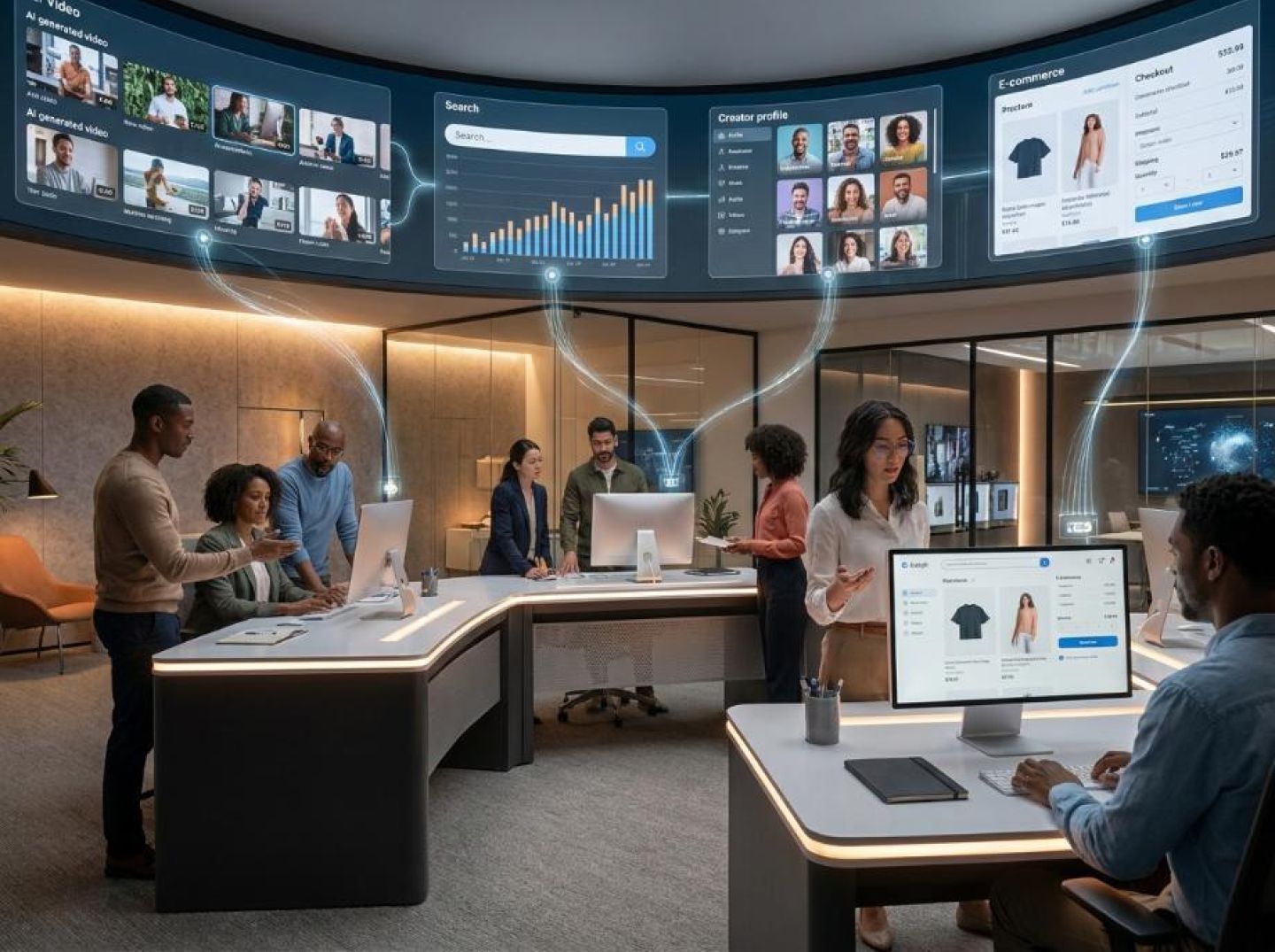
Start at the top. Symphony, TikTok's generative AI creative studio, now lets brands produce TikTok-first video from a text prompt or a handful of existing assets. Upload a product photo, describe the scene you want, and Symphony — powered by ByteDance's Seedance video model — renders a ready-to-post clip. It can translate voiceovers into multiple languages, and it can generate AI avatars that look and move convincingly enough to stand in for a founder who's too busy to sit in front of a camera. But the more consequential feature is the daily video generation engine: a fresh, auto-generated ad variation every single day, customized to your brand based on past activity. The system is designed to cycle out underperformers and scale winners automatically, functioning less like a creative tool and more like an always-on media buyer who also happens to produce the assets.
Move to discovery. TikTok has been quietly becoming a search engine for an entire generation of users, and Search Hubs formalize that shift with paid placements that sit at the top of TikTok search results, letting brands control the search experience around their name using videos, banners, and creator content. For any marketer who has watched branded queries leak to competitors on Google, the appeal is immediate.
Then there's the premium layer. As Neil Patel's analysis of TikTok's 2026 IAB NewFronts detailed, the platform introduced four formats built explicitly to compete with TV and streaming budgets. Logo Takeover places a brand at the moment users open the app, co-branded with TikTok itself — early tests showed double-digit lifts in both awareness and purchase intent. Prime Time delivers up to three sequential ads from the same brand to the same user within a fifteen-minute window, timed to high-engagement periods or cultural moments, giving advertisers the ability to tell a continuous story across multiple exposures. TopReach extends massive-scale awareness plays, and an expanded Pulse suite lets brands place ads adjacent to the platform's highest-performing organic content.
The numbers underneath these formats are hard to dismiss. TikTok now reaches more than 200 million Americans and 1.99 billion monthly active users globally, with an engagement rate of 3.7 percent — nearly eight times higher than Instagram and twenty-five times higher than Facebook. Its commerce arm, TikTok Shop, generated $15.82 billion in U.S. sales in 2025 with 108 percent year-over-year growth, and native checkout means users can now complete a purchase without ever leaving the app.
Stitch all of this together and the picture is clear. TikTok has collapsed creation, discovery, search, and purchase into a single ecosystem. It is not pitching itself as a social platform with ad inventory bolted on; it is positioning itself as a full-funnel engine where entertainment, commerce, and performance converge. For marketers willing to commit budget and creative energy, the toolkit is genuinely formidable — the most ambitious build-and-convert stack any social platform has shipped to date.
That ambition, however, carries a blind spot. And it's a significant one.
Every major ad platform has made the same architectural choice, and it's not an accident. The tools they build for advertisers are designed to optimize inward — drawing on your account history, your uploaded assets, and your own performance data to generate recommendations and automate execution. TikTok's Symphony suite is no exception. As Social Media Examiner has detailed, Symphony's auto-generation and daily variation features pull from your past creative activity to produce new iterations, remixing what you've already run into fresh cuts calibrated to your own engagement patterns. It's impressive engineering. But the data inputs are yours and yours alone.
This means that before you have meaningful performance data — in a new vertical, with a new product, or on a new account — you're essentially guessing. Symphony can generate a polished video and rotate hooks daily, but it cannot tell you that UGC testimonials anchored around a specific price point are outperforming problem-solution formats three-to-one in your category right now. It doesn't know what your competitors are running, which opening lines are stopping thumbs at scale across your market, or which creative patterns have demonstrated staying power over the past 90 days. That intelligence simply doesn't exist inside any first-party tool, because first-party tools are scoped to first-party data.
The limitation extends well beyond TikTok. Meta's Advantage+ creative suite optimizes around your catalog and your conversion events. Google's Asset Studio, as MarTech has described, generates and scales creative assets using AI — but the inputs are your briefs, your brand guidelines, your existing campaigns. Even cross-channel management platforms that sync edits across ten networks at once are still operating within the boundary of what you've already built. They make execution faster and more consistent, but they don't widen the aperture of what you know before you execute.
This matters especially on TikTok because of how the platform's algorithm distributes content. As the App Samurai Blog notes, TikTok remains the best platform for community-driven growth where social proof is the primary conversion driver. That's a critical insight: if social proof patterns — real people endorsing real products in formats the community already trusts — are what actually convert on TikTok, then knowing which social proof patterns are already winning is upstream of building your own. You need that competitive and categorical context before you open the creative editor, not after.
And even once you do have performance data, you're optimizing in a vacuum. Your CTR improved 12 percent this week — but relative to what? Your cost per acquisition dropped — but is it still twice the category median? Without competitive benchmarks, your optimization loop is closed but not calibrated. This is the same gap that's driving demand for third-party measurement tools across the industry. As AdExchanger reported, marketers increasingly want to know not just how they're performing incrementally but how they stack up against their peer group — whether they're over-performing, under-performing, and what else they should try.
None of this is an indictment of TikTok's product team. The gap is structural, a category limitation shared by every platform that builds tools for its own advertisers. Platforms are incentivized to help you spend more effectively within their ecosystem, not to hand you a map of what everyone else is doing inside it. That map has to come from somewhere else — and recognizing that it's missing is the first step toward building a creative strategy that isn't flying blind.
Platform-native tools answer the question "What should we build for you?" — generating fresh creatives from your brand assets, optimizing bids against your own conversion data, cycling out your underperformers and scaling your winners. That's genuinely valuable. But an instream ad spy tool answers a fundamentally different question: "What's already winning out there?" The first is generative; the second is evidential. Performance marketers need both, and conflating them leads to wasted spend.
In concrete terms, a competitive ad intelligence tool gives you live visibility into the ads your competitors are actively running on TikTok right now — not a library of past campaigns or a curated gallery of best practices, but a real-time feed of what's in market. You can filter by engagement signals: comment velocity, share counts, view milestones. More importantly, you can filter by ad longevity — how many days a creative has been running continuously. Duration live is the closest public proxy for profitability; no rational media buyer keeps spending on an ad that isn't returning. When you see a competitor's video running unchanged for six weeks, you're looking at validated proof of performance, not a hypothesis.
That distinction matters enormously in a platform environment where the creative throughput expectations are staggering. As App Samurai has noted, platforms like Meta and TikTok have evolved from targeting engines into "Creative Intelligence Platforms" where the prevailing strategy demands providing the algorithm with 10+ hooks per week and letting machine learning find the users. Ten hooks a week is a relentless production pace, and no team can sustain it by brainstorming from scratch every Monday morning. Spy tools are where you source and validate those hooks — studying which opening lines, visual patterns, offer structures, and calls to action are already driving engagement in your niche so that every new creative iteration starts from evidence rather than instinct.
This is also where the economics of learning budgets come into sharper focus. Any responsible performance marketer treats initial spend on a new format or platform as a learning investment, with the explicit goal of scaling from a position of knowledge rather than guesswork. Competitive intelligence is precisely the mechanism that converts guesswork into knowledge before that learning budget is spent. Instead of running fifteen untested hooks at $200 each to discover which framing resonates, you study the hooks that are already surviving market selection in your category, build informed variations, and enter your testing phase with hypotheses that have external validation behind them.
None of this replaces what TikTok's Symphony suite does. Symphony can generate a fresh video from a text prompt, produce daily creative variations tailored to your brand, and cycle winners in and out automatically. Those capabilities are impressive — but they operate entirely within the boundary of your own account data and brand inputs. They cannot tell you that your top competitor just shifted from pain-point hooks to aspirational hooks and saw engagement triple. They cannot reveal that every profitable ad in your vertical is now leading with a specific CTA structure or price anchor. They cannot show you that a creative format you haven't considered — a green-screen testimonial, a silent demo with captions, a duet-style reaction — is dominating paid placements in your category this week.
The competitive layer doesn't contradict the platform layer. It completes it. One system builds; the other scouts. And the marketers who treat scouting as optional are the ones subsidizing their competitors' education with their own ad budgets.
The real leverage isn't in choosing between competitive intelligence and TikTok's native tools — it's in running them as sequential stages of a single creative pipeline. Here's what that looks like in practice, step by step.
Step 1: Mine the market before you make anything. Open your ad spy tool of choice and filter competitor creatives in your vertical by longevity and engagement signals. An ad that's been running for sixty days with consistent spend is a far stronger signal than one that spiked and disappeared. You're looking for ads that survived the platform's own Darwinian pressure — the ones the algorithm kept serving because they kept converting. This is the intelligence layer that no platform-native suite provides, because it requires visibility into what's happening outside your account.
Step 2: Extract patterns, not pixels. You're not copying a competitor's video. You're cataloging the structural elements that recur across winners: the hook format (text-on-screen question versus face-to-camera confession), the pacing (quick-cut versus single-take), where the CTA lands relative to the narrative arc, and how the offer is framed. These patterns are the creative brief that your competitor's media budget already validated for you.
Step 3: Feed those validated concepts into Symphony. This is where TikTok's generative engine earns its keep. Rather than starting from a blank prompt or relying solely on your existing brand assets, you're supplying reference structures that have already demonstrated traction. As Social Media Examiner has detailed, Symphony can generate video from prompts and existing assets, then produce daily auto-generated variations — a system designed to cycle out underperformers and scale winners. When the initial creative input is directionally sound, that optimization loop starts from a stronger position. You're not waiting for the algorithm to stumble onto what works; you're handing it a hypothesis the market has already stress-tested.
Step 4: Deploy into premium placements with confidence. TikTok's newer formats reward creative quality with disproportionate reach. Prime Time, for instance, delivers sequential ads from the same brand to the same user within a fifteen-minute window during high-engagement periods — a storytelling capability that only pays off if your creative earns attention across multiple exposures. Pulse placements position your ads alongside trending content. Search Hubs capture high-intent users at the moment of query. Each of these premium surfaces amplifies strong creative and punishes weak creative faster than standard in-feed inventory. Starting with competitively validated concepts means your first dollar in these placements is less likely to be wasted on discovery.
Step 5: Let the machine iterate from an elevated baseline. Once your campaign is live, TikTok's auto-optimization engine takes over — adjusting delivery, testing variations, and reallocating spend toward what converts. The critical difference in this workflow is where the optimization begins. Instead of exploring from zero, the system is refining from a starting point that already encodes market-proven hooks, formats, and offer angles.
The net effect is compression. You compress the learning phase because you're not paying to discover what competitors have already surfaced through their own spend. You compress the production phase because Symphony generates platform-native variations faster than any human editing team. And you compress the distribution phase because premium placements like Prime Time and Pulse accelerate the feedback loop between creative and conversion. As MarTech has noted, the real shift in modern ad operations isn't about better dashboards — it's about changing who or what does the upstream operational work. This workflow applies that principle to the creative layer: competitive intelligence handles the upstream research that would otherwise consume hours of testing budget, and TikTok's tools handle the downstream execution at a speed and scale no manual process can match.
Neither toolset alone gets you there. Together, they turn what used to be a multi-week creative testing cycle into something that can launch with directional confidence on day one.
The gap between what TikTok's native tools can tell you and what competitive intelligence reveals isn't unique to this platform — but it's more consequential here than anywhere else. Three dynamics specific to TikTok make the cost of flying blind on competitor strategy significantly higher than on Meta or Google.
Creative fatigue hits faster, so discovery phases cost more. TikTok's feed velocity is unlike anything else in paid social. The culture rewards novelty, punishes repetition, and cycles through trends in days rather than weeks. Ad half-lives are measurably shorter: a creative that's crushing it on Monday can start declining by Thursday, and by the following week it's dead weight. On Meta, you might get two to three weeks of solid performance from a winning ad before fatigue sets in. On Google Search, a well-structured text ad can run for months. TikTok doesn't afford that luxury. That compressed timeline means every day you spend in a discovery phase — testing hooks, iterating on formats, figuring out what resonates — is a day where you're burning budget against creative that's already aging. When App Samurai describes TikTok as the leader for "viral, UGC-style growth" where social proof drives conversions, the implication is that the creative itself is the targeting. You can't lean on intent signals or keyword matching to bail out a mediocre video. Starting your creative development from competitive intelligence — knowing which hooks, formats, and narratives are already surviving the feed's brutal natural selection — collapses your discovery phase from weeks to days. On TikTok, that time savings isn't a nice-to-have; it's the difference between scaling profitably and watching your budget evaporate during testing.
The algorithm rewards volume, and volume without direction is expensive. TikTok's own tools are built around this reality. As Social Media Examiner detailed in its breakdown of TikTok's Symphony suite, the platform now offers daily auto-generated video variations and a system designed to cycle out underperformers and scale winners automatically. That's an extraordinary production capability — but production without strategic direction just means you're generating more darts to throw blindly. Symphony can produce ten new creatives a day for your brand; competitive intelligence tells you which of the ten directions those creatives should explore. Without that external input, you're relying entirely on TikTok's algorithm to sort signal from noise using your budget as fuel.
The platform is collapsing the entire funnel into one environment, which raises the stakes at every stage. TikTok isn't just an awareness channel anymore. With Search Hubs, in-app purchasing, and booking integrations, a single creative now has to perform across discovery, consideration, and conversion — all within the same feed experience. That means a weak creative doesn't just waste impressions; it leaks revenue at every stage of a funnel that's now entirely contained inside one app. When the full journey from first impression to purchase happens without the user ever leaving TikTok, the creative carries more weight per dollar than on any other platform. Starting that creative process with knowledge of what's already converting in your category — not just what your own tests eventually surface — is the highest-leverage move available.
Taken together, these three dynamics create an environment where the penalty for ignorance compounds faster than anywhere else in digital advertising. TikTok's native tools are powerful engines, but engines need navigation. Competitive intelligence provides it.
Receive top converting landing pages in your inbox every week from us.
Featured
The FIFA World Cup generates more than unforgettable sports moments—it creates one of the world's largest real-time creative testing environments. Every viral celebration, comeback, and emotional reaction reveals exactly what captures attention, sparks engagement, and drives consumer intent. Instead of treating these moments as entertainment, smart marketers analyze them as creative signals, using TikTok trends, premium ad formats, and audience behavior to build more effective performance campaigns. By systematically decoding viral content and adapting proven emotional frameworks across advertising channels, brands can create campaigns that resonate long after the final whistle.
Liam O’Connor
7 minJul 13, 2026
Featured
TikTok is rapidly evolving into a self-contained advertising ecosystem where AI-generated creatives, search discovery, premium placements, and in-app commerce all operate within the platform's own measurement framework. While these tools offer remarkable efficiency, they also make advertisers increasingly dependent on TikTok's internal data and optimization. Smart marketers counterbalance this by using competitive intelligence before launching campaigns—studying live competitor creatives, funnel strategies, and premium ad executions to validate ideas before spending. In a growing walled garden, external intelligence becomes the key to making better advertising decisions.
Priya Kapoor
7 minJul 12, 2026
Featured
TikTok's 2026 advertising ecosystem is the most comprehensive full-funnel marketing platform yet, combining AI-powered creative generation, search advertising, premium placements, and in-app commerce into a single workflow. But even its powerful native tools share one critical limitation: they optimize only from your own account data. They can't reveal what competitors are already succeeding with. By combining TikTok's AI-powered execution tools with competitive ad intelligence, marketers can start with market-proven creative concepts instead of costly guesswork—reducing testing costs, accelerating optimization, and gaining a decisive edge in one of digital advertising's fastest-moving environments.
Marcus Chen
7 minJul 12, 2026