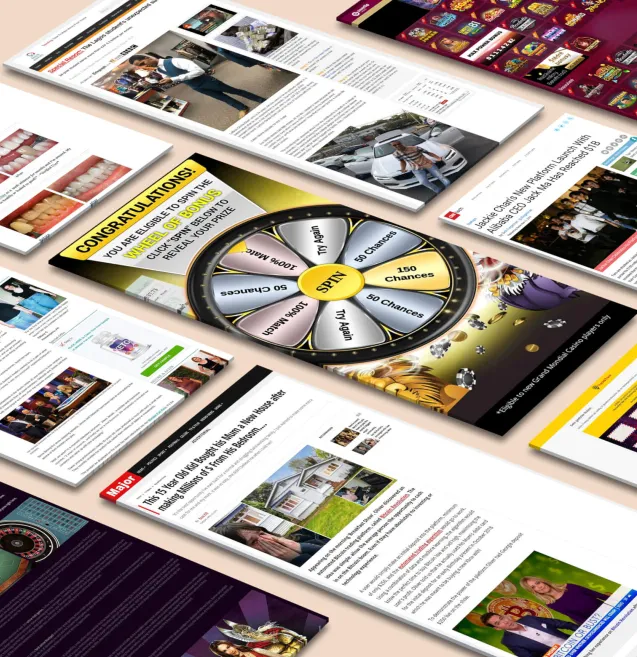
Are You Spying on Your Competitors' Push Ad Campaigns?

Our spy tools monitor millions of push notification ads from over 90+ countries and thousands of publishers.

Get Started

Publishing Push Notification Ads and launching campaigns for your brand or product is much easier to do today compared to years ago. However, sometimes, you might find yourself wondering: why am I still not getting the results I want? The answer: you’re probably doing it wrong.

You know what you want: higher traffic with better conversions at the lowest possible costs. It might seem easy to understand, but it’s a lot more difficult to execute. To avoid wasting your valuable resources, here are 5 common mistakes you might be making when you create and publish your Push Notification Ads (and what you should do instead).

1. You Fail To Establish Credibility

Gaining your potential customers’ trust is essential in the success of any business: since you’re building your business through advertising, you have to establish credibility from the start. This is especially true if you are promoting a business, and not just a product. False and misleading ads will drive your customers away, and it will for sure not be good for you in the long run.

What To Do Instead:

  • Never use names of celebrities, logos, brands, or products that are in no way affiliated to your business
  • If you were to reference a brand, make sure to use the brand logo only if it is on the product itself – do not just use the logo as this might misrepresent the brand
  • Do not start your ads with messages that “threaten” your customers (e.g. “your system has a virus you’re not aware of” or “you will lose data if you don’t click on this”)
  • Be professional – don’t use sexually explicit language or images just to get clicks, as these clicks will not be converted to business anyway.

2. You Don’t Bother With Getting Creative

Traditional designs are good and could be quite effective – but not in this century. Remember WordArt from the time when dial-up Internet is still a thing? Yeah, now is surely not that time – and your designs should not be stuck in that period either.

What To Do Instead:

  • The 80-20 rule is a good rule to follow: your Push Notification Ads should be around 80% visuals and 20% text. If your ad is too text-heavy, it will not be appealing to customers; at the same time, if you don’t put just enough text, then you might find it difficult to convey your message.
  • Create your own designs and do not simply copy popular layouts or interfaces – a lot of tools are available online nowadays, so it shouldn’t be difficult for you to make high-quality creatives (pro tip: Canva is a good place to start)

3. Your Targets Are All Over The Place

Setting the right targets could not only save you time and money, but also increase the chances of a successful ad campaign. However, if you’re simply focusing on one target (for example: location), you will most likely get unsatisfactory results.

What To Do Instead:

  • Narrow and wide targeting – to understand your audience, start with a wide target, taking into consideration the GEO, device type, OS, browser, carrier, and browser language. Depending on your campaign goals and after you have tried the wide targeting, you can then launch narrower campaigns to hit the right users.
  • Target based on activity – users are categorized into high-, moderate-, and low-activity groups. You will have better chances at getting higher CTR with high-activity users, but do not focus solely on this group. Start by testing on high-activity users first (especially for new campaigns) and see how your audience interacts with your campaign. From there, work your way down to the other groups and find out which gets more volume for lower the price.

4. Your Ads Are Not Timed Well

Good timing is key to a successful ad campaign, and, contrary to popular belief, good timing does not always mean high frequency. Planning ahead of time is one thing, but selecting the frequency of your ads is another. You need to choose a suitable schedule depending on the purpose of your ads, and not doing so could result in less traffic (and even annoy your target audience in the process).

What To Do Instead:

  • Use low-frequency ads for long-term campaigns, especially if you only have one landing page. This will enable you to use your creatives for much longer and will keep you from annoying your target audience.
  • Use high-frequency ads for short-term, one-time, or special events like summer sales, football games, holidays, or festivals.

5. You’re Not Using The Right Model

It might take a little getting used to, but choosing the right model for your Push Notification Ads is the most cost-effective way to get good results. One common mistake is simply choosing what seems to be the cheapest option, but it turns out to be the least profitable one in the end. Without using the right model, you might just completely miss your targets.

What To Do Instead:

  • Always know your numbers – keep track of the results of your previous tests and make sure to compare data to know which ones to use for specific targets. At the same time, do not forget to compare the costs between the models you use.
  • Do not be afraid to switch, test, mix and match – for example, if you wanted to choose between which creatives to use, you can start with testing your creatives on a CPC model, compare the CTR between the creatives, and then choose the one with the highest CTR for your next CPM campaign. In this case, you are not only switching between creatives: you are also switching between models to find out which suits your campaign the most.
  • Check prices – remember: your ultimate goal is to get the best conversation rates, and you will not be able to do so without checking the prices of different ad models.
  • Do not combine all GEOs in a single campaign – if you combine two GEOs in one campaign, you might end up overpaying for one and not getting enough traffic from the other. For example, if the CPC in Italy is 0.01 and is 0.1 in Sweden, and you decide to combine these two GEOs in a single campaign, you might be paying for a CPC of 0.055 but your CTR and CPA at both GEOs are not optimized.

If you ensure that you create quality designs, credible and well-timed content, and well-organized models, you can be assured that you will achieve your campaign goals and improve your push notifications ad performance.

Top converting landing page sample images
Top Converting Landing Pages For Free

Receive top converting landing pages in your inbox every week from us.

Related Articles
Why Your Competitors' Ad Data Is More Honest Than Your Own Analytics Dashboard

Most Read

Why Your Competitors' Ad Data Is More Honest Than Your Own Analytics Dashboard

This article challenges the assumption that first-party analytics provide the most complete picture of marketing performance. It argues that internal dashboards are inherently limited by survivorship bias, showing only the behavior of users who already entered a brand’s funnel while ignoring broader market dynamics. By contrast, competitor ad data reveals valuable external signals such as keyword opportunities, messaging shifts, auction dynamics, spend patterns, and emerging market trends. The article explores how revealed preference theory, ongoing competitive intelligence systems, and AI-powered analysis can help marketers move beyond isolated internal metrics and build a more honest, market-aware view of performance. Ultimately, it advocates combining first-party analytics with competitor intelligence to create a more accurate and actionable decision-making framework.

Priya Kapoor

Priya Kapoor

7 minJun 12, 2026

OOH Is Hiring While Digital Advertisers Are Automating — Here's What That Gap Means for Your Campaigns

In-Depth

OOH Is Hiring While Digital Advertisers Are Automating — Here's What That Gap Means for Your Campaigns

This article explores the widening operational gap between the out-of-home (OOH) advertising industry and digital advertising, highlighting how OOH companies continue to scale through hiring while digital advertisers increasingly rely on automation, AI, and competitive intelligence. It examines how automation has transformed digital media buying, optimization, and campaign management, while many OOH organizations still depend on relationship-driven workflows and manual processes. The article also analyzes how emerging technologies such as programmatic DOOH, agentic AI, and predictive demand intelligence are beginning to modernize OOH, creating opportunities for early adopters. Ultimately, it argues that advertisers who combine OOH’s real-world impact with digital-style automation and intelligence systems will gain a significant competitive advantage in the years ahead.

Priya Kapoor

Priya Kapoor

7 minJun 12, 2026

The Measurement Problem OOH Can't Solve (And How Push and Native Advertisers Already Did)

Must Read

The Measurement Problem OOH Can't Solve (And How Push and Native Advertisers Already Did)

This article examines the fundamental measurement gap between out-of-home (OOH) advertising and performance-driven digital channels. While OOH continues to rely on probabilistic attribution models such as store visit tracking, web lift studies, and geographic correlation analysis, native and push advertising were built with measurement as a native capability. The article challenges the industry's "honest measurement" narrative, arguing that deterministic tracking, direct attribution paths, and competitive intelligence tools give native and push advertisers a structural advantage that OOH cannot replicate. It also explores why marketers continue to romanticize billboards despite these limitations and explains how prestige, visibility, and brand perception often influence media decisions more than measurable business outcomes.

Dan Smith

Dan Smith

7 minJun 11, 2026