6 minOctober 29, 2026

Our spy tools monitor millions of native ads from over 60+ countries and thousands of publishers.
Get StartedMost marketers still treat Answer Engine Optimization (AEO) and native ad intelligence as two separate disciplines.
One focuses on organic discovery through AI-powered search experiences. The other focuses on understanding paid campaigns, competitor creatives, and advertising funnels.
But both are built around the same fundamental challenge:
Understanding what a user wants, delivering the most relevant answer, and giving that person a clear reason to take the next step.
Answer engines such as ChatGPT, Gemini, and Microsoft Copilot interpret information and generate responses based on their respective systems and available sources. Advertisers, meanwhile, use competitive intelligence to understand which messages, offers, and landing page experiences are being used to attract specific audiences.
The mechanisms are different, but the strategic opportunity is similar.
A page that clearly explains a solution, answers relevant questions, and demonstrates credibility can serve people arriving from an AI-generated recommendation as well as visitors clicking through a native advertisement.
This is where AEO and ad intelligence begin to reinforce each other.
AEO helps marketers organize information so that answer engines can understand and potentially reference it. Competitive ad research reveals the problems, emotional triggers, and offer structures that attract attention in paid channels.
When combined, these insights can help marketers create landing pages that are more relevant to their audiences, easier to understand, and better aligned with the intent behind each visit.
The goal is not simply to rank in AI Overviews or imitate a competitor's advertisement. It is to build a consistent experience that connects the user's original question to a credible answer and an appropriate conversion path.
AEO and competitive ad intelligence operate in different environments, but they share an important principle: relevance depends on understanding the user's intent.
Traditional SEO focuses heavily on helping search engines discover, interpret, and rank web pages. AEO extends that thinking to AI-powered experiences where systems generate answers, summarize information, and may reference selected sources.
There is no single universal ranking formula for every answer engine. Different systems may use different retrieval, ranking, generation, and citation processes.
However, marketers can still make their content easier to understand and evaluate by using clear explanations, descriptive headings, relevant evidence, and well-organized information.
HubSpot's research into brands receiving citations from AI search experiences discusses patterns associated with frequently cited brands, including content clarity and the importance of providing useful information.
The underlying lesson is straightforward: content should answer real questions instead of forcing readers to search through vague marketing language.
Native advertising has a related objective.
When advertisers research campaigns through tools such as Anstrex, they can investigate the creative angles, headlines, offers, and landing pages being used to attract particular audiences.
A native advertisement might introduce a problem, highlight a possible solution, or create curiosity around a specific outcome. Its landing page then needs to continue that conversation.
If the advertisement promises a practical solution but the landing page delivers unrelated promotional copy, the experience becomes inconsistent.
If the page immediately addresses the user's concern, explains the offer, and supports its claims, it has a better chance of keeping the visitor engaged.
Consider two different customer journeys.
An AI-driven journey
A native advertising journey
The entry points are different, but both journeys depend on a clear connection between the user's expectations and the information presented on the page.
This is why AEO and ad intelligence should not be treated as isolated activities.
AEO helps you understand how to communicate an answer. Ad intelligence helps you understand which problems and messages are attracting attention in the market.
Semrush's overview of AEO versus SEO provides additional context on how traditional search optimization and answer-focused content differ.
The opportunity is to use these insights together.
If AEO helps you build content that answers questions clearly, competitive ad research helps you discover how advertisers attract the people asking those questions.
Anstrex provides a way to investigate advertising activity across supported networks and formats, including native, push, pop, and TikTok advertising.
The objective is not to copy a competitor's creative or reproduce an entire funnel. It is to understand the strategy behind the advertising experience.
Start by narrowing your research to a specific market.
Filter campaigns by relevant criteria such as:
You can also investigate campaigns that appear to have been active for an extended period.
Campaign longevity and repeated creative activity can be useful research signals, but they do not prove that an advertisement is profitable. Advertisers may continue campaigns for several reasons, including testing, brand exposure, or incomplete optimization.
Treat these signals as reasons to investigate rather than proof of performance.
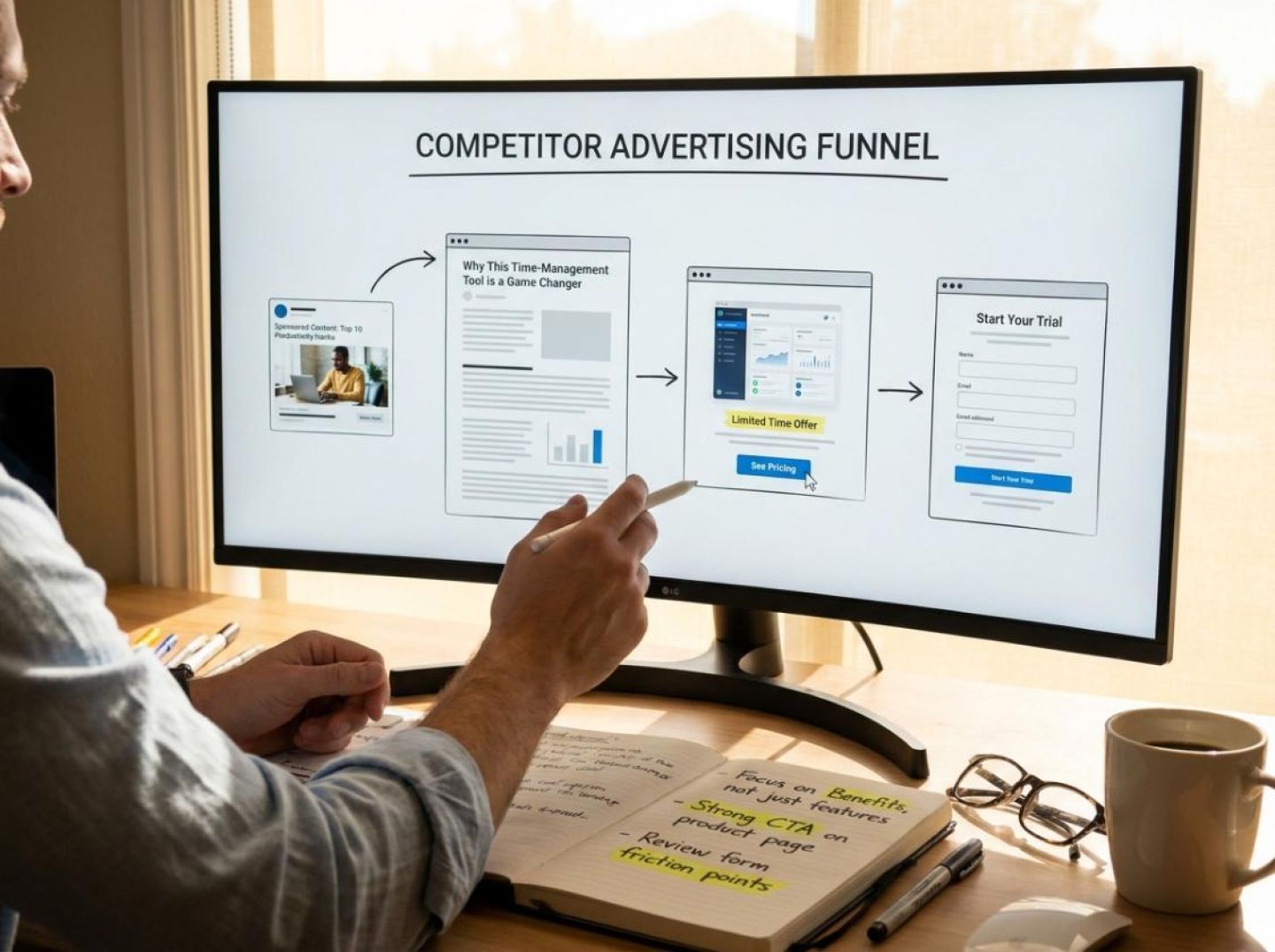
Once you identify an interesting campaign, follow the available destination links and document the customer journey.
A typical funnel might look like this:
Advertisement → Pre-sell page → Offer page → Checkout or lead form
Depending on the campaign, the pre-sell experience could be an advertorial, quiz, listicle, product comparison, or video sales letter.
As you examine each stage, look for recurring patterns.
The advertising angle
What is the advertisement trying to make the audience feel or think?
Common approaches include:
The bridge asset
Does the campaign send users directly to a product page, or does it introduce an intermediate experience?
Pre-sell pages can provide context before asking visitors to make a decision. They may explain a problem, introduce a solution, compare alternatives, or address common objections.
The structure can also provide useful inspiration for AEO content because both approaches benefit from clear explanations and logical information hierarchy.
HubSpot's guidance on optimizing content for AI Overviews discusses the importance of organizing content around relevant questions and making information easy to understand.
The conversion mechanics
Examine how the page encourages visitors to take action.
Ask:
Neil Patel's discussion of high-converting landing pages provides useful background on value propositions, page structure, and conversion-focused design.
A useful way to analyze a competitor's funnel is to assign a purpose to every step.
| Funnel stage | Likely user question |
|---|---|
| Advertisement | What is this, and why should I care? |
| Pre-sell page | Does this problem apply to me? |
| Explanation or comparison | Is this solution credible? |
| Offer page | What am I getting? |
| Checkout or lead form | Am I ready to take action? |
This exercise helps you understand the relationship between the advertisement's promise and the information provided after the click.
It also gives you a framework for building your own AEO-friendly content.
Rather than copying a competitor's headline, identify the underlying question and answer it in your own voice using accurate information and relevant evidence.
Every advertisement begins with a reason to pay attention.
A strong native creative often combines an emotional trigger with a specific problem, desire, or curiosity gap. The headline, supporting copy, and image work together to make the audience interested enough to click.
When researching campaigns in Anstrex, look beyond the design.
Ask what the advertisement is communicating and what question it is encouraging the user to ask.
Many advertising angles can be grouped into four broad emotional categories.
These creatives highlight something the audience wants to prevent.
The implied question might be:
What could happen if I ignore this problem?
Examples include advertisements discussing financial mistakes, missed opportunities, or problems that may become more difficult to solve over time.
Claims involving health, safety, or financial risk require particular care. Emotional relevance should never become an excuse to exaggerate consequences.
These advertisements focus on what the audience could achieve.
The implied question might be:
How can I get a better result or create a new opportunity?
Examples include productivity improvements, business growth strategies, and ways to save time or money.
These creatives focus on reducing frustration or uncertainty.
The implied question might be:
How can I solve this problem without creating another one?
They often work by acknowledging a familiar difficulty and introducing a practical alternative.
These advertisements suggest that the audience may be missing useful information or an opportunity to improve their position.
The implied question might be:
What do other people know that I haven't discovered yet?
Curiosity can attract attention, but the landing page still needs to provide a meaningful answer rather than relying on an endless sequence of teasers.
When you identify an interesting advertisement in Anstrex, use two questions to analyze it:
For example, imagine a business advertisement promoting a new approach to client acquisition.
Its emotional angle might be frustration with unpredictable sales pipelines.
The implied question could be:
How can a small agency generate a more consistent flow of qualified leads without depending entirely on cold outreach?
That question provides a useful starting point for an AEO-focused landing page.
The page can then answer it directly, explain the available approaches, and demonstrate why its proposed solution is relevant.
Once you understand the implied question, use it to shape three important elements.
The headline
State the outcome or problem clearly.
For example:
How Small Agencies Can Build a More Consistent Client Acquisition System
The subheadline
Explain who the page is for and what it helps them understand.
For example:
Explore practical ways to diversify lead generation, improve follow-up, and reduce dependence on a single acquisition channel.
The opening paragraph
Answer the main question before introducing a longer explanation.
For example:
Small agencies can build a more consistent client acquisition system by combining targeted content, referral opportunities, outbound prospecting, and paid acquisition. The right mix depends on the agency's audience, resources, and sales process.
This structure gives readers an immediate explanation while creating a clear foundation for the rest of the page.
The key is to preserve the emotional relevance of the original advertising angle without turning it into an unsupported promise.
A pre-lander has an important role in many native advertising funnels.
It provides an intermediate experience between the advertisement and the final offer. Instead of asking a visitor to make an immediate decision, it can introduce the problem, explain the context, and help the reader evaluate a potential solution.
For cold traffic, this can be particularly useful because visitors may not know the brand or understand the product when they first click.
When researching pre-landers in Anstrex, pay attention to how the strongest examples organize their information.
Some use a narrative structure:
The purpose of studying this structure is not to reproduce a competitor's story. It is to understand how the page moves readers from recognition to understanding and then toward a decision.
A long-form story can keep readers engaged, but it should not hide the information they came to find.
An AEO-friendly pre-lander can use a direct answer near the beginning, followed by the context and supporting details.
For example, a page about improving website lead generation might begin with:
Businesses can improve website lead generation by clarifying their value proposition, matching landing page content to visitor intent, reducing unnecessary form fields, and making the next step easy to understand.
The rest of the page can then explain each recommendation through examples, supporting evidence, and practical guidance.
This approach gives readers an immediate answer while preserving the narrative structure that can make a pre-lander more engaging.
When reviewing a competitor's pre-lander, identify the central promise.
Ask:
A strong page makes the offer understandable without relying on vague claims.
For example, instead of promising that a marketing method will automatically double revenue, explain which activities it is designed to improve and what results would depend on the business's circumstances.
Specificity is useful, but only when it is accurate.
Objections are an important part of both conversion optimization and answer-focused content.
As you inspect competitor pre-landers, note the questions they address.
Common examples include:
Build your own FAQ section around the questions your audience actually asks.
Each answer should be concise, understandable, and complete enough to stand on its own.
Use a clear heading hierarchy, with a main FAQ heading and individual question headings beneath it. Where appropriate, provide links to detailed explanations, supporting documentation, or relevant evidence.
A persuasive pre-lander should not rely on storytelling alone.
Use appropriate credibility signals, such as:
These elements help readers evaluate the information and give answer engines clearer context about the source.
Do not invent expert endorsements, customer results, or research findings simply to make a page appear authoritative.
The best pre-lander combines a coherent story, a clear explanation, useful answers, and credible evidence.
The core landing page is where the entire strategy comes together.
A visitor may arrive from a native advertisement, a search result, an AI-generated answer, or another marketing channel. Regardless of the entry point, the page needs to communicate its value quickly and make the next step clear.
At the same time, its content should be organized so that search engines and AI systems can interpret the information accurately.
Think of the page as having two complementary jobs:
The following structure can help achieve both.
The first screen should explain:
Avoid relying on a clever company tagline that does not explain the actual offer.
For example, a software landing page might use a headline that describes the business problem it solves, followed by a short paragraph explaining its audience and main benefit.
This opening description can also provide a concise overview for systems that interpret or summarize page content.
Not every visitor is ready to convert immediately.
Some users may want to book a demonstration or start a trial. Others may need to understand pricing, compare features, review examples, or learn how the product works.
Make the primary conversion action visible, but provide relevant supporting paths.
Examples include:
The right choices depend on the offer and the user's likely stage in the buying process.
Avoid filling the page with competing calls to action that make the next step confusing.
After the opening explanation, show why visitors should trust the offer.
Relevant proof may include:
For case studies, include enough context to make the results meaningful.
A statement such as "reduced processing time by 27%" is more useful when readers can also understand what was measured, over what period, and under which conditions.
This is important for conversion and for maintaining the credibility of content that may be interpreted or referenced by AI systems.
Use descriptive headings that reflect what visitors want to understand.
Examples include:
Under each heading, begin with a direct explanation. Follow it with details, examples, and relevant evidence.
This creates a page that is easy to scan without sacrificing useful depth.
A visitor may understand the offer but still hesitate.
The landing page should answer the most important questions that could prevent a decision.
Depending on the product, these may involve:
Keep answers factual and easy to locate.
Do not use FAQs to hide important terms or make unsupported claims. The purpose is to reduce uncertainty, not to pressure visitors into ignoring it.
A visitor who reads a case study may be ready to take action. Someone who reaches the FAQ section may have just resolved their final objection.
Make the primary action available at appropriate points throughout the page.
For example:
The page should guide visitors naturally without interrupting every section with aggressive promotional elements.
Once you have researched competitor creatives and mapped their funnels, the next step is translating those insights into your own content.
This is where the relationship between Anstrex research and AEO becomes particularly practical.
A strong advertisement can reveal the audience's underlying problem. A well-structured landing page can then answer that problem directly and explain the solution in greater detail.
Start with the most relevant creative angle you have identified.
For example, imagine a native advertisement that attracts attention by highlighting the difficulty of generating consistent leads.
Instead of copying the advertisement's headline, translate its message into a question:
How can a small business generate more consistent leads without relying on one marketing channel?
That question can become the foundation of an answer-first landing page.
Do not make visitors read several paragraphs before discovering what the page is about.
Start with a short explanation that addresses the main question.
For example:
Small businesses can build more consistent lead generation by combining relevant content, targeted outreach, referral opportunities, and paid acquisition. The right combination depends on their audience, budget, and ability to manage incoming leads.
This opening tells readers what the page covers and establishes the context for the rest of the article.
It also creates a self-contained passage that is easier for search and answer systems to interpret.
After the opening answer, organize the page around the questions someone would naturally ask next.
For example:
This structure makes the page more useful because each section has a clear purpose.
It also gives the content a logical hierarchy that helps readers navigate the subject.
A practical structure for each section is:
For example, a section about reducing advertising waste might begin:
Advertisers can reduce wasted ad spend by improving audience targeting, checking post-click performance, and evaluating traffic quality beyond the initial click.
The section can then explain each activity and provide practical examples.
This is more useful than beginning with an extended promotional story that delays the actual explanation.
Answer-first content does not mean removing persuasive writing.
The creative research you conduct in Anstrex can help you understand the concerns, desires, and situations that make a particular message relevant.
Use those insights to make the page feel connected to the visitor's original reason for clicking.
If the advertisement addresses a frustrating problem, acknowledge that problem. If it introduces a potential opportunity, explain the conditions under which that opportunity may be realistic.
The important distinction is that the landing page must deliver the substance behind the message.
Where appropriate, support your explanations with:
Avoid unsupported income claims, fabricated case studies, exaggerated health benefits, or testimonials that cannot be verified.
A page should be trustworthy even when a reader does not take the desired conversion action.
After writing the page, read only its headings, opening sentences, and bullet points.
Ask yourself:
If the answer is unclear, improve the structure before adding more promotional copy.
The objective is not to write content solely for an AI system. It is to make the page genuinely useful and understandable to the people who visit it.
AEO and competitive ad intelligence are most useful when they inform the same customer experience.
Anstrex can help marketers investigate the advertising angles, creatives, and landing page structures being used in their competitive environment. That research can reveal recurring audience concerns, persuasive messages, and funnel patterns worth exploring.
AEO provides a complementary approach to organizing the information that answers those concerns.
Together, they create a practical workflow:
Remember that visible advertising activity does not prove a competitor's profitability, and well-structured content does not guarantee an AI citation. Both require careful research, realistic expectations, and ongoing evaluation.
The bigger opportunity is to stop treating paid advertising and AI discovery as disconnected marketing activities.
A visitor should receive a consistent, useful experience whether they discover your brand through a native advertisement or an AI-generated answer.
Use ad intelligence to understand what your audience responds to. Use AEO to make your answer clear. Build the landing page that connects the two.
Receive top converting landing pages in your inbox every week from us.
How-To
AEO and ad intelligence may operate in different parts of the marketing funnel, but both depend on understanding user intent. Discover how to use Anstrex to research winning ad hooks, reverse-engineer competitor funnels, and build clear, trustworthy landing pages that serve both paid visitors and AI-driven discovery.
David Kim
7 minOct 29, 2026
Editor’s Pick
CAC tells you what customer acquisition costs, but not whether your business is winning against competitors. Explore a four-layer framework for combining ad intelligence, auction benchmarks, funnel conversion rates, incrementality, and unit economics to make smarter acquisition decisions.
Liam O’Connor
7 minOct 28, 2026
In-Depth
AI can accelerate advertising, but automated targeting, creative changes, and conversion optimization can introduce compliance risks. Discover how marketers can use competitive intelligence to identify useful patterns, establish approved creative boundaries, audit platform settings, and build human-reviewed workflows that balance campaign performance with responsible growth.
Samantha Reed
7 minOct 27, 2026