6 minNovember 12, 2026

Our spy tools monitor millions of native ads from over 60+ countries and thousands of publishers.
Get StartedAI can now generate advertising concepts, images, videos, headlines, and variations at a speed that would have been difficult to imagine just a few years ago. Marketers can produce dozens of creative directions without spending days building every asset manually.
But more output does not automatically mean better advertising.
A campaign can contain 50 polished AI-generated variations and still struggle to attract qualified traffic or convert visitors. The missing ingredient is often not another prompt or a more advanced image generator. It is a reliable connection between creative production and what is happening in the market.
That is where competitive ad intelligence becomes valuable.
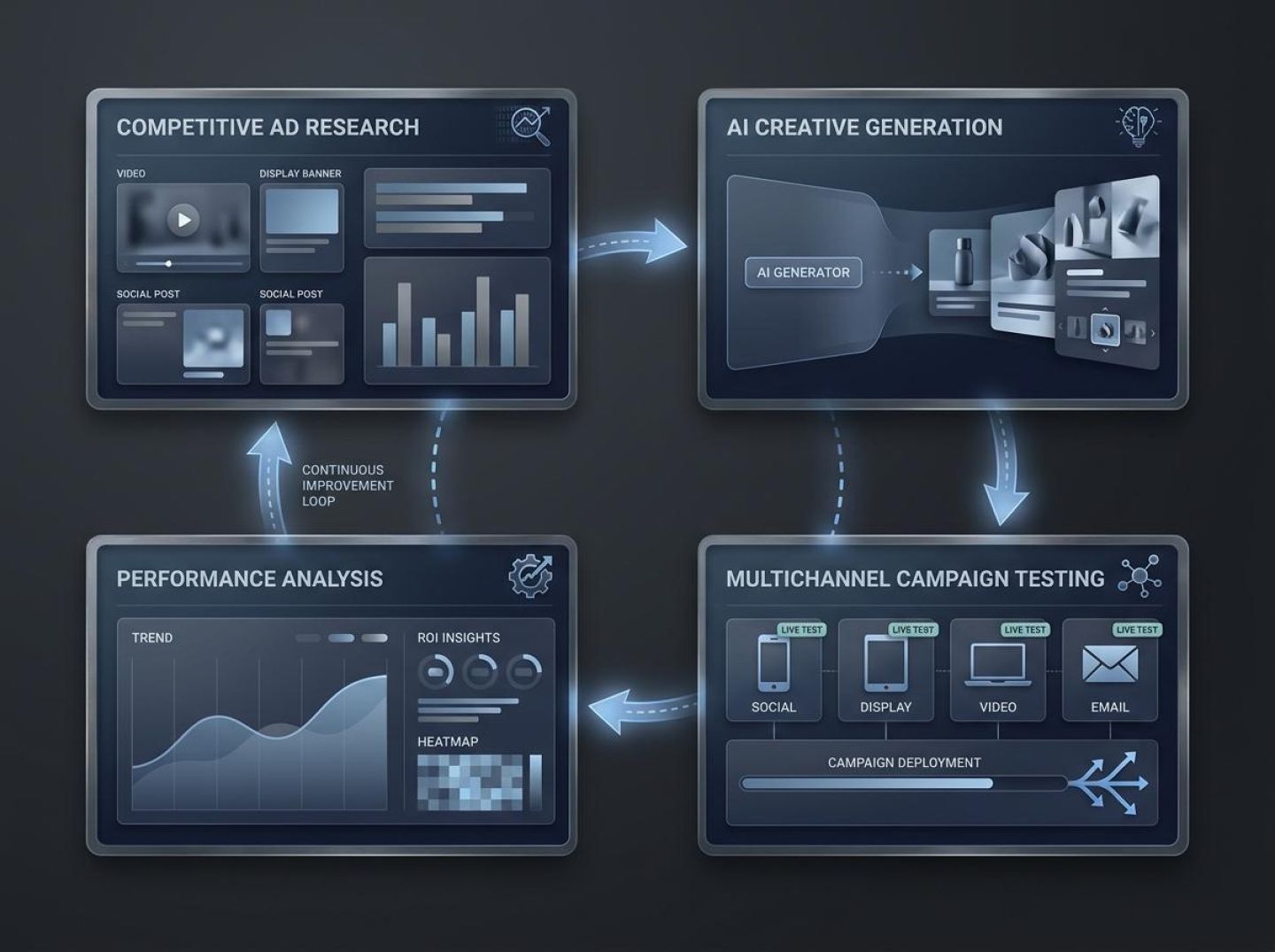
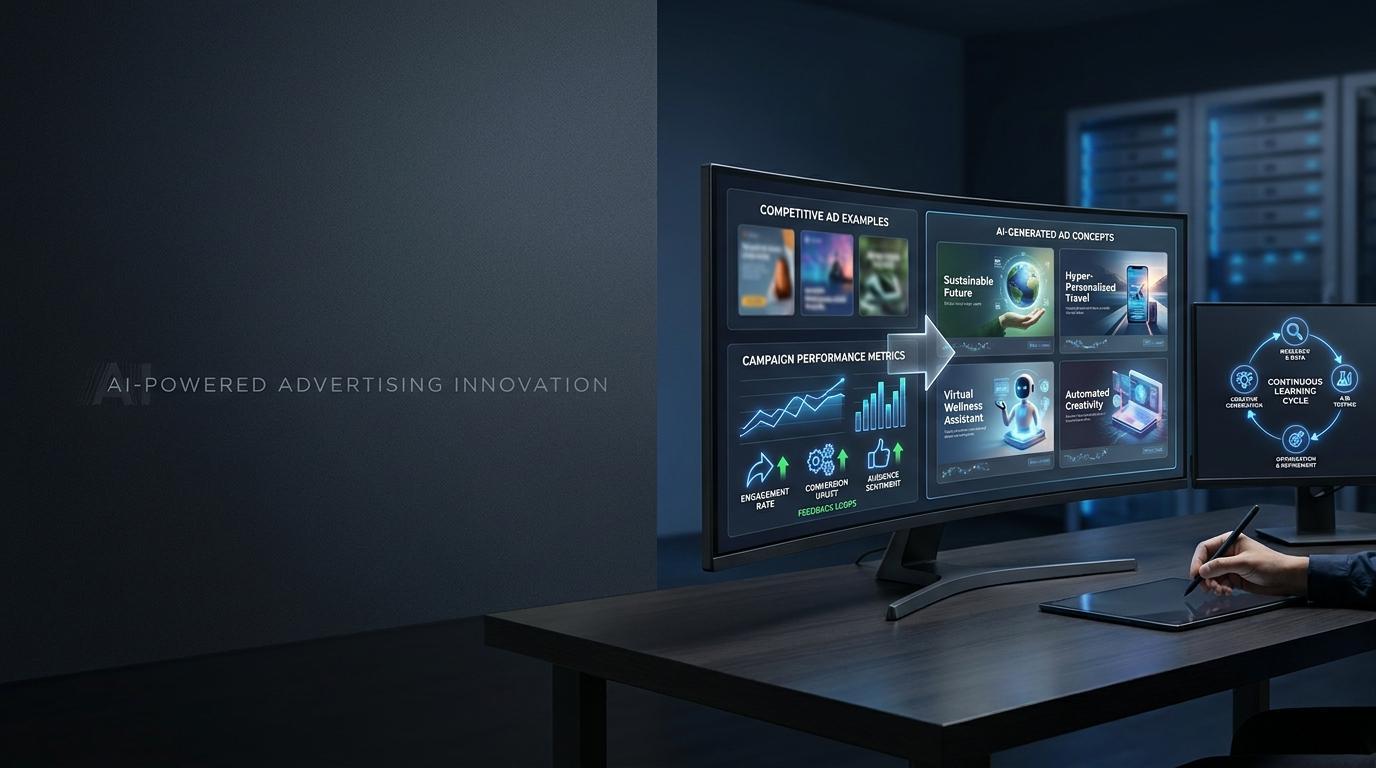
By studying visible competitor advertising patterns, organizing creative elements into reusable structures, and comparing those observations against actual campaign results, marketers can build a continuous feedback loop. AI generates new concepts, ad intelligence informs the creative direction, and campaign testing reveals which ideas deserve further development.
The objective is not simply to create more ads. It is to make each new generation more informed than the last.
Most AI advertising workflows encounter the same problem: the creative never interacts with market reality often enough.
It is easy to generate 50 variations using tools such as Midjourney, Runway, or platform-native creative studios, review the finished visuals, and assume the campaign is ready.
But creative generated without meaningful research or performance feedback can become disconnected from what customers actually respond to.
Several factors contribute to this problem.
Generative AI has made advertising production faster and more accessible.
As Adweek's coverage of OpenArt explains, these tools have developed from experimental technologies into practical creative production systems.
However, generating an asset is different from deciding whether it deserves to be used.
Someone still needs to determine:
Without answers to these questions, AI can produce a large volume of visually polished but strategically interchangeable advertisements.
The problem is not necessarily the quality of the generated images or videos. It is the lack of meaningful direction behind them.
Advertising platforms are also introducing more AI-powered production capabilities.
For example, TikTok's Symphony Creative Studio has been discussed as part of the broader shift toward automated video production, scripting, and creative assistance. Social Media Examiner's analysis explores how these tools are changing the creative workflow.
When more advertisers can generate acceptable-looking advertisements quickly, basic production quality becomes less distinctive.
A polished video, an attractive product image, or a familiar testimonial format may no longer be enough to differentiate a campaign.
The details matter:
These details need to be informed by research and tested against actual audience behavior.
Large-scale creative production can create another challenge: the more assets a brand produces, the harder it becomes to identify which ideas are contributing to meaningful results.
The original draft references Unilever's AI-assisted creator network and its reported scale of 300,000 creators. Search Engine Journal's coverage discusses the opportunities and challenges associated with producing content at this scale.
The important lesson is that volume needs structure.
Individual assets may attract attention without contributing to a consistent brand message or a repeatable creative strategy.
A useful creative operation must therefore do more than generate and distribute content. It needs a way to organize ideas, compare results, identify patterns, and preserve what the team learns.
AI-powered media and decisioning systems are also evolving beyond simple content generation.
As MarTech's overview of AI-powered advertising decisions describes, modern systems are increasingly focused on connecting creative decisions, media allocation, measurement, and optimization.
However, generating creative with AI does not automatically give a team access to a complete optimization loop.
The creative process needs feedback from the media and measurement process. Marketers must understand which hooks attract attention, which promises generate qualified interest, and which combinations contribute to conversions.
Without that connection, teams can multiply production output without multiplying their learning.
Ungrounded AI advertising treats creative generation as an isolated activity:
A more effective approach connects each stage:
The breakthrough does not come from endlessly adjusting prompts in isolation. It comes from connecting creative production to a consistent source of research and performance feedback.
If ungrounded AI creative tends to plateau, competitive ad intelligence can provide a valuable source of direction.
The idea is to treat visible competitor advertisements as structured research examples rather than occasional inspiration.
Every advertisement can reveal something about how another advertiser presents an offer, frames a customer problem, demonstrates a product, or communicates a benefit.
However, an important distinction matters: visible advertising activity does not automatically provide verified performance labels.
A competitor advertisement that remains active for a long period may be worth investigating, but its longevity does not prove that it is profitable. Similarly, a creative that disappears quickly may have been paused for reasons unrelated to performance.
The objective is to identify observable patterns and turn them into hypotheses for your own testing.
Traditional competitive research often happens in isolated sessions.
A marketer searches for a few competitor advertisements, saves screenshots, and uses them as references when developing new campaigns.
That can be useful, but the insights are often disconnected from the creative production process.
A structured workflow makes the information reusable.
Instead of simply collecting advertisements, organize each example around consistent attributes:
These details help teams compare advertisements more systematically.
Competitive ad intelligence can help marketers investigate several types of patterns.
Creative repetition: When similar messages or visual approaches appear repeatedly, they may indicate that an advertiser is exploring a particular creative direction.
Creative variation: Multiple versions of the same concept can reveal which elements are being changed, such as headlines, images, offers, or calls to action.
Placement distribution: When a creative appears across multiple visible placements, it may be useful to investigate how the advertiser is adapting its message to different environments.
Landing-page consistency: Comparing an advertisement with its destination can reveal whether the offer, promise, and customer problem remain consistent after the click.
These are research observations. They do not reveal private conversion rates, campaign budgets, or internal optimization decisions.
Competitive intelligence helps identify what other advertisers are doing. Your campaign data helps determine what works for your business.
These are complementary sources of information, not interchangeable ones.
For example, a competitor may repeatedly use a product demonstration as its primary creative format. That is a useful pattern to investigate.
But whether a demonstration improves your own click-through rate, conversion rate, or acquisition cost depends on your product, audience, offer, and execution.
A strong workflow combines:
As illumin's overview of AI in AdTech explains, AI-powered advertising systems can evaluate combinations of headlines, visuals, and calls to action. The quality of the inputs and the reliability of the feedback remain important.
The same principle applies to content systems.
Neil Patel's discussion of AI content systems emphasizes the importance of connecting content production with audience behavior and performance data.
Advertising teams can apply a similar approach.
Instead of creating disconnected creative batches, maintain a research library that records:
The first step in building a feedback-driven creative operation is to treat ad intelligence research as a data-organization task.
You are not simply searching for advertisements that look interesting. You are identifying recurring creative structures that can be documented, compared, and tested.
Think of this as building a creative genome: a structured collection of the hooks, benefits, visual approaches, proof elements, and story formats that appear across your category.
Start by defining the advertising market you want to investigate.
Include:
Use available filters and search capabilities in your chosen research tools to narrow the results.
You can then prioritize advertisements with observable characteristics worth examining:
These characteristics help prioritize research. They should not be treated as proof that an advertisement is profitable or that the advertiser has found a winning formula.
Choose a manageable sample of advertisements from each platform or research source.
Rather than saving hundreds of screenshots without context, break each advertisement into consistent components.
For video advertisements, consider tagging:
Opening hook
Narrative structure
Proof elements
Offer and risk reversal
Call to action
Editing and visual style
This creates a more consistent way to compare creative examples.
A spreadsheet or lightweight database is enough to begin.
Each row represents one advertisement. Each column represents an attribute you want to examine.
| Creative attribute | What to record |
|---|---|
| Hook archetype | Question, problem, demonstration, surprise, comparison |
| Promise type | Save time, save money, convenience, status, avoid a problem |
| Emotional tone | Aspirational, urgent, playful, reassuring, contrarian |
| Proof type | Demonstration, review, testimonial, authority, comparison |
| Visual mode | Talking head, screen recording, lifestyle montage, animation |
| Story format | Problem-solution, founder story, tutorial, testimonial |
| Offer framing | Discount, bundle, trial, guarantee, standard offer |
| CTA style | Direct response, curiosity, educational, purchase-focused |
| Landing-page type | Product page, advertorial, comparison page, lead form |
The goal is to make creative attributes consistent enough to compare across advertisements.
After tagging a meaningful sample, begin looking for recurring combinations.
For example:
These observations can help you develop creative hypotheses.
However, avoid assuming that a frequently observed combination is automatically the highest-performing one. You are identifying patterns in visible advertising, not reading an advertiser's private campaign results.
Large-scale creative production can easily create inconsistent messaging.
The original draft references Search Engine Journal's coverage of Unilever's AI-assisted creator network, which discusses the challenge of maintaining coherence while scaling content production.
A structured creative genome can help.
It gives your team a documented set of creative attributes to preserve while allowing other elements to change.
For example, you might decide that every advertisement must:
Meanwhile, the hook, story format, visual presentation, and CTA can be varied during testing.
The final output of this stage should not be a folder full of screenshots.
It should be a structured reference library that can inform future prompts, briefs, and creative experiments.
As Adweek's discussion of AI and creative professionals suggests, AI can multiply creative production, but direction and refinement remain essential.
The more clearly you document your research, the easier it becomes to generate variations that have a defined strategic purpose.
Once you have organized your creative research, the next step is to turn those observations into structured creative briefs and concept sets.
This is where Anstrex AI can become part of the workflow.
The objective is not to use AI as a blank-canvas copy generator. It is to give the system clear context, creative references, constraints, and a specific assignment.
Instead of asking it to create 10 advertisements for a product, ask it to develop several concept directions based on the creative attributes you have identified.
Translate the creative genome into a reusable prompt structure.
For example:
This gives the AI a defined creative assignment rather than an unrestricted request.
Suppose your competitive research reveals that several visible advertisements in your category use:
You can use those observations to guide the next creative brief.
For example:
"Develop five creative concept sets for our product using short, benefit-first openings, early product demonstrations, and supporting proof. Explore different customer problems and visual approaches. Adapt the underlying structure of the research examples without copying their wording, branding, or distinctive creative assets."
The difference is important.
You are using competitive examples to understand creative structure, not to reproduce another advertiser's exact advertisement.
A concept set is a group of related creative ideas built around a shared strategic angle.
For example:
Concept Set A — Product Demonstration
Concept Set B — Customer Problem
Concept Set C — Comparison
Each concept should be distinct enough to test a different hypothesis.
Avoid asking AI to create "high-converting" advertisements without defining what that means for your campaign.
Instead, specify the behavior you want to investigate.
For example:
These are hypotheses, not guaranteed results.
The purpose is to make the creative test measurable.
Competitive research should also inform the boundaries of what the AI is allowed to generate.
Consider specifying:
For example, if your research suggests that short videos are common in a particular category, you can ask for 15–30-second script options.
That is a creative direction, not a universal platform requirement.
Likewise, if the product has a verified warranty, the AI may use that information. It should not invent a stronger guarantee or a different duration.
Structured output makes the next testing stage much easier.
Ask Anstrex AI to label each concept using attributes such as:
These labels help connect the generated concepts to the creative genome and the results you collect later.
The important point is to verify the actual Anstrex AI features and input capabilities before presenting specific workflows as available product functions. The concept-set approach is the recommended operating method; supported reference inputs, integrations, and automation should be confirmed against the current product.
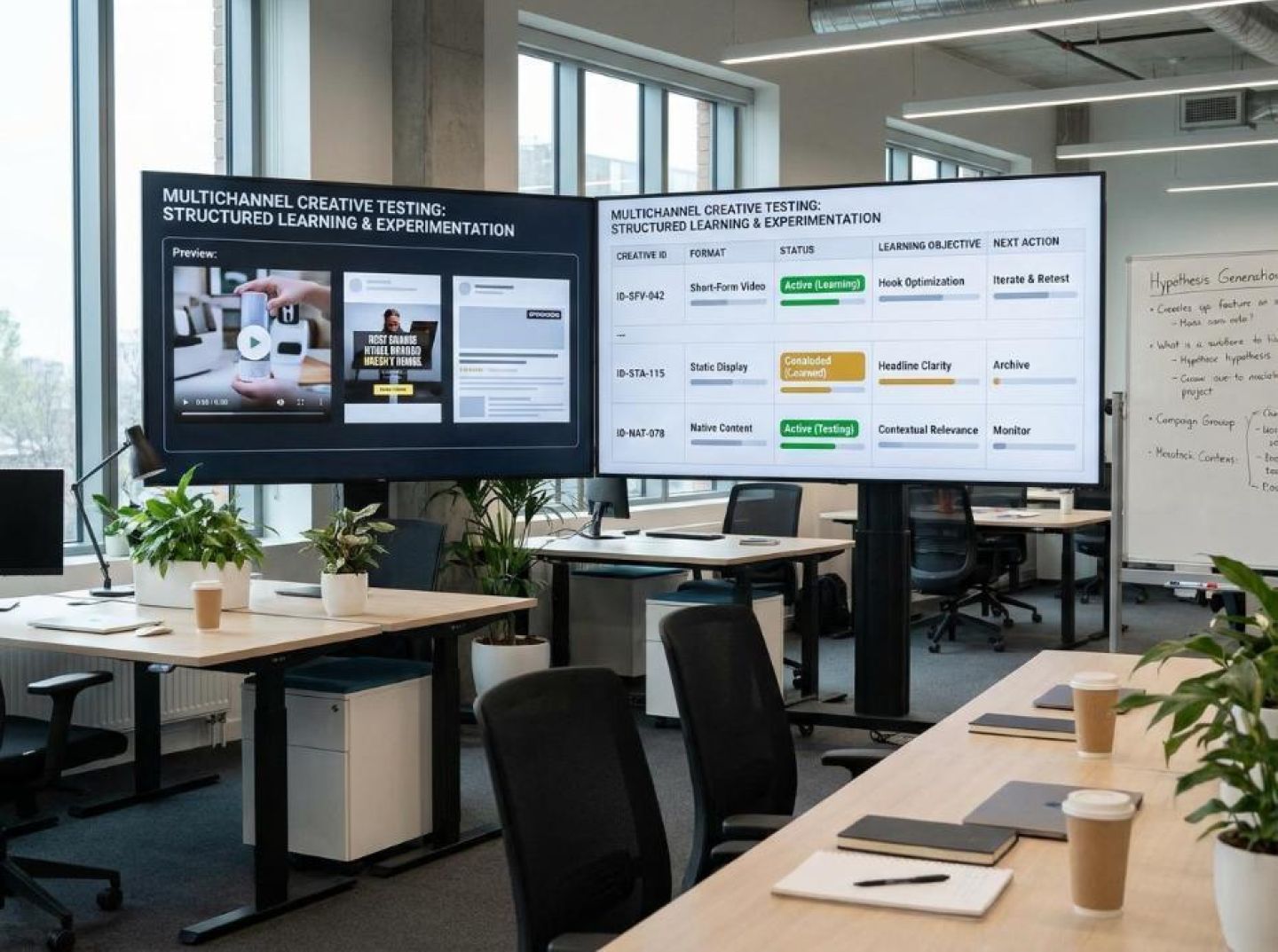
Once the concepts are ready, they need to be tested.
This is where the feedback loop becomes measurable.
A concept that looks compelling in a creative review may perform differently when shown to real audiences. The only way to evaluate it is to run a structured test and examine the results.
Avoid publishing every creative variation across every platform at the same time.
Instead, select a manageable number of concepts and create a consistent package for each one.
For example:
Keep the core concept consistent while changing selected execution elements.
This makes it easier to determine whether the hook, proof device, visual style, or offer is contributing to the observed result.
Different platforms provide different testing environments.
For example:
| Channel | Useful testing focus |
|---|---|
| Meta | Audience response to different creative angles and formats |
| TikTok | Opening hooks, video retention, product demonstrations |
| YouTube | Longer explanations and storytelling |
| Native | Editorial angles, pre-sell content, landing-page continuity |
| Display | Visual messaging and offer presentation |
The appropriate channels depend on the product, target audience, traffic availability, and campaign objective.
Do not assume that a concept that succeeds on one platform will perform identically on another. A creative that works as a short-form video may need a completely different structure to succeed as a native advertisement.
For results to be useful, define your testing conditions before launch.
Consider documenting:
Avoid changing too many variables simultaneously.
If you change the hook, audience, offer, landing page, and bidding strategy at the same time, it becomes difficult to understand what caused a performance difference.
The original draft proposes seven-to-ten-day learning sprints.
That can be a useful planning example, but it should not be treated as a universal rule.
The time required to evaluate a concept depends on traffic volume, conversion frequency, campaign budget, sales cycle, and the amount of data needed to make a reliable decision.
A low-volume lead-generation campaign may need more time than a high-volume e-commerce campaign.
Focus on whether each concept has accumulated enough meaningful data to support a decision.
This is one of the most important parts of the entire workflow.
Before launch, assign each creative a concept ID and tag it with the attributes from your creative genome.
Then connect the results back to those attributes.
For example:
| Field | Example |
|---|---|
| Concept ID | DEMO-001 |
| Channel | TikTok |
| Hook type | Demonstration-first |
| Emotional angle | Convenience |
| Proof device | Product demonstration |
| Visual style | UGC-style |
| Landing-page type | Product page |
| CTR | Actual campaign result |
| Conversion rate | Actual campaign result |
| CPA | Actual campaign result |
| Revenue | Actual campaign result, where available |
This allows your team to compare patterns across campaigns instead of relying on creative filenames or individual ad IDs.
Attention metrics are useful, but they should not be confused with business results.
For video, you may monitor:
For traffic and conversion campaigns, consider:
A creative can generate excellent engagement and still produce weak conversions.
Likewise, a concept with a lower CTR may attract more qualified visitors and deliver better economics.
At the end of each test cycle, ask:
Avoid labeling a creative as a winner based on a small number of conversions or an unusually strong early result.
A result should be considered reliable only when the test has sufficient data and the measurement setup is sound.
The final step is where the creative process becomes a continuous operating system.
Instead of treating every campaign as a separate project, use each testing cycle to improve the research, prompts, creative direction, and media decisions that follow.
Every campaign becomes an opportunity to collect information that can guide the next round of creative development.
Most teams stop after pausing weak advertisements and increasing spend on stronger ones.
A more useful approach is to understand which creative attributes contributed to the result.
Use your research and campaign data to investigate:
Then translate the findings into new prompt instructions.
For example:
"Generate new product demonstration concepts using the opening structure identified in our recent test. Retain the clear product benefit and visual proof, but explore three different customer scenarios. Avoid the curiosity-only hooks that attracted clicks without producing meaningful conversions. Use only approved product claims."
This is more useful than simply asking AI to generate more advertisements.
The prompt contains information about what was tested, what was observed, and what should be explored next.
As Neil Patel's discussion of AI content systems explains, the value of a continuous content system comes from connecting audience behavior and performance data to future production.
As more tests accumulate, the research may reveal patterns that are larger than individual advertisements.
For example:
These observations can become strategic guidelines.
However, avoid turning one campaign result into a universal rule.
A creative pattern that works for one audience, offer, or channel may not work in another context. Keep the findings tied to the conditions in which they were observed.
MarTech's discussion of AI and marketing team structures provides useful context for the broader shift toward connecting creative, media, and strategy through shared information.
The feedback loop should also influence media decisions.
At the end of each test cycle, define clear actions:
Scale: Increase investment in creative-audience-channel combinations that have demonstrated reliable results.
Prune: Retire concepts that consistently fail to meet the campaign's objectives.
Iterate: Develop new variations around promising themes that still need additional testing.
Explore: Test new concepts rather than relying exclusively on previously successful creative.
Use thresholds that reflect your actual business economics.
For example, consider:
Avoid making large spending decisions based on a short-lived spike or a single strong day.
Not every insight should become a permanent creative rule.
It helps to separate two types of learning.
Pattern-level findings
These are attributes that appear repeatedly across several tests, audiences, or campaigns.
Examples might include a particular proof device consistently improving conversion quality or a specific offer structure working across multiple placements.
Context-specific findings
These apply to a narrower situation.
For example, a particular hook may work well for cold TikTok audiences but perform poorly in native retargeting campaigns.
Keeping these categories separate prevents the team from overgeneralizing individual results.
Over time, the most valuable output is not simply a collection of successful advertisements.
It is a documented system for developing and improving creative.
The workflow looks like this:
This is the difference between using AI to produce more content and using AI as part of a continuous creative learning process.
The value comes from connecting research, production, activation, and measurement into one repeatable workflow.
AI has made advertising production faster, but speed alone does not create a competitive advantage.
The real opportunity comes from connecting AI-generated creative with structured competitive research and actual campaign performance.
Anstrex ad intelligence can help marketers investigate visible advertising patterns and understand how other advertisers present their offers. A structured creative genome turns those observations into reusable research inputs. Anstrex AI can then support the development of market-informed creative concepts, while multichannel testing helps determine which ideas deserve further investment.
The process is continuous:
The goal is not to copy every advertisement that appears successful or to generate hundreds of variations without direction.
It is to build a creative operation where each new campaign benefits from the lessons of the previous one.
The strongest AI advertising workflow is not the one that produces the most ads. It is the one that learns the most from every test.
Receive top converting landing pages in your inbox every week from us.
Most Read
AI can produce hundreds of advertising variations, but more creative does not automatically mean better performance. Discover how to use competitive ad intelligence, Anstrex AI, and campaign data to build a repeatable creative feedback loop.
David Kim
7 minNov 12, 2026
Recently Updated
AI can optimize campaigns using your own performance data, but competitive intelligence adds context about the market around you. Discover how to connect both through a practical system for observing competitor activity, testing hypotheses, and scaling validated playbooks.
Elena Morales
7 minNov 11, 2026
Guide
AI search is changing how buyers compare brands before clicking. Discover how performance marketers can use AI answers and competitive ad intelligence to uncover positioning gaps and develop better campaign tests.
Priya Kapoor
7 minNov 11, 2026