9 minNovember 4, 2026

Our spy tools monitor millions of native ads from over 60+ countries and thousands of publishers.
Get StartedFor years, marketers treated traditional media and digital advertising as two separate worlds. Billboards, television, and print were expected to build awareness, while paid social, search, and native advertising were responsible for generating measurable results.
That distinction is becoming harder to defend.
Digital out-of-home advertising can use audience and location data to improve media selection. Connected TV platforms are introducing more sophisticated measurement and creative personalization. Meanwhile, AI-driven advertising systems are changing how campaigns are distributed, optimized, and evaluated.
These developments are creating new opportunities for performance marketers. Instead of treating traditional media as a separate brand-building expense, advertisers can increasingly connect it to the same testing, measurement, and optimization frameworks used across digital channels.
Competitive ad intelligence adds another layer. By studying the creative concepts, messaging patterns, placements, and campaign activity visible across advertising channels, marketers can develop better hypotheses before committing significant budgets.
The opportunity is not simply to bring digital tactics into traditional media. It is to build a connected advertising strategy in which ideas can be discovered, tested, measured, and scaled across multiple environments.
For much of the past decade, marketing organizations have treated brand building and performance marketing as competing priorities.
Brand teams focused on awareness, recognition, and long-term preference. Performance teams concentrated on clicks, leads, conversions, and immediate return on advertising spend.
The separation influenced budgets, reporting structures, campaign planning, and even the way marketing success was defined.
But the distinction has always been more complicated than the organizational charts suggest.
A performance campaign depends on existing demand. Someone must already recognize a problem, understand a product category, or have enough familiarity with a brand to consider clicking an advertisement. Brand-building activity can help create those conditions before a person reaches a search engine or encounters a retargeting campaign.
Research on long-term advertising effectiveness has frequently discussed an approximate 60/40 balance between brand building and sales activation. OOH Today explores how this framework can influence decisions about out-of-home media in its discussion of the 60/40 rule in marketing.
The ratio should not be treated as a universal budget formula. The appropriate allocation depends on the category, business model, growth stage, competitive environment, and measurement period. Its broader lesson, however, is important: campaigns designed to generate immediate conversions cannot always replace investment in future demand.
Performance channels can become increasingly expensive when marketers compete for the same limited pool of ready-to-buy customers.
Paid search can reach a point where additional spending produces diminishing returns. Retargeting audiences may become saturated. Competition can push acquisition costs higher, while repeated exposure to similar messages gradually reduces audience responsiveness.
When this happens, marketers often respond by adjusting bids, narrowing audiences, or producing more creative variations.
Those changes may help, but they do not necessarily address the underlying problem.
If too few potential customers know about the product or recognize the brand, improving the efficiency of conversion campaigns cannot completely solve the shortage of demand.
The solution may require a broader media strategy that introduces the brand to new audiences before they enter the lower funnel.
The distinction between brand and performance is also being challenged by changes in advertising measurement.
Automated systems increasingly control audience selection, bidding, placements, and creative delivery. As described in MarTech's analysis of the AI performance shake-up, automation is changing how campaigns operate across channels.
This creates a measurement challenge. When platforms control more of the delivery process, marketers may have less visibility into the precise factors responsible for a campaign's results.
Click-based attribution alone cannot always explain whether advertising generated new demand or simply captured customers who were already likely to convert.
That is one reason incrementality testing has become more important.
Instead of relying exclusively on platform-reported conversions, marketers can use experiments to estimate what would have happened without a particular campaign or advertising investment.
An example of this direction is the measurement interface covered by AdExchanger's report on Measured's incrementality data tool. The broader movement toward incrementality gives marketing and finance teams a more useful framework for discussing the contribution of different channels.
This changing measurement environment creates an opportunity for physical media.
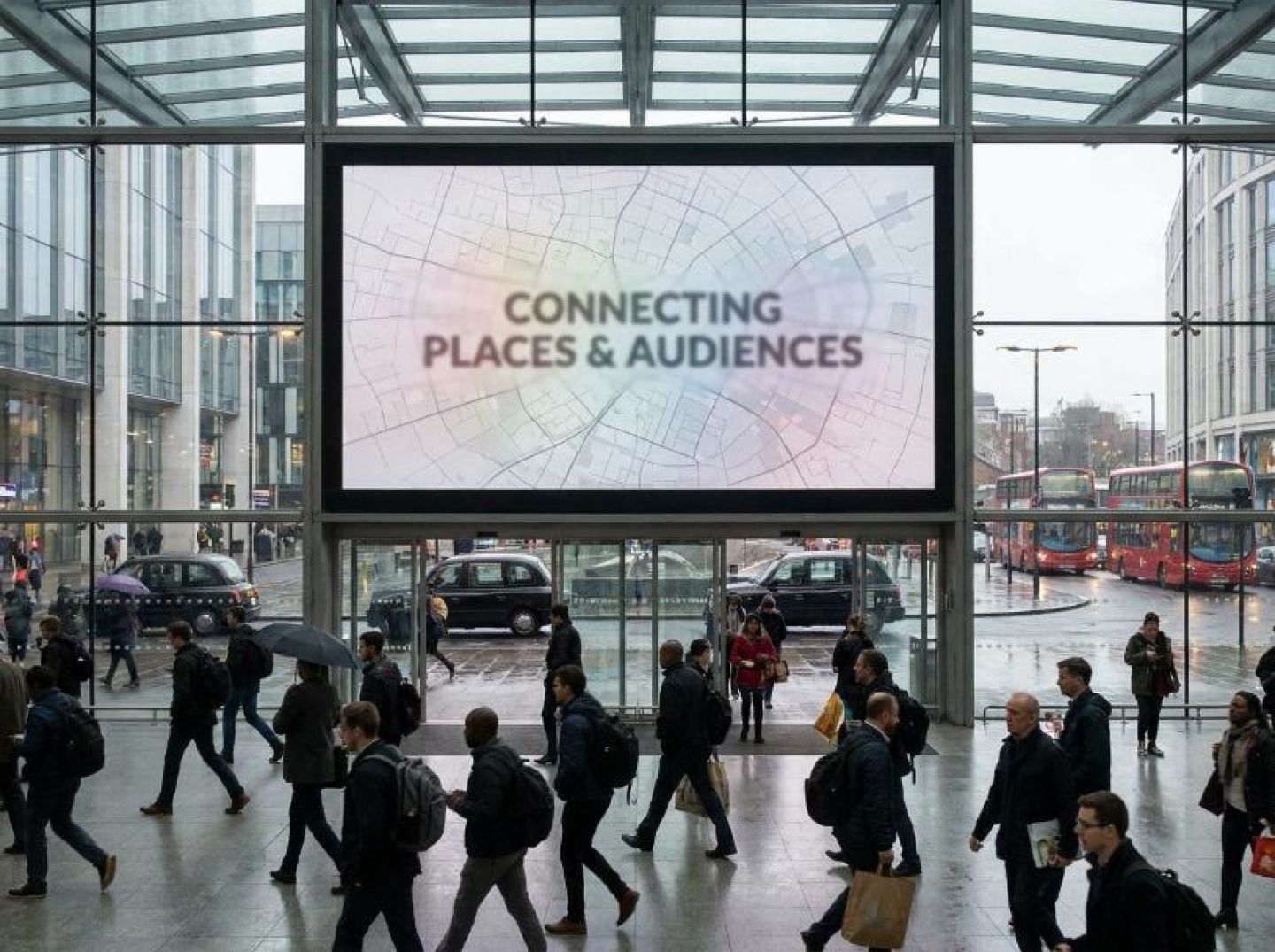
A billboard can introduce a brand to people who have never visited its website. A transit placement can reach commuters repeatedly. A digital screen near a retail location can reinforce a product message when consumers are close to a purchase opportunity.
When these exposures are connected to appropriate measurement methods, traditional media can contribute to a performance strategy rather than being evaluated only through broad awareness metrics.
The important shift is not that every billboard can suddenly be attributed to a sale. It is that marketers can increasingly design experiments to investigate how physical advertising contributes to measurable business outcomes.
The brand-versus-performance debate becomes less useful when the real question is whether a particular investment creates incremental value.
Out-of-home advertising once relied heavily on broad location selection.
Advertisers purchased space based on traffic volume, visibility, and estimated audience demographics. They then evaluated campaigns through reach estimates, brand studies, or other measurements that were often disconnected from immediate business outcomes.
That approach still exists, but the capabilities of modern out-of-home and digital out-of-home advertising have expanded considerably.
Better audience data, programmatic buying, and measurement partnerships are making OOH and DOOH more adaptable to performance-oriented campaign planning.
Traditional OOH planning often began with a question:
Where can we reach the largest number of people?
Audience-led planning introduces a more useful question:
Where can we reach the people most relevant to this campaign?
That distinction matters because the busiest location is not automatically the most valuable placement.
A regional healthcare provider, for example, may benefit more from reaching people in relevant neighborhoods and local environments than from purchasing the largest possible number of impressions along a major highway.
The audience-led DOOH approach discussed in Marketing Dive's overview of smarter DOOH campaigns illustrates how audience, behavioral, and movement information can inform screen selection.
These signals can help advertisers make more relevant placement decisions, although their accuracy and usefulness depend on the underlying data, methodology, and privacy safeguards.
The expansion of programmatic technology has also changed the mechanics of OOH buying.
Instead of relying exclusively on traditional market-by-market purchasing, advertisers can access digital inventory through platforms that support more flexible planning and campaign management.
The AdQuick overview of its DOOH advertising platform describes how data and technology can support more sophisticated inventory selection and optimization.
This brings some familiar digital advertising concepts into physical environments.
Advertisers can consider factors such as:
Programmatic access does not mean every OOH placement is automatically optimized in real time, nor does it guarantee that an advertiser will receive the same level of targeting available in social advertising. Inventory, data access, and buying capabilities vary by provider.
Nevertheless, the planning process is becoming more flexible and data-informed.
One of the biggest historical challenges for OOH has been connecting exposure to downstream activity.
Newer measurement approaches can combine campaign delivery information with location data, mobility insights, retail partnerships, website activity, and other available signals.
Depending on the provider and methodology, advertisers may be able to investigate outcomes such as:
The availability of these measurements does not automatically establish causality. A rise in store visits after a billboard campaign, for example, may have other explanations.
The strongest measurement programs use suitable control groups, geographic comparisons, or incrementality studies to estimate the campaign's actual contribution.
The direction is nevertheless significant. As described in AdQuick's discussion of real-time OOH intelligence, technology is helping make campaign information more accessible throughout the media-buying process.
OOH is also evolving creatively.
Digital screens can display weather-responsive messages, large-scale visual effects, and content designed to encourage people to stop, photograph, or share an experience.
These executions can generate value beyond the initial exposure, especially when the creative becomes part of a local event or cultural moment.
OOH Today's analysis of experience-led out-of-home advertising explores the broader movement from infrastructure-focused advertising toward experiences.
The important distinction is that attention is not the same as commercial impact. A spectacular screen may attract cameras and social shares, but advertisers still need to investigate whether the campaign contributes to brand interest, qualified traffic, or sales.
For performance marketers, that creates an opportunity to combine the reach of physical environments with the measurement discipline of digital campaigns.
Television advertising has traditionally been associated with large-scale reach and brand awareness.
For a long time, marketers had fewer opportunities to connect individual TV campaigns to immediate business outcomes than they did with search or paid social.
That distinction is changing as connected TV, streaming platforms, and measurement technology introduce more sophisticated ways to plan, personalize, and evaluate video campaigns.
The result is a growing overlap between traditional television advertising and performance marketing.
Recent industry developments show how major media companies are investing in better campaign measurement.
Marketing Dive's coverage of the upfronts and the growing role of data and AI describes initiatives from companies including Warner Bros. Discovery and NBCUniversal.
The reported developments include measurement dashboards and performance-oriented tools designed to give advertisers more visibility into campaign activity.
These initiatives reflect a broader expectation: advertisers increasingly want to understand what their video investment contributes beyond the number of impressions delivered.
However, the availability of a measurement dashboard does not guarantee that every reported outcome represents incremental impact. Advertisers still need to understand the underlying methodology, data coverage, and attribution assumptions.
Video advertising is also becoming more adaptable.
Amazon Ads' Dynamic TV Creative initiative, covered in the same Marketing Dive upfronts report, illustrates how AI and commerce-related signals can support more tailored video advertising experiences.
Rather than showing every viewer an identical execution, dynamic creative systems can adapt elements such as headlines, calls to action, and formats based on available signals and platform capabilities.
This creates more opportunities to connect creative decisions with the audience context.
A returning shopper may respond to a different message from someone discovering a product for the first time. A campaign can therefore explore multiple creative approaches without treating the entire audience as one homogeneous group.
The exact personalization capabilities depend on the platform and campaign setup, but the direction is clear: video creative is becoming more flexible and data-informed.
Better reporting is useful, but it does not resolve every measurement challenge.
A video campaign may receive millions of impressions and still leave marketers uncertain about how much additional demand it created.
That is where incrementality testing becomes valuable.
Instead of asking only how many conversions a platform attributed to an advertisement, advertisers can investigate how many additional conversions occurred because the campaign ran.
For example, a marketer could compare similar geographic markets, with one group receiving additional streaming video exposure and another serving as a control.
The difference in outcomes can help estimate incremental contribution, provided the experiment is properly designed and other important variables are accounted for.
The measurement capabilities discussed in AdExchanger's coverage of Measured's incrementality tool illustrate how teams are working to make this type of analysis more accessible.
Measurement explains what happens within your own campaigns. Competitive intelligence helps you understand what other advertisers are doing in the market.
By monitoring visible creative variations, campaign activity, placements, and messaging patterns, marketers can identify changes in competitor strategy.
The competitive auction signals described in AdExchanger's analysis of social advertising intelligence demonstrate the type of information that can help advertisers develop strategic hypotheses.
For example, a competitor may begin using more video placements, introduce a new offer, or repeat a particular message across several campaigns.
These observations do not prove the competitor is profitable or that its strategy will work for another advertiser. They do, however, provide useful starting points for research and testing.
The same approach can inform video strategy. Advertisers can study recurring hooks, formats, offers, and creative structures, then test adapted concepts in their own campaigns.
TV-style video is no longer isolated from the performance conversation. It is increasingly part of a broader media environment where creative, measurement, automation, and competitive research influence one another.
The next opportunity for performance marketers is to stop treating every advertising channel as a separate creative experiment.
A native ad, an in-stream video, a social placement, and a digital billboard may look like completely different formats. But they can communicate the same underlying idea.
A brand might promote one core benefit through a native article headline, a short-form video hook, a streaming advertisement, and a digital screen near a relevant retail location.
Each execution has its own creative requirements, but the central message can remain consistent.
Competitive intelligence can help marketers observe how these ideas appear across the market and develop a more organized approach to testing them.
Historically, marketers often planned different creative strategies for different media.
The native team researched headlines and landing pages. The video team developed hooks and storyboards. The OOH team selected locations, formats, and visual executions.
This structure can create unnecessary fragmentation.
A unified approach begins with the central customer problem, benefit, or offer. The team then adapts the concept to the format and environment in which it will appear.
For example, a single product benefit could become:
These are not identical advertisements. They are different expressions of one creative strategy.
Competitive ad intelligence can help identify how advertisers communicate similar ideas across different placements.
A research process might include:
The objective is to understand how the market communicates, not to assume that every frequently observed advertisement is a proven winner.
An advertiser that repeatedly uses a testimonial format may have a strong creative preference, a long-running campaign, or a particular testing strategy. The observation alone does not establish its conversion rate or profitability.
A unified creative strategy still needs to respect the characteristics of each channel.
A billboard has limited viewing time. A streaming advertisement may have more room for a narrative. Native advertising can use a longer headline and supporting editorial content.
The message should therefore be adapted to the environment.
The discussion in MarTech's article on creative becoming the new targeting is relevant here. As automated platforms increasingly handle audience distribution, the creative itself can play an important role in communicating relevance.
That does not mean creative literally replaces targeting. Audience signals, placement context, platform delivery systems, and campaign objectives still matter.
It means that creative is one of the important inputs that helps an advertising system identify who may respond to a message.
A unified test bed becomes more valuable when the channels are evaluated using compatible business outcomes.
A team might investigate whether a campaign concept produces:
Not every channel can be measured with identical precision. The team should select methods appropriate to the medium and be transparent about limitations.
For example, a billboard campaign may require geographic testing, while a social creative test can be evaluated through platform experiments and qualified conversion data.
The goal is to connect the evidence, not to force every channel into one simplistic attribution model.
OOH Today's discussion of the 60/40 marketing balance and out-of-home media also highlights how physical media can contribute to both brand-building and performance objectives.
When marketers connect creative research, channel adaptation, and measurement, traditional media becomes easier to evaluate as part of a broader campaign strategy.
Privacy changes, platform automation, and evolving advertising technology have changed how marketers think about audience targeting.
In many environments, advertisers have less direct control over granular audience selections than they once did. Automated systems increasingly determine how impressions are distributed, using the signals available within each platform.
This makes creative strategy especially important.
An advertisement communicates more than a product name or promotional offer. Its imagery, language, demonstration, tone, and structure can signal the type of customer problem it addresses.
A video showing a practical product demonstration, for example, communicates something different from a lifestyle advertisement built around aspiration.
The creative helps establish relevance before a person even clicks.
When competitors repeatedly use a particular message, format, or visual approach, those patterns can reveal how they position their products.
An advertiser might observe:
These patterns can inform research and creative planning.
The competitive signals discussed in AdExchanger's analysis of social advertising auctions provide an example of how visible campaign activity can help marketers understand the broader advertising environment.
However, observations such as recurring placements or apparent campaign longevity should be treated as clues, not proof of performance. The actual reasons behind a competitor's media decisions may not be visible.
A useful way to organize competitive research is to think in terms of a creative graph.
Instead of collecting advertisements as isolated screenshots, connect them through shared characteristics:
This structure makes it easier to recognize patterns across channels.
For example, a brand might use a cost-saving comparison in its social advertisements, adapt the same message into a streaming video, and simplify it into a short statement for a digital billboard.
The execution changes, but the central value proposition remains recognizable.
Competitive intelligence is most useful when it helps marketers understand why a creative structure may be worth testing.
Suppose an insurance advertiser repeatedly uses customer stories, while another relies on price comparisons.
Instead of copying the advertisements, identify the underlying approaches:
These are transferable creative frameworks.
A disciplined process looks like this:
The purpose is not to reproduce another advertiser's creative. It is to reduce guesswork by studying the patterns already present in the market.
Creative intelligence helps generate hypotheses, but it cannot independently determine whether an advertisement will work for your business.
A message that attracts attention may not generate qualified traffic. A high engagement rate may not translate into purchases. A creative that works in one market may fail in another.
This is why testing and incrementality matter.
The Measured incrementality tool covered by AdExchanger illustrates the growing interest in making causal measurement more accessible to marketing teams.
When creative research is connected to proper testing, competitive intelligence becomes more than a source of inspiration. It becomes part of a repeatable decision-making process.
The real value of competitive ad intelligence is not simply knowing what other advertisers are doing.
It is turning those observations into a disciplined process for making better marketing decisions.
Traditional media can require larger budgets, longer commitments, and more complicated measurement than many digital campaigns. That makes it especially important to validate creative ideas before expanding into expensive placements.
A practical approach follows five stages: research, test, measure, scale, and learn.
Begin by collecting relevant advertising examples from your category.
Look for patterns that can become testable hypotheses:
The competitive intelligence system described in AdExchanger's coverage of Polaris AI illustrates how auction-level information can help advertisers investigate market activity.
Turn each observation into a test card.
For example:
Observation: Several advertisers in the category are using short customer testimonials.
Hypothesis: A concise testimonial may communicate credibility more effectively than a feature-focused opening.
Test: Compare a testimonial-led video with a product-demonstration video.
Success measure: Qualified leads or purchases, supported by suitable conversion and incrementality measurements.
What could disprove the hypothesis: The testimonial receives more engagement but produces fewer qualified conversions.
This process prevents marketers from treating competitor activity as automatic proof of success.
Before committing to a major TV or OOH investment, test the creative concept in environments where launching variations is relatively quick.
For example:
MarTech's discussion of the AI performance shift is relevant because automated delivery systems increasingly influence how creative variations reach audiences.
However, platform optimization should not be treated as a definitive experiment. Delivery systems may distribute variations unevenly, and platform-reported results can be affected by attribution assumptions.
Use early results to identify promising concepts, then design more controlled tests where the budget and measurement requirements justify them.
Once a creative concept appears promising, investigate whether it generates additional business outcomes.
The correct experiment depends on the channel.
For OOH and DOOH
For CTV and streaming video
For print and direct mail
The objective is to estimate the additional value created by the advertising investment.
Avoid presenting a simple before-and-after increase as proof of incrementality. A campaign may coincide with improved sales without being the sole cause.
When the experiment is well designed, the resulting evidence gives marketing and finance teams a stronger basis for deciding whether to expand the investment.
A creative concept that performs well in a smaller digital test may deserve consideration for larger media placements.
But scaling should involve more than copying the same advertisement into a different format.
Before committing to a major OOH or TV campaign, establish:
Mobile OOH can be one option for brands that need a flexible physical presence across selected geographic areas.
OOH Today's analysis of the 60/40 marketing rule and OOH discusses how mobile billboard activity can contribute to broader brand and performance objectives.
The key is to treat large-scale media as an investment that earns its place through evidence, not as an automatic next step after a successful social campaign.
Competitive research and campaign measurement should not stop when a campaign launches.
Continue monitoring the market and comparing new information against your own results.
A practical weekly or monthly review can include:
The competitive auction intelligence discussed by AdExchanger can help identify visible changes in market activity.
Meanwhile, the measurement challenges discussed in MarTech's analysis of automated campaign systems reinforce why marketers should regularly reassess their measurement assumptions.
A winning concept should not remain in the playbook forever. Audience response changes, competitors adapt, and campaign economics can deteriorate.
The purpose of the loop is to keep learning.
Traditional media does not need to become identical to digital advertising to earn a place in a performance strategy.
Billboards still have different viewing conditions from social feeds. Television still offers a different storytelling environment from native advertising. Print and direct mail still operate through different response mechanisms.
What is changing is the ability to connect these channels through better planning, creative research, and measurement.
Competitive ad intelligence helps marketers identify market patterns and develop stronger hypotheses. Digital testing helps evaluate early creative ideas. Incrementality experiments provide a more credible way to assess additional business value. Traditional media can then be considered for scaling when the evidence supports the investment.
The opportunity is to stop thinking of billboards, streaming video, native placements, and social feeds as disconnected budget categories.
They are different environments in which the same core marketing idea can be adapted, tested, and evaluated.
The next competitive advantage will not come from choosing between old media and new media. It will come from knowing which ideas deserve to move across both — and having the intelligence and measurement discipline to prove their value.
Receive top converting landing pages in your inbox every week from us.
Must Read
ROAS shows what your campaigns return, but not what competitors are teaching the market. Discover how to measure strategic imitation through competitive signals, creative insights, funnel analysis, and a repeatable Anstrex research process.
Samantha Reed
7 minNov 4, 2026
Recently Updated
Cheap media does not have to mean forgettable advertising. Discover how to use competitor spy tools to identify creative patterns, uncover category gaps, and build a repeatable system for producing distinctive ads across lower-cost channels.
Dan Smith
7 minNov 4, 2026
In-Depth
Traditional media is no longer limited to brand awareness. Discover how competitive ad intelligence helps marketers connect billboards, streaming video, native ads, and social campaigns through a unified testing and measurement strategy.
Dan Smith
7 minNov 4, 2026