8 minOctober 31, 2026

Our tools monitor millions of native, push, pop, and TikTok advertising campaigns.
Get StartedA large social media following can look like a valuable business asset. It represents visibility, recognition, and the possibility of reaching thousands of potential customers with a single post.
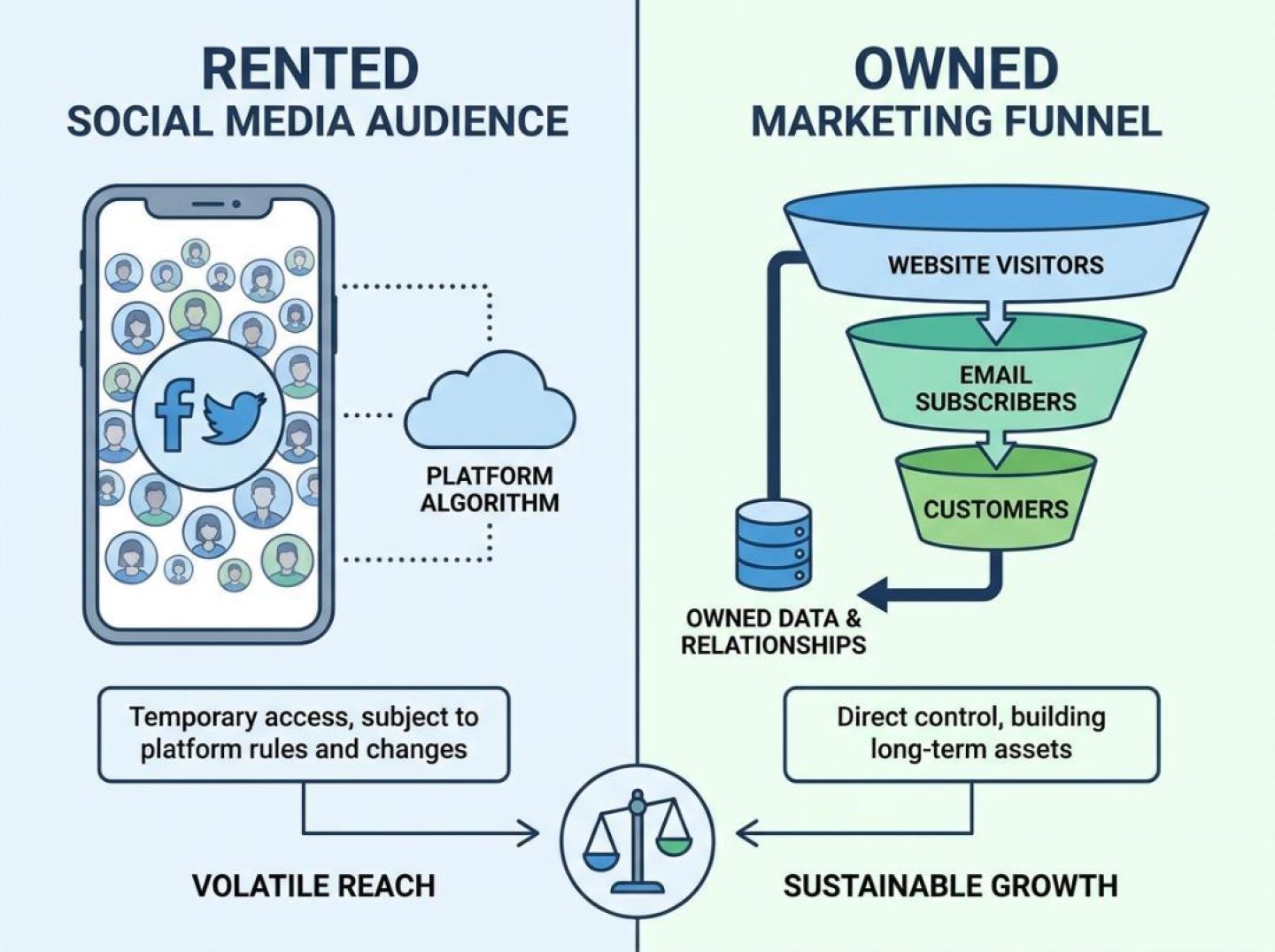
But there is a problem: you don't control the platform distributing your content.
Your followers may recognize your brand, but an algorithm determines how often they see your posts. A change in platform policies, declining organic reach, or a shift in user behavior can quickly reduce your access to that audience.
This is the social media rent trap.
Businesses invest time and money building audiences on platforms they don't own, only to discover that their reach depends on rules they cannot control.
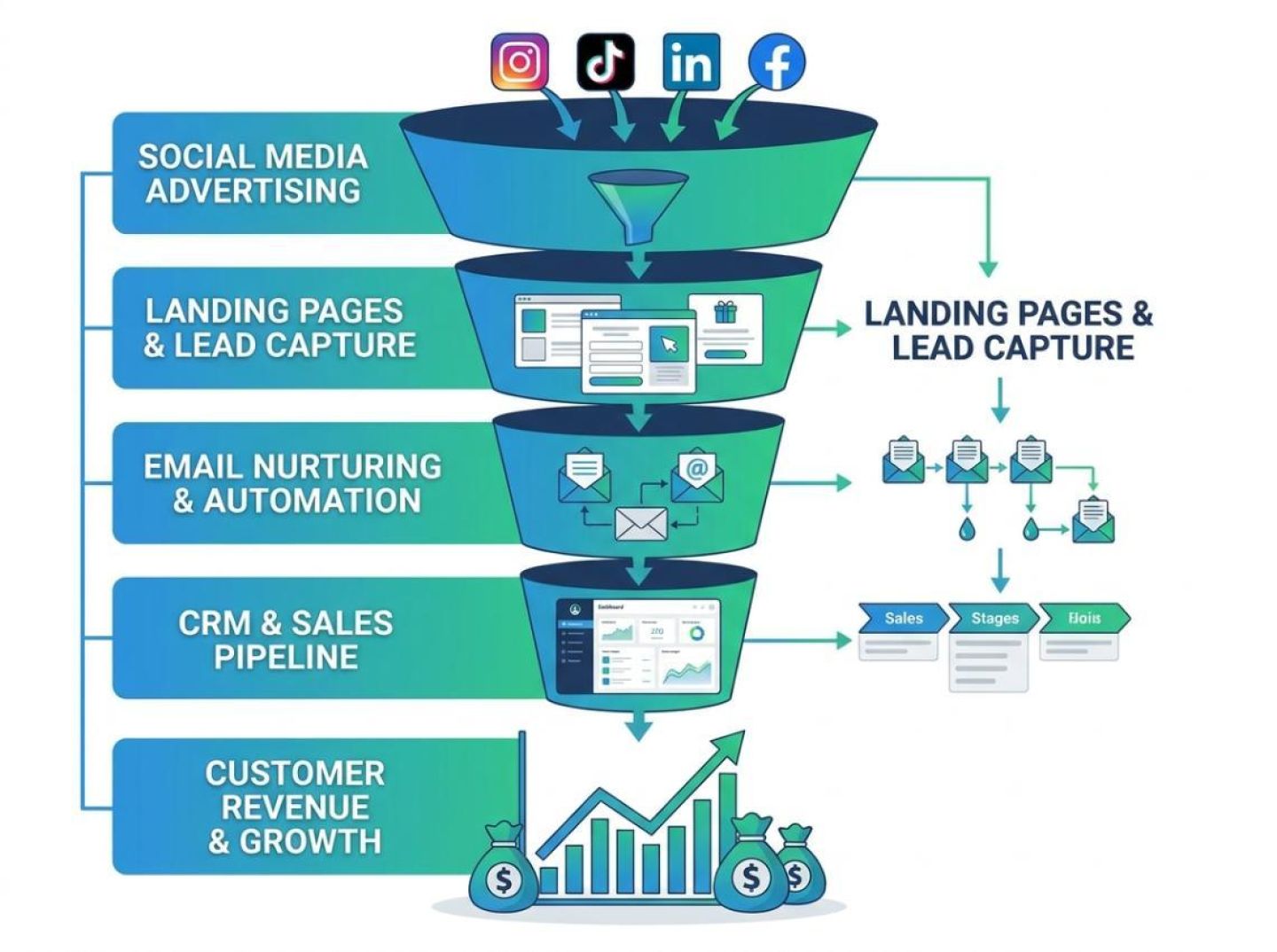
Performance marketers approach the problem differently. They use rented attention as an acquisition channel, then move interested prospects into systems they control: websites, email lists, customer relationship management platforms, and conversion funnels.
Competitive advertising intelligence makes this process more strategic.
By studying competitor advertisements, landing pages, offers, and funnel structures, marketers can identify approaches worth investigating and develop better acquisition strategies of their own.
With tools such as Anstrex, the objective isn't simply to find advertisements to copy. It's to understand how advertisers attract attention, turn clicks into leads, and move prospects toward revenue.
Here's how to make that transition.
A large following on LinkedIn, Instagram, or TikTok can create the impression that a business owns a valuable audience.
But having followers isn't the same as having direct access to them.
Your followers may have chosen to follow your account, but the platform controls the distribution of your content. It determines which posts appear, how frequently they are shown, and which content receives additional visibility.
As MarTech explains in its discussion of social media ownership, a following is only an asset within the limits of the platform's control.
Consider a business with 50,000 followers. That number may look impressive, but it doesn't mean every new post reaches 50,000 people. Organic distribution can fluctuate, and the business cannot independently contact every follower whenever it wants.
The audience exists, but access is conditional.
The traditional PESO model divides marketing into four categories:
Social media plays an important role in discovery and community building. However, it belongs to the shared-media category because the platform controls the distribution environment.
Your website and permission-based email database provide a different kind of control.
You can publish on your own website, manage your subscriber relationships, organize customer information in your CRM, and build follow-up sequences without relying exclusively on an algorithm to distribute every message.
This doesn't mean owned media is completely independent of external providers. Websites still depend on hosting, email systems rely on service providers, and customer databases require proper maintenance. The important distinction is that you have a more direct relationship with the audience and greater control over how you communicate with it.
The history of social media demonstrates how quickly distribution environments can change.
MySpace lost its position as a major social network. Facebook's organic reach evolved as its feed and advertising systems changed. Twitter became X and underwent significant changes in its product and business direction.
Businesses that depended heavily on one platform had to adapt when the environment changed.
The lesson isn't that social media is unreliable or should be abandoned. Social platforms remain valuable discovery and acquisition channels.
The lesson is that a business should avoid making its entire customer acquisition strategy dependent on access it doesn't control.
Likes, impressions, comments, and follower growth can help evaluate social media activity. But they don't necessarily reveal whether that activity is creating lasting business value.
More useful questions include:
Metrics such as amplification rate, virality rate, and follower growth rate can help assess how content spreads, as discussed in Semrush's social media management guide.
However, those metrics still describe activity within the social environment.
To understand whether marketing is creating a more durable asset, connect social performance with website behavior, subscriber growth, CRM activity, and customer outcomes.
This becomes particularly important as discovery expands beyond traditional search and social feeds. People may discover a brand through AI tools, recommendations, or third-party content before visiting its website directly.
Branded search, direct traffic, and assisted conversions can provide additional clues about whether awareness is developing into genuine interest.
The objective is to build relationships that survive beyond the next algorithm update.
Performance marketers don't necessarily view social platforms as places to accumulate followers. They view them as environments where they can reach potential customers and move those people toward a measurable business outcome.
The strategy is straightforward:
Social media becomes the beginning of the customer journey rather than the entire strategy.
Short-form video, creator content, and feed-based advertising give businesses opportunities to introduce products and reach new audiences.
Formats such as TikTok videos, Instagram Reels, YouTube Shorts, and Stories are especially useful for demonstrating products, presenting customer experiences, and communicating a problem quickly.
Performance marketers study the opening moments of these advertisements because the creative needs to earn attention before the viewer moves on.
They may test:
The objective isn't simply to generate likes. It's to attract people who are likely to take the next step.
Video completion, click-through rate, and engagement can provide useful creative feedback, but the strongest creative is ultimately the one that contributes to the campaign's actual objective.
The real opportunity begins after someone clicks.
Instead of sending every visitor to a generic homepage, marketers can direct traffic to a destination designed around the advertisement's promise.
Depending on the business, this might be:
A lead magnet can be especially useful when a visitor isn't ready to purchase immediately.
For example, a software company might advertise a free guide explaining how to solve a particular business problem. The landing page offers the guide in exchange for an email address. The company can then send educational content and introduce its product over time.
The advertisement creates initial interest. The landing page converts that interest into a relationship.
Not every visitor will convert on the first visit.
Some people will watch a video, visit a pricing page, add a product to their cart, or begin filling out a form before leaving.
Retargeting allows advertisers to reach eligible audiences again, subject to platform policies, consent requirements, and available tracking signals.
Different behaviors can support different follow-up messages.
For example:
The important principle is relevance. A person who has already explored pricing may need different information from someone who has only watched a few seconds of a video.
Once someone voluntarily subscribes or becomes a customer, the business has an opportunity to continue the conversation through its own marketing systems.
An email sequence might include:
A CRM can organize these relationships and help the business track leads through different stages of the sales process.
Email is particularly useful for businesses with longer buying cycles because it allows communication to continue after the original advertisement has disappeared from the feed.
However, subscriber acquisition alone isn't the finish line. Marketers should monitor engagement, qualified opportunities, customer conversion, and revenue.
A campaign that generates inexpensive leads may still be unprofitable if those leads rarely become customers.
Likewise, a campaign with a higher initial acquisition cost may be worthwhile if it attracts customers with stronger retention, larger purchases, or greater lifetime value.
Performance reporting should therefore connect advertising data with business outcomes.
Depending on the business, relevant measures include:
This is why sophisticated marketers connect advertising platforms, analytics, and CRM systems whenever possible.
The rented channel generates the opportunity. The owned system helps the business develop and monetize the relationship.
Understanding the value of owned audiences is one thing. Knowing how to build an effective acquisition funnel is another.
This is where competitive advertising intelligence becomes useful.
Instead of starting with a blank page and guessing which creative, offer, or landing page might work, marketers can study existing advertising activity.
Anstrex helps media buyers investigate competitor advertisements and, where available, their associated landing pages and advertising funnels across supported environments.
The purpose is to discover how other advertisers structure their campaigns and identify ideas worth testing.
Use Anstrex to investigate advertisers in your niche, paying attention to:
Don't focus only on individual advertisements.
Look for groups of related creatives. An advertiser may use several different hooks to promote the same product or direct multiple advertisements toward one landing page.
That can reveal how the advertiser is approaching audience acquisition and message testing.
The advertisement is only one part of the conversion journey.
When you discover a relevant creative, follow the available landing page link and examine what happens after the click.
Ask:
For example, a real estate advertiser might send cold traffic to a property valuation tool rather than immediately asking visitors to book a listing appointment.
The tool provides an initial reason to engage, while the lead form creates an opportunity for follow-up.
That is a different funnel strategy from sending visitors directly to a property listing.
A strong funnel should create continuity between the advertisement and the destination page.
Examine the progression:
Advertisement hook → Landing page headline → Problem explanation → Solution mechanism → Proof → Call to action
If an advertisement promises a simple solution to a specific problem, the landing page should reinforce that promise.
If the page immediately changes the subject, introduces an unrelated offer, or creates confusion, the visitor may lose confidence.
Record the exact messages and transitions you observe.
Look beyond colors and visual styling.
Study how the landing page organizes information:
These details help you understand the advertiser's approach to persuasion and conversion.
They don't prove which page elements caused the campaign to succeed, but they provide useful hypotheses for your own experiments.
Suppose you discover a competitor running a direct-to-product advertisement.
You might decide that the creative angle is relevant but that your business needs a longer customer relationship.
Instead of copying the entire campaign, adapt the approach:
This is the important difference between copying a competitor's advertisement and learning from its funnel structure.
Anstrex provides a research starting point. Your strategy determines how to adapt those observations to your own audience, offer, and business model.
Once you understand the basic research process, the next step is identifying advertisers worth studying.
A useful starting point is to look for campaigns that show repeated activity over time.
An advertiser maintaining multiple creative variations, running campaigns across different placements, or repeatedly promoting the same offer may be worth closer investigation.
However, there is an important distinction: advertising intelligence tools generally reveal observable activity, not a competitor's private financial results.
You cannot assume that an advertisement is profitable simply because it has been visible for several months.
Instead, use longevity and repetition as research signals.
Inside Anstrex, investigate campaigns with characteristics such as:
A campaign observed for 60–90 days may deserve more attention than an advertisement seen only once.
But the observation period should not be confused with the actual launch date or proof of uninterrupted delivery. Data coverage, ad rotation, and platform reporting can affect what a research tool displays.
The same applies to estimated ad strength, gravity, or placement volu
Organize the advertisers you discover into useful groups.
Established brands
These may include direct-to-consumer businesses, software companies, e-commerce retailers, and lead-generation brands.
Their advertising can reveal how established businesses communicate value, structure offers, and maintain consistent positioning.
Less familiar advertisers and domains
Some campaigns may use unfamiliar brand names, generic domains, or landing pages that are difficult to associate with a well-known company.
Investigate their destinations and offer structures before drawing conclusions about who is behind them.
Affiliate-focused advertisers
Affiliate activity can be particularly useful to study because multiple publishers or affiliates may promote the same underlying offer using different creatives and presell approaches.
Look for:
These patterns can reveal how an offer is being distributed and marketed.
They do not establish the commission rate, earnings per click, or profitability of the affiliates involved.
Not every advertisement that appears in a spy tool deserves the same level of attention.
A short-lived campaign may represent an experiment, seasonal promotion, or limited launch.
A more persistent campaign may show a consistent creative direction with incremental variations.
You can classify observations into two groups.
Short-lived or experimental patterns
Persistent campaign candidates
The second group is often more useful for understanding how advertisers refine their messaging.
Still, persistence is not proof of profitability. Campaigns may remain active for reasons other than strong returns, including testing, brand objectives, or imperfect budget controls.
Affiliate marketers often operate with direct financial incentives tied to the actions they generate.
That makes their creative and funnel activity particularly interesting to investigate.
For example, if several affiliates are promoting the same offer through different advertorials, you can study:
A repeated offer across several affiliates can suggest that the offer has meaningful distribution interest.
But it does not prove strong earnings per click or a profitable backend. Those financial details require evidence that public ad observations alone usually cannot provide.
The objective is to identify promising research opportunities, then investigate the underlying funnel.
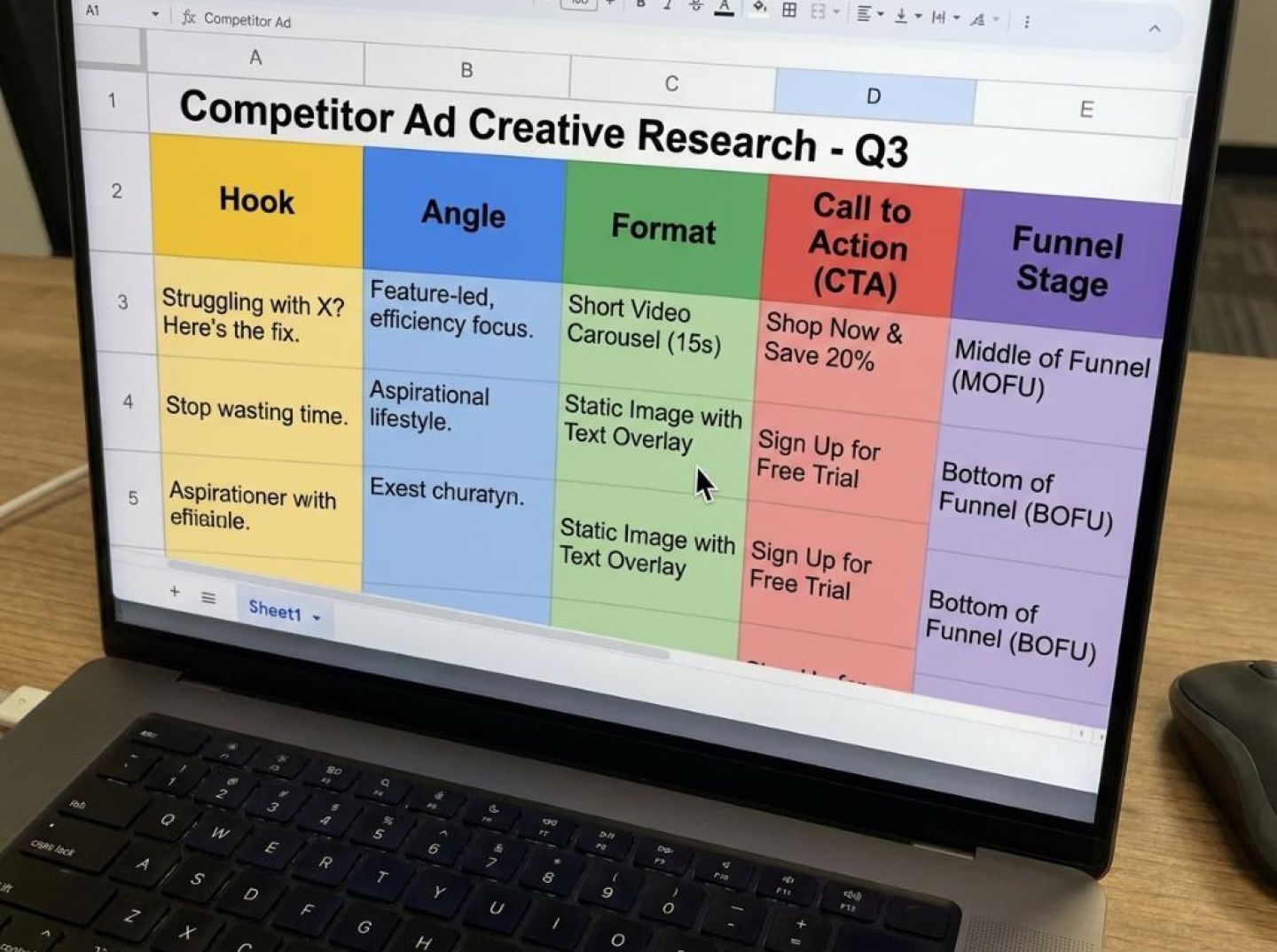
After identifying relevant advertisers, organize their creative approaches into a searchable library.
Don't simply save the advertisement. Record the decisions behind it.
This makes it easier to compare campaigns and recognize recurring patterns.
The hook is the opening element designed to earn attention.
For video advertisements, the first few seconds are particularly important because viewers can scroll away immediately.
As you review relevant creatives in Anstrex, record the opening lines, visuals, and first product demonstrations.
Examples of hook structures include:
These are illustrative structures, not claims about specific winning advertisements.
Group your observations into hook categories:
Over time, you may notice several recurring approaches within your niche.
The hook gets attention. The angle determines how the advertiser frames the offer.
Common angles include:
Pain relief: Focuses on a frustrating problem the audience wants to solve.
Aspiration: Presents a desirable future outcome or lifestyle.
Speed and simplicity: Emphasizes convenience, ease, or reduced effort.
Social proof: Uses customer experiences, testimonials, or popularity claims.
Economic logic: Focuses on savings, value, cost comparisons, or financial benefits.
Record the angle separately from the hook.
For example, a video might begin with a curiosity-driven question but ultimately sell the product through an economic savings argument.
Separating these elements helps you understand the difference between how an advertisement attracts attention and why it gives someone a reason to buy.
Different formats create different opportunities for communication.
Common examples include:
Record which formats appear most frequently in the campaigns you're studying.
You can also compare how advertisers use formats at different funnel stages. For example, a brand might use informal creator videos for initial discovery and more detailed product demonstrations for retargeting.
That is an observation worth testing, not an automatic rule.
A call to action tells the visitor what to do next.
But the wording also reveals something about the funnel.
Consider these examples:
Record the CTA alongside the destination page.
A button label alone doesn't reveal the entire funnel. The important information is what happens after the visitor clicks.
A simple spreadsheet or database is enough to begin.
Recommended fields include:
| Field | What to record |
|---|---|
| Advertiser | Brand, account, or domain |
| Channel | Where the advertisement appeared |
| Observation date | When you captured it |
| Hook | Opening line or visual |
| Angle | Main persuasion approach |
| Format | UGC, testimonial, explainer, carousel, etc. |
| CTA | Button or action language |
| Funnel stage | Prospecting, consideration, retargeting, conversion |
| Landing page | Destination URL |
| Offer | Product, discount, lead magnet, trial, etc. |
| Notes | Interesting patterns or testing ideas |
Your goal isn't to reproduce every pixel of a competitor's creative.
It's to create a reference library that helps you make informed decisions about your own messaging, formats, and offers.
An advertisement may look convincing, but the real customer journey continues after the click.
To understand how a competitor structures its acquisition strategy, investigate every publicly accessible step of the funnel.
That may include:
Your objective is to understand how the advertiser moves a visitor from initial interest toward a commercial decision.
Some advertisers send visitors directly to a product page. Others introduce an intermediate page designed to prepare the visitor before presenting the main offer.
This intermediate page may be:
Each approach creates a different experience.
A quiz, for example, may ask visitors several questions before showing a recommendation. An advertorial may explain the problem and introduce the product through an editorial-style narrative.
Record the following:
The next step is to understand how the visitor moves from the presell page to the main landing page.
Does every visitor receive the same offer?
Does a quiz change the recommendation?
Does the CTA lead to a product page, a registration form, or a consultation?
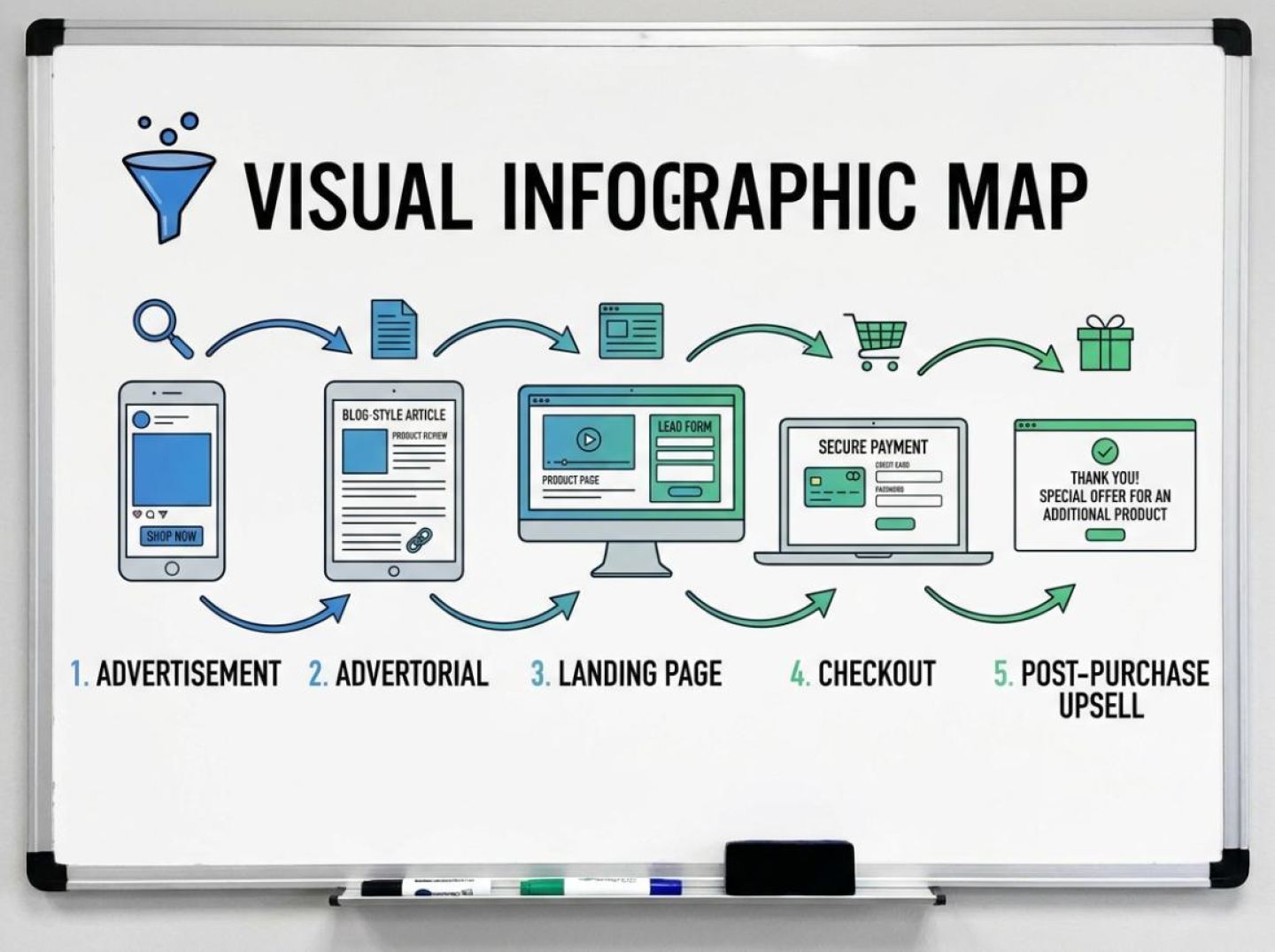
Create a simple visual map:
Advertisement → Presell page → Main landing page → Checkout → Upsell
Not every funnel contains all five stages, and some journeys may include additional steps.
The important thing is to document the actual sequence you can observe.
Once you reach the primary landing page, examine how the advertiser presents the offer.
Above the fold
Body content
Visual hierarchy
These observations can help you form hypotheses about how the advertiser is reducing friction and communicating value.
Don't record only the advertised price.
Look at the complete commercial proposition.
Capture:
Pay attention to how the offer changes throughout the funnel.
An advertorial might introduce a broad benefit, while the checkout page provides specific deliverables, pricing, and terms.
Understanding that progression helps you see how the advertiser moves from an attention-grabbing promise to a concrete purchase decision.
If you can access the checkout and post-purchase sequence, document what happens after the initial offer.
Questions worth investigating include:
This is particularly useful when studying businesses that rely on repeat purchases, subscriptions, or higher-value services.
A low-priced entry product may be only the first step in a larger customer relationship.
However, a visible upsell does not reveal how frequently customers accept it or how much revenue it generates.
After documenting the customer journey, identify the elements worth testing in your business.
For example:
Observation: Several competitors introduce a quiz before presenting the main offer.
Hypothesis: A short assessment may help qualify visitors and make the next offer feel more relevant.
Experiment: Compare a direct product landing page with a quiz-based entry page.
Measurement: Evaluate completion rate, qualified leads, purchase conversion, and revenue per visitor.
Another example:
Observation: Competitor advertorials explain the problem before introducing the product.
Hypothesis: Educational content may help visitors understand the offer before they encounter a sales message.
Experiment: Compare an educational presell page with a direct product page.
Measurement: Evaluate landing page engagement, lead quality, and downstream conversion.
This is how competitive intelligence becomes practical campaign strategy.
Social media can introduce your business to thousands of potential customers, but a large follower count doesn't guarantee that you own the relationship.
The real opportunity is to turn temporary attention into something more durable.
Performance marketers do this by combining paid acquisition with landing pages, lead capture, CRM systems, email nurturing, and measurable conversion funnels.
Ad spy intelligence helps make the process more informed.
By studying competitor advertisements, creative patterns, landing pages, offers, and customer journeys, you can identify approaches worth testing instead of building every campaign from scratch.
Anstrex can support that research by helping you investigate advertising activity and discover the landing pages behind relevant campaigns.
But the advantage doesn't come from copying what competitors publish. It comes from understanding why their funnels are structured the way they are, adapting relevant ideas to your own business, and validating those ideas with your own performance data.
Your followers may belong to a platform's distribution environment.
Your customer relationships deserve a more durable foundation.
Stop renting attention without building anything behind it. Use advertising intelligence to turn traffic into leads, leads into customers, and customers into lasting business value.
Receive top converting landing pages in your inbox every week from us.
Guide
Stop relying entirely on social media followers. Discover how performance marketers use competitor ad research, landing page analysis, and funnel strategy to turn paid attention into owned customer relationships.
Liam O’Connor
7 minOct 31, 2026
Guide
Move beyond random screenshots and build a structured ad intelligence library that connects competitor research, creative patterns, and cross-channel testing.
Priya Kapoor
7 minOct 31, 2026
In-Depth
AI can analyze competitor advertisements and generate new creative at scale, but not every apparent winner reflects real customer demand. Learn how to filter competitor insights, train AI with business context, and validate campaigns using meaningful human signals.
Samantha Reed
7 minOct 30, 2026