10 minOctober 30, 2026

Our tools monitor millions of native, push, pop, and TikTok advertising campaigns.
Get StartedAI has made it easier than ever to produce advertising creative. A marketer can generate product images, draft dozens of headlines, create video concepts, and develop campaign variations in a fraction of the time it once took.
But when everyone has access to similar tools, producing more creative is no longer a meaningful competitive advantage.
The result is a crowded advertising environment filled with polished but increasingly interchangeable content. Brands can create more ads, but that does not automatically mean they can create more effective ones.
This changes the role of competitive intelligence. Instead of relying entirely on internal brainstorming and creative testing, marketers can study the advertising activity already happening across their markets. Competitor ads provide clues about emerging hooks, visual formats, messaging approaches, offers, and audience conversations.
The opportunity is not to copy what competitors publish. It is to understand the patterns behind their creative decisions, use those observations to develop better hypotheses, and feed the resulting insights into AI-assisted workflows.
In an environment where creative production is becoming easier for everyone, the advantage belongs to the teams that know what is worth creating in the first place.
AI was supposed to democratize advertising creative, and in many ways, it has.
A small business can now produce professional-looking product images and campaign concepts without hiring a large creative team or paying for an expensive production shoot. Generative tools have reduced the time, cost, and technical expertise required to bring an idea to life.
As one performance strategist discussed in Social Media Examiner's article on AI for better ad creative, product imagery that once required substantial production budgets can now be generated at a fraction of the cost.
That is a significant change for smaller advertisers. The problem is what happens next.
When thousands of brands use similar models, prompts, templates, and creative conventions, the same technology that increases production capacity also creates creative saturation.
The result is an advertising landscape filled with:
The issue is not that AI-generated creative is inherently ineffective. It is that widespread access to the same production capabilities makes generic output easier to reproduce.
Platform changes are also encouraging advertisers to think beyond superficial variations. Meta's advertising ecosystem has increasingly emphasized creative diversity and meaningful differences between concepts rather than relying exclusively on large numbers of minor adjustments. See Social Media Examiner's coverage of Facebook advertising tools.
This creates an important distinction: changing a headline, background color, or opening frame is not necessarily the same as testing a genuinely different advertising idea.
At the same time, marketers are becoming more selective about how much decision-making they delegate to AI. Generative systems can support research, analysis, copywriting, and production, but human judgment remains important when decisions involve brand positioning, audience understanding, and budget allocation.
The broader operational role of AI is evolving as well. Instead of functioning only as a tool for generating creative or adjusting campaigns, AI is increasingly being used to coordinate complex advertising workflows across channels. As discussed in AdExchanger's analysis of AI and omnichannel advertising, orchestration is becoming an important part of the conversation.
But better orchestration does not automatically produce more memorable advertising.
Audiences still respond to ideas that feel relevant, distinctive, entertaining, or emotionally meaningful. Research and practitioner perspectives discussed by TopRank Marketing highlight the continuing importance of authenticity, humanity, vulnerability, and transparency in B2B content.
The lesson is straightforward: AI can increase how much advertising a team produces, but it cannot guarantee that people will care about it.
The brands that stand out are not necessarily the ones with the largest collection of AI tools. They are the ones that use those tools to develop ideas competitors have not already exhausted.
Generative AI has reduced the production gap between large and small advertisers.
A solo marketer with a laptop and a few subscriptions can now produce work that once required a studio, a copywriting team, and a significant production budget. This creates a new baseline for creative capability.
However, equal access to tools does not mean equal advertising results.
AI can help answer the question, "Can we make enough creative?" It does not automatically answer the more important question: "Are we making the right creative for this audience?"
That is where strategy, experience, and market knowledge become more valuable.
Consider three factors that separate effective advertisers from teams simply producing more content.
The first advantage is knowing what problem a creative test is supposed to solve.
Instead of asking an AI tool to generate 20 advertisements, an experienced marketer might ask:
These questions give AI a clearer direction.
They also make the resulting work easier to evaluate because each creative has a defined purpose.
The second advantage is understanding what success actually means.
A campaign can generate inexpensive clicks without attracting qualified prospects. A landing page can produce strong engagement without generating meaningful sales. A video can receive considerable attention without contributing to the business objective.
Marketers need to connect creative decisions to the outcomes that matter.
Depending on the campaign, those outcomes might include:
The right metric depends on the business model and campaign objective. The important point is to avoid treating engagement as a substitute for profitability.
The third advantage is understanding what makes a particular audience respond.
A creator-style product demonstration might work well for a consumer gadget. The same format may be inappropriate for a specialized B2B service or a regional healthcare provider.
The audience, buying journey, level of trust required, and complexity of the offer all influence the creative approach.
AI can generate variations based on instructions, but the advertiser must supply the context that makes those instructions meaningful.
This is why competitive intelligence matters.
When marketers understand what other advertisers are testing, how messaging changes across campaigns, and which creative patterns repeatedly appear in their niche, they have a stronger foundation for making decisions.
The goal is not simply to collect more examples. It is to understand the market well enough to give AI better direction.
AI has made it possible to generate more advertising variations than most teams can reasonably evaluate.
That sounds like an advantage, but quantity alone does not create useful learning.
A marketer can generate 100 versions of an advertisement, launch them, and identify one that performs better than the others. Yet if the variations are poorly designed, the results may reveal very little about why the winning creative worked.
This is the difference between random variation and hypothesis-driven testing.
Imagine testing 20 advertisements that all use the same product image, the same offer, and nearly identical messaging.
The only differences are the headline, background color, and placement of a small visual element.
Even if one variation performs better, the result may not provide a meaningful strategic insight. It may simply reflect a minor execution difference or normal variation in delivery.
Now consider a different approach.
Instead of generating 20 superficial variations, develop five distinct creative hypotheses:
Each concept tests a different reason someone might respond to the advertisement.
AI can then help produce variations within those concepts, allowing the team to explore execution without losing sight of the original hypothesis.
Advertising platforms continuously optimize delivery based on their own systems and available signals.
That makes performance testing valuable, but it also means results need context.
A creative may receive more impressions because of delivery decisions rather than because it is inherently more persuasive. A short-term performance increase may not persist when the audience, placement, or campaign conditions change.
Advertisers should therefore avoid treating every apparent winner as a universal rule.
Instead, evaluate results against the original hypothesis:
AI can generate and organize creative experiments, but human judgment is still needed to interpret the results.
A high-performing advertisement might succeed because it communicates an important customer benefit, uses an unexpected visual, or addresses an objection that competitors have overlooked.
Those are strategic lessons, not merely formatting instructions.
As discussed in TopRank Marketing's exploration of AI and B2B creativity, distinctive ideas often come from a deeper understanding of people and what makes them pay attention.
The objective should not be to test everything AI can produce. It should be to test the ideas most likely to reveal something useful about the audience.
Creative testing can tell you which of your concepts performs better under particular conditions. Competitive research helps you understand whether you are exploring the right concepts in the first place.
Competitive spying may sound aggressive, but the practical activity is straightforward: systematically studying publicly available advertising to understand how other brands communicate with the same market.
In an AI-saturated advertising environment, competitors are constantly publishing creative experiments.
Their advertisements reveal information about the messages they are testing, the formats they use, the offers they promote, and the audiences they appear to target.
The opportunity is to organize those observations instead of treating every advertisement as an isolated source of inspiration.
A useful competitive intelligence process examines three layers:
Start by examining the creative itself.
Instead of saving random advertisements, organize them according to consistent characteristics.
For each creative, record:
These categories help reveal patterns across multiple advertisements.
For example, a competitor might initially rely on polished product images before gradually introducing creator-led demonstrations and customer testimonials.
That shift is worth investigating. It could reflect a new creative direction, an effort to address customer objections, or an attempt to reach a different audience.
It does not automatically prove that the new format performs better, but it gives you a useful hypothesis to explore.
Tools such as TikTok's advertising research resources and specialized competitive intelligence platforms can help marketers discover and organize these examples. Social Media Examiner's discussion of AI and TikTok advertising provides additional context on researching creative activity.
The existence of an advertisement does not tell you whether a competitor considers it successful.
However, repeated activity can provide useful clues.
Look for:
For example, a competitor might launch one customer testimonial video and later introduce several variations featuring different customers, opening hooks, or product demonstrations.
That pattern suggests the concept is important enough for the advertiser to continue developing.
It may indicate a promising campaign direction, but it is not proof of profitability. An advertisement can remain active for reasons unrelated to strong performance, and publicly available libraries do not necessarily reveal the advertiser's actual budget or return.
The correct approach is to treat repeated activity as a signal worth investigating—not as a confirmed performance result.
The third layer is understanding how people react.
An advertisement tells you what a brand wants to communicate. The audience's response can reveal whether the message is understood, questioned, appreciated, or rejected.
Where publicly visible, examine:
Comments can be especially useful for discovering customer language.
For instance, if viewers repeatedly ask whether a product works with a particular setup, that may reveal an objection worth addressing in your own creative or landing page.
However, visible engagement is not the same as verified purchase intent. Use audience reactions as qualitative research, then validate important assumptions through your own campaign data.
The purpose of competitive research is not to reproduce another advertiser's successful-looking creative.
Instead:
The best competitive research does not make your advertisements look more like everyone else's. It helps you understand the market well enough to create something more relevant and distinctive.
Competitive research becomes much more valuable when its findings influence the way your team creates and evaluates advertisements.
Many advertisers stop after collecting screenshots, saving interesting examples, or borrowing a headline idea.
That leaves the most important opportunity unused.
The objective should be to build a continuous process that turns public advertising observations into structured insights, better creative briefs, more relevant AI prompts, and more useful campaign experiments.
Think of it as a competitive intelligence feedback loop.
Start with a consistent way to document what you find.
A spreadsheet or lightweight database is enough. The important thing is to use the same categories across your research.
For every relevant advertisement, record:
This makes it easier to compare creative activity across brands and time periods.
Instead of collecting hundreds of disconnected screenshots, you build a searchable library of market observations.
Once you have enough organized observations, use them to improve your creative briefs.
A generic prompt might say:
"Write 10 TikTok ad scripts for our product."
That leaves the model to guess what the audience cares about and what creative direction might be appropriate.
A more useful prompt provides context:
"Develop 10 TikTok ad script concepts for our product. Explore distinct approaches based on the competitive research provided: problem-focused demonstrations, myth-busting hooks, customer objections, and creator-style storytelling. Give each concept a different opening idea and emotional angle. Use natural audience language, maintain our brand voice, and include one clear call to action. Do not copy competitor wording, creative assets, or distinctive campaign concepts."
This gives the model a more specific creative direction while preserving originality.
The goal is not to ask AI to reproduce competitor advertisements. It is to help AI understand the market conventions and audience concerns that should inform your own creative development.
Competitive intelligence provides context. Your campaign results provide evidence about what works for your business.
Combine both.
For example, suppose several competitors appear to be using product demonstrations and customer testimonials.
You can use that observation to develop two hypotheses:
Test those concepts in your own account and evaluate the results against your campaign objectives.
If the demonstration attracts more qualified prospects, that is a useful internal finding. If the testimonial generates more engagement but fewer conversions, that tells you something about the relationship between attention and purchase intent.
Your own results should determine whether an external pattern deserves to become part of your strategy.
As your competitive research expands, manual organization can become time-consuming.
This is where AI and automation can help.
For example:
These systems should support the research process, not make unsupported performance claims.
A model might identify that several competitors use a similar problem-focused opening. It should not conclude that the hook is profitable unless there is reliable evidence supporting that conclusion.
Human review remains essential.
The important question is not simply, "What pattern did the tool detect?"
It is, "What does this pattern suggest about the audience, and how should we test that idea?"
Finally, integrate research into the normal campaign workflow.
A competitive snapshot can be included in:
Campaign kickoff documents: Summarize relevant competitor activity, recurring hooks, visible offers, and potential audience objections.
AI prompt libraries: Update shared prompts with useful audience language, relevant creative formats, and new strategic directions.
Creative reviews: Compare new concepts against current market patterns to identify opportunities for differentiation.
Campaign post-mortems: Evaluate whether the original competitive hypothesis was supported by your own performance data.
This turns competitive research from an occasional activity into an ongoing source of strategic direction.
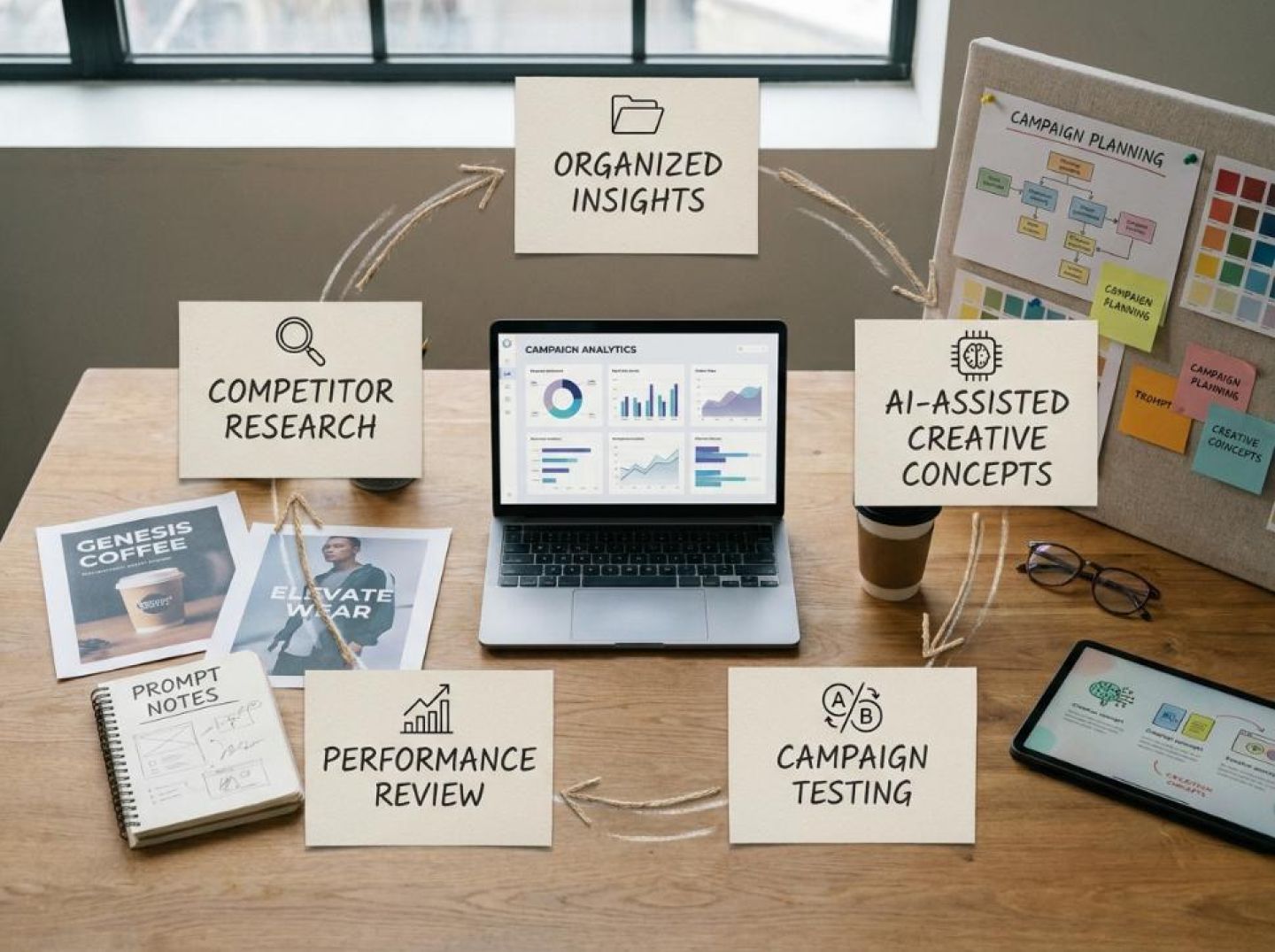
The complete feedback loop becomes:
Observe → Organize → Interpret → Generate → Test → Learn → Observe again.
Once your research process is established, the next challenge is finding relevant advertisements efficiently.
This is where ad intelligence and spy tools become especially useful.
Instead of manually browsing social feeds and saving random examples, advertisers can use specialized platforms to discover competitor creatives, examine campaign activity, and organize advertisements using available filters.
Three particularly useful areas to investigate are creative longevity, delivery-related signals, and placement distribution.
An advertisement that has been visible for several weeks or months may be worth examining more closely.
In fast-moving advertising environments, continued activity can suggest that an advertiser has a reason to keep the creative in circulation.
But longevity needs context.
A long-running advertisement is not automatically profitable. It could be part of a low-budget campaign, a brand awareness initiative, or an evergreen promotion that serves a purpose beyond immediate conversions.
Use longevity as a discovery filter, not a profitability score.
When reviewing long-running creatives, ask:
The answers can help you identify concepts that deserve further research.
Most public advertising libraries do not reveal complete campaign budgets or verified returns.
However, some tools provide additional information, such as estimated reach, impressions, activity history, or other delivery-related indicators.
These can help you prioritize which advertisements to investigate.
For example, an advertisement that appears frequently across multiple placements may deserve closer attention than an isolated creative.
But exposure does not establish profitability.
An advertiser might spend heavily on awareness, test a new offer, or maintain a campaign for strategic reasons unrelated to immediate return on ad spend.
Treat spend estimates and visibility indicators as directional signals, and avoid presenting them as confirmed financial results.
Placement analysis can reveal how advertisers adapt messaging and formats to different contexts.
Look for patterns such as:
These differences may reveal how advertisers think about audience attention and the customer journey.
For example, a short video may introduce a product problem, while a longer demonstration explains the solution in greater detail.
That is a useful creative hypothesis to test, even if the competitor's actual targeting strategy and campaign performance remain unknown.
The most useful insights often emerge when several observations are considered together.
| Intelligence signal | What it can suggest | What it cannot prove |
|---|---|---|
| Ad longevity | Continued campaign activity or strategic importance | Profitability or positive ROAS |
| Repeated creative concepts | A recurring messaging or testing direction | That the concept is a confirmed winner |
| Estimated reach or impressions | Potential exposure or delivery scale | Exact budget or acquisition cost |
| Multiple placements | Creative adaptation across environments | The advertiser's complete funnel strategy |
| Audience comments | Questions, objections, and reactions | Actual purchase intent or conversion rate |
| Landing page changes | Possible changes in messaging or offer strategy | Why the advertiser made the change |
The value of ad intelligence comes from combining these signals with your own market knowledge and campaign data.
For example, if a competitor repeatedly uses a particular product demonstration, adapts it across placements, and receives questions about the same product benefit, you may have discovered a useful creative direction.
You can then develop an original version, test it with your audience, and evaluate the actual business results.
That is a much stronger process than simply copying an advertisement because it has been running for a long time.
AI has changed the economics of advertising production.
Brands can generate more concepts, produce more variations, and move from idea to execution faster than ever. But as these capabilities become widely available, creative volume becomes less distinctive.
The advantage shifts toward the advertisers who understand their market.
They know which customer problems matter, which messages are becoming repetitive, which creative formats are attracting attention, and which opportunities competitors may be overlooking.
Competitive ad research makes that understanding more systematic.
It helps marketers study public advertising activity, identify recurring creative patterns, recognize possible market shifts, and develop better hypotheses for their own campaigns.
AI then helps turn those insights into more concepts, more relevant prompts, and faster production workflows.
The important distinction is that AI should accelerate the process—not replace the judgment behind it.
When everyone has access to similar creative tools, the winning question is no longer how many advertisements you can generate.
It is whether you understand the market well enough to create something worth noticing.
The brands that win the AI creative arms race will not necessarily produce the most ads. They will be the ones that learn the most from the market before creating their next one.
Receive top converting landing pages in your inbox every week from us.
Editor’s Pick
AI has made ad production faster and cheaper, but it has also made creative sameness harder to escape. Discover how competitor ad intelligence helps marketers find better ideas, build smarter tests, and turn public advertising activity into a strategic advantage.
Dan Smith
7 minOct 30, 2026
How-To
AI is changing media buying, but building more tools is not the only answer. Explore a three-role organizational model that combines AI infrastructure, system oversight, and competitive ad intelligence to help media-buying teams make better decisions.
Rachel Thompson
7 minOct 29, 2026
Most Read
Industry averages offer a useful starting point, but they rarely reflect the competition in your exact market. Learn how to build more meaningful conversion benchmarks using competitor research, funnel analysis, and live advertising signals.
Elena Morales
7 minOct 29, 2026