8 minNovember 13, 2026

Our spy tools monitor millions of native ads from over 60+ countries and thousands of publishers.
Get StartedA strong advertising idea should not have to live and die on one platform.
A concept that connects with an audience on TikTok might also work as a Meta video, a YouTube story, a native advertising angle, or even a message adapted for connected TV. The execution will change, but the underlying promise, emotional tension, and proof can remain consistent.
That is the thinking behind creative that travels: developing one strong creative idea into a family of distinct, channel-appropriate executions, then using competitive intelligence and first-party performance data to improve the system over time.
This approach matters as advertising platforms automate more of the work once handled through manual audience selection and campaign segmentation. Google's Performance Max, Meta's Advantage+ and TikTok's automated expansion are examples of this broader shift. As automation takes on more delivery decisions, the message and creative assets become increasingly important inputs.
As MarTech explains in its analysis of AI making creative the new targeting, creative can help platforms identify which users are most likely to respond.
But creative volume alone is not the answer. Producing dozens of near-identical ads does not necessarily create meaningful testing opportunities. The goal is to develop different creative hypotheses, adapt them intelligently, and measure what actually works.
Competitive ad intelligence can help marketers understand the creative patterns appearing in their markets. Their own campaign data must then determine which ideas deserve further investment.
“Creative that travels” starts with a simple premise: if algorithms increasingly decide who sees an advertisement, the idea inside the ad needs to be strong and structured enough to work across different placements and audiences.
Channel-by-channel campaigns were designed for a different advertising environment. Media buyers could isolate campaigns, define tightly controlled audiences, and rely heavily on targeting precision. That model has not disappeared, but automated campaign systems have changed how much control advertisers have over individual audience and placement decisions.
As MarTech's analysis of creative as the new targeting discusses, platforms such as Performance Max, Advantage+, and TikTok's automated systems are placing greater importance on creative signals.
In practical terms, the headline, opening visual, product demonstration, offer, and proof can all help communicate who an advertisement is relevant to.
When every channel is treated as a separate project, teams can end up producing many assets that communicate essentially the same idea. They might change the background, presenter, or color treatment without changing the underlying proposition.
That creates the appearance of creative variety without necessarily giving the platform or the marketing team a genuinely different hypothesis to evaluate.
MarTech's coverage of creative diversity makes this distinction important: increasing the number of ads does not automatically solve a creative problem when the underlying concepts remain too similar.
Creative that travels takes a different approach.
Instead of building unrelated assets for every channel, marketers begin with one central idea and develop several meaningful expressions of it. These can explore different emotional frames, problem-and-solution narratives, product demonstrations, testimonials, and proof devices.
Each version should answer a different question about why a potential customer might care.
The need for this approach becomes more apparent as content production expands. Unilever's creator-network strategy, discussed in Search Engine Journal's analysis of AI-scaled creator networks, illustrates the scale of content operations that large brands are exploring.
When organizations produce content across numerous creators, markets, and platforms, manual evaluation becomes harder to manage. Teams need better ways to organize creative assets, identify patterns, and connect creative decisions to outcomes.
The answer is not simply to produce more channel-specific ads.
A fragmented approach creates two problems:
A connected creative system makes it easier to reuse what has been learned while still adapting the execution to the channel.
For example, Kroger's work analyzing nearly 2,000 creative assets across Meta and DV360 demonstrates how creative attributes can be studied alongside e-commerce outcomes. Marketing Dive's reporting on Kroger's predictive scoring work describes how this kind of analysis can help identify relationships between creative characteristics and conversion.
That does not mean a particular visual element will guarantee sales. It shows why marketers should evaluate creative systematically rather than relying entirely on subjective preferences.
Creative scoring and media optimization are also becoming more connected. Search Engine Journal's coverage of the DAIVID–ADIN.AI partnership describes an effort to connect creative effectiveness analysis with media execution.
The broader lesson is that creative needs to be designed with measurement in mind.
Instead of treating every placement as a fresh campaign, marketers can treat each placement as another opportunity to test and refine a shared idea.
The objective is not to make every advertisement look the same. It is to create a coherent system in which different executions can contribute to a larger body of learning.
Many brands still treat a big idea as a spectacle: a hero film, an ambitious stunt, or a high-profile launch that generates attention for a short period.
The campaign may earn press coverage or become a case-study presentation, but its creative components are not always developed into assets that can support ongoing performance marketing.
Creative that travels reframes the big idea as a performance asset: a concept that can be measured, adapted, and redeployed across different placements.
Kroger's creative-analysis work is one example of why this matters. By analyzing more than 1,900 video and image assets across Meta and DV360, the project explored how specific creative attributes related to e-commerce conversion. Marketing Dive's coverage of Vidmob's study provides a useful example of moving beyond subjective creative evaluation.
The important shift is from asking which execution looks best to asking which combinations of message, structure, and visual elements are associated with meaningful outcomes.
A big idea can then become a library of reusable components rather than a single finished advertisement.
This direction also appears in the development of omnichannel advertising technology. VideoWeek's coverage of COOL AI describes an approach to connecting creative production, budget allocation, and attribution across channels.
The strategic implication is straightforward: a creative concept that only exists as one long-form video gives a broader campaign system fewer ways to test and adapt it.
A more flexible brief starts with a testable thesis:
Consider TikTok's Out of Phone initiative, which has been discussed in Social Media Examiner's coverage of the program. The initiative illustrates how social video can extend into physical environments such as gyms, taxis, and retail locations.
A concept designed only for a carefully produced social video may be difficult to adapt to these other surfaces. A concept built around a simple visual trigger, a clear message, and recognizable proof may be easier to translate.
Creative-analysis tools are also expanding the possibilities for evaluating large collections of advertisements. DAIVID's Creative Audit is one example referenced in VideoWeek's coverage of advertising and creative-analysis developments.
The value of this type of analysis is not that a tool can guarantee which concept will win. It is that marketers can examine more creative examples and look for relationships between elements such as emotion, branding, product framing, and attention.
Competitive intelligence adds another layer.
By studying visible competitor advertising across platforms, marketers can look for recurring creative structures and ways that advertisers adapt messages to different environments. Omnichannel measurement initiatives from major media organizations, including those discussed in Marketing Dive's reporting on data and AI in upfront presentations, show why cross-platform measurement is becoming an increasingly important industry focus.
The goal is not to copy a competitor's stunt or assume that a frequently visible advertisement is profitable.
It is to identify creative patterns worth investigating, develop original concepts around them, and test those concepts against actual campaign results.
The mental model to abandon is campaign as event.
The replacement is idea as a flexible performance asset.
A big idea earns its value when it can be translated into useful experiments, measured across different environments, and improved through repeated learning.
If creative is becoming a more important signal in automated advertising, the creative map becomes an important part of the media plan.
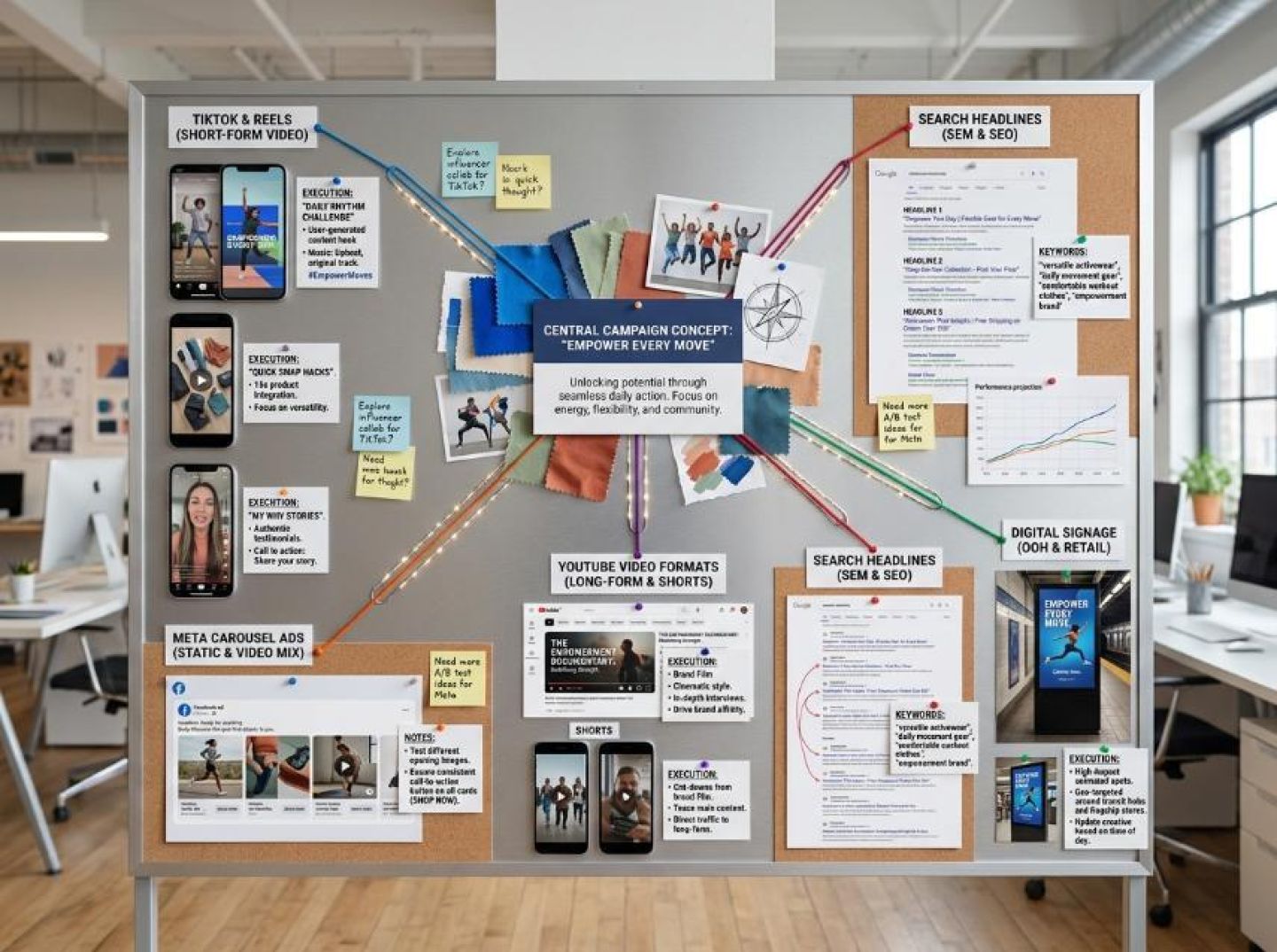
Instead of beginning with channels and formats, marketers can start with one performance-ready idea and map the different ways it could be expressed across platforms, placements, and contexts.
Spy data helps ground that map in observable market activity.
A practical creative map can be organized into three layers:
This structure is useful because automated campaigns have changed the role of traditional media planning. As MarTech explains, creative can help qualify broad delivery when advertisers have less direct control over audience selection.
That makes it valuable to understand how advertisers package messages and structure creative assets, rather than focusing only on manual audience settings.
A cross-channel creative map should begin with an inventory of observable patterns.
Gather relevant examples from sources such as:
Then organize the examples around three questions.
1. What narrative structures appear repeatedly?
Look for how advertisers introduce a problem, present an offer, demonstrate a product, or establish credibility.
For example, some ads may lead with social proof before introducing the offer. Others may use a problem, emotional tension, product demonstration, and proof sequence.
These patterns are observations to investigate, not proof that the ads are delivering strong results.
2. How do hooks change across channels?
A core message such as “we did the hard work so you do not have to” could appear as:
The message remains recognizable, but the execution changes to fit the environment.
3. Which creative elements keep reappearing?
Look for recurring proof devices, visual motifs, and emotional themes.
Examples include customer reviews, recognizable credentials, demonstrations, time savings, convenience, social status, or fear of missing out.
Repeated appearances are useful research signals, but they do not establish that a particular element is responsible for campaign performance.
The observations can become an angle library that sits upstream of production.
An angle library is a structured collection of:
This makes it easier for creative teams to develop genuinely different concepts instead of producing large batches of cosmetic variations.
The approach aligns with the broader discussion of creative volume and meaningful variation in MarTech's guide to AI-native advertising.
Next, document how a shared concept could be translated into different placements.
For example, a testimonial-led concept might become:
TikTok's Out of Phone initiative, discussed by Social Media Examiner, offers an example of social-originated creative extending into physical environments.
The creative map should document the relationship between each execution:
Core idea → channel treatment → landing experience → measurable outcome.
Every route should have a reason to exist. It should not be added simply because a channel is available.
Competitive research can help generate ideas, but your own campaign data must determine whether those ideas deserve more investment.
The DAIVID and ADIN.AI partnership described by Search Engine Journal illustrates an emerging effort to connect creative-effectiveness analysis with media execution.
You can apply the underlying discipline without adopting the same technology.
Use spy data to develop hypotheses. Launch controlled tests using your own campaigns. Then evaluate the results against relevant business metrics.
For example, if a testimonial-led hook performs better than a product-feature-led hook in your own Meta campaign, investigate whether that insight can translate to another channel.
Do not assume the same result will automatically carry over. The audience, placement, offer, and measurement conditions may differ.
Over time, the creative map should become less about what competitors appear to be doing and more about what your own evidence supports.
It becomes a living blueprint for deciding which ideas deserve another variation, another placement, or another test.
Once the central idea is established, the next challenge is adapting it to each channel without losing its identity.
The objective is not to resize one advertisement repeatedly. It is to understand how the same promise can be expressed through different formats, attention patterns, and user expectations.
Competitive intelligence can help identify the formats and creative structures appearing in the market. Your own testing should determine which adaptations are worth keeping.
Meta and TikTok are environments where the opening moments of an advertisement can strongly influence whether someone continues watching.
Creative-production tools such as RenderTiger are relevant because they make it easier to develop multiple versions of an idea. A StoreYa case study reports a 59% ROAS lift associated with RenderTiger-powered creative testing in one Meta account.
That result is specific to the reported case. It should not be treated as a guaranteed outcome for other advertisers.
A practical workflow:
The goal is to build a library of testable hooks, not simply one hero video.
YouTube often gives advertisers more room to develop an idea through explanation, demonstration, and storytelling.
A short-form concept may need several adaptations:
Use visible competitor ads as references for format and storytelling patterns. Examples may include founder-led explanations, unboxings, expert reactions, product demonstrations, and direct-response narratives.
The point is not to force every platform into the same house style. It is to preserve the central message while respecting how people consume content in each environment.
In search and native advertising, the mutation is often more linguistic than visual.
A central promise can be translated into different headline structures.
For example, a general message about reducing wasted advertising spend could become:
These are illustrative copy directions, not proven winning headlines.
Competitive research can help marketers examine which claims, emotional frames, and offer structures are appearing in their categories.
For paid search and native placements, investigate themes such as:
The resulting insights can inform new social hooks, landing-page messages, and email subject lines.
Omnichannel tools such as COOL AI are discussed in VideoWeek's coverage of the movement away from agency silos. The broader idea is to evaluate channels against shared business outcomes where the available measurement and integrations allow it.
That does not mean every channel can be compared directly using identical metrics. The measurement method must account for each channel's role and limitations.
When an idea moves into connected TV or premium video, the creative has to work in a different viewing environment.
The central promise can remain the same, but the execution may need stronger storytelling, clearer branding, and a more deliberate call to action.
A practical adaptation could include:
Amazon's Dynamic TV Creative has been discussed in Marketing Dive's reporting on data and AI in upfront presentations.
Such developments illustrate how creative customization is becoming part of the connected TV conversation. However, specific personalization features and availability should be verified against current product documentation before being used as operational instructions.
Creative-audit tools may also help teams investigate how elements such as emotion, branding, and pacing relate to attention and recall. These relationships should be evaluated using the methodology and outcome data behind each tool.
As social-originated creative extends into physical environments, marketers have additional opportunities to adapt a central idea.
TikTok's Out of Phone partnerships, discussed by Social Media Examiner, provide an example of creator content appearing in settings such as gyms, taxis, and retail environments.
For these placements, simplify the creative:
Competitive research can help identify visual conventions and formats in a category. Vendor information and placement-specific research are more appropriate for understanding what inventory is actually available.
Across all these environments, the discipline remains consistent:
One central idea. Multiple channel-native executions. A shared measurement framework.
The creative should travel without becoming a collection of disconnected advertisements.
Once a central idea can be adapted across channels, the next challenge is deciding which variations deserve more production time and budget.
This is where predictive creative testing can help.
The purpose is not to know with certainty which advertisement will win before it launches. It is to use available evidence to make better-informed decisions about what to test first.
Traditional creative testing often requires producing assets, launching campaigns, and waiting for enough results to evaluate them. Meanwhile, creative-analysis and optimization systems are exploring ways to connect pre-launch assessments with live campaign performance.
The DAIVID and ADIN.AI partnership discussed by Search Engine Journal is an example of this direction.
The useful lesson is the discipline behind the workflow: make creative decisions measurable, record what was tested, and compare predictions with actual outcomes.
Competitive advertising data can help you identify patterns worth testing.
For example, you might observe that several advertisers in a category use before-and-after demonstrations, while others rely more heavily on founder stories or customer testimonials.
These observations can become research hypotheses.
Do not convert the frequency of a creative format into a claimed success rate. Seeing an approach repeatedly does not establish its conversion rate, ROAS, or profitability.
Instead, record the observation and use it to decide what your team should test.
Identify the elements that can change between versions:
Then build a test matrix around specific questions.
For example:
This approach creates more meaningful creative diversity than producing many ads that differ only in appearance.
As MarTech's coverage of creative diversity emphasizes, changing the underlying idea matters more than simply increasing the number of assets.
Once the test matrix is established, use available evidence to prioritize which variants should launch first.
You can combine:
A spreadsheet can be enough to begin.
For each concept, record the hypothesis, expected outcome, confidence level, and reason for prioritization.
If you use a predictive score, label it as an estimate. A model's ranking is not a guarantee that the highest-scoring advertisement will produce the best ROAS.
Allocate testing resources according to the strength of the hypothesis and the cost of being wrong. Keep room for new concepts that challenge existing assumptions.
A faster production process can make it easier to test distinct creative directions.
The StoreYa case study on RenderTiger describes a reported Meta campaign in which template-driven creative production supported a 59% ROAS lift.
The result is an example of what happened in that account, not a universal benchmark.
The broader operational lesson is that teams benefit when they can produce, launch, and evaluate creative variations without rebuilding every asset from scratch.
Templates and automation should reduce repetitive work while preserving meaningful differences between concepts.
When a concept performs well in one environment, it may be worth adapting it for another.
For example, a short-form social hook could be simplified for a digital signage placement or developed into a longer video.
But success on one channel does not prove that the same creative will perform equally well elsewhere.
Different environments have different audience behavior, attention patterns, response mechanisms, and measurement limitations.
Treat each adaptation as a new hypothesis. Use the results to decide whether the concept deserves further investment.
A creative testing system should distinguish between attention metrics and business outcomes.
Views, engagement, and click-through rate can help diagnose creative response. They do not independently establish profitability.
Depending on the campaign, the evaluation may include:
The appropriate metric depends on the campaign objective and the quality of the available measurement.
The goal is to replace “Which ad do we like?” with a more useful question:
Given the evidence we have, which creative hypothesis deserves the next test, and what result would justify scaling it?
That turns creative production into a structured investment process rather than a sequence of subjective decisions.
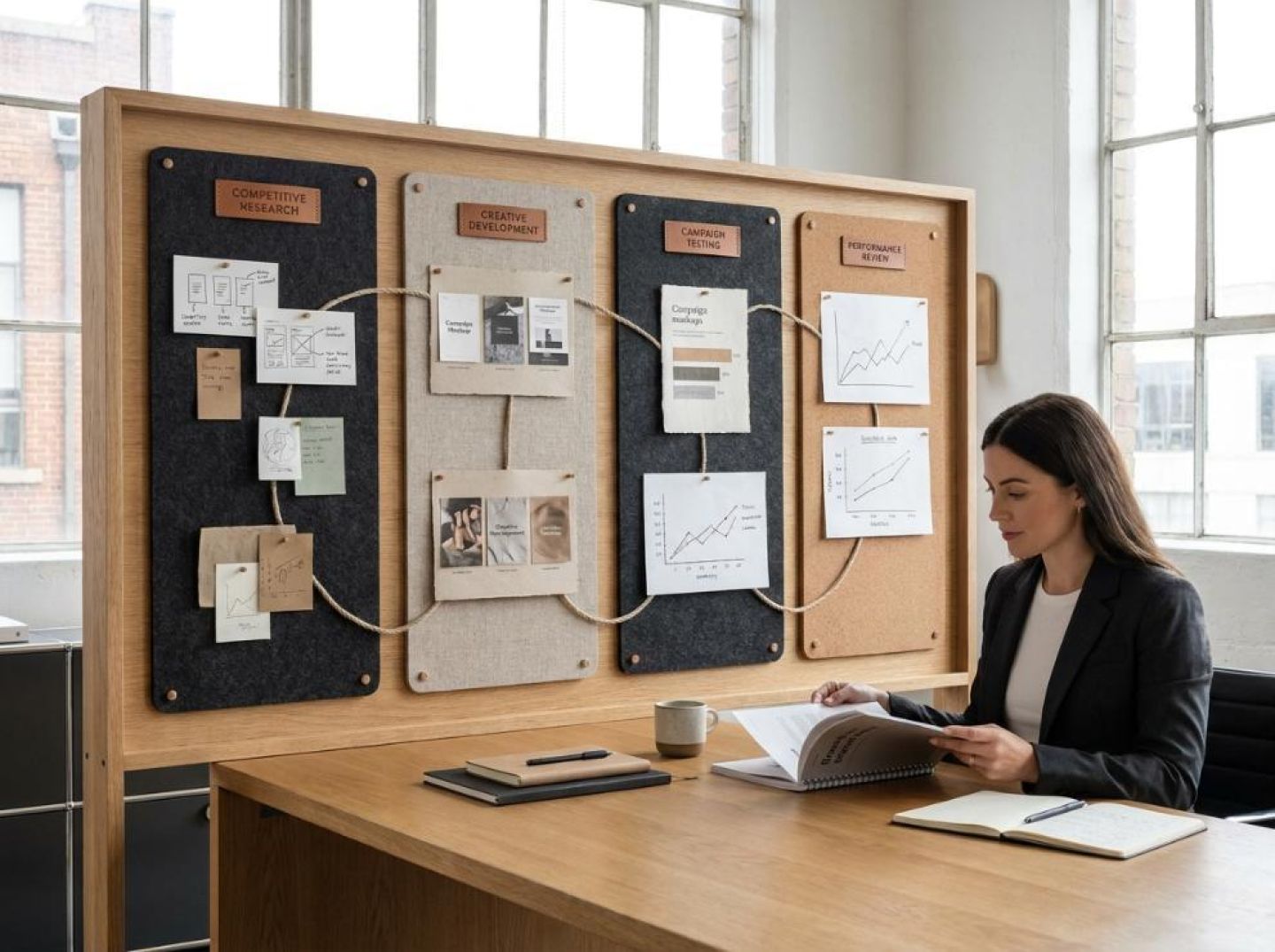
The final step is turning the creative strategy into a repeatable operating process.
A creative arbitrage machine does not require one perfect dashboard or a fully autonomous advertising platform. It requires a consistent system for gathering information, producing variations, evaluating results, and applying what the team learns.
Four layers make this process easier to manage:
Start by bringing the relevant campaign and creative information into a consistent reporting structure.
Where supported by the available integrations and permissions, collect:
The purpose is to connect creative decisions with their outcomes.
Omnichannel tools such as COOL AI are discussed in VideoWeek's coverage of efforts to break down agency silos.
Whether a team uses a commercial platform, reporting integrations, or a carefully maintained spreadsheet, the underlying requirement is the same: data should be organized consistently enough to support meaningful comparisons.
Do not assume every channel's metrics are directly interchangeable. Make sure the reporting framework accounts for differences in attribution, conversion windows, and campaign objectives.
A shared concept should make production more efficient, not make every advertisement identical.
Develop a workflow that allows teams to produce several genuinely different creative directions from one brief.
For example, a creative family might include:
The StoreYa case study on RenderTiger reports a 59% ROAS lift in one Meta account and describes test creatives reaching 5.51x compared with 3.47x for incumbent assets under the reported conditions. These figures should be understood as results from that particular study, not expected outcomes for every campaign. Read the RenderTiger case study.
The operational goal is to create a reliable process for developing and evaluating multiple creative directions.
A shared creative system needs clear ownership.
Every asset should follow a consistent creative taxonomy.
For example:
This makes it easier to compare related assets later.
A team might discover that a particular style of demonstration works well in one placement but performs poorly in another. That is a useful finding only if the creative assets are labeled consistently enough to identify the pattern.
Creative analytics should not be reserved for occasional campaign reviews.
Kroger's analysis of more than 1,900 assets across Meta and DV360, described in Marketing Dive's coverage of its predictive scoring work, illustrates how large creative libraries can be studied alongside conversion outcomes.
Tools such as DAIVID's creative-analysis products have also been discussed in VideoWeek's reporting on advertising and creative-analysis developments.
Teams can use this type of analysis, or a simpler internal process, to investigate relationships between creative elements and campaign results.
A useful operating rhythm could look like this:
Daily — Guardrails
Weekly — Pattern finding
Monthly — Strategic review
New advertising environments will continue to emerge.
TikTok's Out of Phone partnerships, discussed by Social Media Examiner, illustrate how social-originated creative can extend into physical environments.
When a new placement becomes relevant, the team should not need to invent an entirely new process.
Start with an existing concept, identify the placement's requirements, adapt the creative, and evaluate the results using an appropriate measurement approach.
For example, a strong TikTok hook might need to become a sound-independent visual message for a digital signage environment. That adaptation should be treated as a new creative test, not an assumed extension of the original campaign's performance.
Operationalizing creative arbitrage is ultimately about creating a repeatable system in which competitive research informs creative hypotheses, production turns those hypotheses into testable assets, and first-party results guide the next decisions.
Creative that travels is not about copying competitor advertisements or distributing the same asset across every available platform.
It is about developing a strong central idea, breaking it into meaningful creative components, and adapting those components to the environments where your audience encounters advertising.
Competitive ad intelligence helps marketers observe how advertisers present their offers, structure their messages, and adapt creative across visible placements. It provides research material and inspiration, not proof of private campaign performance.
Your own campaign data supplies the validation.
The most effective process connects four activities:
When these activities work together, one big idea can become much more than a single campaign. It can become a reusable creative system that helps your team produce better experiments, carry useful insights between channels, and make more informed decisions about where to invest next.
Receive top converting landing pages in your inbox every week from us.
Guide
One strong idea can do more than power a single campaign. Discover how to use spy data, creative testing, and performance insights to adapt winning concepts across social, video, search, native, CTV, and DOOH.
Dan Smith
7 minNov 13, 2026
In-Depth
Competitive ad research shows what advertisers are doing. AI agents can help turn those observations into structured decisions. Discover how to connect Anstrex-style intelligence, campaign data, automated execution, and human oversight in a practical media-buying system.
Rachel Thompson
7 minNov 12, 2026
Most Read
AI can produce hundreds of advertising variations, but more creative does not automatically mean better performance. Discover how to use competitive ad intelligence, Anstrex AI, and campaign data to build a repeatable creative feedback loop.
David Kim
7 minNov 12, 2026