12 minNovember 12, 2026

Our tools monitor millions of native, push, pop, and TikTok advertising campaigns.
Get StartedPerformance marketers have spent years collecting competitive intelligence: researching competitor advertisements, tracking landing pages, studying offers, and monitoring how brands position themselves across different traffic sources.
But collecting intelligence and acting on it are two different things.
An ad spy tool can help reveal what competitors are advertising. A media-buying agent needs to answer a more complicated question: given what is happening in the market and inside our own campaigns, what should we do next?
That is the next stage of advertising automation.
Agentic AI is moving beyond tools that simply summarize reports or generate recommendations. More advanced systems are being designed to interpret information, plan actions, and execute selected tasks through connected platforms and workflows.
For performance marketers, this creates an opportunity to connect competitive ad intelligence with campaign operations.
The objective is not to give an AI agent unrestricted access to advertising budgets. It is to build a controlled system in which market observations, first-party performance data, business objectives, and risk policies work together.
The result is a more connected approach to media buying: one that can identify market changes, recommend responses, test opportunities, and learn from the outcomes.
Performance marketers already spend considerable time studying their competitors.
They monitor advertisements, compare landing pages, investigate promotional offers, and look for changes in creative direction. Tools that make competitive advertising research easier have turned this activity into a regular part of campaign planning.
But there is still a gap between observing the market and making operational decisions.
Competitive intelligence answers questions such as:
An autonomous media-buying system must answer a different set of questions:
The missing link is not simply more information. It is the ability to translate information into controlled decisions.
Agentic AI has become an increasingly important topic in advertising and media buying.
The source article cites an IAB 2026 Outlook finding that 96% of buyers are aware of agentic AI for ad buying and that two-thirds are increasing their focus on it. These figures are attributed to MarTech's analysis of agentic media buying and its guardrails.
The broader shift is from systems that help marketers inspect information toward systems that can interpret information and carry out selected tasks.
For example, an AI system might:
Some emerging systems are also exploring more direct execution across buying environments.
Adweek's coverage of AI agents gaining access to advertising budgets discusses platforms and infrastructure providers working toward agent-driven media operations.
These developments indicate that advertising automation is expanding beyond isolated platform features. However, the exact capabilities, availability, and level of autonomy vary between products.
Traditional campaign reporting tells marketers what happened.
A dashboard might show impressions, clicks, conversion rates, cost per acquisition, and return on ad spend. The marketer then reviews the results, identifies a problem, and decides what to change.
Decision intelligence aims to connect those stages.
Instead of stopping at reporting, a system can analyze performance changes, investigate possible explanations, and recommend actions. Depending on its integrations and permissions, it may also execute approved changes.
illumin's overview of agentic AI in programmatic reporting explores this transition from reporting toward more action-oriented workflows.
Likewise, MarTech's discussion of deciding where to spend next describes the growing interest in AI-assisted media allocation and optimization.
The important distinction is that an agent's recommendation is not automatically correct. Its usefulness depends on the quality of its inputs, the objective it is optimizing, and the reliability of the measurement behind its decisions.
The distinction is straightforward:
Ad spying is observational. Agentic buying is operational.
An ad intelligence platform can help a marketer understand what is happening in the competitive environment. An agentic buying system needs to decide what action is appropriate for the advertiser's own business.
To bridge that gap, two requirements become essential.
Trustworthy signals: The agent needs reliable information about market activity, campaign performance, conversion quality, and business outcomes.
Explicit boundaries: The agent needs clear instructions about what it can change, how much it can spend, which policies it must follow, and when human approval is required.
This matters because an AI system can optimize perfectly against the wrong objective.
For example, an agent that is instructed to minimize cost per click may find inexpensive traffic that never becomes a customer. A system that optimizes for reported conversions may overvalue low-quality leads if the conversion events are inaccurate.
MarTech's discussion of agentic media-buying guardrails highlights the importance of traffic quality and security as automation moves closer to buying decisions.
Advertising measurement is also becoming more complicated as automated systems and AI agents interact with websites and digital services.
Not all non-human traffic is necessarily malicious. Some automated activity can represent legitimate research or transactions initiated by consumer-directed agents. Other activity may involve bots, fraudulent clicks, or invalid traffic.
AdExchanger's discussion of non-human audiences examines why advertisers may need to reconsider how they evaluate non-human traffic.
For an autonomous media buyer, this creates a quality-control challenge.
A system must not assume that every inexpensive click, recorded conversion, or unusual traffic pattern represents valuable demand. It needs to distinguish legitimate activity from suspicious or low-quality behavior using appropriate verification and measurement signals.
The real opportunity for performance marketers is therefore not to hand an AI system an advertising dashboard and let it operate without supervision.
It is to decide what information the system can trust and what actions it is allowed to take.
If your understanding of AI media buying is a chatbot that summarizes campaign reports, the technology is moving toward a more operational role.
Agentic systems are designed to perform sequences of tasks. They can observe information, evaluate possible actions, use connected tools, and report the outcomes.
Rather than relying on one general-purpose assistant to handle everything, a system may use multiple specialized agents that each manage a specific part of the workflow.
A single instruction such as "optimize my campaign" hides a large number of separate responsibilities.
A more specialized architecture might include:
Pacing agent
Monitors campaign spending against daily, weekly, and lifetime budgets. It identifies underdelivery or overspending and recommends adjustments within defined limits.
Bidding agent
Evaluates available performance data and recommends bid changes based on campaign objectives, acquisition costs, and business economics.
Creative agent
Organizes creative variations, identifies fatigue indicators, and prepares new concepts for testing.
Research agent
Monitors visible competitor advertisements, landing pages, offers, and changes in market activity.
Reporting agent
Combines information from connected sources and explains important changes in campaign performance.
These agents can work together through a coordinating system.
For example, a research agent might detect that several competitors have introduced a new offer. A strategy agent could assess whether that change matters to the advertiser. A creative agent might prepare alternative messages, while a media-buying agent evaluates whether a limited test is appropriate.
The system still needs reliable data and clear authorization before it can execute changes.
Traditional advertising automation often relies on fixed conditions.
For example:
These rules can be useful, but they only respond to conditions that someone has already anticipated.
Agentic systems aim to interpret a wider range of information and consider multiple possible actions.
For example, instead of simply reacting to a high CPA, an agent might investigate:
It can then recommend a more targeted response.
This does not mean every agent uses advanced reasoning or reinforcement learning. Capabilities differ, and many systems still depend on predefined rules, statistical models, or specific optimization methods.
The useful distinction is that the workflow can move beyond isolated triggers toward a more complete process of diagnosis, planning, and controlled execution.
As more specialized agents become available, an orchestration layer can coordinate their work.
A marketer might provide a high-level objective such as:
"Improve qualified lead generation while maintaining our acquisition-cost target and keeping spending within the approved monthly budget."
The orchestrator could then route tasks to different agents:
Some actions may be executed automatically. Others may require a human to review and approve them.
This is particularly important for decisions involving new offers, sensitive categories, large budget changes, legal restrictions, or brand positioning.
The source draft cites research into AI's role in streaming TV buying and notes that buyers are more comfortable using AI for planning and optimization than giving it complete control of campaign management. The cited source is AdExchanger's analysis of the stakeholders shaping AI in streaming TV.
The original source sentence ends before completing its comparison of buyer attitudes, so I have not supplied a missing percentage or completed the unfinished statistic.
In a more agentic advertising environment, marketers may spend less time performing repetitive adjustments and more time defining:
This does not remove the need for media-buying expertise.
It makes that expertise more important at the level of system design, objective setting, and oversight.
An autonomous media buyer needs more than platform pixels and last-click CPA.
It needs a structured view of the competitive environment, the advertiser's own campaigns, and the risks associated with the available data.
Competitive intelligence can provide valuable context, but raw screenshots and unorganized research are difficult for an agent to interpret consistently.
The solution is to organize the information into four layers:
Most competitive research begins with a simple question:
"What are competitors advertising right now?"
A more useful research dataset organizes the observations into relationships.
For example:
You can also record available delivery proxies, such as frequency of observation, visible geographic distribution, and changes in the number of creative variations.
The key is to distinguish actual measurements from estimates.
If a research tool provides an estimated spend range, label it as an estimate. If it only shows that an advertisement was observed repeatedly, record the observation rather than turning it into a verified impression count.
An agent should be able to distinguish between:
This prevents the system from treating every data point as equally reliable.
illumin's discussion of agentic AI in reporting provides useful context for the transition from passive reporting to structured decision intelligence.
The second layer organizes the actual creative.
Instead of storing advertisements as disconnected images and videos, classify them by their observable attributes.
Format traits
Concept tags
Offer construction
Visual motifs
CTA and positioning
You can tag an initial sample manually and use supported classification tools to help organize larger collections.
A vision-language model may also help identify visible creative attributes, but its labels should be checked for accuracy.
Once the dataset is structured, an agent can answer more useful questions:
"Show me the short-form product demonstration ads in this category that have appeared in the German market during the past 60 days."
The system can then use those examples to recommend creative directions or prepare briefs.
The objective is to understand the underlying creative structure without copying another advertiser's wording, brand identity, or distinctive creative assets.
An advertisement is only one part of a customer journey.
The destination page can reveal how the advertiser develops the offer after attracting attention.
Where publicly observable, organize landing-page information into categories such as:
This information can help an agent understand how different creative approaches connect to different destination-page experiences.
For example, a research system may observe that a competitor's educational video leads to a quiz-style landing page, while another advertiser sends similar traffic directly to a product page.
That creates a useful testing question:
"Should our next campaign test an educational pre-sell experience against a direct product page?"
It does not prove that the competitor's funnel has a higher lifetime value or conversion rate. Those outcomes require reliable performance data.
The distinction matters because visible funnel structures are observations, not private business results.
AdExchanger's analysis of AI in streaming TV buying discusses the importance of using AI to improve execution while retaining human ownership of strategy and accountability.
The fourth layer is often overlooked.
A useful media-buying system needs to identify not only promising opportunities but also information and actions that should be treated with caution.
Examples include:
Risk labels should be based on evidence and clearly defined rules.
For example, a landing page should not be labeled malicious merely because its design is unfamiliar. A traffic source should not be labeled fraudulent based only on inexpensive clicks.
Instead, use appropriate security checks, platform quality reports, independent verification, and first-party evidence.
The agent should be instructed to treat uncertain information differently from verified information.
This can be implemented through confidence labels, source records, and approval requirements.
Together, these four layers give an agent a more complete picture of the advertising environment.
| Data layer | Main purpose | Example use |
|---|---|---|
| Market graph | Understand competitor activity | Detect visible changes in channel and offer patterns |
| Creative genome | Organize creative attributes | Identify recurring hooks and formats |
| Funnel anatomy | Understand post-click experiences | Compare landing-page approaches |
| Risk and trust signals | Prevent unsafe decisions | Flag uncertain claims and suspicious destinations |
The competitive intelligence pipeline should also connect with the advertiser's own campaign data.
That may include platform reporting, conversion events, CRM outcomes, traffic-quality information, and business metrics, depending on available integrations and permissions.
The result is not a system that knows everything about competitors. It is a system that can combine observable market information with verified first-party results and make decisions within defined limits.
Turning competitive ad research into a system that can influence live advertising budgets requires more than a prompt and an automation tool.
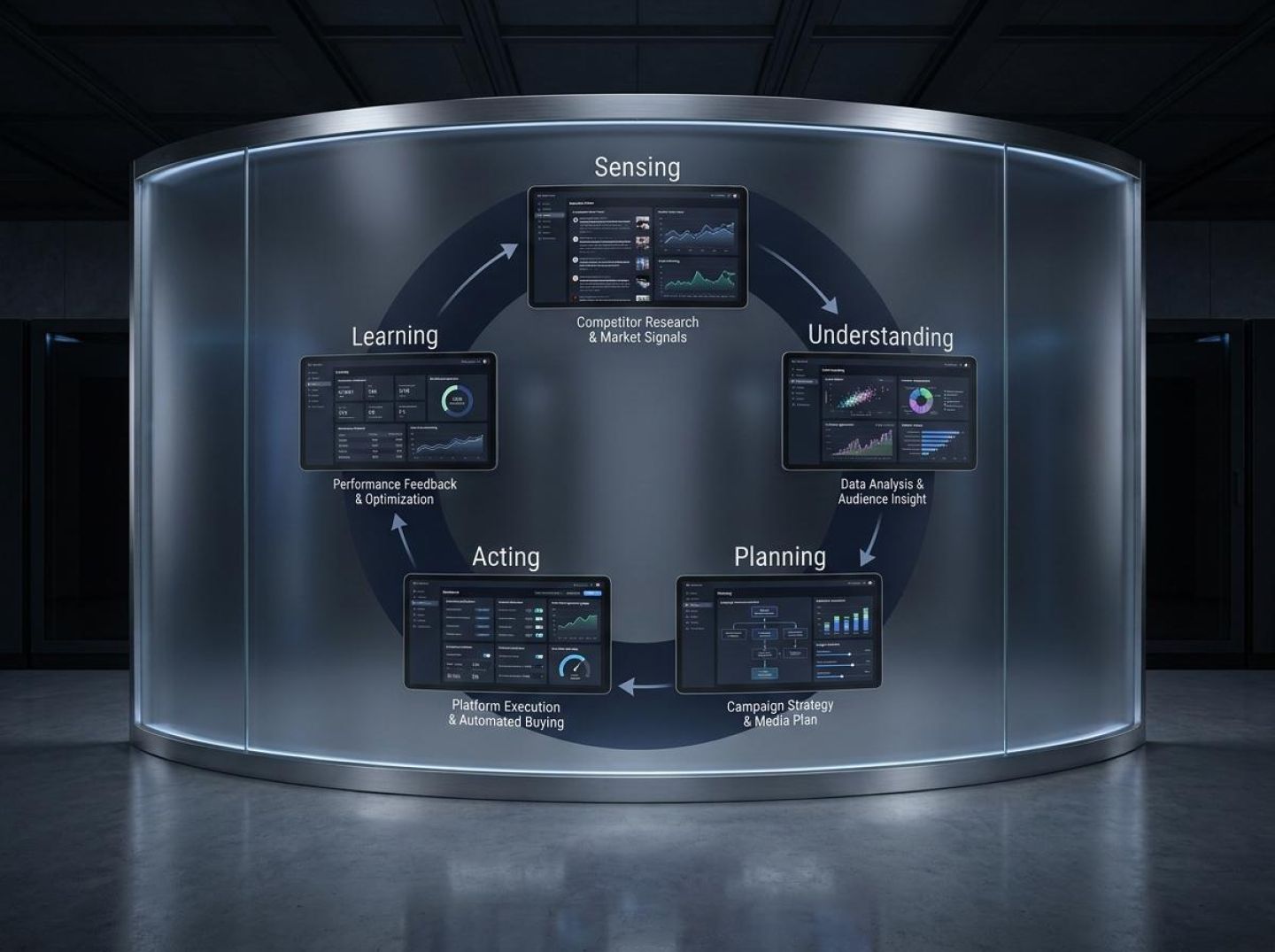
It requires an architecture that can collect information, interpret it, plan actions, execute approved changes, and evaluate the results.
A practical closed-loop architecture can be organized into five layers:
The sensing layer collects information from the systems the advertiser is authorized to access.
Potential sources include:
The objective is to create a consistent information structure.
For example, the system might connect:
Creative → Placement → Campaign → Audience → Landing Page → Outcome.
Not every field will be available for every source. A competitor's public advertisement may provide creative and destination information but not its private audience, budget, or conversion results.
The ingestion system must preserve those distinctions.
A competitive intelligence process similar to the one discussed in MarTech's guide to AI agents for marketing workflows can help organize monitoring across competitor pages, public updates, advertising libraries, and review sites.
That research can then be compared with the advertiser's own campaign information.
Collecting information is not enough.
The system needs to organize the information into meaningful categories and identify relationships.
This is where language models, classification systems, and search technologies can help.
For example, the system might group creative examples into themes such as:
It can also identify changes in visible market activity, such as new creative variations, different offers, or a competitor entering another geographic market.
These findings become a structured view of the competitive environment.
However, the agent should not describe a competitor as "winning" unless it has reliable performance evidence. A more accurate description might be:
"Competitor A has increased the number of visible creative variations using product demonstration messaging."
That is an observable finding.
The system can then suggest a hypothesis:
"Test a demonstration-first creative against our existing problem-solution approach."
This keeps observations and recommendations separate.
Once the agent has an organized view of the market and the advertiser's performance, it can begin proposing actions.
Potential recommendations include:
Each recommendation should include:
Objective: What business result is the action intended to improve?
Evidence: Which market observations and first-party results support it?
Hypothesis: What is expected to happen?
Risk: What could go wrong?
Budget: How much can the experiment spend?
Measurement: Which metrics will determine whether it worked?
For example:
"Test a product demonstration creative against the current testimonial creative for the same audience. Use the existing acquisition-cost target and limit the experiment to the approved test budget. Evaluate qualified conversions rather than CTR alone."
This is more actionable than simply telling an agent to copy a competitor's creative strategy.
This is where an agent moves from analysis into execution.
To make changes to live advertising campaigns, it needs authorized connections to the relevant advertising platforms or operational tools.
Depending on the available integrations, these may include:
Access should be limited to the actions required for the task.
For example, an agent might be allowed to:
It should not automatically receive unrestricted permission to change account settings, create new offers, access unrelated customer information, or spend beyond its authorized budget.
A central orchestration service can translate approved instructions into platform-specific actions and record what was changed.
Every action should have an audit trail containing:
After an action is executed, the system needs to evaluate what happened.
The learning layer collects:
The goal is to understand not only whether a metric changed, but also whether the action contributed to the intended business outcome.
For example, an agent may recommend moving budget toward a campaign with a lower reported CPA.
But if that campaign produces fewer qualified leads or lower customer value, the change may not improve the business.
The system should therefore evaluate decisions against the advertiser's actual objectives, not just one platform metric.
More advanced systems may use bandit algorithms or reinforcement-learning methods, but those approaches require suitable data, carefully defined reward functions, and safeguards against unstable or harmful behavior.
The core architecture remains the same: observe, understand, plan, act, and evaluate.
An AI agent that can analyze advertising data is useful.
An AI agent that can spend money requires a much more serious level of control.
The transition from competitive research to autonomous media buying is not just a technical challenge. It is also a governance challenge.
A reliable system needs to define what the agent is allowed to know, what it is allowed to change, and which decisions must remain under human control.
A practical framework has three layers:
Policy is the human-written foundation of the system.
It translates business, legal, brand, and operational requirements into instructions that an AI agent can evaluate.
Examples include:
A reliable internal source of truth can help keep these rules consistent across creative and media workflows.
MarTech's discussion of AI agents in marketing workflows provides relevant context for the importance of centralized information and consistent guidance.
For media buying, policy must also define which inventory, placements, audiences, and traffic patterns are acceptable.
The agent should not be allowed to override these restrictions simply because a campaign appears inexpensive or produces strong short-term results.
Parameters are the measurable constraints that determine how far the agent can explore.
Examples include:
These controls should be specific enough that the agent cannot interpret a broad objective as unlimited permission.
For example:
"Increase the daily budget by no more than 15% within the approved campaign. Do not exceed the campaign's total budget or change the account-level objective."
This is clearer than simply instructing the system to scale winning campaigns.
Permissions define what the agent can actually do.
For example, it may be allowed to:
But it may not be allowed to:
The distinction between recommendation and execution should be explicit.
An agent may be allowed to recommend a new campaign while requiring a human to approve its launch.
Human oversight should not be reduced to a checkbox.
It should be built into the actual decision process.
There are three important override moments.
1. Pre-action approval
Some decisions should require approval before execution.
Examples include:
The agent should provide its reasoning, supporting information, expected outcome, and risk assessment so the reviewer can make an informed decision.
2. Real-time kill switches
Even a system with strict initial permissions needs a way to stop activity quickly.
Provide clear controls at the relevant levels:
Automated tripwires can also pause execution when important thresholds are breached.
Examples include:
A kill switch should be tested before an agent receives meaningful spending authority.
3. Post-action audits
Every important autonomous decision should be explainable.
The system should record:
This creates an audit trail that humans can review and use to improve future policies.
There are situations where an agent should be stopped even when the immediate performance metrics look positive.
Data-quality exploitation
The agent may discover inexpensive inventory that receives overly generous conversion credit but produces poor-quality leads.
The correct response is to investigate the measurement problem, not simply increase spending.
Legal or brand conflicts
The agent may identify a tactic that reduces acquisition costs but conflicts with legal guidance, brand positioning, or market restrictions.
Human strategy must take priority.
Misinterpreting non-human traffic
The agent may overvalue activity from automated systems because it appears efficient in the reporting data.
Before scaling, the advertiser needs to understand whether the activity represents legitimate demand, invalid traffic, or something that requires additional verification.
Unsupported competitive assumptions
The system may infer that a competitor's long-running advertisement is profitable or that a change in visible creative activity signals a specific internal strategy.
These are not verified facts.
The agent should treat them as hypotheses until stronger evidence is available.
The central principle is simple: an AI system should not be allowed to optimize around a result that contradicts the advertiser's actual business interests.
An autonomous media buyer should not begin by controlling an entire advertising portfolio.
The safer approach is to introduce the system gradually, establish reliable measurement, and expand its responsibilities only when it demonstrates consistent performance.
The objective is to prove that the agent can improve decision-making without creating unacceptable financial, operational, or compliance risks.
Choose a manageable starting environment:
Give the agent a narrow set of responsibilities.
For example, it may monitor campaign pacing, prepare creative recommendations, or suggest budget adjustments without executing them.
Once the recommendations are reliable, you can allow it to perform selected low-risk actions within approved boundaries.
This is a more practical way to evaluate the system than giving it unrestricted authority from the beginning.
The source article cites Adweek's coverage of early agentic media-buying platforms when discussing limited deployments and human oversight.
Do not evaluate the pilot only by how many tasks the agent completes or how quickly it produces recommendations.
The central question should be:
"Can this system make better and more consistent decisions than our existing workflow without compromising the business?"
Measure outcomes such as:
Compare the results with an appropriate baseline.
Where possible, use controlled comparisons to distinguish improvements caused by the agent from normal changes in market conditions.
MarTech's analysis of AI-powered spend allocation reinforces the importance of evaluating media decisions based on business outcomes rather than simply increasing automation.
Once the system is operating reliably, connect it to a structured competitive research process.
The agent can monitor:
These observations can be delivered to the media-buying workflow as research signals.
For example:
This turns competitive research into a more continuous process.
It does not mean every competitor change should trigger a campaign adjustment. The agent should prioritize observations based on relevance, confidence, and potential business impact.
The pilot should not end with another dashboard.
The system should provide concise recommendations that explain:
For example:
"Competitor A has introduced a new visible product-comparison creative. Our existing comparison campaign has stable conversion quality but limited creative variation. Recommendation: prepare two differentiated comparison concepts and test them within the existing experiment budget. No budget increase is recommended until sufficient conversion data is available."
This is much more useful than an unexplained instruction to increase spending.
Once the initial pilot is reliable, expand gradually.
1. Channels
Move from one advertising environment to additional platforms and placements.
Each channel requires its own data integrations, campaign controls, reporting definitions, and policy checks.
The goal is not to make every platform operate identically. It is to coordinate decisions while respecting channel-specific requirements.
2. Markets and audiences
Expand into additional geographic markets using localized rules.
These may include:
Do not assume that an agent trained on one market's results can automatically make reliable decisions in another.
3. Depth of autonomy
Increase the agent's responsibilities only as the system demonstrates reliability.
A sensible progression is:
Structural decisions, new offers, major budget reallocations, and sensitive business changes may remain human-controlled even after the system becomes more capable.
The final stage is to integrate agent-assisted decision-making into regular team processes.
That means:
The marketer's role becomes less about manually adjusting every campaign setting and more about managing the intelligence, constraints, and decisions that guide the system.
The real advantage is not simply that an AI agent can work continuously.
It is that competitive research, campaign execution, and performance learning can become part of one connected operating process.
Competitive ad research has traditionally helped marketers understand what other advertisers are doing.
Agentic AI creates an opportunity to take that research further by connecting it to campaign planning, testing, and execution.
But autonomous media buying requires more than a large collection of competitor advertisements. It needs structured market information, reliable first-party performance data, clear objectives, and strict governance.
The practical workflow is:
Anstrex-style competitive intelligence can provide the market research foundation. Connected advertising and analytics systems provide the operational and performance data. AI agents can help coordinate the work, while human governance keeps decisions aligned with the business.
The future of performance marketing is not simply about giving AI control of advertising budgets.
It is about building a system that knows what it can trust, understands what it is trying to achieve, and operates within boundaries that protect the advertiser.
The advantage comes when competitive intelligence stops being something marketers merely observe and becomes information they can use to make better, controlled decisions.
Receive top converting landing pages in your inbox every week from us.
In-Depth
Competitive ad research shows what advertisers are doing. AI agents can help turn those observations into structured decisions. Discover how to connect Anstrex-style intelligence, campaign data, automated execution, and human oversight in a practical media-buying system.
Rachel Thompson
7 minNov 12, 2026
Most Read
AI can produce hundreds of advertising variations, but more creative does not automatically mean better performance. Discover how to use competitive ad intelligence, Anstrex AI, and campaign data to build a repeatable creative feedback loop.
David Kim
7 minNov 12, 2026
Recently Updated
AI can optimize campaigns using your own performance data, but competitive intelligence adds context about the market around you. Discover how to connect both through a practical system for observing competitor activity, testing hypotheses, and scaling validated playbooks.
Elena Morales
7 minNov 11, 2026