7 minSeptember 18, 2026

Our tools monitor millions of native, push, pop, and TikTok advertising campaigns.
Get StartedYour feeds can feel like they’re drowning in the same thing: slick, soulless “10 tips” posts, lookalike UGC, and carousel ads that read like they were written by the same bored robot.
You’re not imagining it. Cruddy AI‑generated content—what one panel of media leaders bluntly called “AI slop”—is flooding social platforms and ad networks. Algorithms are actively trying to throttle it, too: LinkedIn is now suppressing posts its systems flag as generic, hollow AI output, a crackdown that Neil Patel notes is already reshaping what performs on the platform.
If you’re a performance marketer, that should send a chill down your spine.
On one side, you’re under more pressure than at any point in the last decade: flat or shrinking budgets, rising CAC, and leadership teams demanding more revenue per impression. As one analysis of modern stacks puts it, performance marketing isn’t suffering from a lack of tools; it’s suffering from an inability to make the tools—and the data behind them—actually work harder together. On the other side, the easiest lever you’ve got—“just use AI to make more creatives faster”—is exactly what’s stuffing your channels with low‑trust, low‑CTR noise.
So why are some teams using the same underlying AI tech and quietly crushing it?
It’s not because they have a secret, better model. It’s because they’re feeding their models radically better inputs.
Most brand and agency workflows still treat AI as a glorified copy intern: open ChatGPT, paste a vague prompt, and hope something non‑embarrassing comes out. At best, they sprinkle in generic persona notes or a dusty messaging doc. The result is content that sounds “correct” but feels interchangeable—precisely the kind of thing platforms are starting to detect and demote as low‑quality AI.
Meanwhile, buried inside your browser tabs is the one ingredient almost no one is giving their models: live competitive intelligence.
Tools like Anstrex and other spy platforms sit on exactly the kind of signal that old‑school planning never had at this scale: which hooks your competitors are scaling, what angles survived split‑testing, how they’re rotating offers by funnel stage, and which placements they’re quietly pouring budget into. Competitive AI platforms already prove how powerful this signal is; systems like Polaris ingest auction‑level data—shifts in CPMs, placements, and geo concentration—and turn them into hypotheses about why a brand is winning before the rest of the market catches up, as recent reporting on competitive signals inside social auctions makes clear.
Performance marketers with spy tools are sitting on the same class of advantage—and most are leaving it on the table.
The real unlock isn’t adding “more AI” to your stack. It’s turning your competitive spy data into the AI’s source of truth, so it stops guessing from stale, generic training data and starts pattern‑matching against live, validated market winners. When you route those intelligence streams into your workflows, AI stops sounding like everyone else and starts sounding like the only team in your category that actually knows what’s working this week.
That’s the shift cutting through the AI‑slop era. As one practitioner‑focused guide to AI agents argues, the teams winning with automation are the ones grounding their agents in a consistently updated hub of brand, customer, and competitive intel, not just spinning up more prompts.
If you have access to tools like Anstrex and you’re still using AI as a blank‑page writer, you’re playing the hardest version of the game. Used right, that same AI can become your unfair advantage—the engine that turns raw spy data into conversion‑crushing creative that no generic model can touch.
Generic AI isn’t failing performance marketers because it’s “bad at writing.” It’s failing because it’s blind to context, competition, and consequence — the three things your job actually depends on.
Most large language models are trained to predict the next plausible word, not the next profitable decision. They remix a statistical average of the internet into something that sounds like “best practices.” That’s why so many AI‑written hooks, ad angles, and landing pages feel interchangeable. They’re not wrong; they’re weightless.
Platforms are starting to treat that weightlessness as a quality problem, not a quirk. LinkedIn has gone so far as to label the flood of polished‑but‑empty content “AI slop,” and its new algorithm changes are explicitly designed to suppress posts that look generic or automation‑generated, limiting their reach beyond your immediate network, as LinkedIn’s own product team explained. In other words: the exact kind of content generic AI is best at producing is the kind of content the distribution pipes are learning to ignore.
That’s a death sentence for performance marketing, where distribution and differentiation are non‑negotiable. When your ad, email, or landing page reads like it could have been written by any brand in your category, algorithms and humans treat it the same way: they skim past it.
AI systems themselves are starting to filter for this sameness. When generative engines choose which sources to cite or recommend, they prioritize material that offers something they can’t synthesize from their own training data. As one AI strategist puts it, if you can swap your brand name with a competitor’s and the asset still makes sense, it’s generic — and there’s no reason for AI to surface it over anyone else’s work, because it adds nothing beyond what the model can already generate on its own, a point Social Media Examiner underlines. That same logic applies to the content you publish and the creatives you launch: if an untrained model could plausibly have written it, why would a platform favor it or a prospect remember it?
For performance marketers, generic AI also fails at the moment of decision. A model can happily spit out “5 angles for a spring promo” or “10 TikTok hooks for DTC skincare.” What it can’t see — unless you force‑feed it — is the live auction environment, your category’s shifting cost curves, or where competitors are quietly winning. Competitive signals like sudden CPM drops, changes in placement mix, or a rival’s move into a new geography are invisible to a default chatbot, even though they’re exactly the kind of clues modern auction markets expose first. Those are the signals that specialized tools like Polaris AI are built to capture and interpret in real time.
This is where most “AI for marketers” workflows break. You open a blank chat window, ask for “high‑converting copy,” and get something that would work just as well for your closest competitor — because the system has no embedded understanding of:
Without that, AI becomes a template factory. It can help you do more of what everyone else is already doing, faster, which is precisely the treadmill LinkedIn’s detection team is now penalizing and AI recommendation systems are learning to ignore.
Meanwhile, marketers who are winning with AI are doing something very different. They’re feeding agents a structured “source of truth” about their brand, offers, and competitors, then using those agents to monitor rival landing pages, ads, and pricing changes on a weekly cadence. One team that adopted a competitive intelligence agent — configured to track product updates, review sites, and ad libraries — found it could turn what used to be a quarterly research slog into a continuous feedback loop, freeing a week of human time every month and preventing their agents from drifting into off‑brand or generic output, as one CMO described in.
The gap is no longer between “AI” and “no AI.” It’s between marketers who let generic models guess in a vacuum, and those who wire AI directly into the noisy, high‑stakes reality of their auctions, creatives, and competitors. The former get AI slop. The latter get leverage.
Meanwhile, marketers who are winning with AI are doing something very different. They’re feeding agents a structured “source of truth” about their brand, offers, and competitors, then using those agents to monitor rival landing pages, ads, and pricing changes on a weekly cadence. One team that adopted a competitive intelligence agent — configured to track product updates, review sites, and ad libraries — found it could turn what used to be a quarterly research slog into a continuous feedback loop, freeing a week of human time every month and preventing their agents from drifting into off‑brand or generic output, as one CMO described in.
The gap is no longer between “AI” and “no AI.” It’s between marketers who let generic models guess in a vacuum, and those who wire AI directly into the noisy, high‑stakes reality of their auctions, creatives, and competitors. The former get AI slop. The latter get leverage.
Most performance teams responded to the “AI slop” problem by buying more tools instead of fixing their data. Dashboards, copy generators, “creative copilots,” audience analyzers—your stack probably grew faster than your revenue. The result is exactly what you’re seeing in feeds: everyone using the same generic prompts on the same generic models, drawing from the same generic web.
The issue isn’t that your AI stack is too small. It’s that it’s under‑fed with the one ingredient foundation models don’t have: live, structured evidence of what’s actually working for you and your competitors.
Ad intelligence was supposed to solve this. Yet most of it is still “built for a pre‑AI world,” optimized for static reports instead of real‑time decisions. As one analysis of modern ad intelligence pointed out, the real breakthrough is when a marketer can ask, in plain language, which competitors suddenly ramped CTV spend in a specific country, how that differs by market, and which creatives backed the shift—and get an answer in seconds, not days, because the underlying data is unified and queryable across channels and markets, not a patchwork of partial exports and screenshots. When that unified foundation exists, AI stops being a glorified summarizer and becomes a multiplier.
Without that foundation, however, your AI simply accelerates bad analysis. Feed a model vague, outdated, or incomplete inputs and you’ll get beautifully worded, confidently wrong recommendations. This is exactly how you end up with “best practices” that ignore the fact that your top‑spending rival just pulled out of YouTube in Germany, or that their CTR spikes only when they pair a certain hook with a specific offer. The model can’t see any of that unless you show it.
Spy data—done right—is that missing fuel. Not just “competitor inspiration,” but structured, time‑stamped evidence: which brands are increasing spend on which channels, what creative formats they’re betting on, which value props they repeat, when they rotate offers, how they localize, and how all of that shifts when market conditions change. On its own, this is interesting but overwhelming. Plugged into your AI stack, it turns generic copilots into situation‑aware operators.
This is the same logic behind the rise of “expert‑backed AI.” As one breakdown of productized expertise argues, generic AI is commodity; people will pay for tools where the model is constrained by a specific expert’s frameworks, decision trees, and lived experience, so the output mirrors tested methodology rather than vague “standard advice” you could get anywhere. These expert‑backed systems shift AI from education (“here’s how you might think about it”) to implementation (“here’s what to do in this scenario”).
Competitive spy data does for performance marketing what those expert frameworks do for consulting. Instead of asking a base model, “Write five hooks for our new product,” you’re asking, “Given this week’s competitive spend in our category, the top three angles our rivals are running, and the creatives they’ve saturated, generate hooks that:
Now your AI is not hallucinating strategy from the ether; it’s triangulating between your performance data and a live view of what’s happening in the market.
This matters even more as platforms start to punish sameness. LinkedIn, for instance, is now actively suppressing “polished‑sounding, generic, and hollow” AI content—what its VP of Product labeled “AI slop”—by limiting its ability to travel beyond a user’s immediate network. Their detection systems were trained to spot posts that lack original perspective and to choke distribution accordingly. The lesson is bigger than LinkedIn: platforms and AI recommenders alike are learning to recognize their own generic output and down‑rank it.
To win in that environment, you can’t feed your AI the same fuzzy “write like a DTC brand” prompts as everyone else and hope for the best. You need inputs that the model itself could never scrape from the open web: high‑fidelity, cross‑channel competitive data blended with your own account history. That’s what turns “yet another AI tool” into an edge: not more automation layered on top of dashboards, but a shorter, smarter path from spy signal to creative decision.
Most “AI slop” isn’t caused by the model. It’s caused by what you feed it.
If you give a general‑purpose model vague prompts and the open web, it will do exactly what it’s designed to do: average. You’ll get something pleasant, plausible, and totally forgettable. That’s a liability now that platforms like LinkedIn are explicitly suppressing generic AI content that lacks original perspective or expertise, limiting its reach beyond your immediate network, as Laura Lorenzetti explained in LinkedIn’s announcement. In other words: if your AI sounds like everyone else’s AI, the algorithm will bury you.
The way out is to stop treating the model as the “expert” and start treating your competitors’ funnels as that expert.
This is where spy data changes the game. Competitive intelligence tools that surface auction signals, funnel flows, creative performance, and spend efficiency across channels are already translating noise into strategy. When platforms like Polaris AI aggregate CTR, CPM, share of voice, and spend efficiency, then map them to shifts in placements and geos, they can infer why one brand is quietly out‑buying the rest of the category, as described in their analysis of insurance competitors. That pattern recognition is exactly what your AI is missing.
The move is simple but profound: treat your top competitors’ live funnels as the “expert framework” your model must obey.
Instead of prompting “Write a high‑converting ad for our SaaS,” you build a structured brief from hard data:
Then you wire that into the model as constraints, not suggestions:
You’re no longer asking the model to imagine what “good” looks like. You’re handing it a working theory of the category, backed by observed auction performance.
This is the same principle that experts are using to build “expert‑backed AI” products. When Kelly Sinclair talks about embedding tested frameworks and decision trees into AI tools so clients use an expert’s thinking instead of generic best practices, she’s describing a process where the model is constrained by a proven methodology rather than left to freestyle, as outlined in her discussion of bot squads and expert‑backed AI. You’re doing the same thing—only your “expert” isn’t a guru; it’s the aggregate behavior of the most efficient buyers in your market.
The result is content that looks and behaves nothing like AI slop:
That’s exactly the kind of originality‑plus‑expertise blend that platforms say they’ll reward. LinkedIn has been explicit that AI‑assisted content is welcome when it carries authentic expertise or meaningful contribution, and that brands who combine AI efficiency with real subject‑matter depth will gain a distribution edge as its algorithm matures, according to their strategy breakdown.
Most marketers respond to “AI underperforming” by shopping for another agent or plugin. But as one recent analysis of performance stacks pointed out, the real constraint isn’t the model; it’s the data foundation you give it, and whether that data is operationalized into strategic decisions instead of sitting in disconnected tools, as argued in a piece on making your stack work harder, not bigger, for enterprise performance teams.
Turning competitor funnels into expert‑backed AI is how you fix that. You’re not asking the model to invent a strategy. You’re forcing it to reason inside the lines drawn by the best operators in your category—then adapt that playbook to your brand, your offer, and your constraints.
That’s how you move from AI that sounds like a blog post to AI that behaves like a strategist.
If Section 3 was all about mindset, this is where we get into the wiring diagram.
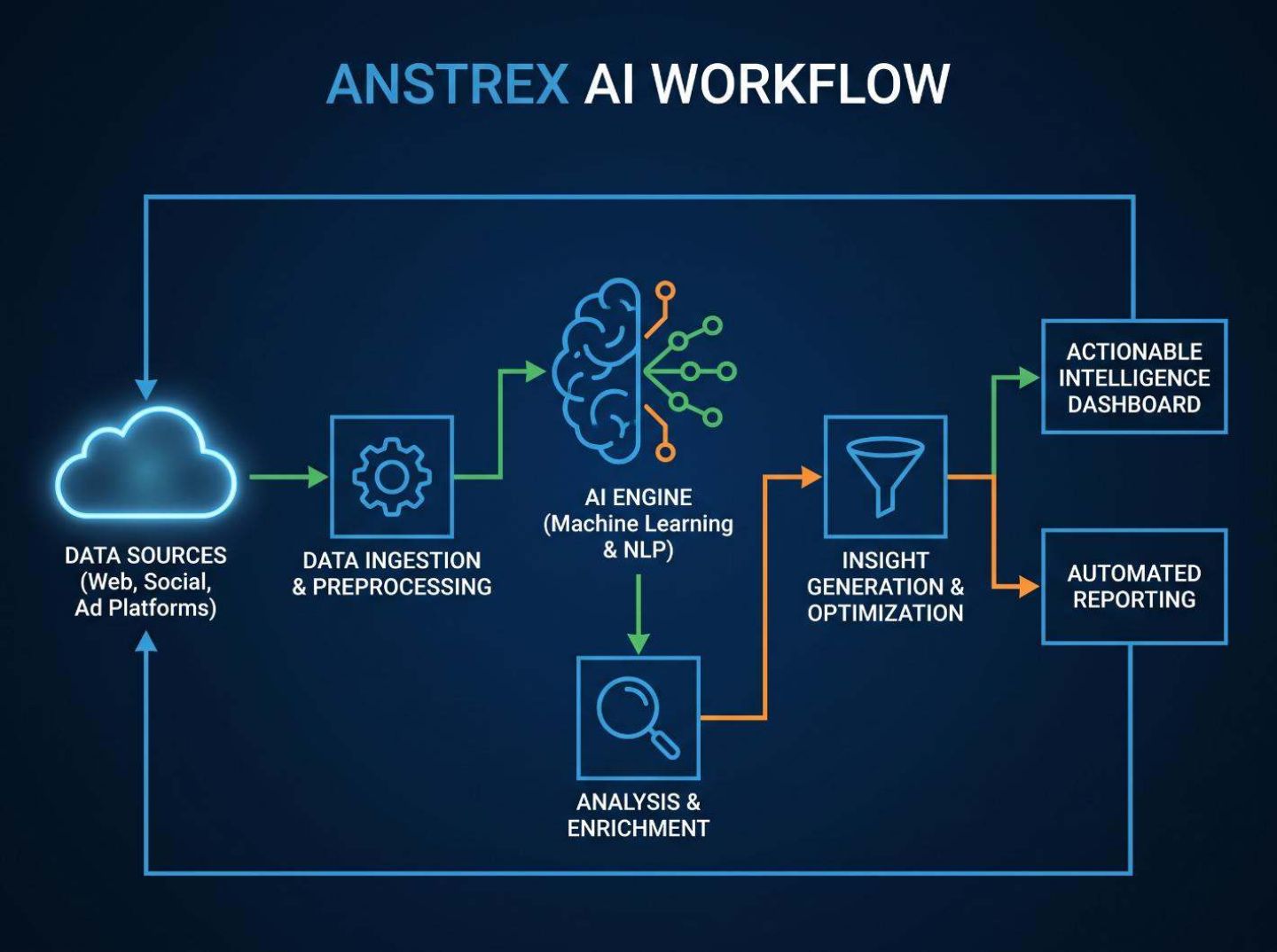
The goal is simple: turn Anstrex spy data into the “expert” your AI listens to, so you stop getting generic “best practices” and start getting copy and creatives that feel like they were ripped out of your competitors’ winning funnels—without actually copying them.
Below is a practical workflow you can plug into your existing stack.
Most performance teams make the same mistake: they open ChatGPT, paste a single ad, and say “rewrite this for my product.”
That’s how you get AI slop.
Instead, you want to do what modern AI ops teams do with their own brands: create a structured, always‑on “source of truth” that AI can reason over. When one marketing leader rolled out three AI agents, they only saw gains after they built a unified, well‑maintained knowledge base with positioning, product details, and competitive intel that every agent pulled from, as MarTech notes.
You’re going to build the competitor version of that from Anstrex.
For each chunk, ask AI to summarize what this funnel is doing, not just what it says. You’re extracting strategy, not sentences.
3. Turn those patterns into a reusable brief.
Combine the summaries into a structured document:
This becomes your “Competitor X Playbook.” Store it where your AI tools can access it—vector database, custom GPT, or a simple internal doc you paste in before big tasks.
Now, every time you prompt, you’re not asking the open web what “usually works.” You’re telling AI: “Here’s how the winners in this niche actually acquire customers. Work inside those constraints.”
Platforms are explicitly suppressing content that looks like it was cranked out of a generic AI tool. LinkedIn, for example, is downgrading polished‑sounding but hollow posts that lack original perspective, limiting their reach beyond first‑degree connections, as Neil Patel reports.
The fix isn’t “hide that it’s AI.” It’s “feed it better context.”
When you’re generating ads or landing copy, structure your prompts in three layers:
2. Input: Your constraints.
3. Output: Clearly defined deliverable.
That last condition is crucial. One strategist points out that if an AI can swap your brand for a rival and nothing breaks, the content is generic—and modern AI rankers have no reason to favor it, as Social Media Examiner explains.
You’re literally telling the model: “Be specific enough that I’m not interchangeable.”
Finally, use Anstrex data not just as inspiration but as the grading rubric for your AI.
3. Close the loop with performance data.
As you run these creatives, feed your own CTR, CVR, and ROAS back into the same system. Over time, you’re no longer just copying what Anstrex shows you; you’re training an internal, expert‑backed AI that knows:
That’s how you move from “AI that paraphrases the market” to an always‑learning system that uses competitor spy data as a starting point—and your performance data as the final authority.
If you’re going to wire AI directly into your competitive intelligence, you need one mantra burned into your brain: “Steal signals, not sentences.”
The lazy version of AI‑assisted spying is obvious and dangerous. You scrape the top creatives in Anstrex, paste a few into ChatGPT, and say, “Write me something similar for my offer.” The model obliges, sandblasts away anything distinctive, and hands you a Franken‑ad that’s ethically dubious, strategically shallow, and increasingly likely to get suppressed by platforms that are now actively downgrading generic AI content.
On LinkedIn, for example, posts that trip its “AI slop” detectors are no longer promoted beyond a user’s immediate network; the algorithm is explicitly targeting polished‑but‑hollow AI content that lacks original perspective, according to a recent update from Neil Patel’s team. You might not get banned, but you’ll be shouting into a void. The same dynamic is emerging across the ad ecosystem, where executives describe low‑effort AI content as the opposite of “premium,” even as they concede that AI is now embedded in almost every part of media production, as recent coverage in AdExchanger points out.
So the first trap to avoid is ethical: outright copying.
If your Anstrex‑to‑AI workflow is producing creatives that mirror competitors’ hooks, structure, and even phrasing, you’re not “leveraging market intelligence.” You’re plagiarizing. Beyond the legal and reputational risk, this is strategically self‑defeating. You’re flattening your advantage down to whatever already works for the incumbent instead of building a differentiated position AI can amplify.
Instead, you want to do what competitive intelligence platforms like Polaris AI do at the auction level: capture signals and translate them into hypotheses, not replicas. Polaris doesn’t care that a Progressive banner says “Save 20% in minutes”; it cares that CPMs are falling, that spend is shifting toward certain placements, that a specific geography is heating up. Those patterns become a theory about why Progressive is out‑buying competitors, not a brief to copy their taglines, as described in a recent AdExchanger feature.
Your Anstrex workflow should work the same way. When you feed creatives to an AI model, your prompt should sound like a strategist, not a counterfeiter:
Then, crucially, you anchor the model in your own assets and point of view. You’re not asking, “Make me Progressive.” You’re asking, “Given the patterns above and my brand’s unique angle, what’s the sharpest way for us to enter this conversation?”
That’s also how you avoid the second trap: becoming yet another source of generic AI output the ecosystem starts to ignore.
AI‑driven surfaces—search, recommendation systems, copilots—are increasingly tuned to reward content that offers something models can’t hallucinate on their own. As one breakdown of AI recommendation behavior notes, if someone can swap your brand name with a competitor and the content still works, AI has no reason to favor it over anything else in its training set, a point emphasized by Social Media Examiner’s analysis of how to get AI to recommend your business.
If your ads are thin remixes of competitor language, you fail that test instantly. There is nothing uniquely “you” in there for algorithms—or humans—to latch onto.
The antidote is expert‑backed AI: encoding your own frameworks, customer insights, and contrarian beliefs into the system so it consistently produces perspective, not just prose. As Social Media Examiner’s coverage of “bot squads” makes clear, the real value of expert‑powered tools is that they embed a distinct way of thinking into the workflow rather than regurgitating generic “best practices” that anyone’s bot could spit out, which is exactly how Kelly Sinclair defines the difference.
Competitor spy data should sharpen that expert lens, not replace it. Use Anstrex to see what the market is rewarding; use your own methodology to decide how you’re going to respond.
The last trap is strategic dependence: letting competitor behavior become your roadmap.
Auction‑level intelligence shows how quickly strategies can shift. A drop in a rival’s CPM or a sudden pivot into new placements may look like a winning move from the outside, but it could be driven by a short‑term promo, a misread test, or internal politics. When you feed those moves directly into AI and ask it to “optimize like them,” you’re building reactive, second‑order strategies on top of potentially noisy signals.
A more robust approach is to treat competitor data as constraints and guardrails, not instructions:
Now the model is helping you zag where others zig. You’re using AI to interrogate the competitive field and then weaponizing your difference, not your sameness.
In a world where platforms are actively suppressing “AI slop,” where premium is being redefined around engagement and authenticity, and where AI recommendation engines favor content that adds net‑new value, the winning play is clear: resist the urge to copy and paste. Treat competitor spy tools as radar, not a photocopier, and use AI to turn what you see out there into something only your brand could have written.
Receive top converting landing pages in your inbox every week from us.
Featured
Testing only inside Google Ads and TikTok can hide platform bias, attribution problems, and misleading performance signals. This guide shows how to combine spy-tool intelligence with controlled experiments across Google, TikTok, Native, Push, and Pops to identify which creative and funnel patterns actually drive incremental results.
Priya Kapoor
7 minSep 18, 2026
Editor’s Pick
Generic AI output is becoming easier to recognize and harder to differentiate in performance marketing. This guide shows how to turn competitor spy data into structured AI inputs, build expert-backed creative workflows, and generate original ads that use market intelligence without copying competitors.
Marcus Chen
7 minSep 18, 2026
Must Read
AI-powered ad platforms can optimize campaigns efficiently while quietly steering budgets toward narrow, platform-defined outcomes. Learn how to use Anstrex as an outside-in audit layer to uncover machine bias, compare real market behavior, and build AI media plans with stronger guardrails, audit loops, and human overrides.
Liam O’Connor
7 minSep 16, 2026