9 minOctober 31, 2026

Our tools monitor millions of native, push, pop, and TikTok advertising campaigns.
Get StartedYou've probably heard the promise: activate Demand Gen, Performance Max, and Smart Bidding, and Google's AI will find your best customers while you sleep.
The promise is appealing, and these campaign types offer powerful automation. Demand Gen can reach audiences across visual and discovery-focused Google environments, while Performance Max helps advertisers access multiple Google inventory surfaces through a unified campaign. Smart Bidding uses auction-time signals to adjust bids according to the advertiser's selected objectives.
But there's a problem that automation cannot solve on its own.
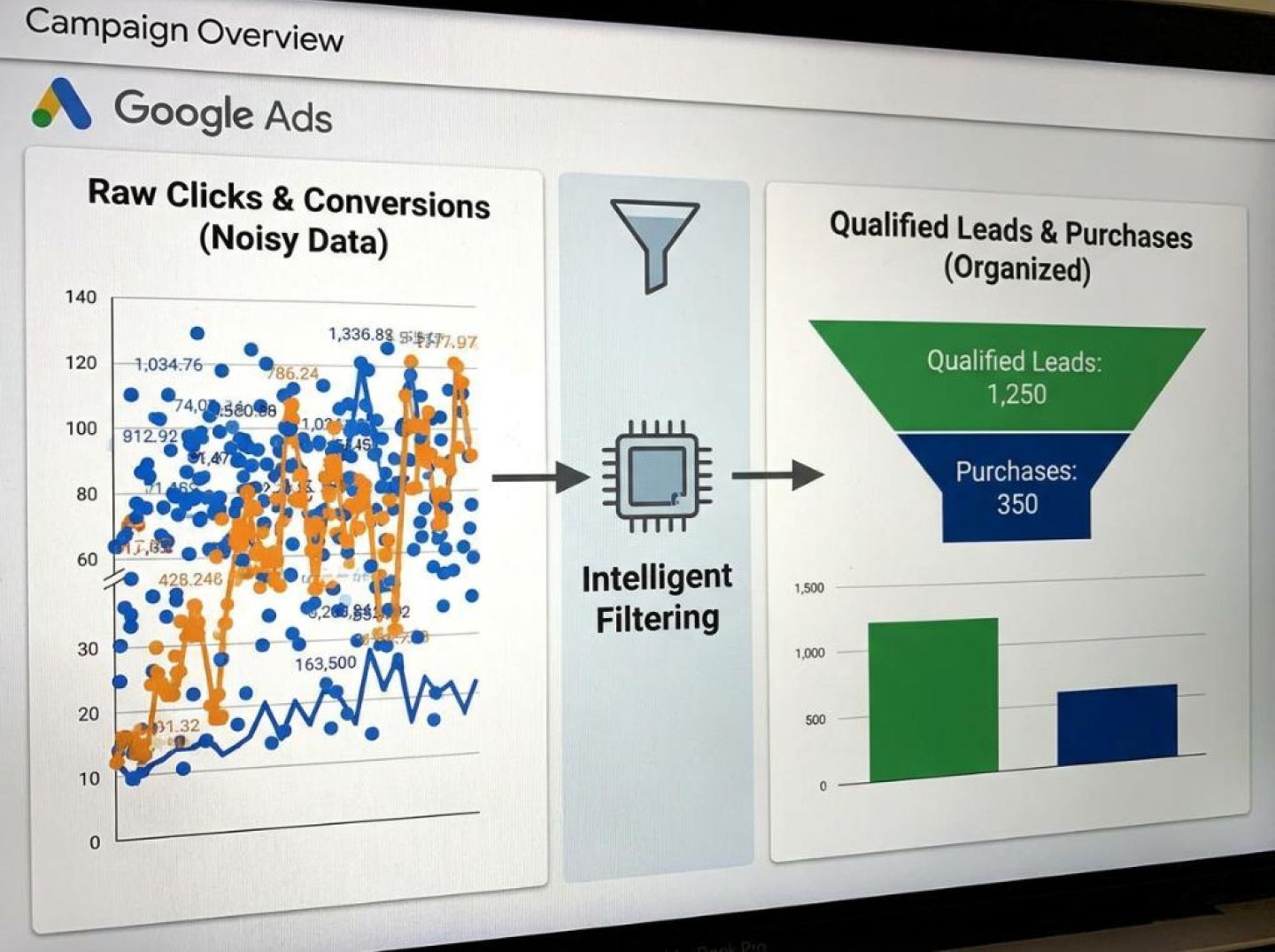
When your conversion data is weak, noisy, or misleading, Google's algorithms can optimize toward the wrong outcomes.
Imagine an account that counts purchases, qualified leads, newsletter subscriptions, accidental button clicks, and duplicate form submissions as equally valuable conversions. The bidding system may see a growing number of successful actions, but the business may see very little improvement in actual revenue.
The algorithm isn't necessarily making a mistake. It's responding to the success signals it has been given.
This is one of the biggest challenges in modern PPC: as advertising platforms become more automated, the quality of your conversion architecture becomes increasingly important.
A campaign can generate impressive click-through rates, lower reported acquisition costs, and more conversions without necessarily attracting better customers.
So how do advertisers improve the signals behind their campaigns?
One overlooked resource is competitive ad intelligence.
Ad spy tools are often treated as creative research platforms: places to discover competitor advertisements, explore landing pages, and collect headline ideas. But they can also help advertisers investigate how other businesses structure their offers, qualify prospects, and guide visitors toward meaningful buying actions.
Tools such as Anstrex provide an external view of advertising activity that can complement your internal Google Ads data.
By studying competitor messaging, landing pages, and funnel structures, you can develop better hypotheses about customer intent and improve the way your own campaigns distinguish valuable conversions from low-intent activity.
The goal isn't to feed competitor data directly into Google's AI. It's to use market intelligence to make better decisions about the signals your campaigns should optimize toward.
Demand Gen, Performance Max, and Smart Bidding are built around automation, but automation still depends on information.
Google's systems use available conversion data and other contextual signals to determine which auctions, audiences, and opportunities are most likely to achieve an advertiser's objectives.
Google's official overview of Demand Gen campaigns explains how these campaigns reach audiences across YouTube, Discover, Gmail, Maps, and other visual surfaces. Its Demand Gen product updates also illustrate how Google is expanding creative, product-feed, and measurement capabilities.
The underlying assumption is straightforward: provide enough meaningful conversion information, and the system can identify patterns associated with successful outcomes.
The challenge is that many advertisers aren't measuring success as accurately as they think.
A platform can report conversions with impressive precision while the business struggles to connect those events to actual revenue.
For example, an advertiser might track:
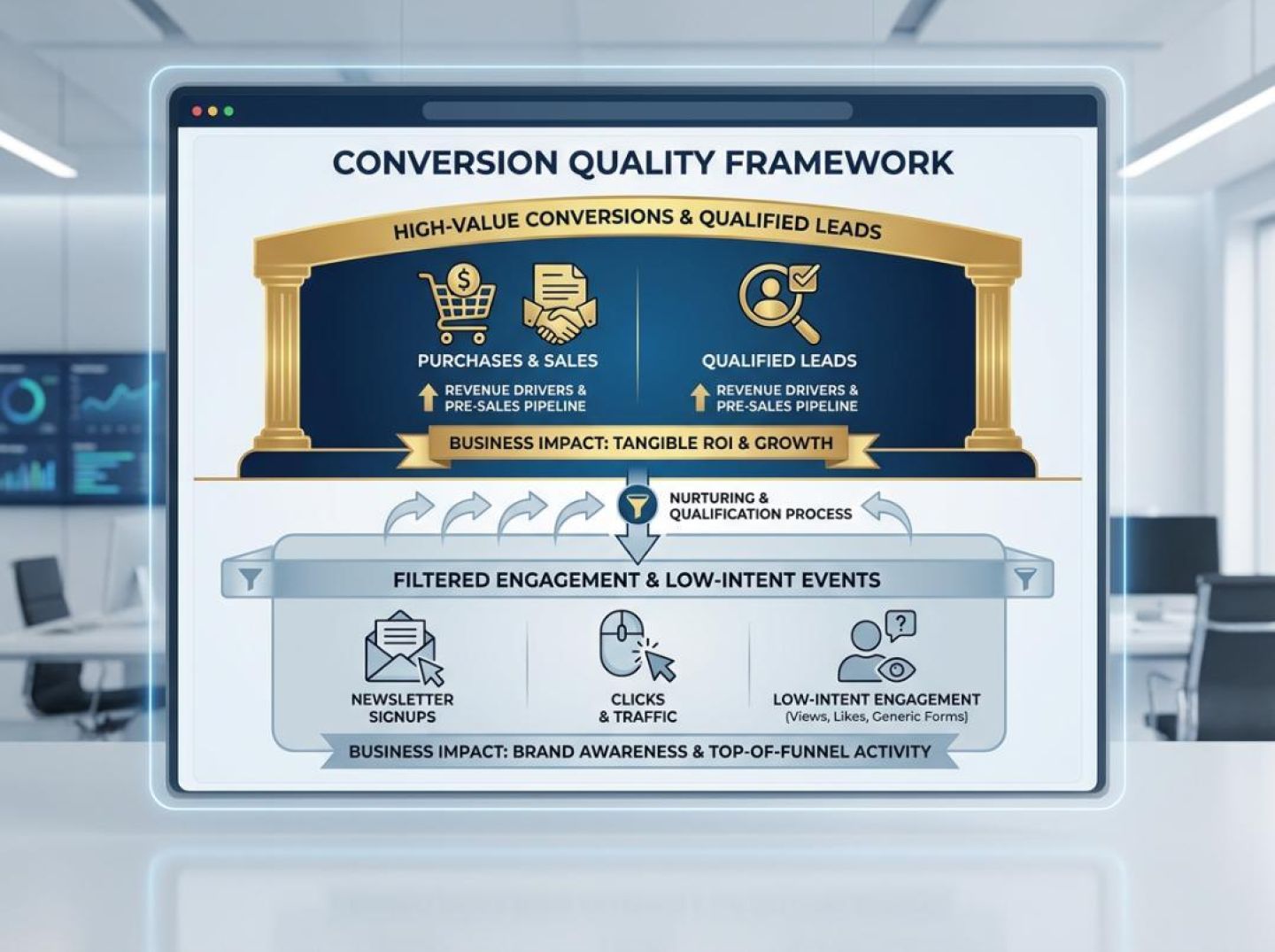
These actions represent different levels of commercial intent.
A newsletter subscription may indicate interest, but it isn't equivalent to a purchase. A form submission may create a sales opportunity, but it doesn't guarantee that the lead is qualified.
If these events are configured carelessly as primary bidding goals, the system may prioritize the actions that are easiest to generate rather than the ones that create the most business value.
This is why conversion architecture matters.
Advertisers need to distinguish between events that help them understand the customer journey and events that should directly guide automated bidding.
Modern advertising platforms can generate and deliver many creative variations across different audiences and placements.
This creates opportunities for relevance, but it can also make performance interpretation more complicated.
In The Paradox of Personalization: Billions of AI-Tailored Ads Creates a Measurement Mess, Erez Levin examines how extreme creative personalization can make it harder to understand advertising effectiveness at a broader level.
When creative, audience, placement, and bidding decisions change simultaneously, advertisers may struggle to understand which factors actually contributed to an outcome.
A dashboard might show that a particular combination generated conversions, but it may not provide enough information to establish whether the result came from the creative, audience, placement, offer, or an existing demand pattern.
This is especially important when a campaign is expected to achieve multiple objectives.
A campaign designed to generate awareness, introduce a new product, and close purchases is doing several different jobs. Judging all of those activities through one short-term conversion metric can hide important differences in performance.
Customer discovery doesn't happen exclusively through traditional search engines anymore.
People increasingly use AI assistants, social platforms, video content, and other discovery environments to research products and services.
A Search Engine Journal report on ChatGPT access and traditional search behavior summarizes research finding that broader access to ChatGPT Search was associated with a reduction in traditional search queries, with the decline reaching 17% after 20 weeks in the studied population.
This creates a more complicated journey between initial awareness and eventual purchase.
A potential customer might:
If your reporting only focuses on the last measurable interaction, you may underestimate the contribution of earlier touchpoints.
Historical campaign data can also become less representative as customer discovery habits change.
That doesn't mean search advertising has lost its value. It means advertisers need to understand how their campaigns fit into a broader customer journey.
Google has continued to develop its measurement and reporting capabilities, including cross-channel measurement approaches and tools such as Meridian.
Its Demand Gen product updates describe features such as Campaign Type Attribution and Uplift Experiments, which are intended to help advertisers understand campaign contributions and relationships between campaign types.
However, more detailed reporting cannot repair a poorly configured conversion system.
If the underlying conversion action is misleading, a more sophisticated dashboard may simply make the misleading result easier to observe.
The underlying problem can be summarized in four points:
The result is an account that may look healthy while customer quality, revenue, and long-term growth remain stagnant.
This is where competitive ad intelligence becomes useful.
Your Google Ads account shows what happens within your own campaigns. Competitor research helps you investigate how other advertisers present their offers, structure their funnels, and guide customers toward different actions.
That external perspective can help you challenge assumptions about what meaningful intent looks like in your market.
Smart Bidding doesn't need to understand your entire business to optimize a campaign. It needs to identify patterns associated with the conversion goals you've configured.
That distinction is important.
If your primary conversion goal is a purchase, the system can use purchase-related signals to pursue that outcome.
If your primary conversion goal is a button click, it may instead learn to find people who are more likely to click that button.
The platform is optimizing according to the instructions and information available to it.
Click-through rate measures how often people click after seeing an advertisement.
It's useful for understanding how effectively an ad attracts attention, but it doesn't establish whether those visitors are commercially valuable.
A creative might generate a high CTR because it uses a provocative headline, an unexpected image, or a curiosity-driven message.
But what happens after the click?
A strong CTR is a useful signal, not a complete measure of campaign success.
This is why advertisers should evaluate creative performance alongside downstream outcomes.
Consider an e-commerce account with the following primary conversion events:
If all four actions are treated as equivalent bidding outcomes, the campaign may pursue users who frequently perform early-stage actions without completing purchases.
The same problem can affect lead generation.
Imagine a business that counts every form submission as a successful conversion, even when many submissions contain incomplete information or come from people who have no realistic buying interest.
The reported CPA may improve because the system finds more people who submit forms cheaply.
But if sales representatives cannot turn those submissions into qualified opportunities, the campaign isn't delivering the intended business result.
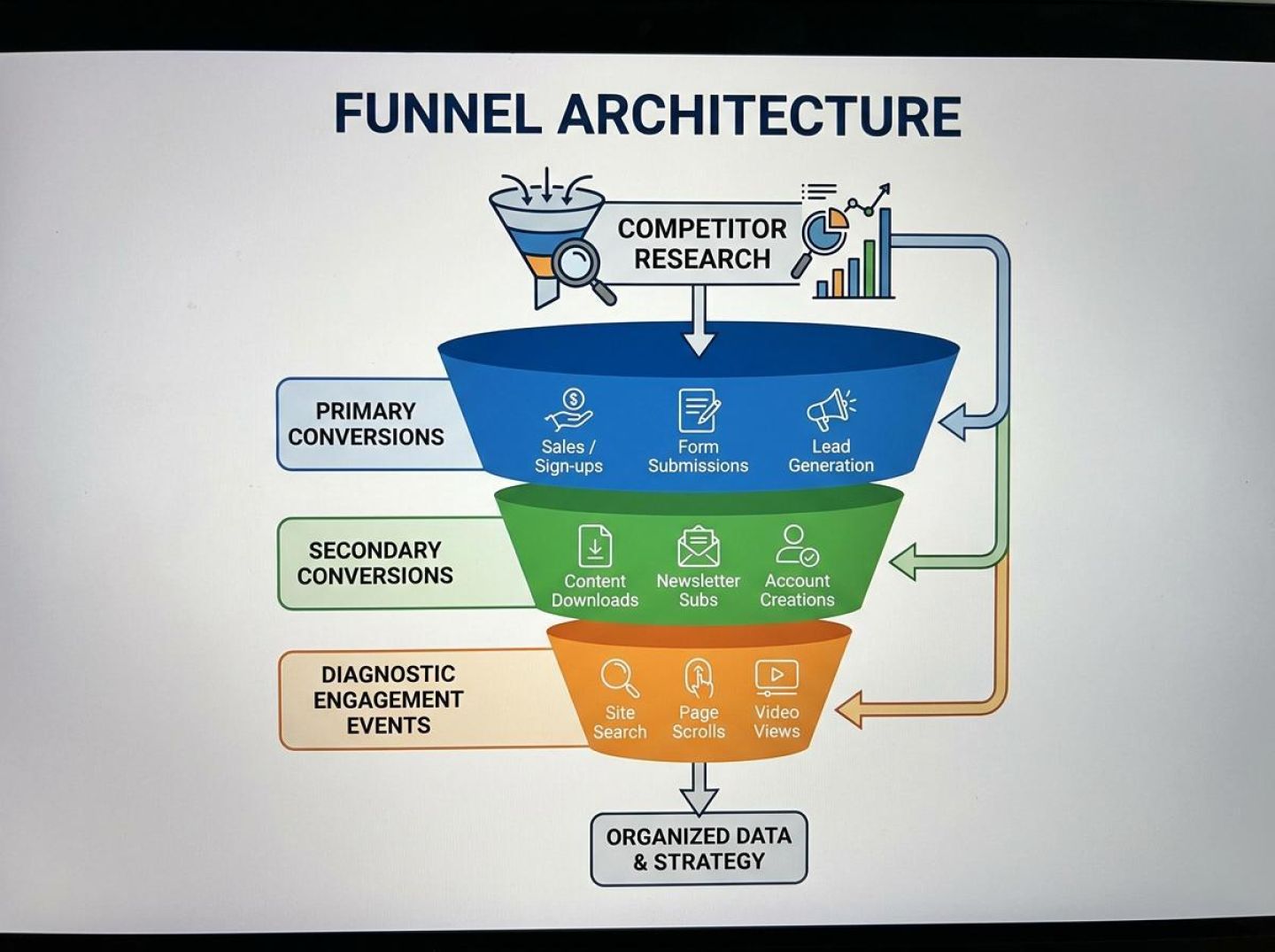
A practical way to address this is to distinguish between primary and secondary conversion actions.
Primary conversions are the meaningful actions you want automated bidding to pursue.
Examples might include:
Secondary conversions are useful events for observation and analysis but shouldn't necessarily guide bidding.
Examples might include:
The correct configuration depends on your business model and campaign objective. Some actions may be valuable primary goals in one business and only secondary indicators in another.
For instance, a free-trial registration might be an important primary conversion for a SaaS company if it is a meaningful acquisition milestone. For another business, a trial registration might be too early to represent a qualified opportunity.
Rather than assigning the same importance to every event, develop a hierarchy that reflects how people progress toward revenue.
| Intent level | Example action | Measurement role |
|---|---|---|
| Tier 1 | Purchase, signed order, confirmed deposit | Direct commercial outcome |
| Tier 2 | Qualified demo, serious sales inquiry, validated trial | High-intent opportunity |
| Tier 3 | Lead magnet, webinar signup, newsletter subscription | Early interest |
| Tier 4 | Generic click, unqualified quiz completion, page engagement | Diagnostic activity |
This framework is a starting point, not a universal Google Ads configuration.
Some advertisers may have insufficient purchase volume to optimize directly toward sales. In that situation, a carefully selected intermediate event may be necessary while the business improves its measurement and qualification process.
The important thing is to understand what each event represents and avoid treating every interaction as an equally valuable outcome.
For businesses with suitable tracking and sufficient data, conversion values can help represent differences in commercial value.
For example, a completed purchase might carry its actual revenue value, while a qualified lead could receive an estimated value based on historical lead-to-customer conversion rates and average deal value.
A generic newsletter subscription should not automatically receive the same value as a signed contract.
Values should be based on credible business data, not arbitrary numbers designed to make a dashboard look better.
As customers move between search, video, social, AI-assisted discovery, and direct website visits, the full journey becomes harder to measure.
A campaign may influence demand without receiving direct credit for the final purchase.
Conversely, a campaign may receive credit for a conversion that was already likely to happen.
This makes it important to distinguish between attributed conversions and incremental business outcomes.
Use appropriate attribution methods and, where feasible, controlled experiments to understand whether advertising is actually generating additional value.
The objective isn't to eliminate automation. It's to give automation a clearer definition of success.
Ad spy tools have a reputation for being creative research platforms.
Marketers use them to find competitor headlines, inspect landing pages, study video formats, and collect examples for future campaigns.
Those are useful applications, but they don't capture the full strategic value of competitive intelligence.
When your Google Ads campaigns are struggling with weak conversion signals, external research can help you understand how the market communicates buying intent.
The important distinction is that an ad spy tool doesn't directly train Google's bidding model. It helps you make better human decisions about the creative, offer, landing page, and conversion architecture that your own campaigns use.
Think of it as an external research and classification layer.
Instead of asking:
"What advertisements should I copy?"
Ask:
"What patterns in the market can help me understand the difference between discovery, consideration, and genuine buying intent?"
Study groups of advertisements and compare their characteristics.
For example:
This creates a more useful picture of how advertisers approach different stages of the customer journey.
A practical research library should organize advertisements according to more than appearance.
Record the following:
Demand creation
These advertisements introduce a problem, product, category, or new idea to an audience that may not be actively shopping.
Typical characteristics include:
Demand capture
These advertisements attempt to convert existing interest into a more immediate action.
Typical characteristics include:
The distinction is not always absolute. An advertisement can create interest and capture demand simultaneously.
However, classifying its apparent role helps you understand what kind of response the advertiser is trying to generate.
A headline alone doesn't tell you how much intent an advertiser is trying to capture.
Compare the offers and destinations associated with different creative concepts.
For example:
| Creative approach | Possible destination | Intent to investigate |
|---|---|---|
| Educational video | Guide or article | Early interest |
| Product demonstration | Product page | Product consideration |
| Comparison creative | Comparison page | Active evaluation |
| Free-trial advertisement | Trial registration | Product adoption |
| Consultation offer | Qualified booking form | Sales opportunity |
| Direct product promotion | Checkout | Purchase intent |
These are research classifications, not verified campaign objectives. The actual purpose should be inferred from the visible customer journey and confirmed wherever possible.
Suppose your own campaign counts every guide download as a primary conversion.
You research competitors and notice that their customer journeys often include additional steps before a sales conversation:
That observation doesn't prove competitors use those exact steps as their bidding goals.
But it raises an important question for your own business:
"Are we asking Google to optimize for the first sign of interest, or for an action that better represents a qualified opportunity?"
You can then compare your current conversion architecture with your actual sales process.
Perhaps you need to introduce lead qualification, import qualified opportunity events, or assign more realistic values to different actions.
AI creative tools can generate numerous combinations of headlines, images, videos, and messages.
But more creative variations don't automatically produce better business results.
Without a clear strategy, automation may simply produce more variations of messages that attract inexpensive clicks.
Competitive research can provide context for the decisions humans make before and after those variations are launched.
For example:
Your research becomes a guide for campaign design and measurement—not a substitute for actual performance evidence.
That is how ad spy tools evolve from idea libraries into strategic intelligence systems.
Once you've identified relevant advertising patterns, the next step is to investigate the customer journey behind them.
The goal is to understand how competitors move visitors from an advertisement toward a meaningful action.
This can help you redesign your own funnel so that the conversion events sent to Google better reflect commercial intent.
Start with relevant competitor campaigns in your ad spy tool.
Follow each available link and document the sequence.
A typical journey might look like:
Primary advertisement → Landing page → Micro-conversion → Sales page or demo flow → Confirmation page
Not every campaign will contain every stage. Some advertisers send traffic directly to checkout, while others use multiple educational or qualification steps.
For each campaign, record:
Don't stop at the hero section. Explore the buttons and links that a real visitor would encounter.
The objective is to create a clear map of the decisions the advertiser asks a prospect to make.
Now examine the funnel from a measurement perspective.
Ask:
"If this were my campaign, what would this action tell me about the visitor?"
A guide download may indicate initial interest.
A completed product assessment may reveal a stronger need.
A qualified demo request may indicate serious buying consideration.
A completed purchase is a direct commercial outcome.
This classification helps you identify which actions are suitable for bidding and which should remain diagnostic.
Be careful not to assume that a competitor uses a particular action as its primary Google Ads conversion. Publicly visible landing pages do not reveal another advertiser's private conversion settings.
You are analyzing the customer journey, not accessing the competitor's tracking configuration.
Use a consistent system to organize the visible steps.
Tier 1 — Direct commercial outcomes
These are usually the clearest revenue-related events.
Tier 2 — High-intent buying signals
These may be suitable primary conversions when the business has evidence that they predict revenue.
Tier 3 — Early-stage interest
These are useful audience-development actions, but their commercial value varies.
Tier 4 — Engagement indicators
These can help analyze user behavior without necessarily being suitable primary bidding goals.
The same action can belong to different tiers depending on the context. A detailed application form for a high-ticket service may represent stronger intent than a generic contact form.
Use the classification as a framework, then validate it against your own customer data.
With the competitor funnel map complete, compare it with your own website and conversion process.
Look for unnecessary steps and misleading events.
Practical improvements may include:
The objective isn't to make every funnel longer.
It's to ensure that the actions you measure represent genuine progress toward the business outcome.
Once your funnel is clearer, review your Google Ads conversion setup.
A practical framework might look like this:
| Conversion action | Suggested treatment |
|---|---|
| Completed purchase | Primary, with actual value |
| Qualified sales opportunity | Primary where appropriate, with defensible estimated value |
| Demo request | Primary if it represents a meaningful business objective |
| Newsletter subscription | Usually secondary |
| General content download | Usually secondary |
| Product page view | Diagnostic |
| Generic button click | Diagnostic unless it represents a verified business action |
The final configuration should reflect your actual business model, sales cycle, and available conversion volume.
For businesses with longer sales cycles, consider connecting CRM outcomes to advertising measurement through suitable offline conversion or enhanced conversion workflows where supported.
This can help close the gap between an initial lead and the eventual commercial result.
Don't assign arbitrary values simply to make low-intent events appear important. Use actual historical conversion rates, revenue data, and reasonable estimates.
The outcome should be a cleaner feedback loop: advertisements attract relevant prospects, landing pages qualify them, and meaningful conversion events inform automated bidding.
One of the easiest mistakes in competitive research is assuming that the advertiser with the most visible activity must be the most successful.
A large number of impressions or creative variations can make an advertiser look important.
But visibility alone doesn't establish profitability.
If you're researching competitors to improve your Demand Gen and Smart Bidding strategy, focus on patterns that suggest disciplined testing and a coherent customer journey.
Three signals are particularly useful: observation longevity, creative iteration, and funnel consistency.
A campaign that appears repeatedly over an extended period deserves investigation.
Inside your spy tool, look for:
An advertisement observed for 90 days may be more interesting to study than one that appears briefly and disappears.
However, longevity is not a direct profit report.
A campaign may remain active for brand awareness, seasonal planning, testing, or other strategic reasons. A spy tool's observation history may also differ from the campaign's actual launch date or delivery history.
Treat duration as a reason to investigate, not proof of success.
Next, examine how the advertiser changes its creative.
A structured testing pattern may look like this:
For example, a software company might maintain the message "Reduce manual invoicing work" while testing:
These variations provide useful examples of how one commercial proposition can be expressed in different ways.
Compare that with a campaign that changes its audience, offer, promise, and creative direction repeatedly within a short period.
The second pattern may be experimental, but it provides less clarity about which underlying idea the advertiser is trying to validate.
Don't assume that frequent creative changes prove an advertiser is struggling. They may simply reflect an active testing program.
The useful question is whether the variations appear to follow a recognizable strategy.
Finally, examine whether the advertisement, landing page, and final action work together.
Look for:
A coherent funnel is worth studying because it provides a clear hypothesis about how the advertiser wants visitors to progress.
For example, an advertiser might use multiple creative hooks but consistently direct visitors toward the same product assessment and qualified demo process.
That pattern can reveal a stable customer journey, even though it doesn't establish the advertiser's internal conversion settings or financial results.
To make this analysis repeatable, evaluate each advertiser using a simple research scorecard.
| Research dimension | What to examine |
|---|---|
| Longevity | How long the creative or campaign has been observed |
| Iteration | Whether variations follow a consistent creative concept |
| Offer consistency | Whether related advertisements promote the same proposition |
| Funnel continuity | Whether the ad and landing page communicate the same promise |
| Intent progression | Whether visitors move toward meaningful commercial actions |
| Evidence quality | Whether any actual performance results are publicly documented |
This helps you prioritize advertisers for deeper research without confusing visible activity with verified financial success.
The best competitor to study isn't necessarily the one with the most advertisements.
It's the one whose creative strategy, offer, and customer journey provide useful lessons for your own campaign design.
Demand Gen, Performance Max, and Smart Bidding can automate a significant amount of advertising work.
But automation cannot independently decide what success should mean for your business.
If your conversion setup treats weak engagement and meaningful purchases as equivalent outcomes, your campaigns may optimize toward activity that looks impressive in a dashboard but contributes little to revenue.
The solution starts with better measurement.
Separate primary conversions from secondary events. Understand how visitors progress through your funnel. Assign values based on credible business information. Connect advertising activity to qualified leads and actual customer outcomes wherever possible.
Then use competitive ad intelligence to improve the decisions behind your campaigns.
Anstrex can help you investigate competitor advertisements, creative variations, offers, and visible landing page journeys. These observations provide a broader view of how advertisers in your market attract and qualify prospects.
Use that information to develop stronger hypotheses, build more coherent landing pages, and decide which customer actions deserve to guide your bidding strategy.
The distinction is important: competitor research doesn't directly train Google's AI. It helps you build a better strategy and a cleaner measurement framework for the campaigns that do.
More clicks aren't necessarily better. More reported conversions aren't necessarily better. The real goal is to give your campaigns clearer signals about the customers and actions that create business value.
Receive top converting landing pages in your inbox every week from us.
In-Depth
AI disclosure alone cannot prove a brand is trustworthy. Discover how verified performance, competitive intelligence, and transparent evidence can strengthen buyer confidence.
Dan Smith
7 minNov 1, 2026
Most Read
Web analytics shows what visitors do on your properties. Discover how ad intelligence adds a competitive view of the offers, messages, and funnels shaping your market.
Rachel Thompson
7 minNov 1, 2026
Must Read
City pages reveal where local demand exists and what customers need. Learn how to use those insights to build smarter native, push, and TikTok campaigns.
David Kim
7 minNov 1, 2026