7 minJune 23, 2026

Our tools monitor millions of native, push, pop, and TikTok advertising campaigns.
Get StartedThere is something genuinely admirable about the traditional creative brief. It is a document of intention — a distillation of strategy, audience insight, brand positioning, and campaign objectives into a single artifact that, at its best, gives a creative team everything it needs to produce great work. For decades, programs built around structured briefs — agency apprenticeships, portfolio school challenges, seasonal "Get Out the Vote" competitions — have served as both training grounds for emerging talent and quality-control mechanisms for the industry. Nobody disputes their value. The question is whether their rhythm still matches the world they're supposed to serve.
Consider the cadence. A traditional creative brief is born from a planning cycle — quarterly business reviews, seasonal campaign calendars, annual brand strategies. It moves through layers of approval: brand team to strategy to creative director to production. Even in a well-run agency, the journey from brief to finished asset can consume weeks. In the golden era of thirty-second television spots and magazine spreads, that timeline was a feature, not a bug. It created space for reflection, iteration, and craft.
But modern performance marketing doesn't operate on that clock. When brands need to test hundreds of creative variants and surface winners within days to respond to cultural moments or competitive shifts, as MarTech has outlined, the structured brief becomes a bottleneck dressed in professional respectability. Speed is no longer a nice-to-have; it is a competitive advantage in its own right, and every day a brief spends circulating for sign-off is a day the market has already moved.
The advertising industry itself seems to agree, even if it hasn't said so explicitly. When WPP — the world's largest ad-holding group — unveiled a new studio called Hex staffed by roughly fifty Gen Z creative technologists sourced from its Creative Tech Apprenticeship program, it was making an institutional confession. The apprenticeship, a nine-month paid program introduced in 2022, deliberately recruits from outside traditional advertising and engineering schools. Its curriculum prioritizes creative problem-solving and fast technology adoption — not the patient brief-to-campaign pipeline that defined agency life for half a century. WPP built Hex because the conventional talent model, and by extension the conventional workflow model, could not close the skills gap fast enough. If the holding company that houses Ogilvy, VMLY&R, and GroupM decides it needs to bypass its own established pipeline, the rest of the industry should take that as a signal rather than an anomaly.
None of this means the creative brief is worthless. Strategic clarity — sharp positioning, distinctive brand narrative, well-defined audience understanding — matters more than ever when execution can be automated and scaled at machine speed. As MarTech argues, when AI handles production, differentiation comes from stronger inputs: clearer messaging frameworks and more deliberate brand storytelling. The brief's intellectual content remains essential. What has expired is its form factor — the slow, sequential, approval-laden document that assumes campaigns have months-long development cycles.
The institutions that train young creatives aren't wrong about the importance of strategic thinking. They're wrong about the tempo at which that thinking needs to be deployed. And in performance marketing, where every hour of delay translates directly into wasted spend or missed opportunity, slow isn't just inconvenient. Slow is expensive.
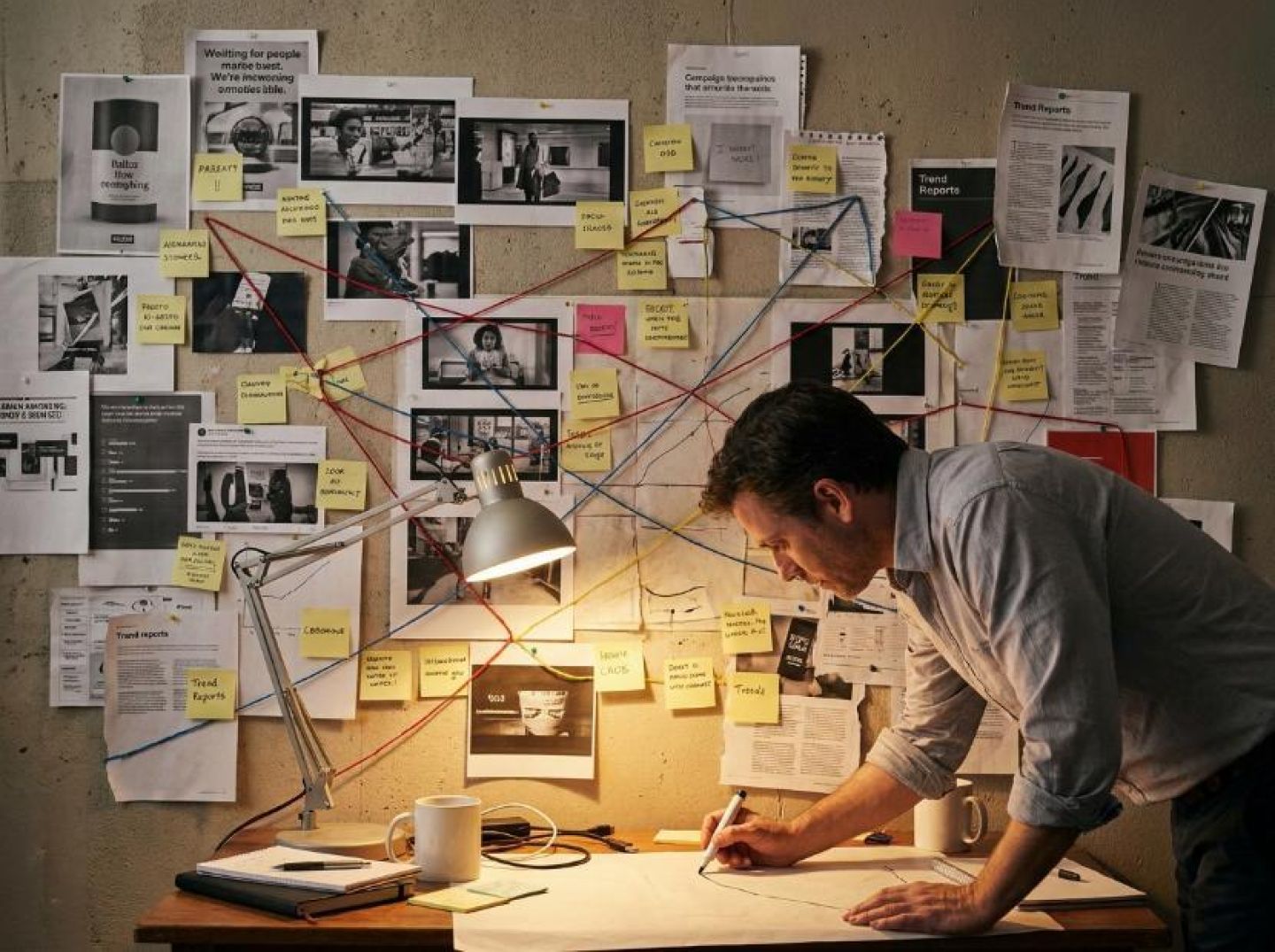
Think about what an ad spy tool actually is. Not the way most marketers use it — a quick glance at a competitor's latest Facebook carousel — but what it represents structurally. A competitive intelligence library with 156,000 or more active advertisers, running campaigns across 64 countries, refreshing daily, is not a surveillance utility. It is the largest, most current, always-updating creative brief ever assembled. It is a living curriculum of what's running, where, for how long, and — if you know how to read it — why.
The traditional creative brief is a snapshot of intention. It captures what a brand hopes will work, filtered through the assumptions of the people who wrote it. A competitive intelligence library captures what is actually working, filtered through the only mechanism that matters: market performance. Ads that keep running are ads that keep performing. Ads that disappear after three days told you something too. The marketer who browses this library daily, deconstructing structural patterns across categories, platforms, and geographies, is receiving a more rigorous creative education than any structured program can deliver — because the feedback loop is real, continuous, and merciless.
This is where the modular creative philosophy becomes critical. App Samurai's recommendation to build 10 modular hooks and 3 value propositions, then serve different combinations contextually based on the environment — professional tools get efficiency messaging, entertainment apps get creative expression messaging — doesn't emerge from a traditional brief. It emerges from pattern recognition. You see that ads emphasizing time savings generate a 50 percent higher click-through rate than ads emphasizing creative freedom, and your entire creative strategy pivots accordingly. That kind of insight requires volume, velocity, and variation — precisely what a living ad library provides and what a static brief document cannot.
The same principle operates at the measurement layer. When DAIVID and ADIN.AI integrated creative effectiveness scoring directly into media execution, they formalized something that data-driven advertisers already understood intuitively: creative quality is now a data problem, not an inspiration problem. Their system scores creative before launch to predict likely performance, scales winners and pauses underperformers in real time during the campaign, and feeds historical results back into benchmarks that shape the next round of creative decisions. DAIVID CEO Ian Forrester framed the core issue directly — creative has been "measured in isolation, disconnected from media results" for too long. The live loop his partnership builds is, in essence, a perpetual creative brief that rewrites itself based on outcomes.
This is the paradigm shift that traditional programs struggle to accommodate. A junior creative sitting in a portfolio school is taught to treat the brief as sacred — the starting point from which ideas flow. A data-driven advertiser treats the brief as a hypothesis that was obsolete the moment it was printed, because the real brief is already live. It exists in the thousands of ads launching and dying every hour, in the contextual testing matrices that reveal which value propositions resonate in which environments, in the effectiveness scores that finally connect creative decisions to business outcomes in a single unbroken chain.
The information asymmetry used to favor agencies with proprietary research and client histories. Now it favors anyone willing to study the feed. The creative brief isn't a document anymore. It's an ecosystem — and it never stops updating.
Every ad has a half-life, and it's getting shorter. In fast-moving categories like AI-powered apps, creative decay isn't a quarterly concern — it's a daily one. As App Samurai's growth playbook documents, AI app ads lose effectiveness within days because the novelty of an AI-generated result wears off almost as fast as it captures attention. A static ad showing "look what this AI can do" burns through its audience before the campaign manager even opens the performance dashboard on Monday morning. The recommended countermeasure is a modular creative approach — ten interchangeable hooks, three rotating value propositions, contextual testing by placement — all governed by a data-driven roadmap that feeds performance signals back into the next round of production in near real time.
That speed of decay is not unique to AI apps. It's a preview of where all digital advertising is headed as platforms accelerate delivery, algorithms exhaust high-propensity audiences faster, and consumers develop pattern recognition for ad formats they've already seen twice this week. The traditional brief cycle — conceive, develop, launch, measure, reconceive — was built for a world where campaigns ran for weeks or months before anyone questioned whether the creative was still working. In a world where a winning hook can plateau in seventy-two hours, that cycle isn't just slow. It's structurally incapable of keeping up.
Scale compounds the problem. Consider what happens when a single global brand tries to maintain creative freshness across hundreds of markets simultaneously. Unilever now distributes content through a network of roughly 300,000 creators, and as Search Engine Journal has noted, seventy-one percent of those creators are already using AI tools in their workflows. At that volume, the traditional evaluation infrastructure — human review panels, quarterly brand-lift studies, even conventional A/B testing with manual winner selection — simply breaks down. No committee can review that much output. No quarterly tracker can detect that an ad set in Indonesia decayed on Tuesday while a variant in Brazil is still climbing. The feedback loops that made brand-building feel orderly in the broadcast era collapse under the weight of modern distribution.
This is precisely where the daily practice of scanning a competitive intelligence library shifts from "nice to have" to survival mechanism. When a marketer opens an ad spy tool each morning and filters by category, by platform, by recency, they are doing something no institutional brief can replicate: observing creative decay and creative emergence across an entire market in near real time. They can see which competitor hooks appeared three weeks ago and have since disappeared — a signal of fatigue. They can spot new visual formats or messaging angles that just entered the feed — a signal of emergence. That pattern recognition, repeated daily, builds an intuition for the half-life of creative in their specific category that no retrospective performance report can match.
The implications go beyond competitive analysis. As MarTech has argued, the ability to test hundreds of creative variants and surface winners within days gives brands "unprecedented agility" — but only if the strategic inputs are strong enough to guide that velocity. Speed without direction is just noise. The advertiser who combines real-time competitive scanning with rapid modular production doesn't just react faster. They develop a compounding informational advantage: each day's observations refine tomorrow's creative hypotheses, creating a flywheel that no annual young-creatives program, no matter how talented its participants, can spin fast enough to match. Creative decay is relentless. The only defense is intelligence that moves at the same speed.
Every major ad platform is racing to embed creative intelligence directly into its own ecosystem, and the tools they're building are genuinely impressive. Reddit's acquisition of Memorable AI — a system that scores creative effectiveness and suggests optimizations before a single impression is served — signals that platform-native creative intelligence is no longer a nice-to-have. It's becoming a core feature of the ad stack itself. Meanwhile, Keynes launched Kortex, an AI-powered CTV platform that gave apparel brand Tuckernuck what its senior paid media manager Jordan Light called "quite a bit of enlightenment" — the ability to finally "pop open the hood" and understand not just what was working, but why. On the publisher side, Amazon released Signal IQ to help publishers pinpoint which bidstream signals actually drive demand, turning opaque auction mechanics into actionable intelligence. And partnerships like DAIVID and ADIN.AI are creating what Search Engine Journal described as a "live loop between creative intelligence and media execution," scoring creative before launch and scaling winners in real time.
These tools represent a genuine leap forward. A marketer using Kortex can see that beachside creative outperforms rainy-day imagery in specific regions. A publisher using Signal IQ can identify which data signals command premium bids. A brand running Reddit ads can pre-test creative against Memorable AI's predictive models. Each of these capabilities would have required a dedicated analytics team and weeks of post-campaign analysis just two years ago.
But here's the structural problem no platform will volunteer to solve: each of these tools optimizes within its own walled garden, for its own auction dynamics, according to its own definition of success. Reddit's Memorable AI will tell you what works on Reddit. Kortex will illuminate CTV performance within Keynes' inventory. Amazon's Signal IQ surfaces demand drivers within Amazon's exchange. None of them will tell you what's winning on a competitor's TikTok campaign, what hook format is dominating across Meta and YouTube simultaneously, or whether the creative strategy you're perfecting for one channel is already saturated on another.
A marketer who relies exclusively on platform-native intelligence is seeing the world through five different keyholes — each offering a sharp, detailed view of a single room while the rest of the house remains invisible.
This is where cross-platform competitive intelligence becomes not a luxury, but a necessary counterweight. An ad spy tool spanning 156,000 or more active advertisers across platforms and geographies provides the panoramic view — the one that reveals which creative strategies are winning universally versus which are artifacts of a single platform's algorithm. It's the difference between knowing your Meta carousel outperformed your last Meta carousel and knowing that the entire category has shifted to UGC-style video openers across every channel.
The most sophisticated marketers will use both. They'll leverage platform-native tools like Kortex and Memorable AI for execution-level optimization — the regional targeting, the format tweaks, the bid adjustments. But they'll layer cross-platform competitive intelligence on top for strategic direction — the trend identification, the whitespace discovery, the creative positioning that no single platform can see because no single platform has the incentive to show you the bigger picture. As Fraser Cottrell of Fraggell noted in his framework for scaling AI-powered ad creative, the foundational step is building context about who your customers are and what great ads look like. Platform-native tools supply half that context. The other half — what your competitors are running, what's breaking through across channels, what the market considers "great" right now — lives outside any single platform's walls.
"We understand Gen Z because we are Gen Z," reads the about page on Hex's website. It's a confident declaration, and on its surface, it makes intuitive sense. WPP's new studio — staffed by roughly 50 creative technologists sourced from its Creative Tech Apprenticeship program, all falling within the Gen Z age range — promises to "authentically connect" clients to younger audiences "through digitally native storytelling using platforms integral to our lives." The pitch is polished, the positioning is sharp, and the intent is genuinely progressive. But strip away the branding and what you're left with is a familiar claim dressed in new language: trust our instincts because we belong to the demo.
That's not a creative strategy. It's a credential. And credentials, no matter how demographically precise, are not the same as systematic intelligence about what actually works.
Consider the assumption embedded in Hex's positioning. It implies that membership in a generation confers predictive insight into what will resonate with that generation — that being 24 and fluent in TikTok idioms means you can reliably produce ad creative that outperforms for a 24-year-old audience. But every performance marketer who has watched a "sure thing" creative concept flatline in paid social knows that intuition about cultural fluency and evidence of creative effectiveness are two entirely different things. The former tells you what feels right. The latter tells you what converts. And the gap between those two things is where most ad budgets go to die.
This isn't a knock on young talent — it's a knock on the logic that treats demographic identity as a proxy for creative intelligence. The real issue, as DAIVID's CEO has argued, is that creative has long been "measured in isolation, disconnected from media results" — evaluated on subjective appeal or cultural relevance without ever being tied back to the business outcomes it's supposed to drive. When you decouple creative judgment from performance data, you inevitably default to taste-based decision-making, whether that taste belongs to a 55-year-old executive creative director or a 23-year-old creative technologist.
What actually predicts performance isn't generational intuition — it's pattern recognition at scale. It's studying thousands of creative executions across platforms, audiences, and formats to identify which visual compositions, hooks, color palettes, and narrative structures consistently drive measurable outcomes. As MarTech has detailed, AI-native advertising is moving targeting beyond demographic segmentation entirely, toward real-time intent signals and behavioral patterns. If the targeting layer has already evolved past "Gen Z as a monolith," why would we accept a creative layer that still treats generational membership as a sufficient analytical framework?
The smarter model isn't to staff a studio with people who are the audience. It's to build systems that can read the audience — continuously, quantitatively, and without the cognitive biases that even the most culturally attuned humans carry. That means creative testing infrastructure where hundreds of variants surface winners within days, not weeks. It means modular creative frameworks like the ones App Samurai recommends, where multiple hooks and value propositions are tested contextually based on where and when a user encounters the ad. It means treating creative not as an expression of identity but as a variable in a system — one that can be measured, iterated, and optimized with the same rigor we apply to bidding and audience segmentation.
Hex may very well produce brilliant work. But the premise that generational identity is a creative differentiator belongs to an era before we had the tools to actually know what performs — and more importantly, why.
Receive top converting landing pages in your inbox every week from us.
Quick Read
OOH is increasingly becoming a measurable performance channel, but many industry roles are still built around selling inventory rather than outcomes. This guide explores how OOH careers can evolve toward performance marketing through attribution, ad intelligence, funnel design, landing-page data, and measurable campaign optimization.
David Kim
7 minSep 20, 2026
Featured
Testing only inside Google Ads and TikTok can hide platform bias, attribution problems, and misleading performance signals. This guide shows how to combine spy-tool intelligence with controlled experiments across Google, TikTok, Native, Push, and Pops to identify which creative and funnel patterns actually drive incremental results.
Priya Kapoor
7 minSep 18, 2026
Editor’s Pick
Generic AI output is becoming easier to recognize and harder to differentiate in performance marketing. This guide shows how to turn competitor spy data into structured AI inputs, build expert-backed creative workflows, and generate original ads that use market intelligence without copying competitors.
Marcus Chen
7 minSep 18, 2026