10 minAugust 6, 2026

Our tools monitor millions of native, push, pop, and TikTok advertising campaigns.
Get StartedIf you've spent any time researching how to use AI for marketing copy, you've encountered the same directive repeated with near-religious conviction: train the AI on your voice. Feed it your best writing. Teach it your cadence, your quirks, your worldview. Jeff Bullas recommends a minimum of 15,000 words of your own long-form content for effective voice training, arguing that the goal is to make it "impossible for AI to sound like anyone else." The logic is sound — if you're a thought leader, a brand journalist, or a Anstrex.com/blog/bayashis-tiktok-ad-stuns-the-world-heres-why" target="_blank" rel="noreferrer noopener">content creator building an audience around a personal identity, your voice is the product. Dilute it and you dilute your value.
This advice isn't wrong. It's just built for the wrong audience.
The distinction between brand marketing and performance marketing isn't a quibble — it's a chasm. Brand marketers are playing a long game of trust, recognition, and reputation. They need authenticity because their audience is choosing them over alternatives, and sameness is the enemy. That's exactly the concern MarTech raises when warning advertisers to strengthen strategic inputs like brand narrative, messaging architecture, and audience understanding in an AI-native world. For these marketers, undifferentiated output erodes the very thing they're selling: a relationship with a recognizable identity.
But if you're an affiliate, a media buyer, or a performance marketer running paid traffic to offers you didn't create for brands you don't own — none of this applies to you. Your ad creative isn't a relationship-building instrument. It's a disposable conversion mechanism with a shelf life measured in days, sometimes hours, before fatigue sets in or the platform's algorithm demands fresh variations. Nobody clicks your ad because they recognize your "voice." They click because the hook landed, the angle resonated with a pain point, and the visual stopped the scroll for 1.3 seconds longer than the competitor's.
When you train AI on your own unproven copy, you're doing something remarkably counterproductive: you're encoding your assumptions, your untested instincts, and your biases into a system that will faithfully reproduce them at scale. It's like studying your own losing poker hands to improve your game. You get very efficient at losing.
The brand-voice framework also ignores a fundamental asymmetry in how these two worlds operate. A brand marketer who publishes a mediocre blog post suffers a slow, invisible erosion of authority. A media buyer who launches ad creative based on untested assumptions suffers an immediate, measurable cash loss. The feedback loop is tighter, the stakes per impression are higher, and the penalty for self-referential copy is denominated in wasted spend, not vague audience drift.
This doesn't mean AI is useless for performance marketers — far from it. It means the training data needs to come from somewhere fundamentally different. Not from your archive of previous attempts, but from the market itself: from the ads that are already winning auctions, already converting clicks, already proving what audiences respond to right now. The question isn't "How do I make AI sound like me?" The question is "What is already working, and how do I reverse-engineer it faster than anyone else?"
That reframe changes everything about how you should be using these tools — and it starts with understanding what competitive intelligence actually looks like in a modern ad auction.
Every ad that survives in a paid social auction for more than a few days is a hypothesis that passed its test. It earned clicks, held attention long enough to convert, and justified continued spend — otherwise the media buyer would have killed it. When you look at a competitor's ad library and see the same creative running for weeks or months with consistent spend behind it, you're not looking at someone's rough draft. You're looking at a market-validated conclusion about what resonates with the exact audience you're trying to reach.
This is the training context most marketers completely overlook when they sit down to prompt an AI. They feed it brand guidelines, tone-of-voice documents, and their own past campaigns — all of which reflect internal assumptions about what should work. Competitor ad data reflects what does work, validated not by a committee but by thousands of real purchasing decisions. The most revealing insights about a competitor's strategy don't come from their press releases or blog posts; as AdExchanger has argued, the most valuable competitive signals are hidden inside media allocation decisions and efficiency trends — the patterns embedded in where rivals choose to spend, how long they sustain that spend, and which creatives they let run at scale. A creative that persists in a competitive auction environment is a creative that's earning its place.
The mistake marketers make is treating this data as something to merely glance at for "inspiration." Instead, it should be structured and fed directly into AI prompts as operational context. And this is where the approach aligns with something counterintuitive: the argument that you should stop asking AI to do deep creative thinking in the first place. As MarTech recently put it, the most effective use of AI isn't forcing it to invent strategy from a blank slate — it's deploying it against operational problems where pattern recognition, synthesis, and recombination are the actual tasks. Analyzing a stack of proven competitor ads and extracting the structural patterns that make them work is precisely that kind of operational task.
Think of it this way. MarTech's own metaphor of treating AI as an eager, slightly unreliable intern is actually the perfect frame for this workflow. You wouldn't hand an intern a blank whiteboard and say "create our Q3 campaign." But you absolutely would hand that intern a folder of fifty high-performing competitor ads and say: "Tell me what hooks appear in the first three seconds. Tell me which pain points get repeated. Tell me what offer structures show up most often. Tell me what's different about the ads that ran for six months versus the ones that died in a week." That's not creative genius. That's sorting, categorizing, and surfacing patterns — exactly the kind of work where AI is genuinely reliable.
When you give a language model this kind of context, you fundamentally change the quality of its output. Instead of generating copy from the statistical average of everything it's ever seen — which is how you get the generic, interchangeable ad copy that consumers increasingly distrust — you're constraining it within a set of proven parameters specific to your vertical. The AI isn't inventing. It's recombining elements that already have conversion data behind them. The difference between prompting with your brand voice document alone and prompting with a structured breakdown of what's already winning in your market is the difference between asking AI to guess and asking it to analyze. One of those is a creative task AI handles poorly. The other is an operational task it handles exceptionally well.
Here's where the theory becomes a workflow. The competitive intelligence prompting framework operates as a closed loop — pull, extract, generate, verify — and each step matters because skipping any one of them is how you end up with ad creative that looks smart on a screen but dies in an auction.
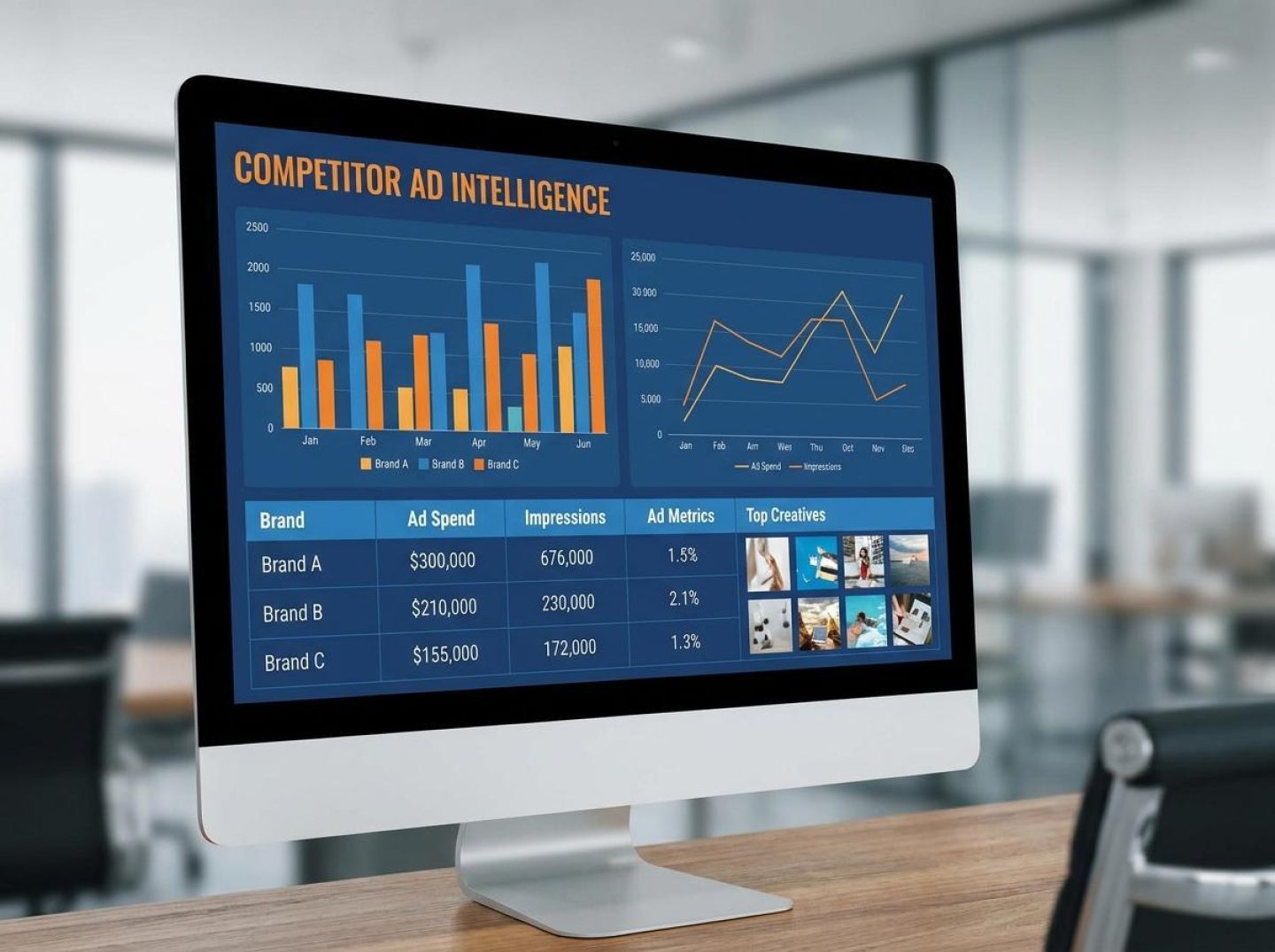
Step 1: Pull the right ads, not just any ads. Open your competitive intelligence tool and filter ruthlessly. You're not looking for every ad a competitor has ever run — you're looking for the survivors. Sort by longevity and spend signals. An ad running for six weeks with consistent or increasing spend behind it is a fundamentally different data point than one that launched yesterday. As AdExchanger noted when examining how Polaris AI translates competitive signals into actionable hypotheses, the most valuable intelligence isn't knowing who spends the most but understanding why they're winning before the rest of the market notices. In a spy tool like Anstrex, that means prioritizing creatives with long run times across multiple geos or networks. Pull ten to fifteen of these proven survivors for each competitor — enough to spot patterns, not so many that the signal drowns in noise.
Step 2: Feed those creatives into AI with structured extraction prompts. Don't just paste an ad and ask "what makes this work." That gets you a vague compliment, not usable intelligence. Instead, use prompts that force the model to decompose the ad into discrete components: the hook pattern (what stops the scroll and why), the offer framing (how the value proposition is positioned relative to alternatives), the emotional trigger (fear, aspiration, curiosity, social proof), and the CTA structure (urgency mechanism, friction reduction, next-step clarity). Run each winning ad through this extraction individually, then ask the AI to identify recurring patterns across the full set. This is where competitive intelligence becomes competitive architecture — you're reverse-engineering the structural logic beneath surface-level copy.
Step 3: Generate new variations that remix proven patterns for your offer. With the extracted patterns documented, prompt the AI to produce ad variations that apply those structural frameworks to your specific product, audience, and constraints. The key instruction: the AI should borrow the pattern, not the language. You want the same hook type, not the same hook. The same emotional sequence, not the same words. This is where the process diverges from plagiarism and becomes strategic remixing at scale.
Step 4: Stress-test every output before it touches a campaign. This is non-negotiable, and it's where most teams skip a step that costs them. Search Engine Journal's cognitive mirage framework makes the risk explicit: AI can synthesize competitor language and present it as original insight with such structural confidence that teams stop challenging what appears well-reasoned. For performance marketers, this means an AI-generated ad variation might surface a pattern that looks like the reason a competitor's ad works but actually isn't — it might be mimicking the copy style while missing the offer economics or audience context that truly drove results. The discipline is straightforward: treat every AI-generated ad variation as a hypothesis, not a finished creative. Run inverse-premise prompts — ask the AI to argue why each variation would fail. Then launch the survivors into split tests with small budgets before scaling.
The entire loop — pull, extract, generate, verify — can run in under two hours. You're not starting from a blank page or from your own untested instincts. You're starting from market-validated evidence, and that dramatically compresses the distance between first draft and winning creative.
This is the objection that sounds smart in a meeting and falls apart under scrutiny. If every advertiser feeds competitor ads into their AI workflows, won't the output converge into identical creative? Won't we end up in the very sea of sameness that brand-voice advocates have been warning about — where every headline, hook, and call to action sounds like it was stamped from the same machine?
The concern isn't invented. It's a legitimate observation about what happens when everyone uses the same models with the same inputs. And in certain channels, the consequences are already measurable. Google's algorithm is already down-ranking undifferentiated AI content at scale, YouTube has stripped monetization from AI-only channels, and Pinterest has introduced controls letting users limit AI-generated content in their feeds. If you're publishing blog posts or SEO articles, homogenization is a real and present threat. The platforms are actively punishing it.
But here's where the objection breaks: paid social and native advertising operate under completely different rules than organic content. Ad platforms don't penalize creative similarity the way search engines penalize content similarity. Meta's auction system doesn't care whether your hook sounds like a competitor's hook. It cares whether your ad stops the scroll, earns the click, and converts at a cost that sustains your bid. Facebook doesn't have a duplicate-content filter running across advertisers the way Google runs one across indexed pages. Two ads with nearly identical opening lines can both win their respective auctions simultaneously — because they're being served to different audience segments, at different times, against different competing bids.
The homogenization argument confuses the channel. In organic publishing, your content is your product — it needs to be distinctive because the platform is curating a feed and penalizing redundancy. In performance marketing, your ad is a delivery mechanism for an offer. The creative's job is not to be unique. Its job is to interrupt, qualify, and convert. If four competitors all use urgency-driven hooks because urgency works, the winning move isn't to be "different" for differentiation's sake. It's to execute urgency better — with a superior offer, tighter targeting, and faster iteration cycles powered by AI.
This is where the real differentiation lives in direct response, and it has never lived at the creative level. It lives at the offer level: your price, your guarantee, your bonus stack, your risk reversal. It lives at the funnel level: what happens after the click, how fast your page loads, how well your landing page continues the narrative the ad started. And it lives at the targeting level: which audiences see which message, how quickly you can read auction signals and reallocate spend. Creative convergence on proven patterns is a feature of performance marketing, not a bug. It means the market has identified what works, and now execution speed and offer strength determine who wins.
None of this means you should produce lazy, carbon-copy ads. As Social Media Examiner's breakdown of AI-driven ad creative makes clear, Meta's own Andromeda update now treats hundreds of slight variations of the same ad as a single creative, which means you still need genuinely distinct variations in structure, visual treatment, and angle. But "distinct" in the context of paid media means structurally different enough to earn its own delivery path in the algorithm — not philosophically original. You're not writing a novel. You're engineering a click.
So yes, if you and your competitors both train AI on the same winning patterns, your ads may share structural DNA. That's fine. The competitor with the better offer, the faster testing cadence, and the sharper post-click experience will still win — and they'll win faster precisely because they didn't waste cycles trying to be creatively unique in a channel that doesn't reward it.
There's a statistic making the rounds that should concern every marketer using AI: a majority of U.S. consumers say AI makes content quality worse, and younger consumers are even more likely to agree. Other research shows consumers distrust AI-powered search results and feel that visible AI content doesn't make them trust a brand more. If you've been following the discourse, you've probably seen these numbers cited as reasons to slow-roll AI adoption across the board. And if you're a performance marketer, you've probably felt a momentary twinge of doubt about the entire workflow this article advocates.
Here's the thing: that doubt is misplaced, because it conflates two entirely different consumer experiences.
The trust data is measuring reactions to content where the consumer knows or suspects AI was involved — blog posts that read like they were extruded from a template, brand communications that feel hollow, chatbot interactions that circle without resolving. When MarTech warns that consumer skepticism can turn AI misuse into a reputation problem, they're talking about organic touchpoints where a reader has opted in to engage with your brand voice, where authenticity is the implicit contract, and where the gap between "human-crafted" and "machine-generated" is viscerally felt. That's content marketing. That's brand journalism. That's the long game of trust.
Paid ad creative operates under a completely different psychological contract. When someone scrolls past your ad in a Meta feed, they are not evaluating whether a human wrote the headline. They are not checking for signs of AI involvement. They are processing a visual, a hook, and a value proposition in under two seconds, and they're either stopping or they're not. The question isn't "does this feel authentic?" — it's "does this feel relevant?" Those are profoundly different cognitive filters.
This distinction matters because it determines where the trust research applies and where it doesn't. A consumer who feels the difference when content is clearly AI-generated without thought or care is reacting to lazy execution in a context that demands genuine connection. But a direct-response ad that stops the scroll, communicates a clear benefit, and drives a click isn't operating in the trust economy — it's operating in the attention economy. The consumer doesn't know or care whether the copy was written by a junior copywriter, a senior creative director, or a large language model trained on your competitors' best-performing hooks. They care whether the offer is compelling.
This is why the concerns raised about Meta's AI creative tools producing obvious blunders — bikes with two handlebars, men appearing in women's networking ads — are legitimate but categorically different from the trust objection. Those are execution failures, not authenticity failures. When AI generates a garbled product image, the problem isn't that the consumer detected AI involvement and lost trust. The problem is that the ad is objectively broken. The fix is quality control, not philosophical hand-wringing about whether AI belongs in the creative process.
Performance marketers should absolutely take the trust data seriously — for their content strategies, their email nurture sequences, their thought leadership, and every owned-media touchpoint where the audience has a relationship with the brand voice. But applying that same caution to paid creative, where the only metric that matters is whether the ad drives the desired action at an efficient cost, means letting a misapplied data point slow down a workflow that demonstrably works. The consumer trust research is real. Its applicability to your ad account is not. Draw the line sharply, or you'll optimize for the wrong kind of authenticity in a channel that rewards relevance over rapport.
Receive top converting landing pages in your inbox every week from us.
Quick Read
OOH is increasingly becoming a measurable performance channel, but many industry roles are still built around selling inventory rather than outcomes. This guide explores how OOH careers can evolve toward performance marketing through attribution, ad intelligence, funnel design, landing-page data, and measurable campaign optimization.
David Kim
7 minSep 20, 2026
Featured
Testing only inside Google Ads and TikTok can hide platform bias, attribution problems, and misleading performance signals. This guide shows how to combine spy-tool intelligence with controlled experiments across Google, TikTok, Native, Push, and Pops to identify which creative and funnel patterns actually drive incremental results.
Priya Kapoor
7 minSep 18, 2026
Editor’s Pick
Generic AI output is becoming easier to recognize and harder to differentiate in performance marketing. This guide shows how to turn competitor spy data into structured AI inputs, build expert-backed creative workflows, and generate original ads that use market intelligence without copying competitors.
Marcus Chen
7 minSep 18, 2026