The marketing industry often treats Gen Z authenticity as something that requires expensive brand activations, influencers, and cultural experiences. This article argues that the real issue is format sensitivity: younger audiences do not necessarily reject advertising—they reject disruptive advertising. Native ads can solve this scalability problem by matching the editorial environment, using contextually relevant creative, and combining brand-building with measurable performance. The article also presents a competitive intelligence framework for analyzing the headlines, visuals, voice, and landing-page structures that resonate with ad-averse audiences.

Our spy tools monitor millions of TikTok ads from over 55+ countries. Biggest TikTok Ad Library in E-commerce and Mobile Apps!
Copying a viral influencer format can create a dangerous gap between attention and actual conversion. This article explains why views and engagement do not necessarily predict purchase intent, how influencer credibility can collapse and contaminate associated creative styles, and why scaling synthetic AI content brings its own platform and trust risks. It argues that sustained paid ad activity offers a more stable conversion signal, helping marketers identify durable hooks, audience-qualification patterns, and creative structures that can inform original campaigns without blindly copying trends.
Push and pop advertising may offer granular tracking, but many media buyers still optimize using incomplete platform-reported metrics. This article explores the measurement gap at the carrier-device layer, where differences in mobile networks, devices, operating systems, rendering, and traffic behavior can significantly affect downstream performance. It presents a practical framework for segmenting historical data, benchmarking creative by high-value traffic segments, and using independent verification to identify discrepancies between reported and confirmed conversions.
TikTok trends can rise, mutate, and become risky within days, making traditional weekly monitoring and static brand-safety systems too slow. This article explores how media buyers can read the full lifecycle of fast-moving trends, understand how creative itself influences algorithmic targeting, and use contextual intelligence to identify potential adjacency risks. The goal is not simply to avoid dark trends, but to recognize their evolution early and make faster, more informed decisions about when to engage, adapt, or stay away.
BMW’s unconventional “Get Even With Corners” campaign shows how breaking category conventions can help advertisers escape creative fatigue. This article explains how affiliate and performance marketers can use competitor ad libraries to identify oversaturated hooks, visuals, and emotional angles, then apply a simple Inversion Method to create genuinely different campaigns. The goal is not to produce more minor variations, but to map the creative landscape, find the whitespace, and deliberately break one familiar pattern to regain attention and improve performance.
Performance marketers do not need a massive brand budget to benefit from brand fandom. By studying the emotional triggers, identity signals, rituals, and community mechanics visible in successful competitor campaigns, marketers can adapt those underlying patterns into original direct-response creative. The article presents competitive intelligence as the bridge between brand-building principles and measurable performance marketing—helping advertisers identify emotional whitespace, reverse-engineer durable creative patterns, and borrow cultural momentum without copying a brand's assets.
Most dropshippers treat TikTok virality as a buying signal when it is often already a late-stage indicator. This article explains how to look upstream at paid ad activity, advertiser entry, creative maturity, spend acceleration, and rate-of-change metrics to identify product opportunities earlier. It provides a practical scoring system and 48-hour audit to help dropshippers decide whether a viral product still has enough margin and market runway before entering.
Consumers are becoming more willing to accept advertising when it provides clear value, but tolerance does not equal attention. For native and push advertisers, the opportunity is to turn that growing tolerance into engagement through relevance, trustworthy creative, competitive intelligence, and rigorous measurement. The advertisers that understand what already works—and continuously validate it against their own data—can reduce wasted impressions and build stronger campaigns.
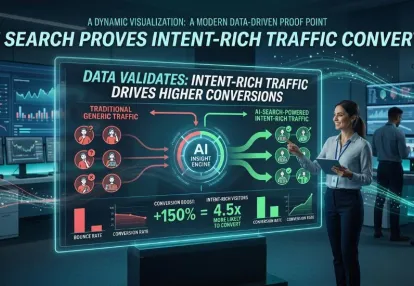
AI search is proving what push and native advertisers have understood for years: intent matters more than impressions. AI-referred visitors arrive after researching, comparing, and narrowing their options, producing smaller but higher-value audiences. The same principles—specificity, credibility, strong message-to-landing-page alignment, and competitive intelligence—can help marketers improve both paid campaigns and AI visibility.
Google's growing use of its own properties in AI results is reducing the visibility and traffic available to external publishers and brands. As AI Mode reshapes search discovery, performance marketers can reduce their dependence on Google by exploring push, pop, and TikTok in-stream advertising—using competitive ad intelligence to identify proven campaigns and enter alternative channels before costs rise.
As AI automates more of the performance marketer's execution work, human pattern recognition is becoming more valuable—not less. The competitive edge comes from studying live competitor campaigns, recognizing shifts across channels, and using those insights to give AI stronger strategic inputs. Ad intelligence becomes the training ground for better judgment, while automation turns that judgment into action at scale.
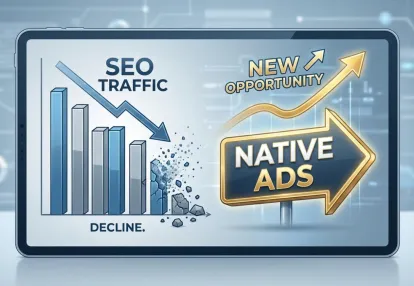
As Google search traffic declines, publishers are under growing pressure to replace lost revenue, creating new opportunities for native advertisers. Performance marketers can use competitive ad intelligence to identify undervalued publisher inventory, study proven campaigns, test networks, and secure favorable placements before pricing and competition normalize.
TikTok's growing ability to detect AI-generated content is changing how advertisers should approach creative. With billions of videos already labeled and stronger enforcement emerging, synthetic creative carries increasing distribution and compliance risks. For performance marketers, human-first content—real creators, real footage, and authentic testimonials—can provide a stronger combination of trust, algorithmic performance, and resilience against detection.