Native Ads, Push Ads, TikTok Ads
11 minNovember 17, 2026

Our spy tools monitor millions of native ads from over 60+ countries and thousands of publishers.
Get StartedMost marketers still approach AI Overviews and ChatGPT-style answers through a traditional SEO mindset: How do I rank in this new space?
That question matters, but it misses another opportunity.
Answer engines can also provide a useful source of competitive intelligence. They reveal the brands, products, explanations, and narratives that appear in response to conversational buyer questions. When monitored systematically, these answers can help marketers understand how a category is being described and which topics deserve further advertising research.
Traditional SEO tools organize demand around keywords. Answer-engine research adds another layer: prompts — the conversational questions people use to describe problems, compare products, and evaluate solutions.
For example, buyers may ask:
These questions reveal more than search terms. They expose the language, concerns, and decision criteria that marketers can investigate when developing native, push, and TikTok campaigns.
The opportunity is to connect two different research layers:
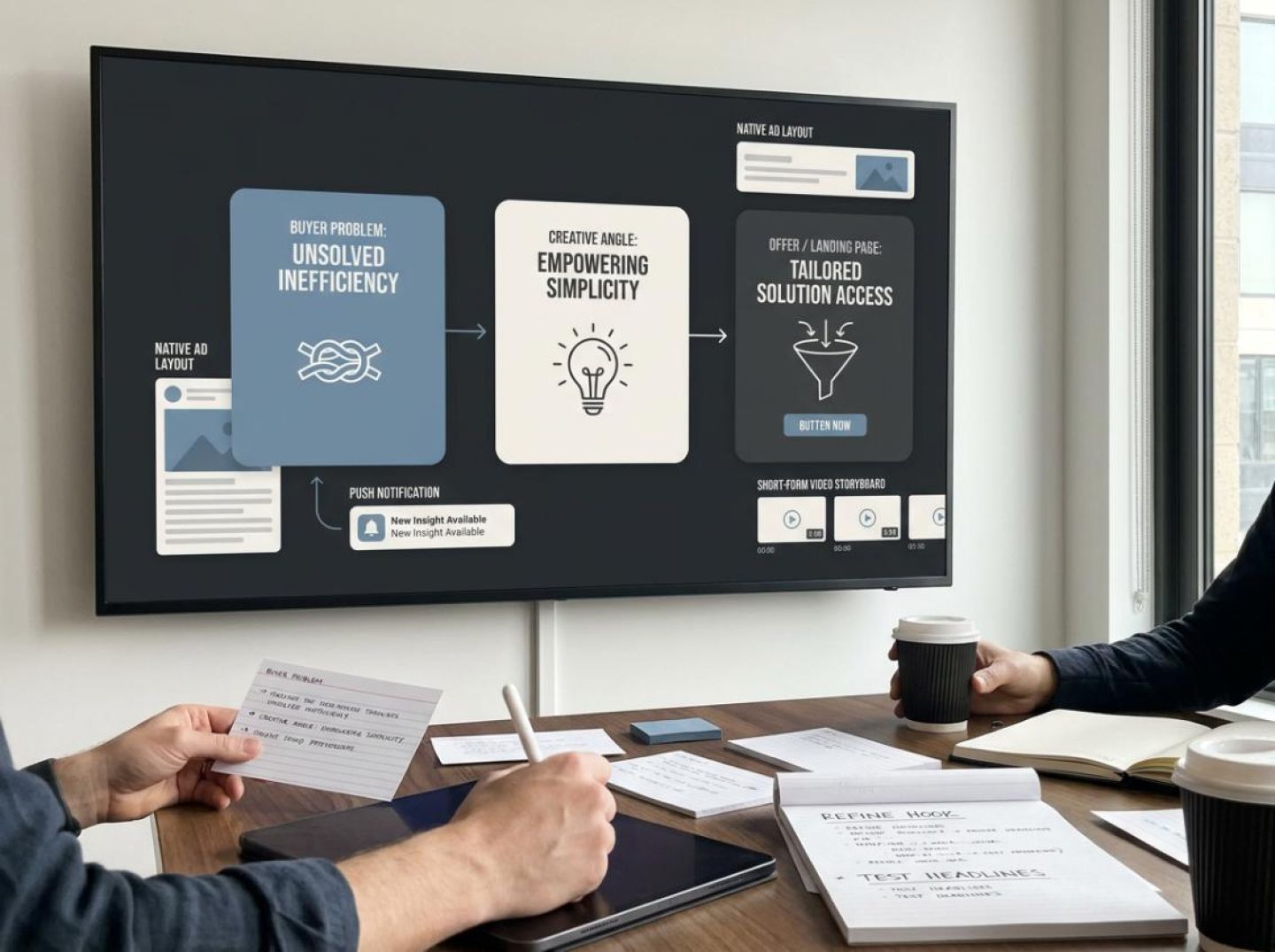
Together, these layers create an Answer Engine Spy Stack: a repeatable research process that turns conversational discovery signals into better-informed advertising hypotheses, creative briefs, and landing-page ideas.
The goal is not to assume that an AI recommendation proves a campaign is profitable. It is to use answer-engine visibility to decide what to investigate next — then use advertising intelligence to study how similar market narratives are being presented to buyers.
Answer Engine Optimization (AEO) is often treated as a simple extension of SEO: another way to earn visibility in search results. But AI-generated answers introduce a different kind of research opportunity.
Instead of looking only at rankings and clicks, marketers can study which brands and sources appear when buyers ask conversational questions.
HubSpot’s framework for AI search behavior highlights the importance of understanding the questions customers ask AI systems, rather than focusing exclusively on traditional keyword lists. Those questions can reveal:
Once you begin collecting prompts through an AEO platform, AI visibility tool, or structured manual research process, you can compare which brands appear across different questions.
For example, your company might appear in answers about basic product features but disappear from recommendations involving implementation, pricing, or industry-specific use cases.
These visibility gaps can be useful research signals. Backlinko’s discussion of PR and SEO collaboration provides context for how brands can identify opportunities to strengthen their authority and content coverage around topics that matter to their audiences.
This is where the idea that AEO is simply “SEO 2.0” becomes limiting.
Traditional SEO often measures performance around specific keywords and search positions. Answer-engine research can also examine topical breadth and entity presence across related conversational questions.
A brand might rank well for “CRM for small business” while appearing less frequently in answers to related prompts such as:
HubSpot’s analysis of AI Overviews and SEO discusses how AI-generated search experiences can expand beyond a single query into related questions and topics.
For paid media teams, this creates three useful research inputs.
AI answers often summarize products using recognizable positioning themes: budget-friendly, beginner-friendly, enterprise-ready, or designed for creators.
MarTech’s article on three things to know about AI-native advertising emphasizes the importance of clear and differentiated value propositions in conversational discovery environments.
If answer engines repeatedly describe a competitor as the default choice for beginners, that may indicate a positioning opportunity. You can investigate whether your own product has a stronger benefit, a more specific use case, or a different audience to address.
Repeated prompts and follow-up questions can provide a useful source of language for advertising research.
If buyers repeatedly ask about saving time, avoiding technical complexity, or reducing unnecessary expenses, those themes may be worth exploring in native headlines, push notifications, and TikTok scripts.
You can then investigate how advertisers in the same category communicate similar benefits. For example, TikTok ad research tools and the AI-powered Content Suite discussed by Social Media Examiner can provide additional context for studying short-form creative approaches.
The point is not to copy an AI answer. It is to identify recurring customer concerns and examine how advertisers translate comparable concerns into creative messages.
A brand may have useful expertise that is not reflected in the answers appearing for important category prompts.
Backlinko’s guidance on PR and SEO collaboration discusses the value of clear, extractable content assets. These can include concise explanations, well-structured sections, supporting evidence, and useful summaries.
Those same principles can inform advertising content. A clear research finding, comparison, or practical explanation can become the foundation for an article, an advertorial angle, or a short-form video concept.
However, an AI citation should not automatically be treated as proof that a message will convert. It is a signal about visibility and source selection, not a measurement of advertising performance.
The important shift is this: answer engines are not only places where marketers want to be found. They are also places where marketers can observe how their category is being discussed.
When that research is connected to ad intelligence, it can inform media buying, creative testing, and content planning.
Before you can connect AI answers to advertising research, you need a structured picture of the answer-engine landscape.
That means mapping three things:
People increasingly describe their needs through full questions and specific scenarios.
Instead of searching only for “best XYZ tool,” a potential customer might ask:
HubSpot’s AI search behavior framework provides a useful starting point for identifying customer questions and understanding how they relate to business context.
You can build an initial prompt list from several sources:
The objective is to create a research dataset that reflects how buyers describe their needs, rather than relying entirely on a list of industry keywords.
Once you have seed prompts, use AI visibility tools and manual checks to record which brands, publishers, and pages appear in the answers.
Semrush offers an AI Visibility Toolkit, while the supplied draft references Backlinko's PR and SEO resource as a related source for visibility and authority research.
For each prompt, record:
AI answers can change by platform, prompt wording, location, and observation date. Treat your findings as dated snapshots, not permanent rankings or a universal picture of what every buyer sees.
After collecting prompts and answers, look beyond the brand names.
For each high-value prompt, ask:
MarTech's discussion of AI-native advertising emphasizes the importance of making products and value propositions clear in conversational discovery environments.
This gives marketers a useful framework for reviewing the narratives that appear in AI answers. It does not reveal the private logic behind a model's response, but it can show which messages and sources are visible in the observed output.
Once prompts and narratives are mapped, look for three types of opportunities.
1. Prompt gaps
These are questions where the buyer's problem is clear, but the answer does not provide a strong or relevant commercial solution.
Semrush's marketing strategy framework discusses aligning marketing with how buyers discover and compare options.
A prompt gap can help you identify a topic worth investigating for an educational advertorial, comparison page, or push campaign. It does not automatically mean there is no competitor serving that demand elsewhere.
2. Narrative gaps
These occur when answer engines repeatedly surface a concern or aspiration, but the visible answers do not fully address it.
For example:
HubSpot's research into AI Overviews and AEO provides context for the way AI search experiences can expand across related conversational questions.
Repeated themes can inspire TikTok scripts, native advertorials, and push messages. Before using them, validate that the l
3. Authority gaps
These appear when a competitor or publisher is repeatedly cited as an authority, but the content you review seems incomplete, outdated, or poorly matched to a particular buyer need.
Backlinko's PR and SEO collaboration guidance discusses ways to build useful content assets and strengthen visibility.
From an advertising perspective, an authority gap may suggest a counter-positioning opportunity. For example, you could investigate whether a more current comparison, a clearer explanation, or a different use case deserves its own creative angle.
Answer-engine outputs and advertising platforms change. A one-time audit will quickly become outdated.
Build a repeatable process that includes:
The same principle applies to ad creative research. TikTok's Symphony Creative Studio is an example of how AI-assisted creative tools are becoming part of the advertising workflow.
Your answer-engine research should be similarly adaptable. New prompts and narratives can become ideas to investigate across native, push, and TikTok advertising.
An AI answer is not a complete sales funnel. But it can contain clues about how a buyer's problem is being framed, which benefits are emphasized, and what types of solutions are being presented.
Your task is to examine those clues and translate them into advertising hypotheses.
Start with the structure of the answer, not just the brand names.
For example, an answer might say:
“For budget-conscious beginners, X is a strong choice because it is easy to use and offers a free starting plan.”
That sentence contains several elements:
These elements can help you develop a creative brief, but they do not reveal the advertiser's actual targeting settings or the internal reasoning behind the AI response.
Instead of asking only, “Why is this brand appearing?”, ask three more useful questions.
Look for action words and transitions:
If an answer describes a journey such as “learn → compare → try a free tool,” you can use that structure as inspiration for a native advertorial or a TikTok hook-to-CTA sequence.
The journey is a creative hypothesis, not proof that the brand uses that exact funnel.
Angles are the emotional or practical frames that make a recommendation relevant to a particular buyer.
Common examples include:
When an answer repeatedly emphasizes a particular audience or pain point, consider whether that theme deserves a place in your advertising research.
HubSpot's overview of AI search behavior discusses the importance of direct answers to customer questions. The same customer-focused approach can help marketers develop clearer ad messaging.
AI answers may mention entry offers without displaying an actual advertisement.
Examples include:
These are offer archetypes worth recording when they appear repeatedly across a category.
Do not assume that an answer engine's mention of an offer proves it is the most successful offer in the market. Instead, use it as a starting point for investigating how advertisers present similar offers and what alternatives they use.
Once you have identified a potential audience, angle, and offer, adapt the idea to the advertising format.
For native and push advertising
Use recurring customer questions as inspiration for headlines.
For example:
A native advertorial can follow a similar educational structure:
For push advertising, compress the same idea into a short message that focuses on one clear concern or benefit.
For TikTok advertising
An answer that explains a problem, why the usual solution may not work, and what to consider next can inspire a three-part video structure.
You can map the answer into:
TikTok's Symphony tools and related creative workflows are discussed in the supplied Social Media Examiner article.
Use these structures as creative starting points rather than assuming that an AI answer is a proven script.
The omissions in an answer can be just as useful as the details it includes.
If an answer gives a product recommendation but says little about pricing, implementation, or niche use cases, those areas may suggest questions worth addressing in your own content.
Potential angles include:
The goal is not to exploit inaccurate answers or manufacture fear. It is to identify unanswered buyer questions and create genuinely useful advertising content around them.
You have mapped prompts. You have reviewed answer narratives and identified potential angles and offers. Now you need a workflow that connects those findings with the advertising creatives and destination pages you can research.
Think of the Answer Engine Spy Stack as two complementary layers:
The advantage comes from connecting the two research layers into a repeatable process.
Many media buyers begin their research by searching for the best-performing or most popular ads in a niche.
An alternative approach is to start with the questions and topics that appear in answer-engine research.
Platforms such as Semrush's AI visibility resources and HubSpot's AI search behavior framework can help marketers organize the prompts and topics they want to monitor.
Build a list containing:
Then translate those findings into research inputs for Anstrex:
For example, a repeated question about reducing back pain while working at a desk might inspire a research theme around ergonomic products. You could then investigate how advertisers in that category communicate product benefits and direct users to relevant landing pages.
When using Anstrex, focus on the visible information available in the platform. Ad research can help you examine creative messaging and destination-page approaches, but it does not reveal private advertiser metrics, targeting settings, or internal optimization decisions.
The purpose of this step is to make your advertising research more focused.
Answer engines may present information as comparison tables, pros-and-cons lists, step-by-step guides, or “best for” recommendations.
These answer structures can inspire the types of advertising creatives and landing pages you investigate.
Native ads
If your research repeatedly surfaces “top five” recommendations or “best for [audience]” answers, investigate listicle-style pre-landers and comparison pages.
Look at how advertisers introduce the problem, organize their recommendations, explain product differences, and present the next step.
Push ads
If prompts repeatedly focus on an urgent or frustrating problem, investigate how push advertisers communicate that concern in a short headline and visual.
The goal is to understand how different advertisers frame the same problem — not to assume that a dramatic message is effective simply because it is visible.
TikTok ads
If answer engines frequently provide mini-guides or step-by-step explanations, use that structure as inspiration for short-form video research.
TikTok's AI-assisted creative tools and advertising workflows provide context for the growing use of AI in video ideation and production.
A possible video structure is:
The key is to align the information structure across the answer, ad, and landing page. That can make the buyer journey easier to follow, provided the message is accurate and the destination fulfills the promise.
The process should not end after you find interesting ads.
Use the creative and landing-page patterns you observe to generate new content ideas, then monitor whether those topics appear in answer-engine research over time.
Semrush's marketing strategy framework discusses the importance of adapting marketing activity as markets and buyer behavior change.
You can apply the same iterative approach to your spy stack:
HubSpot's AI search behavior resource and Backlinko's PR and SEO guidance offer additional context for structuring content around buyer questions and visibility.
This creates a continuous research loop:
One important distinction: this process does not prove that an ad is profitable, that an AI answer caused a purchase, or that an advertising creative directly influences an answer engine. Those outcomes require separate performance and attribution evidence.
The Answer Engine Spy Stack is valuable because it connects two complementary views of the market: what buyers ask and what advertisers visibly communicate.
Prompt and answer capture is where the spy stack becomes an operational research process.
If you are not recording what people ask, how answer engines respond, and which sources are cited, you have no consistent dataset to compare over time.
Most teams will benefit from a hybrid setup:
Together, these sources can help you build a dataset of prompts, answer formats, URLs, entities, and citations that informs advertising research.
Start with customer and CRM information
If your team uses HubSpot, its AI search behavior framework discusses how business context can help identify relevant customer prompts.
Potential inputs include:
Use those inputs to create seed prompts that reflect real buying situations:
For each prompt, check the relevant answer engines and record:
HubSpot's AI search behavior resource emphasizes the importance of understanding the questions customers actually ask AI systems.
Treat this as ongoing customer research, not a one-time visibility audit.
Expand the research with AI visibility tools
Next, use AI visibility tools to broaden your view beyond your own CRM data.
The supplied draft references Semrush's AI Visibility Toolkit and Backlinko's PR and SEO resource in this context.
Organize your prompt research into three groups:
Review the data regularly. For each important prompt, record:
Semrush's marketing strategy framework provides broader context for keeping marketing plans aligned with how buyers currently discover and compare brands.
Create a manual prompt and answer log
A spreadsheet or Notion database can act as the connective layer between your AEO research and advertising research.
Useful columns include:
| Field | What to record |
|---|---|
| Prompt | Exact wording, including modifiers such as “for beginners,” “2026,” or “cheap” |
| Engine | Gemini, ChatGPT, Perplexity, or another answer engine |
| Capture date | When the answer was checked |
| Answer shape | Ranked list, mini-guide, comparison, decision tree, or definition |
| Emotional angle | Risk avoidance, budget, speed, simplicity, or social proof |
| Cited URLs | The leading sources shown in the answer |
| Entities | Brands, products, publishers, influencers, or frameworks mentioned |
| Persona | The intended buyer profile, if one was used in the test |
This changes the question from “Do we rank for this?” to “How is this topic being answered, and which brands are visible in that answer?”
MarTech's AI-native advertising article offers additional context for the importance of clear product positioning in conversational discovery.
Finally, connect your prompt log to creative research. If an answer engine repeatedly mentions a particular brand, product category, or buyer concern, use those terms as starting points when researching advertising creatives.
The supplied Social Media Examiner discussion of TikTok advertising tools describes how marketers can use creative research tools to explore ads by brand, industry, and objective.
Each relevant row in your prompt log can become a small research brief: a buyer question, a set of visible brands, a recurring concern, and a topic to investigate across native, push, and TikTok advertising.
Once prompts, answers, and citations are being captured consistently, the next step is to turn the raw information into a usable research structure.
Narrative and entity mapping organizes your findings around three dimensions:
Think of each prompt-and-answer pair as a small story.
It has a buyer with a particular need, a problem to solve, and a set of brands or product types presented as possible solutions.
Your job is to organize those elements into a consistent taxonomy.
1. Categorize by niche
Start by tagging each prompt according to its market and category.
For example:
A prompt such as “best chewable calming treats for small dogs” should belong to a relevant category rather than remain an isolated research entry.
Semrush's marketing strategy framework provides broader context for organizing marketing activity around market segments and buyer needs.
The objective is to make your prompt clusters useful for campaign planning and landing-page research.
2. Map buyer intent
Conversational prompts often provide more context than short keyword phrases.
Use a simple intent classification system:
For example:
| Prompt | Possible intent |
|---|---|
| “What are signs my dog needs calming treats?” | Problem awareness and education |
| “Do calming treats or prescription medication work better for dog anxiety?” | Solution comparison |
| “Are XYZ brand chews safe for small dogs?” | Brand verification and purchase research |
You should also categorize the answer itself.
Does the engine provide a definition, a step-by-step explanation, a recommendation list, or a product comparison?
That format can inform the content you research next. A comparison-style answer may inspire a native listicle, while a how-to answer may suggest a short educational video.
HubSpot's AI search behavior resource provides context for organizing buyer questions around the customer journey.
3. Identify and normalize entities
Entities are the recognizable brands, products, people, and concepts appearing in the answers.
For advertising research, organize at least four types.
MarTech's coverage of AI-native advertising provides additional context for organizing product information around clear problem-and-solution messaging.
Make the mapping consistent
Use a simple three-step workflow:
These clusters can help organize advertising research and content planning.
Connect the map to your creative workflow
Once the prompt and entity map is organized, use it to develop more focused research briefs:
AI-assisted tools such as TikTok's creative and advertising solutions can provide additional context for developing and researching short-form creative concepts.
Narrative and entity mapping turns a collection of AI answers into an organized market-research resource. It helps you see which buyer questions, product categories, and brand mentions deserve further investigation — and gives your advertising team a clearer starting point for developing relevant creative ideas.
An Answer Engine Spy Stack brings two research activities together.
AEO research helps you understand the prompts buyers use, the answers they receive, and the brands and sources that appear in those answers. Anstrex helps you investigate visible advertising creatives and destination pages across supported advertising channels.
The value is in connecting those observations without confusing them with proof of campaign performance.
Start with a structured prompt log. Categorize the questions by niche and intent. Record the brands, products, and sources appearing in the answers. Then use those findings to guide your advertising research in Anstrex.
From there, turn useful observations into creative hypotheses, landing-page ideas, and content briefs. Review the results, update your research, and repeat the process as buyer questions and advertising messages change.
The result is a more connected approach to competitive intelligence: understand what buyers are asking, investigate what advertisers are showing, and build your next creative strategy around evidence rather than guesswork.
Source completeness note: The uploaded draft ends after the “Narrative & Entity Mapping” subsection. This conclusion is an editorial addition to provide a complete ending for the supplied material; it does not represent a missing original section.
Receive top converting landing pages in your inbox every week from us.
Most Read
AI answers reveal the questions, brands, and narratives shaping buyer discovery. Learn how to capture those prompts, map their intent and entities, and connect the insights with Anstrex to research advertising creatives and landing pages across native, push, and TikTok.
Elena Morales
7 minNov 17, 2026
How-To
ChatGPT is changing how people research products and make decisions. Learn how to study conversational intent, identify creative patterns, and test those insights across Native, Push, Pops, and TikTok.
Elena Morales
7 minNov 12, 2026
Trending
TikTok can reveal creative angles, audience problems, and offers worth investigating. Discover how to use Anstrex In-Stream to research TikTok campaigns, build in-app funnel experiences, and adapt the strongest messaging patterns for Native, Push, and Pop advertising.
Dan Smith
7 minNov 7, 2026