9 minNovember 8, 2026

Our spy tools monitor millions of native ads from over 60+ countries and thousands of publishers.
Get StartedAI search, long-tail intent research, and competitive intelligence from platforms like Anstrex give performance marketers new ways to understand what people are looking for, how they describe their problems, and how advertisers communicate solutions. Yet much of that research never makes it into campaign decisions. It stays buried in screenshots, research documents, and presentations.
As consumers increasingly use conversational queries and AI assistants to explore products and services, their intent becomes more specific and context-dependent. Traditional audience personas often struggle to capture these changing needs. Research from Real FiG Advertising & Marketing and illumin discusses how AI is reshaping search behavior and brand visibility. Meanwhile, MarTech highlights the growing role of behavioral and intent signals in AI-native advertising.
The opportunity is not simply to collect more information. It is to turn that information into something a media buyer can use, a creative team can understand, and an AI-assisted workflow can follow.
One practical way to do this is through job stories: short descriptions of what someone is trying to accomplish in a particular situation, what they need, and why the outcome matters.
Instead of organizing campaigns around broad demographic labels, marketers can develop more useful statements such as:
When a first-time crypto investor gets frustrated by transaction fees, they want a safer and more affordable way to move money so they can invest with greater confidence.
This kind of insight gives campaign teams a clearer starting point for their targeting, creative concepts, landing pages, and offers across native, push, pop, and TikTok advertising.
This guide explains how to mine AI search experiences and long-tail queries for customer intent, combine those findings with competitive advertising observations from tools like Anstrex, and turn the results into testable job stories. It also explores how these stories can provide human-defined direction and guardrails for AI-assisted media buying.
Demographic segmentation became popular because it gave marketers a practical way to organize audiences when behavioral information was limited.
A description such as “women aged 25–54, urban, with household income above $100,000” provides a basic audience profile. However, it does not explain what those people are trying to accomplish, what problem they are facing, or why they might respond to a particular offer.
Demographics describe characteristics. They do not necessarily explain intent.
That distinction is becoming more important as three changes reshape how consumers discover and evaluate products.
Traditional keyword research often focused on matching a search phrase with a relevant page. Conversational AI experiences make that process more complicated.
A person asking a detailed question may have several related needs hidden inside the original query. AI systems can break a broad question into narrower searches and combine information from multiple sources to produce an answer. This process is commonly described as query fan-out, as discussed by Contently.
For example, someone researching a marketing strategy might need to:
These are different tasks, even though they may originate from one question.
That means a campaign or content strategy built around a broad label such as “B2B marketing director” may miss the more valuable context: the person needs to justify a marketing investment before the next planning meeting.
The job is not simply to reach a marketing director. It is to help that person make a defensible business decision.
People encounter products and services across search engines, social feeds, video platforms, and AI-assisted discovery experiences.
The same person may be researching a product in the morning, watching a related video in the afternoon, and comparing prices later that evening. Their immediate needs can change throughout that journey.
Google Discover's reported direction toward a more anticipatory, AI-driven experience illustrates this broader shift. Search Engine Journal discusses changes that could make discovery more responsive to users' interests and activities.
For marketers, this reinforces the importance of understanding the context behind an interaction.
A broad audience label such as “young adults aged 18–24” does not tell a media buyer whether someone is:
These situations can create very different advertising opportunities, even when the people involved share similar demographic characteristics.
AI-driven advertising systems can use available behavioral, contextual, and engagement signals to help determine which messages and opportunities are relevant.
As MarTech explains, AI-native advertising is changing how marketers think about audience selection and campaign delivery.
Rather than relying exclusively on predefined audience categories, marketers increasingly need to understand the problems, motivations, and decision contexts behind customer activity.
Consider two small-business owners:
Both may belong to the same demographic or business audience. However, their immediate jobs are different.
The first needs a manageable migration process. The second needs a way to improve internal adoption.
Their campaigns should reflect those differences.
AI-assisted search and discovery can influence product research before a person visits a website or clicks an advertisement. This makes the customer journey harder to understand through a single traffic or conversion report.
Some marketers are therefore examining additional indicators, including:
Ahrefs outlines approaches to measuring AI search visibility and understanding how brands appear in these experiences.
These measurements can provide useful discovery and visibility signals. However, an AI citation or brand mention does not automatically prove that a customer saw the brand, clicked an advertisement, or converted because of that exposure.
The central problem with classic segmentation is that it describes the audience without fully explaining the job.
Demographics and personas can still provide useful background information. But performance marketers need another layer of insight: the concrete progress someone wants to make in a particular situation.
That is where job stories become useful.
Traditional keyword research asks a straightforward question:
What are people searching for?
Job-story research asks something more specific:
What is happening in someone's life or work when they search for help?
The objective is to identify the situations, triggers, constraints, and concerns behind a query.
These moments can often be expressed as:
These phrases help reveal the context surrounding a person's search.
Instead of beginning with broad keywords, start by examining the search language already associated with your business.
Useful sources include:
Research from Real FiG discusses how AI usage may affect different types of search behavior, including informational and commercial queries.
Treat these findings as a reason to examine your own search and conversion data rather than assuming every industry will experience the same change.
As you review your query data, look for three important patterns.
1. Question-shaped queries
Examples:
These queries reveal the questions people are trying to answer.
2. Long-tail modifiers
Examples:
These details expose the constraints that influence a decision.
3. Timing and trigger phrases
Examples:
These phrases reveal why the person needs a solution now rather than later.
Search data is only one part of the picture.
You can also examine customer questions from:
The goal is to understand the language customers use naturally.
For example, someone might not search for “CRM migration software.” They may ask:
When I'm moving away from spreadsheets, how can I switch to a CRM without losing customer information?
That question communicates more than the product category. It reveals a situation, a concern, and an intended outcome.
This reflects the broader shift toward intent-rich research discussed in MarTech's analysis of AI-native advertising.
Once you have collected relevant queries, translate each one into a consistent format:
When I [situation or trigger] and [constraint or concern], help me [desired progress] so I can [ultimate outcome].
Consider these examples.
Example 1 — Returning to exercise
Example 2 — Moving to a CRM
The purpose is not to rewrite every keyword into a longer sentence. It is to uncover the recurring customer situation and desired progress behind groups of related queries.
AI search visibility can help identify topics and job-story themes worth investigating.
For example, if a brand's content repeatedly appears in AI-generated answers related to a particular customer problem, that may indicate that the topic is relevant to the brand's content strategy.
You can use frameworks such as Ahrefs' approach to measuring AI search visibility to monitor visibility patterns and compare topic coverage.
However, AI citations should not be treated as proof that a job exists at a particular commercial scale. Validate the opportunity using additional evidence, such as:
The outcome of this stage should be a searchable library of job stories tied to observable customer language.
That library becomes the foundation for the next step: identifying the central outcome that connects different queries and customer situations.
The “When I…” moment explains the situation. But a situation alone does not tell a media buyer what message to deliver.
The next step is to identify the outcome the person is trying to achieve.
This is the job core: the central “I want to…” statement that remains consistent even when the wording, channel, or format changes.
Consider this query:
When I've tried three CRMs and my sales team still won't use them, what should I do next?
The situation contains several clues:
The underlying job core might be:
I want to get my sales team consistently recording customer information without having to constantly remind or pressure them.
This outcome can appear in many different queries:
These questions are different expressions of a similar underlying job.
This is important because AI search experiences can expand a question into related sub-queries through query fan-out, as explained by Contently.
If marketers build a separate campaign for every wording variation, they may create unnecessary complexity. Grouping queries around shared job cores can provide a more consistent strategic foundation.
A customer's desired outcome may remain stable while their questions change as they move closer to a purchase.
For practical campaign planning, consider three broad stages.
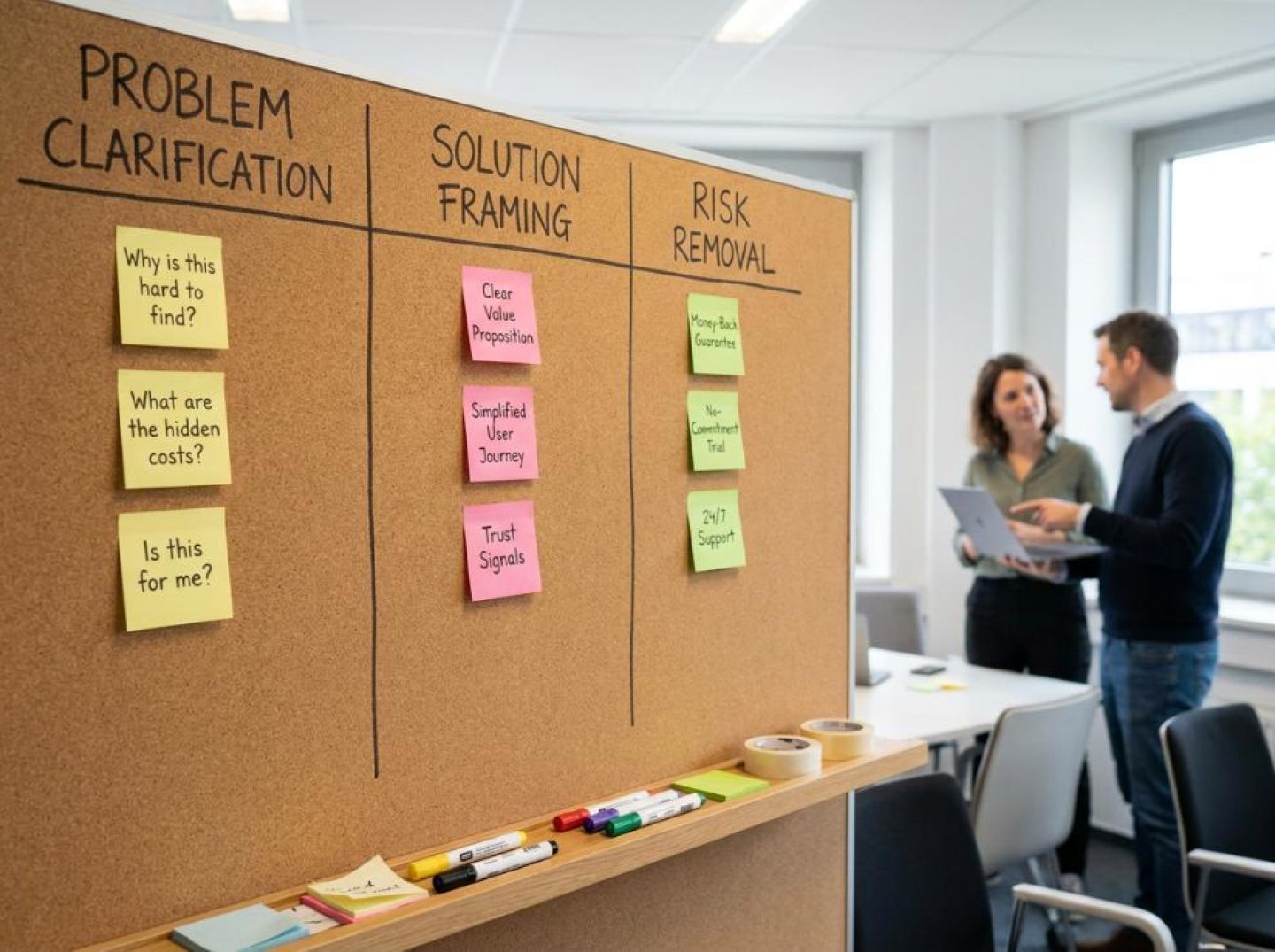
1. Problem clarification — “I want to understand…”
The person is still trying to understand what is wrong.
For the CRM example, this might sound like:
I want to understand why my sales team dislikes using our current CRM.
At this stage, the person may need educational content that explains the problem, introduces possible causes, and helps them identify what needs to change.
As discovery experiences such as Google Discover evolve, Search Engine Journal discusses how content discovery may become more responsive to user interests and context.
Media objective: Introduce the problem and provide useful information without forcing an immediate purchase decision.
2. Solution framing — “I want to figure out my options…”
The person understands the problem and is comparing potential solutions.
For the CRM example:
I want to find a system my sales team will actually adopt.
This is where product comparisons, demonstrations, feature explanations, and commercial search terms can become important.
A Real FiG analysis examines how informational and high-intent search behavior may respond differently to AI usage.
Media objective: Present relevant solutions and explain how they address the specific job, rather than relying on generic product feature lists.
3. Risk removal — “I want to be sure before I decide…”
The person has a preferred solution but still needs reassurance.
For the CRM example:
I want to be sure this won't become another failed rollout that makes my team lose confidence in the process.
Useful messaging at this stage may include:
Content that answers related questions can also improve the usefulness of a brand's overall information coverage. Contently discusses how query fan-out can involve several connected questions when AI systems assemble answers.
Media objective: Address uncertainty and help the customer evaluate the risks of moving forward.
Imagine two decision-makers:
They may have different demographics, professional backgrounds, and media habits. Yet both may share the same job:
I want to stop losing sales opportunities because our pipeline information is unreliable.
The job core gives the marketing team a shared outcome to work toward.
This does not mean demographic information should be discarded. It means demographic characteristics should complement a stronger understanding of customer needs.
Moz's guidance on agentic search also emphasizes broader topic and decision-stage coverage rather than relying on one page targeting one query.
Job cores help marketing teams:
Once the job core is clear, marketers can use competitive advertising observations to investigate how advertisers communicate the payoff customers want.
AI search and long-tail queries help marketers understand the situation and desired progress behind a customer question.
Competitive ad intelligence adds another perspective: how advertisers communicate the outcomes they believe will motivate people to respond.
This helps complete the job story:
When I [situation], I want to [desired progress], so I can [meaningful payoff].
The final part matters because customers are often interested in what a solution enables them to do, not simply the product itself.
For example, a bookkeeping service is not only selling bookkeeping. Its messaging may emphasize peace of mind, better financial visibility, time savings, or greater confidence when making business decisions.
Anstrex can help marketers examine visible competitor advertisements and the messaging, creative formats, and landing pages associated with them.
The objective is not to copy another advertiser's campaign. It is to identify recurring market messages and develop hypotheses worth testing.
Begin with a job story derived from actual customer questions.
For example:
When I realize my DIY bookkeeping has become difficult to manage, I want to get professional help so I can feel more confident about my financial records.
Instead of starting with a list of competing brands, ask:
Which advertisers are communicating with people who have this problem?
Use relevant search terms to explore visible advertisements. For this example, you might investigate phrases such as:
The objective is to find advertisements addressing the same customer concern, even when the advertised products or brands differ.
Once you have collected relevant ads, organize them by the outcome their messaging emphasizes.
For example:
| Payoff cluster | Example messaging |
|---|---|
| Avoid pain | Stop worrying about tax season |
| Save time | Get your books caught up faster |
| Gain control | Understand your business finances |
| Unlock growth | Know your numbers before hiring |
This approach helps identify the different promises advertisers are using to address similar customer needs.
It also makes creative research more useful. Instead of saving advertisements only by competitor or product category, you can organize them around the customer motivation they appear to address.
One useful thing to investigate is how advertising concepts change over time.
If an advertisement appears across multiple dates, placements, or geographic markets, or if an advertiser introduces several creative variations around the same message, those observations may suggest that the concept is worth continued testing.
However, visible ad activity does not reveal the advertiser's actual profitability.
An advertisement may remain active for reasons unrelated to strong returns, and an advertiser may have different objectives across campaigns.
The presence of repeated creative variations can help you form hypotheses about:
Research on AI and advertising technology, such as illumin's discussion of AI in adtech, provides broader context for the growing role of automation in advertising.
The important distinction is that Anstrex provides observable competitive advertising intelligence. It does not reveal another advertiser's private ROAS, conversion rate, acquisition cost, or internal optimization decisions.
The format and destination of an advertisement can offer additional clues about the way a message is being presented.
For example:
These are useful ways to develop hypotheses about messaging and funnel context. They are not definitive proof of the advertiser's intended audience or campaign stage.
Consider an advertisement with the message:
Finally get your books organized so you can sleep better at night.
You might classify its message as a reassurance-oriented payoff and test it in a context where customers need education, credibility, and answers to common concerns.
The advertisement is only part of the research.
When you examine the landing page behind a visible creative, look for details that explain the customer's situation.
These may include:
Specific circumstances
Trigger events
These details help identify when a particular payoff may become especially relevant.
You can then compare the landing-page language with customer queries and search behavior. A Real FiG analysis provides additional context for examining differences between informational and commercial search behavior.
The final step is to translate what you observed into a campaign hypothesis.
For example:
Hypothesis 1
When I'm behind on bookkeeping after raising funding, I want a clear picture of my financial runway so I can make hiring decisions with greater confidence.
Hypothesis 2
When I receive an unexpected tax notice, I want professional help understanding what to do next so I can address the issue without unnecessary delays.
Each job story can inform a campaign brief containing:
The value of Anstrex is not simply having a collection of competitor advertisements. It is using visible advertising activity as one research input to develop better questions, sharper creative hypotheses, and more relevant campaign tests.
A job story framework becomes valuable when a media buyer can use it to plan and launch a test.
That means moving beyond broad customer personas and creating a consistent structure that captures intent, customer motivation, messaging constraints, and campaign objectives.
A practical framework can be organized into three layers:
Start with a simple three-part statement:
Base job story
When I… [situation or trigger]
I want to… [core intent or desired progress]
So I can… [payoff or success outcome]
AI search queries, long-tail keywords, and customer conversations can help identify the first two parts of the statement. MarTech discusses the growing importance of intent and behavioral signals in AI-native advertising.
Competitive advertising research can provide additional ideas about how advertisers communicate the final payoff. Those observations should be treated as hypotheses, not proof that a particular message is profitable.
To make the framework useful for campaign planning, add the following fields:
| Field | What to capture |
|---|---|
| Decision stage | Problem-aware, solution-aware, vendor evaluation, switching |
| Dominant emotion | Anxiety, frustration, confidence, hope, urgency |
| Key concerns | Cost, risk, time, effort, trust, integration |
| Proof objects | Case studies, demonstrations, guarantees, calculators, verified statistics |
| Channel and placement | Search, native, push, pop, social feed, video |
| Creative guardrails | Approved claims, prohibited claims, compliance requirements |
| Campaign objective | Leads, purchases, qualified inquiries, retention |
| Measurement criteria | Conversion rate, cost per acquisition, lead quality, revenue |
This additional information makes it easier for media buyers, strategists, and creative teams to work from the same understanding of the customer.
A taxonomy helps organize job stories so teams can search, compare, and report on them consistently.
Three categories are a useful starting point.
Job type
This describes the kind of progress someone wants to make.
Examples:
These categories can connect to the different sub-questions that appear in complex search experiences. For example, a question about measuring B2B content marketing ROI may involve separate needs around measurement, business value, and executive reporting, as discussed by Contently.
Decision stage
Use a simple progression:
This helps distinguish a person who is just recognizing a problem from someone who is ready to compare offers or make a purchase.
Economic unit
Identify the business outcome connected to the job:
You can combine these categories into a consistent naming structure:
[Job Type] – [Decision Stage] – [Economic Unit]
For example:
Justify – Evaluation – Net New
This gives the team a clear way to organize job stories by customer need, purchase stage, and business objective.
The following examples demonstrate how the framework can be used to develop campaign ideas.
Job classification: Justify – Evaluation – Net New
When I…
I'm under pressure to prove that our content marketing budget is contributing to business results before the next quarterly planning meeting.
I want to…
Quickly gather credible ROI figures and performance benchmarks.
So I can…
Present a defensible, data-backed case for maintaining or increasing the marketing budget.
Signals that inform the job story
These queries can be grouped around the same underlying job rather than treated as entirely separate customer personas.
Media translation
Channels and placements
Creative and offers
Bidding and measurement
Prioritize commercially relevant queries that indicate an active need to evaluate or justify a marketing investment.
Track demo requests, qualified opportunities, and sales conversations associated with this job story rather than evaluating performance using keyword data alone.
A Real FiG analysis can provide context for examining the changing relationship between informational and commercial search behavior.
Job classification: Relieve – Trigger – Net New
When I…
Realize my home needs a deep clean before guests arrive or an important life event, such as moving or preparing for a new baby.
I want to…
Book a trustworthy cleaning service without spending hours comparing providers.
So I can…
Spend less time worrying about the condition of my home and focus on the event ahead.
Signals that inform the job story
Media translation
Channels and placements
Creative and offers
Bidding and measurement
Prioritize searches that indicate immediate or time-sensitive demand, such as “same-day home cleaning” or “deep cleaning before guests arrive.”
Track completed bookings, qualified inquiries, booking value, and customer acquisition cost.
The goal is to measure whether the job-story angle attracts customers who actually book the service, rather than assuming that urgency-related language automatically produces better results.
Moving beyond demographics does not mean abandoning audience segmentation. It means adding a more useful layer of context to the way marketing teams understand customers.
AI search and long-tail queries can reveal the situations, questions, and constraints behind customer intent. Competitive ad intelligence from tools like Anstrex can help marketers examine the messages, offers, creative variations, and landing pages advertisers are using to address similar needs.
When these observations are organized into job stories, they become easier to translate into practical campaign decisions.
A useful job story tells the team:
The most important distinction is between observing a pattern and proving that it works. Search visibility, repeated advertisements, creative variations, and landing-page messages are valuable research signals, but campaign performance still needs to be validated through actual results.
For performance marketers, the advantage comes from connecting those signals to clear, testable hypotheses.
Instead of starting every campaign with a demographic profile or a blank creative brief, start with the job the customer is trying to get done. Then use intent research, competitive intelligence, and campaign data to determine which messages deserve to be tested.
That is how scattered research becomes a more practical foundation for smarter media buying.
Receive top converting landing pages in your inbox every week from us.
Featured
Move beyond demographic personas by turning AI search queries and competitive ad intelligence into job stories that guide campaign targeting, creative strategy, and media buying decisions.
Marcus Chen
7 minNov 8, 2026
Editor’s Pick
More competitor data does not automatically lead to better campaigns. Discover how performance marketers can use Anstrex as an intelligence input for AI-assisted monitoring, creative and funnel clustering, market-change summaries, and prioritized testing hypotheses.
Samantha Reed
7 minNov 7, 2026
Announcement
Generic holiday marketing advice can quickly become outdated. Learn how to use competitive ad intelligence to study competitor campaigns, uncover creative and funnel patterns, and turn those observations into structured experiments for the 2027 holiday season.
Rachel Thompson
7 minNov 7, 2026