7 minSeptember 15, 2026

Our tools monitor millions of native, push, pop, and TikTok advertising campaigns.
Get StartedYour ads are quietly being graded by machines you’ll never see.
Not just your SEO content or glossy brand pages—your TikTok creatives, native advertorials, lead forms, quiz funnels, and checkout flows are being ingested as raw material for the next generation of AI agents, recommendation engines, and shopping copilots. These systems are deciding, in real time, which funnels look safe, credible, and conversion‑worthy—and which ones smell like risk.
In an AI-shaped internet, the question is shifting from “Does a human trust this ad?” to “Does a machine trust this funnel more than the alternatives?”
Consider how fast the journey is collapsing. As Neil Patel notes, the classic path of “Search → Website → Research → Cart → Purchase” is giving way to “Ask AI → Receive recommendation → Buy.” Google is wiring agentic shopping and native checkout into its Gemini experience, while OpenAI is experimenting with instant purchases inside ChatGPT. At the same time, Moz’s analysis of AI visibility shows that these systems don’t just answer one query and stop; they support stateful, follow-up exploration from first question to final purchase. That means your entire performance funnel—from ad click to post-purchase UX—can be traversed, summarized, and judged within a single AI-guided session.
If your funnels don’t radiate trust in machine-readable ways, those AI agents will quietly route high-intent buyers to competitors whose environments they “understand” and “trust” more than yours.
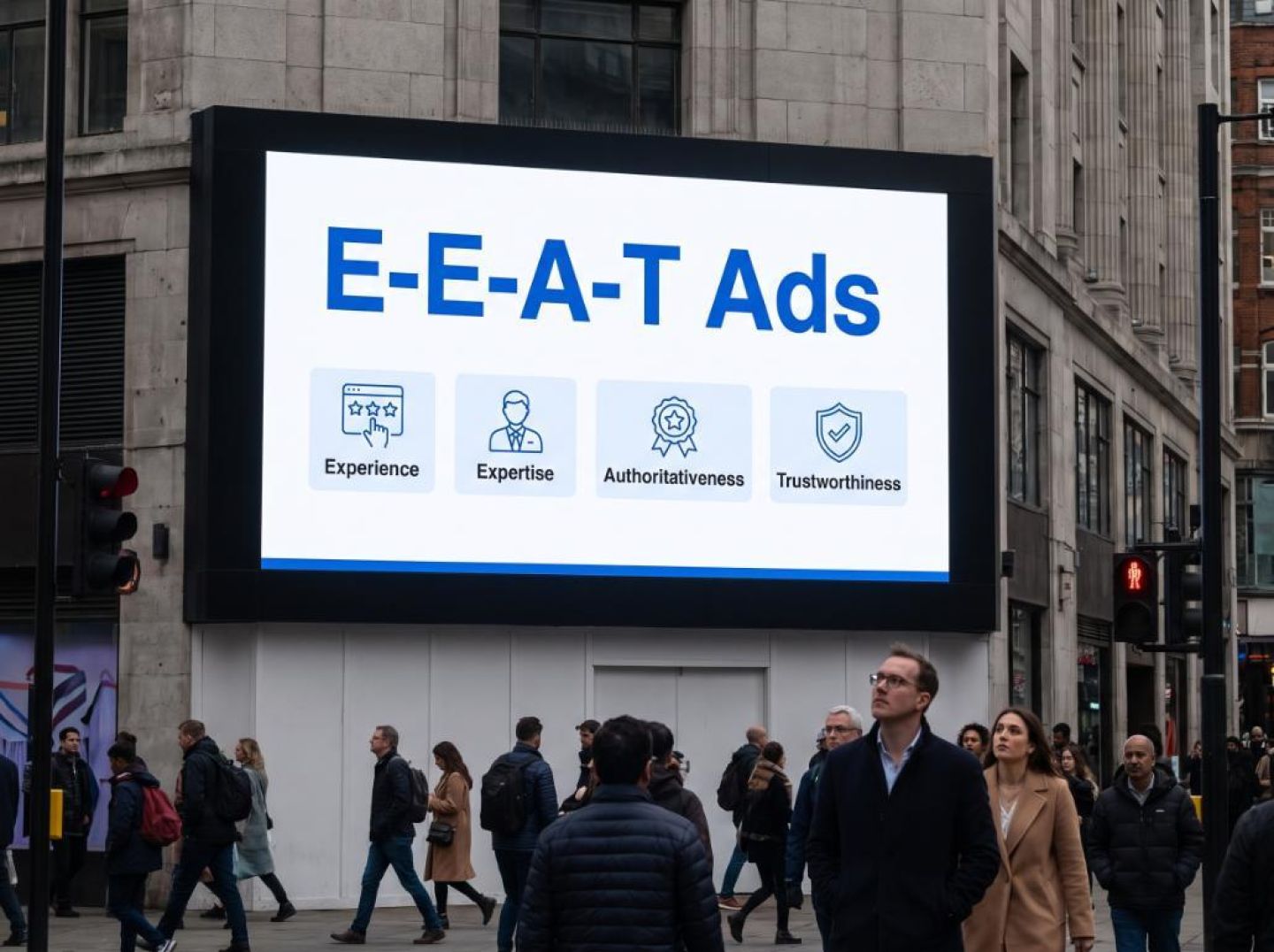
Marketers already know the language of E‑E‑A‑T: Experience, Expertise, Authoritativeness, and Trustworthiness. It emerged as a quality framework for human raters and algorithmic evaluation of content, especially for organic search and YMYL (Your Money or Your Life) topics. Most current discussion over-indexes on brand content and informational SEO—long-form guides, thought leadership, topical authority, digital PR. Those are still critical. But in an AI-native landscape, your performance assets are no longer exempt. Your ad accounts are now part of your E‑E‑A‑T footprint.
AI “answer engines” need to decide, in milliseconds, whether sending someone into your funnel is a good idea. As MarTech explains in its guidance on AI-native advertising, systems increasingly prioritize brands that show up with the “most relevant answer” rather than the loudest ad. That answer isn’t just the copy in your blog post; it’s the clarity of your offer on a pre-sell page, the transparency of your pricing table, the sanity of your returns policy, and the consistency of your product data across creatives, landers, and checkout.
Meanwhile, the traffic mix is shifting under your feet. A PPC study summarized by Real FiG Advertising & Marketing found that broader access to ChatGPT drove double‑digit declines in general search queries, while transactional and commercial intent searches remained remarkably stable. AI is absorbing the early‑stage, informational discovery work—and then either handing the final “ready to buy” moment back to search platforms, or closing the loop inside its own interface. Either way, the AI layer now acts as a filter on which ads and funnels even get the chance to compete for that stable, high-intent demand.
On top of that, these systems are increasingly autonomous. Agentic campaign managers and shopping copilots, described in MarTech’s overview of self-optimizing agents, can already adjust bids, placements, and creative on their own. Tomorrow, those same agents will decide not only how to buy media, but where to send it. If your funnel architecture looks opaque, spammy, or structurally inconsistent to a crawler that struggles with your JavaScript, as the team at Moz warns about some AI systems, you may never see the traffic you think you’re entitled to.
All of this reframes ads and landers as “AI-visible trust surfaces.” Every pixel and line of copy in your funnel is now a signal that can reinforce—or erode—E‑E‑A‑T as machines perceive it. It’s not enough for a human visitor to feel reassured; you need machine-recognizable trust patterns: structured policies in crawlable HTML, consistent product attributes, honest before‑and‑after claims backed by sources AI can verify, UX flows that don’t resemble known scam patterns.
The performance marketers who win the next decade won’t just be better at creatives and bids. They’ll be the ones who deliberately engineer funnels that AI agents can parse, validate, and confidently recommend—training machines to trust the path from ad impression to thank‑you page as much as they trust the logo at the top.
The classic funnel assumed a clean, linear journey: awareness at the top, consideration in the middle, conversion at the bottom. You bought attention with an ad, pushed people to a landing page, and squeezed out a measurable action. Then attribution tools told you which touchpoint “won.”
Zero-click AI search has shattered that sequence.
In AI Mode and other generative interfaces, users get a synthesized answer without ever visiting your site. As AdExchanger reported, more than 90% of early Google AI Mode queries were resolved without a click. Your brand, offer, and even your pricing may be summarized back to the user inside a result they never leave. The “top of funnel” is no longer a page impression; it’s whether you’re included—and framed as credible—inside that AI-generated response.
At the same time, consumer behavior is sliding toward conversational shopping. People are turning to AI assistants to compare products, weigh tradeoffs, and ask “what would you choose for me?” instead of manually scanning SERPs. Research highlighted by illumin shows rising use of generative AI tools for product research and shopping, with users expecting summarized answers drawn from many sources, not a list of blue links. That means your ad, your advertorial, and your checkout experience are no longer isolated steps; they are all raw evidence these systems can pull from to build or withhold trust in real time.
The result is a shift from funnels to “trust loops.” Unlike a funnel, a trust loop has no end state. As AdExchanger argues, trust doesn’t disappear after a click or a purchase; it’s a renewable asset that either compounds or erodes with every interaction. In an AI-mediated environment, each asset in your performance stack—pre-roll video, TikTok UGC, native article, quiz lander, order form—acts as a persistent credibility signal. These elements are crawled, clustered, and re-used as inputs every time an AI tries to decide, “Is this merchant safe? Is this promise believable? Is this experience worth recommending?”
Agentic AI compresses everything further. Google’s push toward AI-driven shopping and features like seamless, assistant-managed checkout mean the journey increasingly looks like “Ask → Get recommendation → Buy,” as Neil Patel noted. When an AI agent can handle comparison, couponing, and even placing the order, there may be only one or two moments when a human explicitly “sees” an ad or a landing page. But the agent can see everything: return policies, hidden fees, social proof quality, UX friction, and any mismatch between claims in your ads and reality on your site.
Critically, these systems are stateful. Users can move from broad research to specific purchase intent in a single conversational thread without ever “starting a new search.” As the team at Moz explains, AI search now supports follow-up exploration within the same session, and it pulls not just from your site but from reviews, media coverage, and social mentions. That means your paid assets are no longer one-off persuasion plays; they’re corroboration or contradiction of a larger narrative about your brand that the AI is constantly updating.
In this environment, “performance” can’t just mean extracting a conversion with aggressive urgency or clever UX. A lander that tricks 2% of visitors into buying but generates refund requests, angry reviews, or negative chatter is now a reputational toxin the AI can detect. A high-CTR ad that overpromises features or pricing may still drive clicks, but its copy will be compared against your product pages, customer feedback, and third-party coverage every time an assistant is asked, “Is this legit?”
As generative content makes traditional SEO and PPC tactics more interchangeable, the advantage shifts “upstream” to trust: who is recognized as a reliable entity, whose claims are corroborated, whose experiences look consistently positive across channels. According to TopRank’s guidance on E-E-A-T, the same signals that help LLMs treat your content as authoritative—experience, expertise, visible credentials, and original proof—are now the ones that keep your ads and funnels in an AI’s circle of confidence.
In other words: your ads and landing pages are no longer discrete conversion hacks. They’re durable trust artifacts feeding a continuous loop, where human journeys are messy and nonlinear but machine evaluation is relentless and cumulative.
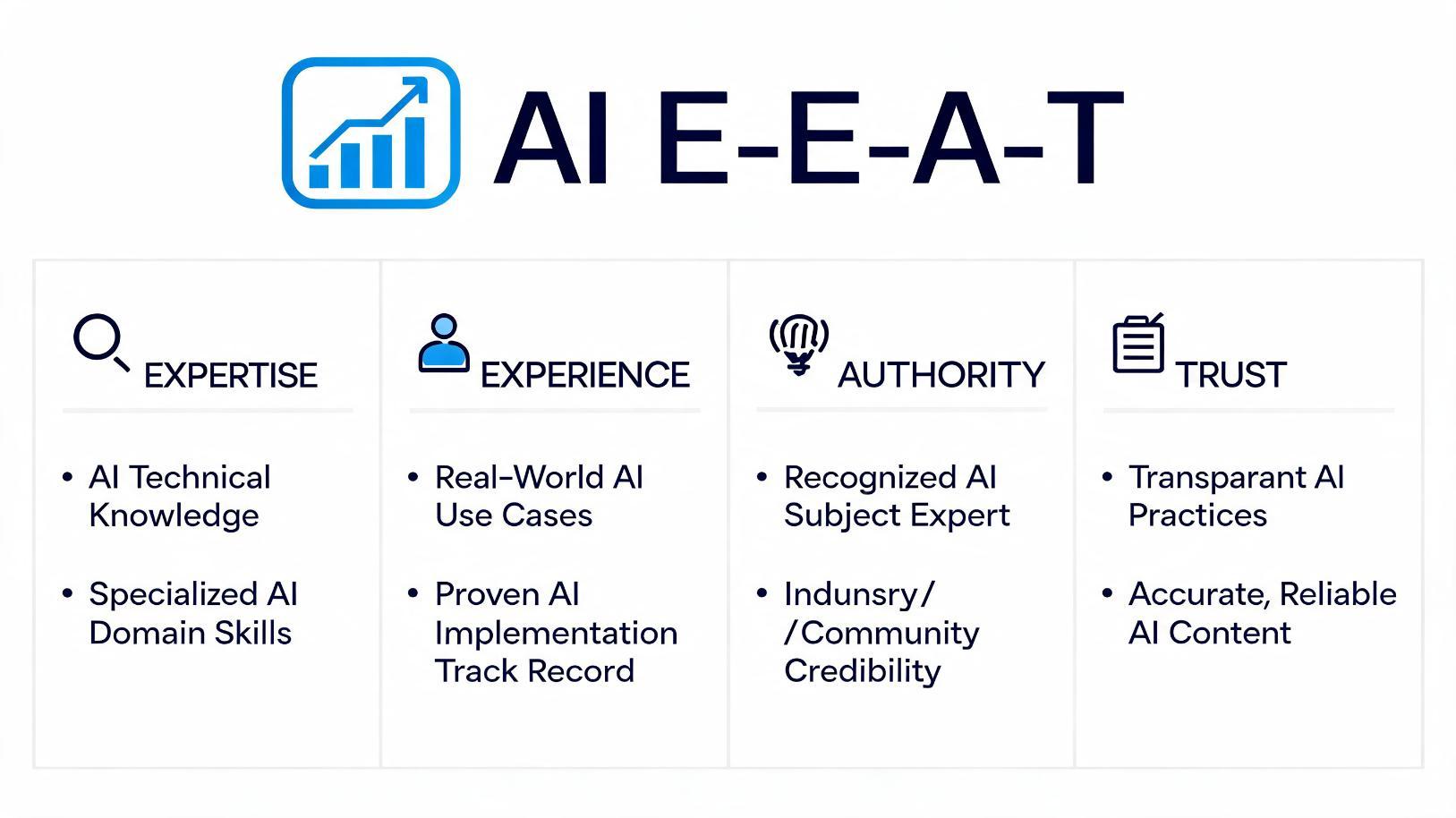
Experience, expertise, authority, and trust are not abstract brand virtues in an AI-first ad ecosystem. They are visible, machine-readable patterns in your creatives and flows. If you want AI agents to route users into your funnel — not just name-check your logo in a summary — you need to translate E‑E‑A‑T into concrete elements that look safe and reliable at a glance and at crawl depth.
Experience: Show you’ve actually done the thing you’re selling
For ads and landers, “experience” is proof that real people have used the product, lived the problem, and can speak from first-hand perspective. Google’s E‑E‑A‑T framework was designed to reward this kind of human context, and those same cues now help AI systems decide which offers feel credible, as the team at TopRank has argued.
In practice, that means:
Expertise: Make credentials and methodology obvious and parseable
Expertise is about showing you know what you’re doing — and doing it in ways machines can validate.
Across formats:
Authority: Surround your offer with corroboration, not just claims
Authority is how the rest of the ecosystem talks about you. AI systems synthesize brand mentions, reviews, and coverage into their answers, treating them as a system-level filter, as the team at Moz has described.
You can surface that authority inside ads and flows in ways that are both user-friendly and machine-legible:
Trust: Design for safety, clarity, and friction where it matters
Trust is the non-negotiable layer. AI systems are risk-averse; they’d rather not recommend a sketchy funnel at all than risk steering a user into harm, especially in finance, health, and other YMYL categories.
To signal trustworthiness in ways machines can verify:
Across native, TikTok, push, and pop, the pattern is the same: make your experience, expertise, authority, and trust tangible in the words, layouts, and flows themselves. You’re no longer just persuading a human in a single session. You’re feeding an always-on network of AI agents the evidence they need to treat your funnel as the safest path forward.
Think of your ads and landing pages less as isolated sales messages and more as structured datasets that answer engines and agents can safely compute on.
In human terms, “does this offer look good?” is fuzzy. For AI systems orchestrating journeys across conversational search, product research, and instant checkout, that fuzzy judgment has to be encoded as fields, relationships, and constraints. Your job is to turn creative and funnel copy into machine-readable evidence.
AI-native advertising isn’t just about spinning up more variants; it’s about making your products “visible and differentiable within conversational discovery environments,” as one analysis of AI-native advertising puts it. That begins with an information model that any crawler or agent can understand:
If generative search is summarizing options instead of listing blue links, you want your offer to be the easiest one to summarize accurately.
Most paid formats already have quasi-structured fields. Use them like a schema, not just a canvas:
The goal is to make every line in your ad a candidate key-value pair.
A technical SEO perspective on AI visibility emphasizes that structured, crawlable pages are the baseline for being surfaced at all. For AI-native funnels, you’re designing for a second layer: interpretation.
On your landers:
You’re not only helping LLMs quote you correctly; you’re also helping agentic systems decide whether to send a user deeper into your funnel at all.
Once the human-visible structure is sound, add formal schema:
In an environment where AI can drive “transactions closer to AI interfaces” via instant or native checkout, as one AI visibility overview notes, the consistency of your product and policy data across web, feeds, and landers becomes non-negotiable. Discrepancies make your offers harder — and riskier — to recommend.
Finally, architect your content so AI can see a complete journey, not a single conversion trap. Research into AI-driven discovery shows that people are increasingly using assistants to “research products, compare solutions, and answer more complex questions” instead of scanning traditional result pages, meaning they expect a coherent narrative across touchpoints before acting, as one analysis of AI advertising trends explains.
If your ads and landers answer only “Why click now?” but not “Is this the right choice versus alternatives?” you’re invisible to the agents tasked with protecting users from bad decisions. When your funnel reads like a structured, evidence-backed case file, machines can finally do more than rent you impressions — they can advocate for your offer.
If you want AI systems to trust your funnel, you have to train them on more than click‑through and last‑click ROAS. You need to mine intent — and its evil twin, anti‑intent — directly from your ad and funnel data, then expose those patterns in ways agents can reason about.
Think of this as building an “answer graph” around your paid media: a living map of what different kinds of users are really trying to do, which paths actually satisfy them, and which journeys look risky or unsatisfying to a cautious machine.
Intent mining starts with reframing your data. Traditional PPC treats keywords and audiences as targeting levers. In an AI‑mediated world, those same artifacts are behavioral labels the models will quietly learn from. As more product research shifts into conversational flows, people are typing and speaking fuller, natural‑language questions, not just “{product} + {city}.” A PPC team attuned to this, as the analysts at Real FiG Advertising & Marketing describe, already mines long‑form, conversational queries to refine bids. You should go further and treat those phrases as training data for your entire funnel.
Start by clustering incoming queries, creative hooks, and on‑site behaviors into “intent cohorts” instead of channel segments. For each cohort, define the atomic questions the user is really asking:
Then, for each cohort, map which ad creatives, surfaces, and paths reduce friction fastest. The answer layer of the web is moving toward a compressed journey — from “Ask AI → Receive recommendation → Buy,” as Neil Patel notes when describing Google’s agentic shopping experiments. That compression means every unnecessary step, missing reassurance, or ambiguous policy on your side is a reason for an agent to route a user elsewhere.
This is where anti‑intent comes in. AI E‑E‑A‑T isn’t only about finding positive signals; it’s also about giving models clear reasons not to push someone into the wrong micro‑journey. If your data says that a certain query pattern (“cheap,” “free,” “DIY”) almost never converts for a high‑touch enterprise offer, you want that to be learnable. Flag those patterns, de‑emphasize hard‑sell CTAs on the first touch, and deliberately steer both humans and agents toward educational, expectation‑setting content instead.
In practice, that looks like:
Agents are risk‑averse by design. They will privilege sources that look stable, deeply documented, and internally consistent. That means your intent graph needs technical and semantic coherence as well. When TopRank’s SEO guidance stresses the importance of clean structure, schema, and crawlability for AI‑powered search, they are effectively describing the substrate those agents use to validate your claims. If your ad promises “same‑day setup,” but your docs, FAQ, and onboarding flows don’t reinforce that promise in crawlable, structured language, the safest thing for an AI assistant to do is not guarantee same‑day anything.
Treat every ad‑driven journey as a hypothesis about intent that you can prove or disprove. Over time, you want your analytics to answer questions an agent might implicitly ask:
The future winners in performance media won’t be the brands with the most granular bid strategies. They’ll be the ones whose funnels double as transparent, machine‑legible experiments in matching intent to experience — and whose data makes it trivial for AI systems to see where that match is consistently strong, and where a reroute is the safer, more trustworthy call.
Receive top converting landing pages in your inbox every week from us.
Most Read
AI systems are increasingly evaluating ads, landing pages, and funnels as trust signals when guiding users toward products and services. This guide shows how to apply E-E-A-T principles to paid media, structure funnel data for AI agents, and use intent signals to build more trustworthy, machine-readable customer journeys.
Samantha Reed
7 minSep 15, 2026
Recently Updated
AI citation visibility is moving beyond Reddit and major forums toward niche review hubs, comparison sites, and other structured third-party properties. This guide shows how ad intelligence can uncover emerging citation hubs and how marketers can build durable, extraction-ready content ecosystems around them.
Dan Smith
7 minSep 14, 2026
Editor’s Pick
Most user-first strategies stop at keywords, missing the real journeys people take across ads, landing pages, emails, and multiple channels. This guide shows how to use competitor ad intelligence and mystery shopping to uncover those journeys and turn them into people-first content briefs and conversion-focused funnels.
David Kim
7 minSep 14, 2026