6 minJune 6, 2026

Our dropship tool integrates with Shopify and Woo-Commerce stores and automates your entire dropshipping business!
Get StartedFor most of the internet's history, your website had three kinds of visitors: humans browsing in a browser, search engine crawlers indexing your pages, and bots running automated scripts. Now there's a fourth, and it's the one most performance marketers haven't built a single landing page for. As Search Engine Journal explains, the agentic web is the layer of the internet where AI agents — acting on behalf of humans — discover, read, and transact with websites. An agent is sent by a person with a task, runs autonomously, and performs multi-step actions: checking availability, comparing prices, filling out forms, completing purchases. It reads your site the way a crawler does and acts on it the way a buyer does. That combination is entirely new, and it breaks every assumption baked into your current funnel.
The scale is already past the "interesting experiment" stage. AI-driven traffic to U.S. retailers grew 393% year over year in Q1 2026 and, for the first time, converted at a rate 42% higher than non-AI traffic — a staggering reversal from just a year earlier, when it converted 38% worse. That inflection point should stop every media buyer mid-scroll. The agent visitor isn't just increasing in volume; it's getting dramatically better at purchasing. And on some sites, the ratio isn't even close anymore — one publisher reports that AI assistants outnumber human visitors by five to ten times on any given day.
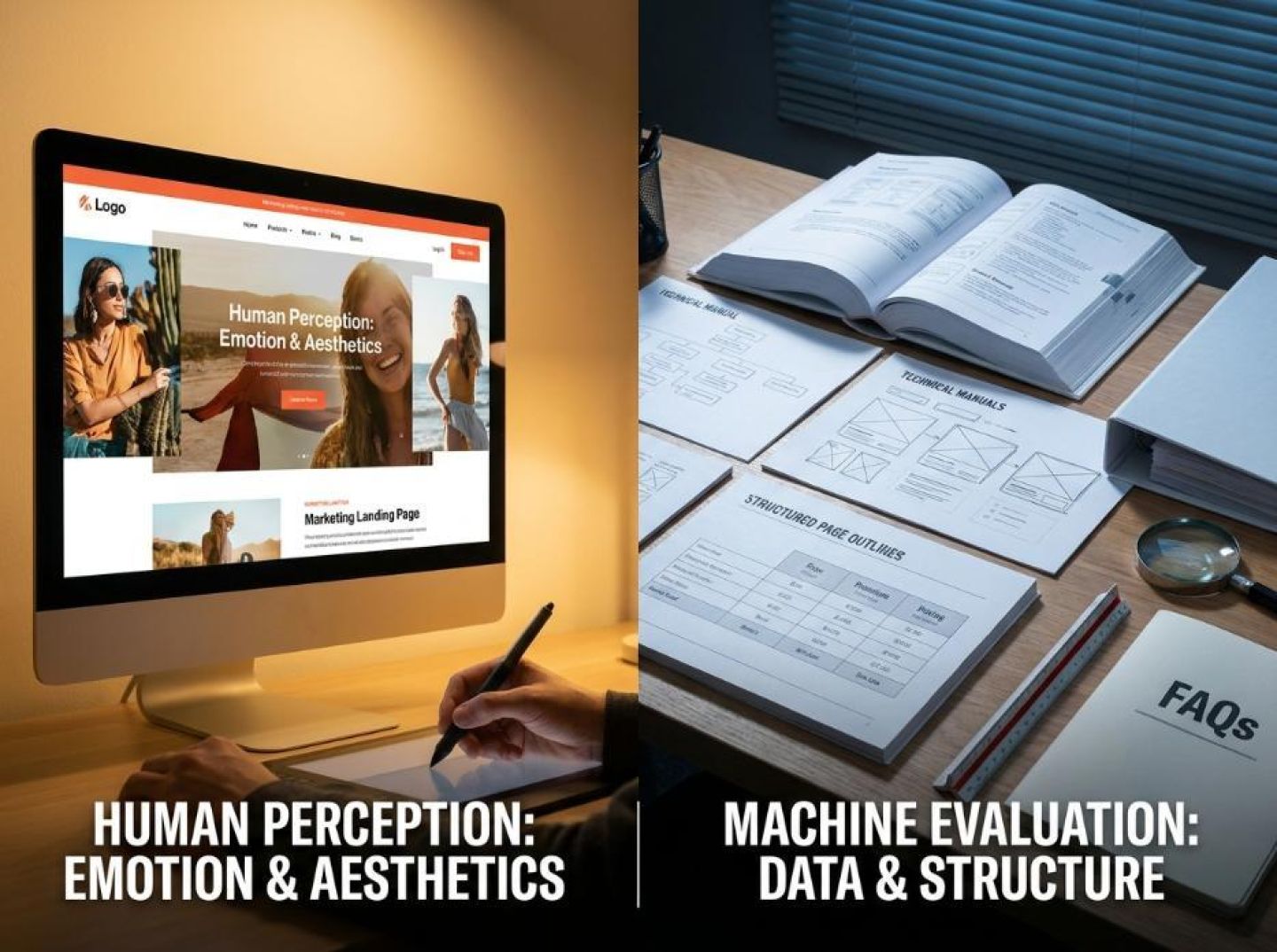
If you've spent a career optimizing for two audiences — the human who clicks and the ad platform algorithm that decides who sees the ad — you now face a third. The autonomous agent acting as a consumer's purchasing proxy doesn't respond to hero images, social proof badges, or urgency countdown timers. It parses structured data. It evaluates differentiated value propositions. It compares your offer against six competitors in the time it takes a human to read your headline. Your landing page's emotional hook is invisible to it; your machine-readable product attributes are everything.
Google clearly sees this coming. At Google Marketing Live 2026, the company announced Gemini-powered ad formats designed to close the gap between a person's initial question and their final purchase — ads that "feel like helpful additions to your conversation" rather than interruptive placements. The language is revealing: Google is no longer optimizing for clicks; it's optimizing for answers. When the dominant ad platform rebuilds its flagship formats around conversational, agent-friendly discovery, it's telling you where the traffic is heading before the traffic gets there.
This is not an SEO problem. It's a conversion funnel problem. As MarTech argues, the brands that win won't be those producing the most ads but those that show up at the right moment with the most relevant answer. Products need to be visible and differentiable within conversational discovery environments — which means clear positioning and accessible, high-quality information that an agent can interpret and recommend without a human ever touching the page.
The fourth visitor just walked into your funnel. It doesn't have eyes, but it has intent, a budget, and the authority to buy. If your competitor's landing page speaks its language and yours doesn't, the agent won't bounce. It won't even arrive. It will choose the other option three steps upstream, inside a conversation you never knew was happening — and your dashboard will show nothing but a slow, unexplainable decline in qualified traffic.
Ask any marketer where the "agentic web" conversation is happening inside their organization and the answer is almost always the same: the SEO team's Slack channel. That's not an accident — it's a gravitational pull created by a decade of content optimization muscle memory, and it has left the people who actually control ad spend, creative strategy, and bid logic almost entirely on the sidelines.
The pattern is easy to trace. The moment AI-generated answers began cannibalizing organic clicks, SEO practitioners moved fast to claim the problem — and the solution. The industry's most sophisticated agentic thinking is now being channeled into sequential workflows: keyword gap analysis automated by AI agents, programmatic content briefs, technical audits that run on autopilot. These are genuinely impressive applications, but they represent a narrow slice of what the agentic web will ultimately demand from brands. If your entire agentic strategy lives inside an organic-search playbook, you've optimized for the canal while ignoring the ocean.
Meanwhile, the frameworks that should be galvanizing performance marketing teams already exist — they're just being read by the wrong people. MarTech's blueprint for AI-native advertising explicitly calls on brands to "ensure your products are visible and differentiable within conversational discovery environments" and to invest in "AI-ready creative processes" that move beyond campaign-based workflows. That language isn't about meta descriptions and schema markup. It's about creative assets, landing-page architectures, and the operating models that govern how ads get made and served. Yet almost no one running native ad campaigns, push notification funnels, or programmatic display buys has internalized these imperatives.
The disconnect gets starker when you look at the supply side. At this year's upfronts, major publishers made it clear that agentic infrastructure is already being woven into premium inventory. WBD announced what it calls Agentic Experiences designed to tap into growing interest in agent-to-agent advertising, while NBCU unveiled plans to roll out always-on AI agents and Fox debuted an LLM-powered contextual engine for scene-level ad insertion. The buy side, however, is still organizing around last year's assumptions — testing AI for headline generation or bid automation, not for the structural reality that an agent may soon be the entity evaluating whether your ad deserves a recommendation at the point of intent.
This misalignment creates a genuine first-mover window. Performance marketers — particularly those buying millions of daily impressions across native and push networks — are sitting on the real laboratory for agentic optimization and don't know it yet. They already run multivariate creative tests at scale, adjust landing pages by traffic source, and iterate on offers in near real time. Those are exactly the muscles required to build what MarTech describes as "continuous testing, learning, and optimization" loops for an AI-native world. The infrastructure is there; the mental model just hasn't caught up.
The irony is rich: the teams with the budgets, the velocity, and the data feedback loops to prototype agentic-ready advertising are waiting for permission from an industry conversation that never thought to include them. Every week that performance marketers defer this work to their SEO counterparts is another week the window stays open — and another week a faster competitor can walk through it.
Picture a high-converting native ad landing page you've built or admired recently. It probably opens with a bold, emotionally charged headline. Below that, a hero image designed to stop the scroll. The price? Tucked inside a JavaScript-triggered modal that only appears after the user clicks "See Plans." The competitive differentiation? Scattered across testimonial carousels and animated comparison graphics that reveal themselves as the visitor scrolls deeper. Social proof pulses in from the edges — notification popups, star ratings fading in on delay timers, a countdown clock nudging urgency. For a human, this choreography works. It mirrors the emotional decision architecture that performance marketers have spent a decade perfecting.
Now imagine an AI agent landing on that same page.
The agent doesn't scroll. It doesn't feel urgency. It doesn't watch your testimonial carousel animate into view. It parses the DOM, extracts structured content, and attempts to match what it finds against the task its human delegated: find me the best project management tool under $15/seat/month with Gantt chart support and SSO. As Search Engine Journal's framework for the agentic web puts it, agents "read websites the way a crawler does and act on them the way a user does." That dual nature is the crux of the design problem. The agent needs to extract like a machine and decide like a person — but your emotionally optimized landing page is built for neither of those parsing logics cleanly.
Here's what breaks down, element by element.
Structured data. If your pricing lives inside a modal triggered by an onClick event, the agent may never see it. Schema markup — specifically Product and Offer schema with price, priceCurrency, and availability properties — gives the agent what it needs without requiring interaction. No schema means no structured extraction, and the agent moves on to a competitor whose pricing is exposed in clean HTML.
Semantic clarity. Your headline might read "The Future of Work, Delivered." Evocative for a human; meaningless to an agent trying to classify your product category. A subheading that says "Cloud-based project management software for teams of 10–500" gives the agent an extractable, comparable data point.
Value-proposition hierarchy. Humans can be guided through a narrative arc that builds to a reveal. Agents need your differentiators front-loaded in the page's semantic structure — ideally in heading tags and structured lists rather than buried inside paragraph copy or animated infographics.
Comparison-friendly formatting. An agent tasked with evaluating three vendors will look for attributes it can normalize across options. HTML tables with clearly labeled rows — features, pricing tiers, integration support — are trivially parseable. A design-forward grid of icons with hover-state tooltips is not.
This isn't hypothetical. MarTech has argued that ensuring "clear positioning, differentiated value propositions, and accessible, high-quality information" is now a functional requirement, not just brand strategy. That directive reads like copywriting advice on the surface, but it's actually a technical specification for agent readability. If the agent can't extract your positioning cleanly, your ad spend drove traffic to a page that effectively doesn't exist for the fastest-growing visitor class on the web.
The marketers who grasp this dual-audience challenge first — designing pages that simultaneously satisfy a human's emotional journey and an agent's structured extraction logic — will own the next performance cycle. Everyone else will keep optimizing for a scroll that never happens.
The infrastructure for creative velocity already exists. Brands are deploying continuous creative optimization loops where AI evaluates engagement signals and automatically evolves messaging to improve performance, testing hundreds of variations in the time it once took to approve a single round of copy. The bottleneck is no longer production speed — it's directional intelligence. When you can generate a thousand landing page variants overnight, the question that actually matters is: what should the next variant look like?
This is where competitive ad intelligence becomes the strategic advantage that creative automation alone cannot provide. Tools like Anstrex, which crawl native and push ad networks at scale, let performance marketers observe what's already changing in live campaigns across millions of creatives and their associated landing pages. Instead of guessing what an agent-optimized native ad might look like, you can watch the shift happen empirically — tracking which competitors are modifying their formats, which headlines are gaining traction, and which landing page structures are climbing the performance rankings.
The patterns emerging in Anstrex's database are subtle but unmistakable once you know what to look for. Landing pages that once buried product specifications beneath emotional storytelling are now front-loading structured product data — price, ingredients, compatibility, shipping terms — in clean, parseable formats near the top of the page. Headlines are drifting from pure curiosity gaps ("You Won't Believe What This Supplement Does") toward direct-answer constructions ("CoQ10 Supplement: 200mg, Third-Party Tested, Ships Free in 2 Days"). Creative copy increasingly leads with factual differentiators rather than saving them for a reveal below the fold. These aren't random A/B test artifacts. They're the early fingerprints of advertisers who understand that an AI agent evaluating their page won't scroll past three testimonial carousels to find the one data point that answers a user's query.
This evolution aligns with what the broader industry is signaling. As Search Engine Journal has documented, agents represent a genuinely new visitor class — one that reads websites the way a crawler does and acts on them the way a user does. When that class of visitor hits a native ad landing page, it doesn't respond to emotional urgency or scarcity timers. It parses structure, extracts claims, and compares them against competing options in milliseconds. The advertisers who show up in Anstrex's top-performing creatives six months from now will be the ones already building for that dual audience — humans who feel and agents who parse.
The practical application is straightforward. Set up competitive monitoring in Anstrex filtered by your vertical and ad network. Track landing pages over time, not just creative thumbnails. Look specifically for the emergence of schema markup, FAQ sections that mirror conversational queries, and value propositions that appear in the first visible viewport rather than behind interactive elements. When you spot a competitor whose landing page has shifted from a long-scroll advertorial to a hybrid format — emotional hook up top, structured data block immediately below — flag it. That competitor isn't just running a new split test. They're building for an audience that doesn't have eyeballs.
The brands gaining an edge won't be those producing the most ads but those showing up with what MarTech has called "the most useful answers" at the right moment and in the right context. Competitive intelligence is how you reverse-engineer what "useful" looks like before the platforms publish their best-practice guides — because by the time those guides arrive, the early movers will have already captured the position.
The brands already adapting their creative strategies share one insight: you don't choose between writing for humans and writing for AI agents. You write for both simultaneously, because both are now reading the same page. The framework below breaks this dual-audience challenge into five layers — each addressing the tension between emotional resonance (what humans need) and structured clarity (what agents need).
Headlines: Emotion Up Front, Specification Underneath. Your H1 still needs to stop a human mid-scroll. Keep the curiosity gap, the urgency, the identity trigger — all the psychological levers that have always worked. But directly beneath that emotional hook, add a secondary line or subheading that states the offer in plain, parseable language. "Finally, Sleep That Feels Like a Superpower" can still be your H1. But the H2 should read something like "Organic Latex Mattress | Queen from $899 | Free 120-Night Trial." Agents acting on behalf of shoppers are performing multi-step tasks like comparing prices and checking availability, and they need unambiguous product identifiers and terms to complete those comparisons. A headline that's all metaphor and no metadata is invisible to this fourth class of web visitor.
Body Copy: Narrative Wrapper, Factual Core. Humans respond to stories. Agents respond to assertions. The solution is nested architecture: wrap your persuasive narrative around discrete, clearly stated facts. Instead of burying your differentiation inside a testimonial carousel, state it in a scannable sentence — "Rated 4.8/5 across 12,400 verified reviews" — then let the testimonials reinforce the claim. Google's new Gemini-powered ad formats are designed to be instantly tailored to a person's unique query and to offer more context for decision-making, which means the source material those formats pull from needs to contain explicit, unambiguous claims rather than suggestive copy that only makes sense with a hero image beside it.
Landing Page Architecture: Visible Information Hierarchy. Stop hiding critical purchase information behind JavaScript modals, accordion menus, and interactive widgets. Price, shipping terms, return policy, key specifications — all of it should live in the static HTML layer. Agents read pages the way a crawler does, but they act on them the way a user does. If the information an agent needs to recommend your product is locked inside a client-side render event, you've effectively opted out of the agentic web.
CTAs: Dual-Path Conversion. Design your calls to action for two modes of engagement. The human CTA can still use persuasive language — "Start Your Free Trial" — but pair it with a machine-readable action endpoint. Structured data markup, clearly labeled form fields, and accessible API endpoints allow agents to complete transactions without needing to interpret ambiguous button text.
Data Structure: Schema as Creative Strategy. Product schema, FAQ schema, offer schema — these aren't just technical SEO checklists anymore. They're the creative brief your landing page delivers to every agent that visits. Treat structured data with the same strategic intent you bring to headline copy. Every schema field is an opportunity to make your value proposition legible to the autonomous systems that are, as AI-driven tools increasingly demonstrate, pulling live data, deciding what to prioritize, and coming back with recommendations before a human ever opens a browser tab.
The brands that master this framework won't feel like they're writing two different messages. They'll feel like they're writing one message clearly — and discovering that clarity was the competitive advantage all along.
Receive top converting landing pages in your inbox every week from us.
Most Read
Discover how performance marketers can build cross-channel verification journeys that turn skeptical prospects into confident buyers across TikTok, native, push, and pop advertising. Learn how to coordinate creative messaging, reinforce trust at every touchpoint, and measure the hidden influence of fragmented customer journeys using competitive ad intelligence.
Elena Morales
7 minOct 20, 2026
Guide
Discover how big-brand cultural stunts, exclusive offers, and “world menu heists” can inspire more effective pop, push, and native ad campaigns. Learn how to use scarcity, localized creative, visual pattern interrupts, and interactive experiences to capture attention, increase engagement, and build scalable direct-response funnels.
Rachel Thompson
7 minOct 9, 2026
How-To
Learn how to turn big brand-building stunts into measurable performance funnels across Native, Push, Pop, and TikTok. This guide breaks down how to repurpose stunt assets, build channel-specific sequences, design story-led landers, and measure their impact on conversions and revenue.
Priya Kapoor
7 minOct 5, 2026