12 minSeptember 6, 2026

Our tools monitor millions of native, push, pop, and TikTok advertising campaigns.
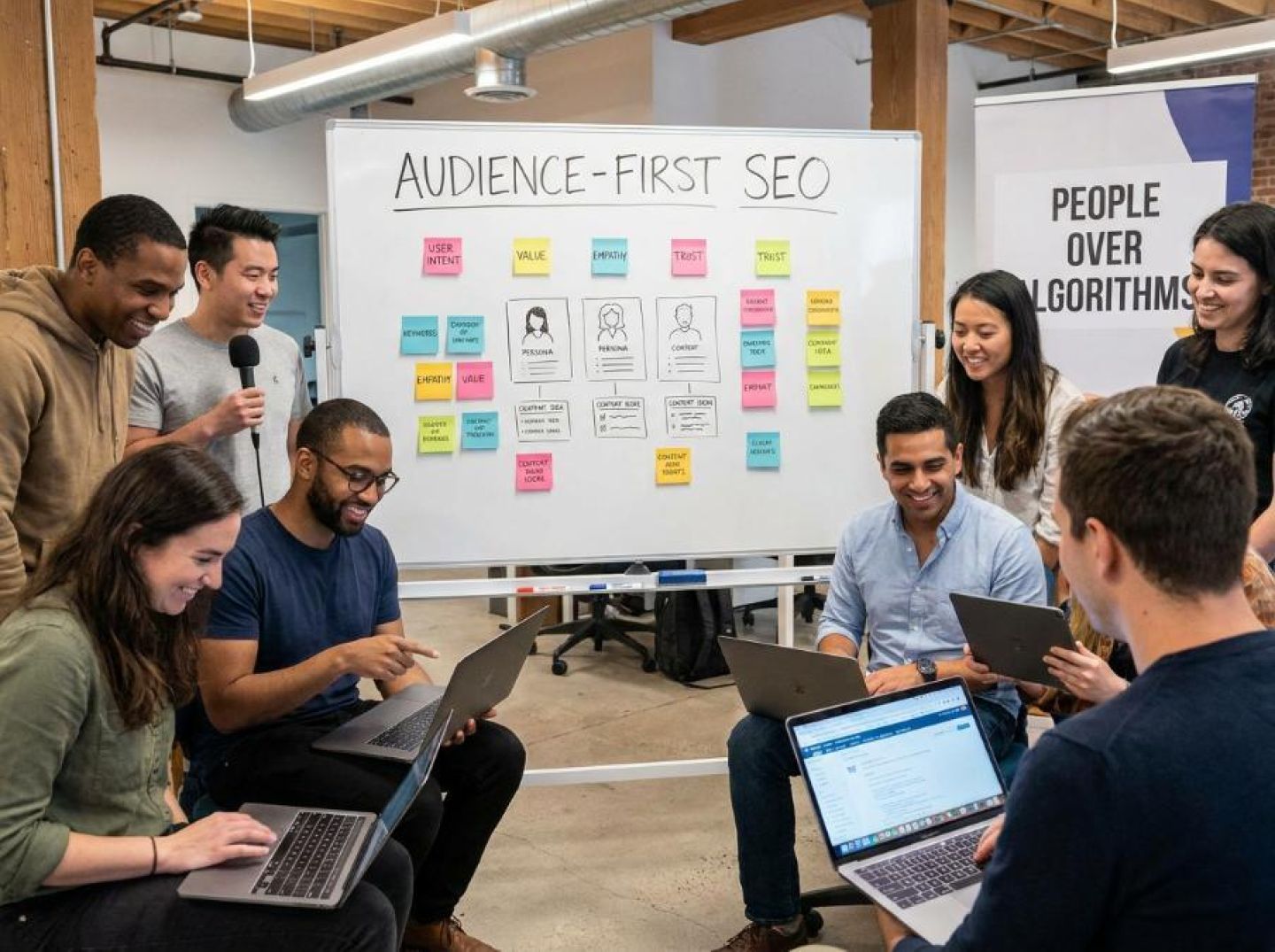
Get StartedAudience-first SEO was a necessary correction to the bad old days of chasing vanity keywords. Centering your work on a defined, high‑value segment forces you to ask, “Who do we actually want on this page?” before you ask, “What can we rank for?” As Neil Patel describes it, that shift concentrates growth among audiences that drive revenue instead of padding sessions with unqualified visitors.
But even this upgraded approach quietly leaves money on the table, because it still assumes that keywords and search demand are the primary raw materials for strategy.
Audience-first SEO typically starts with a target segment, then moves straight into familiar motions: keyword research, gap analysis, and TAM sizing, just done through an audience lens. You might use tools like Ubersuggest, AnswerThePublic, and paid audience research to capture how a segment talks, what questions they ask, and which terms they search for, then map that into an “audience opportunity matrix” that balances search demand, difficulty, and business value, just as.
That is a massive improvement over topic-only SEO. It narrows your focus to queries that can actually turn into pipeline. It also helps your Digital PR team prioritize the publications and communities your audience already visits, instead of generic “high DA” sites, echoing the presence‑driven approach to outreach outlined on.
However, two blind spots remain:
High‑intent buyers often move fluidly between search, social, communities, marketplaces, and paid funnels. Their language changes with each context. Keyword‑first inputs can’t fully capture the questions they ask in Slack groups, the objections they voice to sales reps, or the hooks that actually convert when you pay for impressions.
2. You’re optimizing for slices of a topic, not the topic’s gravity.
Newer research on topical authority shows that you can be perfectly optimized for the specific queries you track while being invisible in the broader topic space that surrounds them. In the Topical Gravity framework from Semrush, a “topic” is treated as the real unit of competition. Their data across 50,000 brands found that in nearly half of topics, the runner‑up had a stronger domain — higher Authority Score, more traffic, more branded searches — and still lost. What differentiated the winner was deeper, more coherent coverage of that topic’s full question space.
Audience-first SEO doesn’t inherently fix this. You might choose a great audience, build smart keyword clusters, and still only address a thin slice of the conversations that define the topic in that audience’s mind. You rank for “best project management software for agencies” but never show up for comparison queries, implementation problems, or role‑specific use cases that live in the same topical field.
The fragmentation of discovery makes this even more expensive. According to the Topical Gravity research, AI engines increasingly answer questions by pulling from brands they already associate with a topic. In their data, ChatGPT turned citations into brand mentions 46% of the time when a brand was established in a topic, and only 18% when it wasn’t. That means authority is compounding at the topic level, not the keyword level: once you’re “the one” in a topic, AI and search interfaces keep reinforcing you.
Audience-first SEO, as it’s commonly practiced, doesn’t explicitly measure or manage that. It tells you who to chase and which keywords to prioritize, but not which topics your brand must own end‑to‑end or how much of each topic’s surface area you’ve actually claimed versus competitors.
Meanwhile, paid media teams are already sitting on the missing half of the story: they know which hooks, angles, and offers consistently earn clicks, leads, and revenue from those same audiences — regardless of whether those phrases show up in any keyword tool. AI‑assisted workflows like those in HubSpot’s SEO stack can scale content creation, but they still depend on the inputs you choose.
When you only feed them keywords and audience personas, you’re optimizing for discoverability, not necessarily for the angles that have been profit‑tested in your ads. That’s the gap this article aims to close: connecting audience‑first SEO with offer‑first, ad‑driven insights, then wrapping both in a topic‑level view of authority so you stop winning isolated queries and start owning the conversations that actually move revenue.
Offer-first intelligence starts from a different question than most SEO frameworks: not “What are people searching for?” but “What already makes them buy?” Your best-performing ads are the most concrete, high-intent evidence you have of what an audience finds compelling. Treat them as the source of truth, and keyword research becomes a way to scale what’s already proven, not to guess from scratch.
This is the logical extension of the audience-first mindset that Neil Patel describes—you still anchor to a high‑value segment, but now you sharpen the focus further around the offers, angles, and promises that actually move that segment to action. Paid media has always been built this way: creative and messaging are iterated against hard conversion data, not against abstract “topics.” The mistake is stopping that learning loop at the campaign level instead of letting it drive your entire content universe.
To make offer-first intelligence usable for SEO, you treat each winning ad like a micro–market signal pack. Behind every high-ROAS ad there is:
Traditional keyword workflows start from the outside in: you pull a big list of terms, cluster them by topic, and then retrofit offers into those buckets. Even sophisticated AI‑assisted workflows on platforms like HubSpot’s SEO tools still assume a keyword-first seed list before they recommend topics, templates, or automation. Offer-first flips the order: you start from the patterns in ads that already win, then use keyword tools to translate and expand those patterns into search language.
In practice, that means building a simple but ruthless “offer board” before you ever open a keyword tool:
You are not trying to catalog “topics” yet; you are isolating profitable offers. Only once you have 10–20 offers that consistently win do you move into translation mode: How would someone who wants this outcome actually search? What questions would they ask one step earlier in the journey?
This is where conventional topical frameworks become servants instead of masters. A model like Semrush’s “Topical Gravity” framework argues that you should define a short set of subject areas where audience questions, your positioning, and revenue overlap. Offer-first intelligence sharpens that overlap. Instead of defining “expense management” as a topic you must own, you define “automating month‑end reconciliation for controllers” because that’s the specific offer that prints money in your ad account. Topical authority is the output; profitable offers are the input.
AI and clustering tools then do what they’re good at: scale. Once you’ve named an offer like “automate month‑end reconciliation,” you can feed adjacent phrasing into keyword clustering tools such as the ones highlighted on the Semrush AI SEO guide or into topic suggestions from HubSpot’s automated SEO workflows. Their job is not to decide what you talk about; it’s to reveal the full search landscape around a proven offer:
Each cluster becomes a content opportunity only if it maps cleanly back to a validated offer. If not, it gets deprioritized—even if search volume looks tempting. This is how you avoid the trap Neil Patel warns about when he describes programs that grow traffic among audiences who will never buy: volume is subordinate to offer–audience fit.
Done right, offer-first intelligence turns your ad account into a high-resolution roadmap for organic and AI search. Paid gives you fast, expensive answers to what the market actually wants; SEO and content turn those answers into durable, compounding assets. Instead of asking keyword tools to predict demand, you ask them to surround and support offers that already prove demand exists.
Start with one thing that’s already working: a specific ad. Not a “campaign” or a vague theme, but a single creative that reliably moves people from scroll to click to revenue. That ad is the seed of your entire cluster.
Don’t just sort by highest CTR. Pull ads that:
This is audience-first in practice: you’re starting, as Neil Patel frames it, from the segment and offer that already generate revenue, not from abstract search volume.
Grab the full artifact set for that winner:
You’re not just “using ad text for keywords.” You’re reverse-engineering the offer, the promise, the objections, and the proof points that made this audience act.
Next, strip the ad down to its message components:
This mirrors the way topical frameworks encourage you to define the overlap between audience questions, credible positioning, and revenue. You’re just doing it from a single piece of high-performing creative instead of a spreadsheet.
From this, write a short “offer narrative” in 3–5 sentences. This becomes the north star for everything in the cluster.
Now you can layer in search data—but only to scale what’s already proven.
Use a keyword tool to translate the offer narrative into real queries:
This is where you consciously refuse high-volume distractions that don’t serve the buyer who actually clicked and converted.
With a cleaned list, cluster keywords by topic and intent. You can follow the same pattern HubSpot’s topic cluster approach uses, but with one twist: every cluster must map directly back to the original offer.
Organize into:
AI can help assemble these clusters quickly. As the Semrush team demonstrates, prompting an AI model with a keyword list and asking it to propose a pillar plus supporting topics is a fast way to generate a first-pass architecture—just don’t let the tool drift away from the original offer or audience.
Topical authority isn’t just about what you publish; it’s about how it connects. Use internal links to create what Semrush calls “topical gravity” around your offer:
You’re designing paths that mirror your proven funnel: awareness of the pain, belief in your mechanism, then commitment to the offer.
Once the structure is clear, you can safely use AI-assisted drafts as a speed boost. Following the workflow outlined in HubSpot’s guidance on AI SEO tools, treat AI outputs as structured research documents, not finished content:
This preserves the speed of automation without, as HubSpot warns, scaling “thin content, mismatched intent, and inconsistent brand voice.”
Finally, reconnect organic performance to the ad that started it:
At this point, you’re no longer guessing which topics might matter. You’re running a closed-loop system where paid and organic co-evolve around the same audience, the same offer, and a cluster architecture intentionally built to turn proven ad messages into durable search demand.
The architecture question isn’t “How do we structure our keywords?” It’s “How do we structure the path from curiosity to the exact offer this ad is already selling?”
Pillars and landing pages are just two different zoom levels on the same offer. Your winning ad tells you which zoom level to start from.
For each cluster, pick a primary anchor:
This mirrors how tools like HubSpot’s SEO topic cluster framework separate broad pillar content from focused landing pages: one builds authority, the other captures demand.
Take the exact promise that’s already getting paid clicks and promote it to the core headline of your hub:
An audience-first approach means the page is architected around the buyer’s problem, not your internal product taxonomy. That’s the same shift audience-first SEO advocates argue for: define the high-value audience and their purchase context before you ever worry about volume.
Concretely:
Once the hub is defined, assign supporting pages based on their job in the journey:
This mirrors how clustering workflows in tools like HubSpot’s SEO tool or Semrush’s Keyword Strategy Builder distinguish between pillar, supporting, and landing content—but instead of starting from raw keywords, you start from the conversion path your ads already proved.
The biggest architectural mistake is letting people fall out of the story that converted them in the first place. To avoid that:
In practice, you’re designing webs, not trees. Every path a high-intent visitor might take from “I saw the ad” to “I’m ready to commit” should be deliberate: the right hub, the right supporting explanations, and one clearly dominant landing page that closes the loop back to the offer that started everything.
Closing the loop starts with redefining what you’re actually trying to grow. You’re not just “doing SEO” or “running ads.” You’re trying to grow an offer topic: the tight bundle of problem, promise, and proof that’s already winning in your paid campaigns.
Paid is how you find that bundle. Organic search and PR are how you amplify it until you own the whole topic everywhere your buyers look.
Take the ad (or small set of ads) that are reliably turning strangers into customers. Strip it down to:
This is your offer topic. It’s narrower than a generic “theme” or keyword category, which is exactly the point. As Neil Patel argues in his audience‑first SEO framework, the most reliable growth comes from aligning content around a specific, high‑value audience, not a broad subject.
Document that in a one‑page brief that everyone uses: paid, SEO, and PR.
This is how you avoid what Semrush’s topical gravity research calls “thin coverage” — ranking for one or two queries inside a topic but disappearing as soon as buyers search a slightly different angle. Paid shows you which angles actually move revenue so you don’t waste organic effort on the wrong ones.
With validated angles in hand, your organic program’s job is to cover the entire question space around the offer topic:
Instead of starting with a giant keyword dump, you reverse the workflow described in tools‑first guides like HubSpot’s AI SEO stack: you begin with offer + audience, then use clustering and question‑mining tools to map how people are already talking about that offer at each stage.
The output is a topic cluster where every page:
This is how you build what Semrush calls real topical authority: you’re present not only for the exact money term, but for the full constellation of related searches, comparisons, and buying questions that sit around your offer.
Now take that same offer topic brief to your PR team.
Instead of pitching random bylines or generic “thought leadership,” you pitch stories and data that reinforce this exact topic in the places your audience already trusts.
Audience‑first digital PR, as described in Neil Patel’s coverage of presence‑based outreach, starts with a simple question: “Where does this specific audience already go for information?” Use your paid audience tools, plus platforms like SparkToro (which HubSpot highlights as an audience discovery tool), to find:
Then design storylines that naturally connect to your offer topic:
Each PR hit does three things at once:
The loop works like this:
Every 90 days, you review performance at the offer topic level, not channel level:
When you operate this way, you’re no longer guessing what topics to “own.” Your winning offers tell you. Paid finds them, SEO surrounds them, PR broadcasts them — and each cycle makes the next offer topic easier to launch and faster to scale.
Block off two weeks. Instead of “an SEO project,” treat this as a focused sprint to translate one proven offer into a durable, multi-channel topic.
Here’s a simple, repeatable playbook you can run with any winning ad.
Start with proof, not hunches:
This is your north star. You’re not brainstorming “content ideas”; you’re mapping the conversation that gets someone to say yes to that offer.
Audience-first means you plan content the way paid already plans targeting. Instead of starting with keywords, you start with people and the language they use, as outlined in this audience-first SEO approach.
Run three quick passes:
2. Search-language sweep
3. Journey sketch
You’ve now built a human journey that just happens to be annotated with search behavior—exactly the inversion that audience-first SEO advocates.
Now you architect a tight, offer-first cluster instead of a sprawl of disconnected posts.
Borrow the cluster logic behind tools like the HubSpot SEO topic cluster feature, but anchor everything on the offer:
Map each asset to a journey stage and make sure every stage has at least one way to move deeper—mirroring the pillar–subtopic–landing page architecture that AI-assisted SEO workflows use as their backbone.
Your creative is sitting on hooks and objections that already convert. Strip them for parts:
This keeps your sprint tightly tied to what actually closed deals instead of drifting into high-traffic irrelevance.
Move fast, but with enough quality that the cluster can earn trust, links, and AI citations over time, in line with how topical depth is rewarded in topic-based frameworks.
Finally, give paid, SEO, and PR each a clear artifact:
At the end of the sprint, you haven’t just “published four blog posts.” You’ve built a self-contained, offer-first topic cluster that carries a buyer from first question to conversion, powered by an offer you already know the market wants.
Receive top converting landing pages in your inbox every week from us.
Must Read
Discover how AI-generated ad fatigue is making native, push, and TikTok campaigns increasingly look alike, weakening engagement and reducing competitive advantage. Learn how to use competitive ad intelligence tools to identify repetitive creative patterns, develop more distinctive ads, and stand out in AI-driven advertising auctions.
Liam O’Connor
7 minOct 14, 2026
How-To
Learn how to connect out-of-home (OOH) advertising with digital performance campaigns to create measurable cross-channel funnels. Discover how to plan LED truck routes, coordinate search and social ads, optimize mobile landing pages, and track conversions so physical advertising drives measurable business results.
Samantha Reed
7 minOct 13, 2026
How-To
Discover how big-brand sports sponsorships use fan behavior, geographic targeting, and cross-channel advertising to reach high-intent audiences beyond celebrity endorsements. Learn how to reverse-engineer sponsorship strategies, validate audience segments with competitive intelligence, and build cost-effective campaigns around local fandom, CTV, mobile, and creator content.
Dan Smith
7 minOct 12, 2026