7 minNovember 7, 2026

Our spy tools monitor millions of native ads from over 60+ countries and thousands of publishers.
Get StartedYou do not need another holiday playbook filled with generic tactics to copy, launch, and hope for the best.
By the time a supposedly winning holiday strategy makes its way into a conference presentation or a year-end marketing recap, the market may already have moved on. Consumer preferences shift. Advertising platforms introduce new features. Auction conditions change. And the creative that worked for another brand last season may not work for your audience this year.
Meanwhile, your competitors are testing new offers, exploring different placements, and adjusting their campaigns in response to what they observe.
For brands planning their 2027 holiday campaigns, relying entirely on old best practices can create an expensive blind spot. A strategy that performed well in one account, category, or season is not automatically right for another.
The answer is not to copy every competitor that appears to be succeeding. It is to understand what they are testing, identify the patterns worth investigating, and use those observations to make better decisions.
That is where competitive ad intelligence comes in.
Instead of brainstorming every campaign idea from scratch, marketers can study visible competitor activity across search, social, Native, Push, Pop, TikTok, and other advertising channels. They can examine creative variations, promotional angles, landing pages, and funnel structures to identify opportunities worth testing.
The goal is not to reproduce someone else's campaign. It is to turn market observations into a more informed research and testing process.
In a crowded holiday season, that process can become a meaningful competitive advantage.
“Best practices” are useful starting points. They become dangerous when marketers treat them as permanent rules.
Many traditional holiday advertising strategies assume three things: platforms remain relatively stable, buyers follow predictable shopping journeys, and media costs behave according to familiar seasonal patterns.
Those assumptions are becoming harder to rely on.
Search results, social feeds, retail media, and programmatic placements are continually evolving. AI-assisted experiences, new shopping features, changing auction mechanics, and updated campaign controls can alter how brands reach customers.
For example, Search Engine Roundtable's September 2026 recap discusses several developments across search and advertising, including changes and experiments that marketers should monitor.
Meanwhile, industry coverage has highlighted developments such as Google's AI Max-related advertising formats, TikTok's testing of website visitor retargeting, and Microsoft's work on AI-ready creative and centralized exclusion lists.
These developments do not mean every advertiser needs to adopt every new feature. They do mean that marketers should verify which tools, formats, and targeting options are actually available when planning a campaign.
A tactic that depended on a particular placement or platform feature last year may need to be reconsidered before the next holiday season.
The traditional holiday shopping journey is no longer easy to describe as a simple sequence of seeing an advertisement, visiting a website, and making a purchase.
Consumers may discover products through creators, social feeds, search results, retail media, recommendations, and AI-assisted research. They may compare several options before returning through a completely different channel to buy.
According to illumin's analysis of 2026 holiday shopping trends, social platforms remain important to gift discovery, with the report stating that 78% of consumers plan to use social media as much as or more than before for this purpose.
That makes it increasingly important to understand the context in which a campaign appears. A short-form video, a search advertisement, a Native recommendation, and a push notification may all serve different roles in a shopper's decision process.
A generic message repeated across every channel may not address those differences.
Holiday advertising can become expensive when multiple brands compete for the same audiences and placements. A budget split that worked for one advertiser may be inefficient for another.
MarTech's discussion of marketing investment and AI-assisted allocation explores how marketing intelligence and better allocation decisions can influence where the next advertising dollar goes.
There are also questions about inventory quality and supply-path efficiency. Marketing Dive's coverage of smarter digital out-of-home planning illustrates why audience composition and context can matter more than choosing a placement simply because it attracts a large number of impressions.
The lesson is not that traditional media planning is useless. It is that broad rules should be treated as starting assumptions, not final decisions.
The practical takeaway: Your holiday strategy should reflect current conditions in your category, the behavior of your target customers, and the competitive activity you can actually observe.
Competitive ad intelligence is more than collecting screenshots of advertisements.
Seeing a competitor use the headline “Holiday Deals You Can't Miss” and rewriting it as “Holiday Savings You Can't Ignore” is not meaningful research. It is surface-level imitation.
A better approach is to investigate the choices behind the visible campaign.
Think of competitive ad intelligence as a structured way to observe what other advertisers are doing, identify patterns, and develop hypotheses that you can test in your own campaigns.
It involves three layers.
Start with the visible advertising activity in your category.
Depending on the tools and platforms available, this may include:
A useful framework defines what to monitor, how frequently to review it, and how the findings will inform decisions. Semrush's guide to Google Ads competitor analysis provides a useful starting point for researching competitor visibility and messaging in paid search.
Instead of checking competitor activity once before Black Friday, establish a consistent review schedule. A weekly or biweekly review from the planning period through the holiday season can help you spot changes over time.
For example, track:
The objective is to build a record of observable activity rather than rely on memory or isolated screenshots.
Visible advertising activity can provide useful clues, but it does not reveal everything happening inside a competitor's business.
You generally cannot see a competitor's actual ROAS, conversion rate, customer acquisition cost, audience exclusions, or internal budget allocation simply by viewing an advertisement.
However, you can observe changes over time.
For example, a competitor might introduce a new promotional angle, show it across several placements, and later display a different group of creatives. That sequence may suggest a testing or optimization process.
It does not prove that the first creative was profitable or that the second group performed better.
Treat these observations as research signals.
If several competitors begin emphasizing gift bundles instead of individual products, that may be a reason to investigate whether shoppers in your category respond to convenience, perceived value, or higher-order-value offers.
You can then test those possibilities with your own customers.
The most valuable part of competitive research happens after you have collected the information.
Suppose you notice several brands using a combination of urgency, social proof, and flexible payment options in their holiday promotions.
Rather than copying their exact headlines, translate the pattern into a testable hypothesis:
Our customers may respond better to a holiday offer that combines a clear deadline with customer proof and a lower-friction payment option.
You can compare that concept against your existing campaign while keeping the other variables as consistent as possible.
This is where disciplined testing matters. WordStream's discussion of budget leaks and campaign testing highlights why changing too many elements at once makes it difficult to understand what influenced performance.
Competitive intelligence should narrow your research field, not replace your own testing.
Studying competitor advertisements is relatively easy. Understanding what makes them worth studying is the harder part.
The goal is not to hand your designer a screenshot and ask for a near-identical version. It is to identify the audience problem, offer structure, message architecture, and campaign context behind the creative.
Start by looking for patterns that persist or recur, but remember that longevity is only a clue. An advertisement remaining visible for several weeks does not prove it is profitable. It may be part of a broader campaign, serve a different objective, or remain active for reasons you cannot observe.
Use that activity to decide what deserves closer investigation.
Before focusing on the headline, ask who the advertisement appears designed to reach and where it appears.
A short-form video promoting last-minute gifts under $50 has a different context from a premium connected-TV advertisement about family traditions.
Look at the format, placement, message, and apparent stage of the customer journey.
If a brand repeatedly uses short-form videos with a specific audience callout, such as “Gift ideas for the dad who buys himself everything,” record the pattern. It may indicate that the advertiser is exploring a particular gifting problem or audience segment.
The same principle applies outside digital advertising. Marketing Dive's coverage of audience-led digital out-of-home planning discusses why audience composition and context can be more useful than choosing a screen based on traffic alone.
Your research notes should capture not only what the advertisement says, but also where and when you observed it.
Do not focus only on the discount amount.
Two advertisers can offer the same percentage discount while presenting completely different reasons to buy.
One may emphasize convenience. Another may focus on exclusivity. A third may reduce perceived purchase risk through extended returns or a price guarantee.
During holiday research, look for offer structures such as:
Then identify the emotional value behind the offer.
Is the advertiser helping shoppers save money, avoid stress, find a suitable gift, or feel confident about a purchase?
Those underlying motivations are more useful to study than the exact wording of a competitor's promotion.
Many effective advertisements follow a recognizable communication structure:
Hook → Credibility → Value → Proof → Call to action
Your task is to identify how each element works.
For every advertisement worth studying, ask:
Record the structure rather than copying the wording.
Over time, you may notice that some brands frequently lead with a specific customer problem, while others rely on demonstrations or quantified product benefits. These patterns can help you develop new creative directions that still fit your own brand.
Observe how campaigns change.
A creative may appear in one format, later show up in several variations, and eventually be replaced by a new concept. Another advertiser may keep a consistent offer but change the opening visual, headline, or call to action.
These changes are worth documenting.
Look for:
MarTech's analysis of AI-assisted marketing allocation discusses the growing role of automation in media decisions. However, visible creative changes alone cannot establish that an algorithm made the decision or that a particular version produced better results.
Use these observations to generate questions, not conclusions.
Once you have identified a useful pattern, apply three guardrails.
Translate, don't transpose.
If a competitor uses a stress-free gifting angle, identify the equivalent problem your own customers experience. Preserve the useful communication principle, but develop a message that is specific to your product and brand.
Test one meaningful idea at a time.
If you want to test an audience-specific hook, keep the offer, audience, and landing page consistent where practical. Avoid changing every element at once. WordStream's discussion of budget leaks explains why uncontrolled changes make campaign learning difficult.
Watch for category saturation.
If nearly every advertiser uses the same “up to 70% off” message, that repetition may be a reason to explore another angle. The opportunity may be to emphasize product quality, convenience, customer support, a useful bundle, or a different seasonal need.
Competitive research is most valuable when it helps you see both what deserves testing and what has become too common to differentiate your brand.
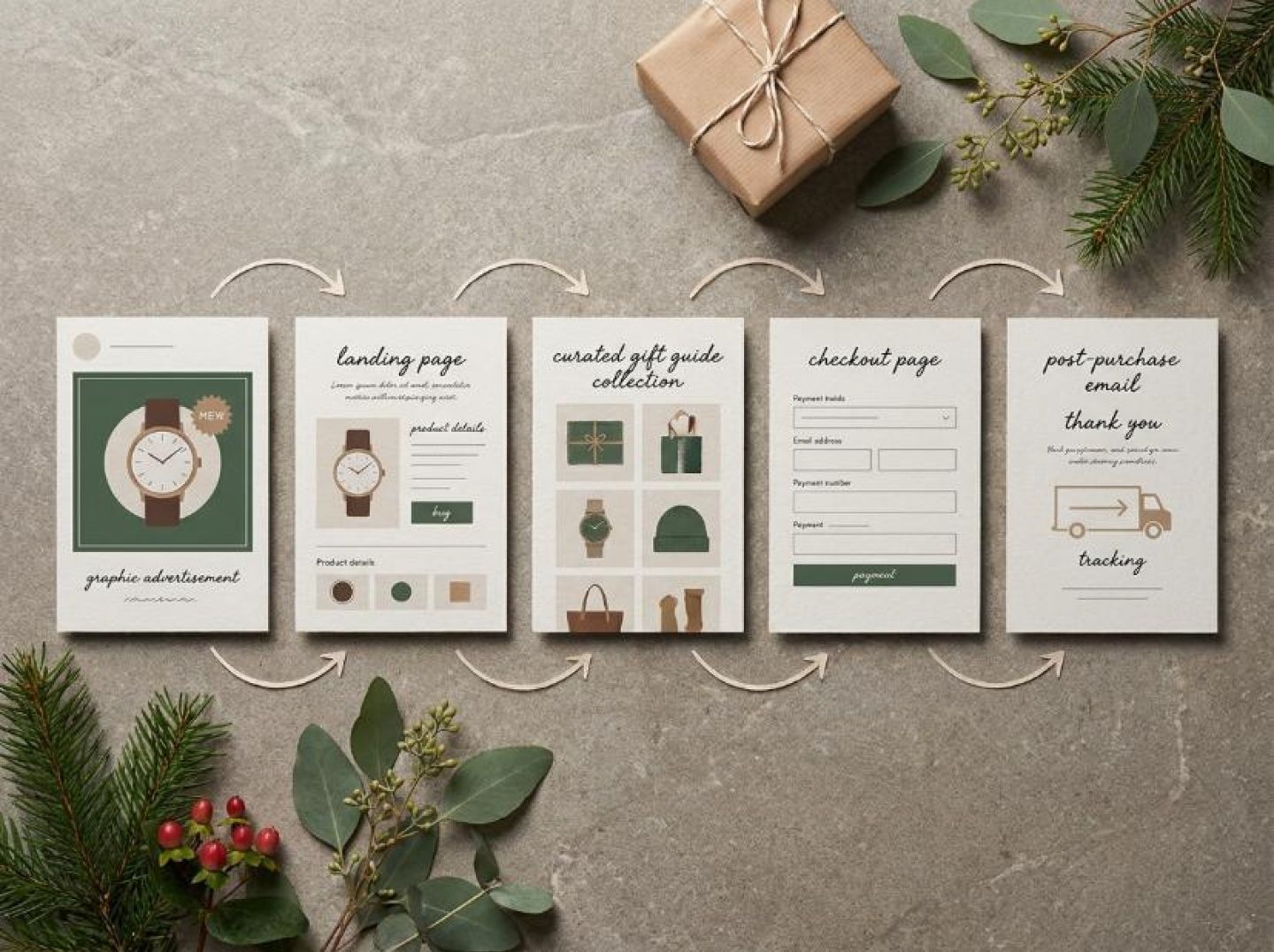
Studying an advertisement without examining its destination is like judging a store by its sign.
A campaign is more than the creative that earns the click. The landing page, offer, checkout experience, and follow-up messages can all influence what happens next.
Competitive ad intelligence becomes more useful when you investigate the customer journey surrounding an advertisement.
Start with an advertisement that is relevant to your category. When it is appropriate and accessible, follow the destination path:
Advertisement → Landing page → Offer → Checkout or lead form → Post-submit experience
Semrush's Google Ads competitor analysis guide discusses the importance of connecting paid search activity with the pages and experiences advertisers use to attract visitors.
As you review a competitor's funnel, ask four questions.
Document the sequence with screenshots and notes. Record the page structure, message, offer, and calls to action.
Do not assume that every visible step is used by every visitor or that you have access to the advertiser's complete funnel. Your research captures the experience you can observe.
Suppose several competitors appear to use gift-finder quizzes. That does not automatically mean quizzes will work for your audience.
Instead, write a hypothesis:
Visitors who are unsure what to buy may be more likely to engage with a guided gift-selection experience than a general product collection.
Then compare that experience against your current landing page.
Other hypotheses might include:
Use small, structured experiments before committing a large portion of your holiday budget.
Test hooks. Compare urgency, convenience, social proof, and gifting-focused messages while keeping the audience and destination page consistent where possible.
Test entry flows. Compare a quiz, curated collection, product page, or homepage to understand which experience best supports your customers.
Test offer structures. Compare a flat discount with a bundle, tiered offer, or value-added bonus. Make sure the comparison is commercially sensible and that the terms are clear.
The purpose is to learn which changes influence your own results, not to prove that a competitor's approach must be correct.
Do not stop researching at the first purchase or lead submission.
Where the experience is visible, review how brands continue the relationship through cart reminders, order updates, gift guides, loyalty programs, subscription offers, and post-purchase recommendations.
This is also a reminder to evaluate your own lifecycle marketing. Acquiring a customer is only one part of the relationship. WordStream's budget leak analysis offers a useful perspective on how inefficient follow-up and acquisition practices can waste marketing resources.
The strongest competitive research process turns a funnel into a collection of testable ideas: what attracts attention, what helps visitors decide, what reduces friction, and what encourages the next step.
AI can help marketers process campaign information, automate repetitive work, and make optimization decisions faster.
But it should not replace strategic judgment.
Competitive ad intelligence supplies research inputs. Your advertising platforms and analytics systems supply your own campaign data. Automation can help evaluate combinations of audiences, messages, placements, and offers against the goals you define.
The important distinction is that competitor observations are not the same as your own performance data.
A competitor's visible creative may inspire a hypothesis. Your own testing must determine whether that idea deserves additional investment.
1. Budget allocation
Automated bidding and allocation systems can use your campaign performance signals to adjust bids or distribute budget according to the controls and objectives you set.
MarTech's analysis of AI in marketing investment decisions discusses how AI-assisted systems are influencing decisions about where marketing resources should go.
Use competitive research to inform the ideas you test. Use your own conversion and revenue data to evaluate whether those ideas deserve more budget.
2. Creative testing and variation management
AI tools can help generate headline variations, summarize creative patterns, organize test results, and identify combinations that deserve further review.
For example, you might use competitor research to develop several distinct approaches:
Your testing system can then evaluate the variants using appropriate campaign metrics.
Do not assume that generating more variations automatically improves performance. The quality of the hypothesis, test design, and measurement still matters.
3. Audience and message sequencing
Holiday shoppers may move between social, search, retail media, email, and other discovery channels. illumin's 2026 holiday shopping analysis discusses the changing ways consumers discover and research products.
AI-assisted tools can help analyze first-party campaign data and manage eligible targeting or sequencing decisions, depending on the platform and available features.
However, competitor advertisements do not reveal the private audience segments or targeting rules behind those campaigns. Do not treat a visible creative as proof of a competitor's audience configuration.
4. Bidding, pacing, and performance monitoring
Automated bidding and pacing can help manage campaigns against defined objectives. Marketers still need to set realistic targets, monitor results, and understand the limits of the available data.
Search Engine Roundtable's 2026 recap discusses developments in Google's advertising ecosystem, including Smart Bidding-related topics.
Do not interpret a single conversion threshold or learning milestone as a universal guarantee that a campaign has enough data to become profitable. Learning behavior varies with the platform, campaign type, conversion volume, and business context.
Choosing which competitors to study.
Not every visible advertiser is a useful model. Prioritize brands with relevant products, audiences, price points, positioning, and customer problems.
Knowing when to break the pattern.
If every competitor uses the same urgency message and promotional format, copying the category standard may make your brand less distinctive. Identify the underlying mechanism and find a way to express it differently.
Protecting long-term business goals.
An algorithm may favor inexpensive clicks or short-term conversion volume. Those outcomes do not necessarily represent profitable customers or sustainable growth.
Evaluate campaign decisions against customer acquisition cost, contribution margin, repeat purchases, lifetime value, and the positioning you want your brand to maintain.
Understanding context that dashboards cannot fully explain.
Customer conversations, cultural shifts, product reviews, creator discussions, and offline experiences can provide context for interpreting performance.
Combining those observations with your own campaign data can produce better strategic decisions than relying on automated metrics alone.
Competitive ad intelligence is most useful when it becomes a regular operating process rather than a last-minute activity before Black Friday.
A practical system does not need to be complicated. It needs consistent research, organized observations, clear hypotheses, and a disciplined way to evaluate results.
Use the following workflow to prepare for the holiday season.
Choose a manageable group of direct competitors and relevant category advertisers.
Include brands that share your audience, solve similar customer problems, or compete for the same advertising attention.
Avoid building a research list based only on company size or visibility. A smaller advertiser with a similar product and customer profile may provide more relevant insights than a major retailer in a different market.
Organize the information you collect in a spreadsheet or research workspace.
Useful fields include:
Save screenshots and destination-page references when permitted and appropriate.
Keep the distinction between an observation and an interpretation clear. For example:
Observation: The advertiser has several visible variations using a bundle-focused offer.
Hypothesis: Bundles may be an important way to communicate value in this category during the holiday season.
That separation helps prevent assumptions from becoming accepted facts.
Set a weekly or biweekly review during the active planning and campaign period.
Look for new messages, offer changes, creative variations, landing-page updates, and recurring themes.
A single screenshot offers limited context. A timeline of observations can reveal how a campaign changes over time.
Still, remember that visible activity does not establish the advertiser's internal results or decision-making process.
Prioritize a small number of hypotheses that are relevant to your customers and commercially practical.
For each test, document:
This keeps competitive research connected to real campaign decisions.
A high click-through rate does not automatically mean a campaign is successful.
Evaluate the metrics that reflect your actual business objectives. Depending on your model, these may include qualified leads, conversion rate, customer acquisition cost, contribution margin, average order value, repeat purchases, and payback period.
Use attribution reports as useful evidence, while recognizing that measurement methods have limitations. Avoid treating one dashboard or attribution model as a complete explanation of customer behavior.
At the end of each testing cycle, record which ideas were successful, which did not meet expectations, and which need more evidence.
Then update your research library.
The goal is to enter the holiday season with more than a folder of competitor screenshots. You want a growing collection of category observations, tested creative principles, funnel insights, and decisions based on your own results.
The biggest risk in holiday advertising is not a lack of ideas. It is spending too much money on assumptions that have never been tested against your market.
Generic best practices can offer direction, but they cannot tell you exactly which message your customers will respond to, which offer will make sense for your product, or which funnel will produce the strongest business results.
Competitive ad intelligence gives you a more informed starting point.
Study the advertisements competitors are running. Examine their offers, creative variations, landing pages, and visible campaign changes. Identify recurring patterns, but do not confuse those patterns with proof of profitability or access to another advertiser's private strategy.
Then bring the findings into your own research and testing process.
AI and automation can help organize information, generate variations, and optimize campaigns against your defined objectives. Human judgment remains essential for choosing the right opportunities, protecting your brand, and deciding when the market's most common approach is not the right one.
For the 2027 holiday season, do not build your campaign around a recycled list of rules.
Build a system that helps you observe the market, question assumptions, test ideas, and make better decisions with your own performance data.
Do not simply copy what competitors are doing. Learn from what you can observe, test what matters to your business, and create a strategy your brand can own.
Receive top converting landing pages in your inbox every week from us.
Editor’s Pick
More competitor data does not automatically lead to better campaigns. Discover how performance marketers can use Anstrex as an intelligence input for AI-assisted monitoring, creative and funnel clustering, market-change summaries, and prioritized testing hypotheses.
Samantha Reed
7 minNov 7, 2026
Announcement
Generic holiday marketing advice can quickly become outdated. Learn how to use competitive ad intelligence to study competitor campaigns, uncover creative and funnel patterns, and turn those observations into structured experiments for the 2027 holiday season.
Rachel Thompson
7 minNov 7, 2026
Most Read
A single high-performing advertisement rarely tells the whole story. Learn how to use Anstrex to investigate the systems behind competitor campaigns — from landing pages and pre-sell experiences to creative testing, channel sequencing, and optimization patterns.
David Kim
7 minNov 6, 2026