8 minNovember 14, 2026

Our spy tools monitor millions of native ads from over 60+ countries and thousands of publishers.
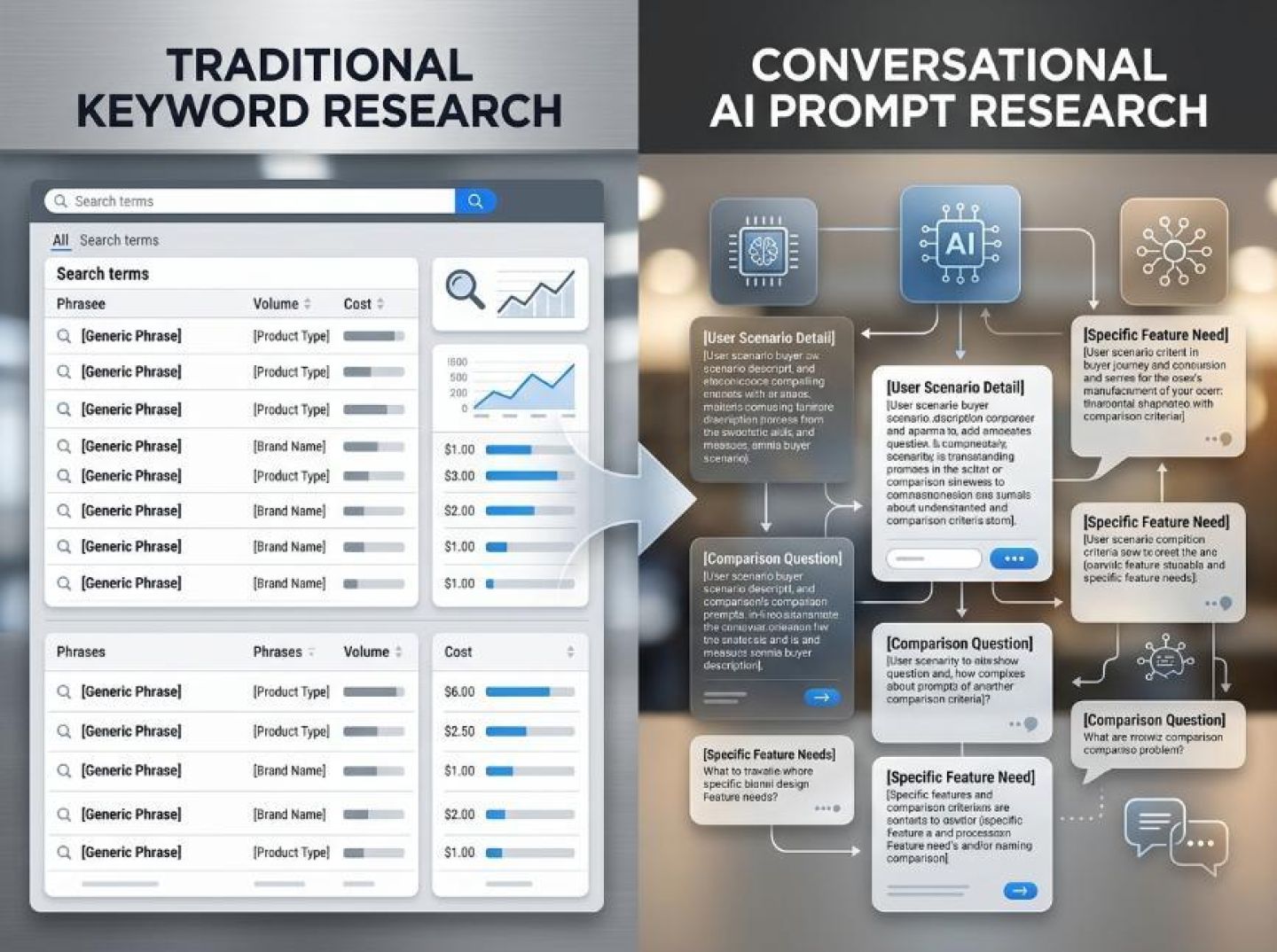
Get StartedAI search is changing how buyers discover, compare, and evaluate products. Instead of entering short keywords, people increasingly ask conversational questions that include their circumstances, preferences, constraints, and concerns. For marketers, this creates a new research opportunity: understanding the questions buyers ask AI systems and examining how brands appear in the resulting answers.
As tools for AI search visibility and prompt tracking develop, marketers can monitor selected questions, compare brand mentions, identify recurring competitors, and study how AI-generated answers frame different solutions. This adds a new layer to competitive research—one that complements traditional keyword reports, auction insights, and advertising intelligence.
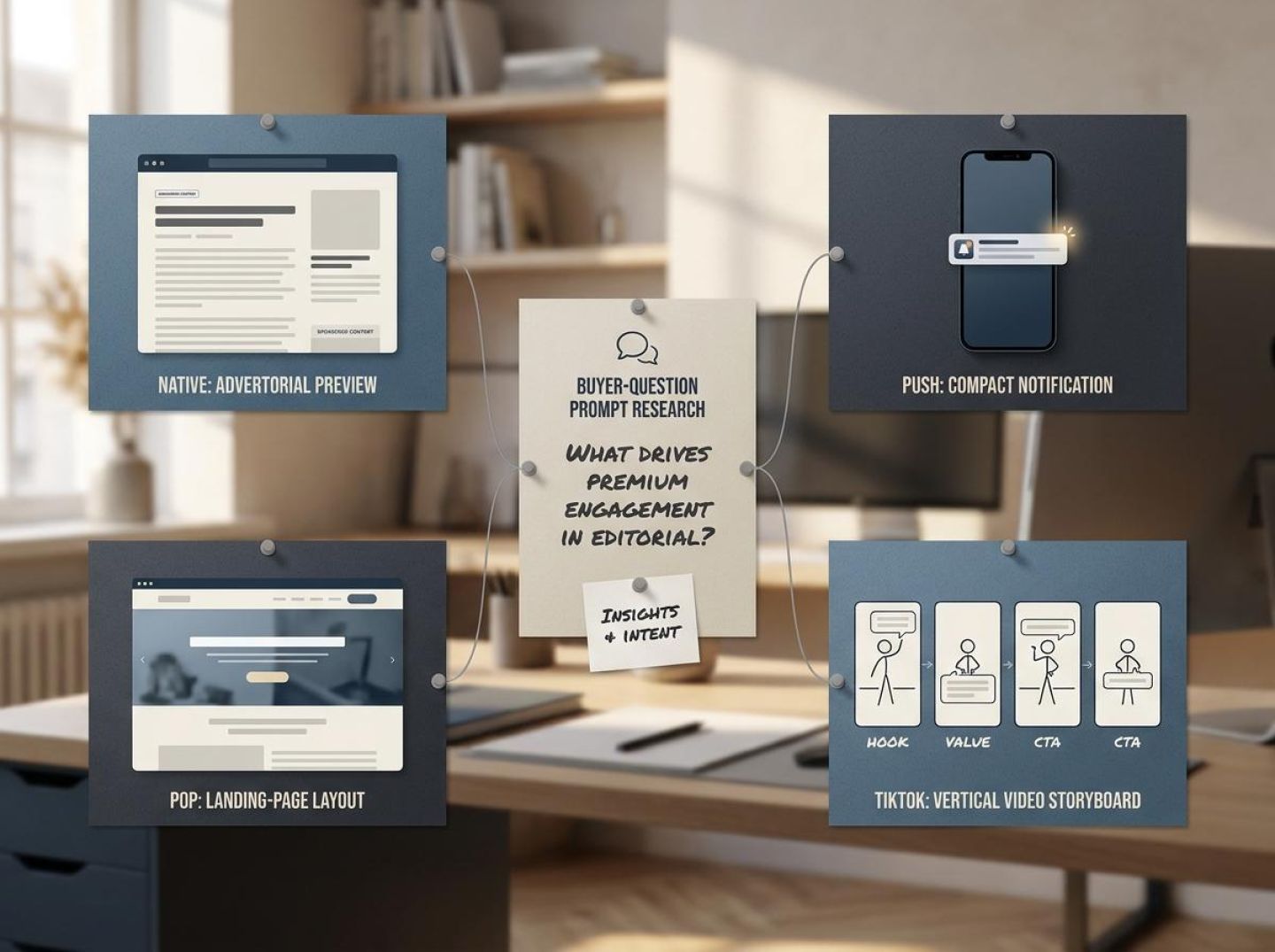
For paid-media teams, the opportunity is to connect those observations to practical decisions. Which buyer concerns deserve a new headline? Which comparisons should a landing page address? Where is a competitor being positioned more clearly? And which creative angles are worth testing across Native, Push, Pop, and TikTok campaigns?
The shift is not from keywords to prompts alone. It is from researching isolated search terms to understanding the questions, comparisons, and objections that shape buying decisions.
For much of the last two decades, competitive research in paid media has revolved around keywords, impression share, and auction insights.
Marketers asked:
The underlying assumption was that a search could be understood through a relatively short phrase, such as "project management software" or "plumber near me."
That assumption is becoming less complete.
People increasingly use AI assistants to describe problems in full sentences. Instead of searching for "email marketing tips," someone might ask, "How can I get more people to open my weekend promotions without sending too many emails?"
As discussed in WordStream's guide to prompt-based keyword research, conversational queries can contain more context than traditional keyword phrases. They may reveal a user's role, immediate problem, desired outcome, and concerns about a possible solution.
Consider the difference:
The second example gives a marketer more context to investigate. It suggests possible product requirements, objections, and messaging themes that a short keyword does not communicate on its own.
Traditional PPC competitive intelligence often combines keyword overlap, search-engine results, competitor ad copy, and available audience or placement information. These sources help marketers understand the competitive environment, but they do not necessarily show how a buyer frames a decision.
Prompt research adds another perspective.
The Semrush guide to prompt research for AI SEO describes the importance of identifying the questions that trigger AI-generated answers and brand recommendations. Rather than focusing exclusively on whether a competitor ranks for "best time tracking app," marketers can investigate more specific questions, such as:
"Which time-tracking tools work best for small agencies that use QuickBooks and do not want to pay for every additional user?"
That question introduces several comparison criteria:
These details can help marketers develop more relevant content, advertising messages, and landing-page experiences.
1. AI is becoming another discovery layer.
Users can now receive summaries, recommendations, and comparisons directly within AI-powered search experiences. This can change how people discover information before visiting individual websites.
WordStream's research on prompt-based keyword research discusses the changing relationship between traditional search behavior and AI-generated answers. The exact impact varies by query, platform, and industry, but marketers have a reason to monitor how these experiences affect discovery.
2. AI visibility is becoming measurable.
AI search analytics tools allow teams to define prompts and monitor how brands appear in generated answers. The HubSpot Marketing Blog's guide to AI search analytics tools discusses how marketers can track brand mentions and competitive visibility across AI search experiences.
This is different from conventional keyword ranking. Instead of simply measuring a position in a search results page, teams can examine whether a brand appears in an answer, which competitors appear alongside it, and what context the answer provides.
3. Buyer questions can inform advertising decisions.
Prompts can suggest which benefits, constraints, and objections deserve attention in advertising.
For example, a team researching project management software might discover recurring questions about client portals, time tracking, automation, or pricing. Those themes can become hypotheses for new ad groups, headlines, comparison pages, and creative tests.
Keyword research still matters. It remains useful for understanding search demand and the language people use. But prompt research adds a broader view of the questions behind that language.
The competitive research process is therefore expanding: from counting search terms to studying the questions buyers ask, the answers they receive, and the brands included in those answers.
Prompt intelligence is the process of collecting, organizing, and analyzing selected natural-language questions and the AI-generated answers associated with them.
It can help marketers understand:
It is important to distinguish this process from accessing private conversations.
Most commercially available AI visibility tools work through defined prompt sets, platform-supported data, or their own testing and monitoring systems. Their results should not automatically be described as transcripts of private conversations between real customers and AI assistants.
A tracked prompt is a research question. Its answer is an observed output from a particular platform, under particular conditions. Together, they provide useful competitive evidence—but not a complete record of what every buyer is asking.
AI visibility platforms increasingly use prompts as a unit of measurement.
For example, the HubSpot Marketing Blog's AI search analytics guide describes approaches for defining and tracking conversational questions, including monitoring how brands appear in AI-generated responses.
Semrush also provides prompt research and tracking capabilities. Its prompt research guide explains how marketers can identify questions that are relevant to their category and use them to guide AI-search research.
The resulting data can help teams investigate questions such as:
The key value is not that these tools reveal every private buyer conversation. It is that they make it possible to study a consistent set of questions and compare how AI systems respond over time.
A collection of prompts is not particularly useful until it is organized.
A practical prompt intelligence dataset can include:
The platform and testing conditions matter. Different AI systems can produce different answers, and results may change with time, location, personalization, model versions, and prompt wording.
Semrush's guide to zero-click searches also provides useful context for understanding why marketers are examining visibility within search experiences that may answer questions without requiring a website visit.
With consistent tracking, the dataset becomes a competitive research resource rather than a collection of isolated screenshots.
Prompt intelligence can uncover competitive patterns that keyword lists may not show clearly.
Your actual comparison set
A company may consider the category leader its main competitor, but AI-generated comparisons could repeatedly introduce a smaller specialist brand.
That is a useful signal to investigate. It may reveal that buyers are comparing solutions based on a specific feature, business model, or use case rather than overall market size.
The narratives associated with competing brands
Suppose AI-generated answers frequently describe one competitor as the simplest solution for small ecommerce businesses, while another is associated with enterprise integrations.
Those descriptions can help marketers identify positioning differences and investigate whether their own messaging communicates the intended value proposition.
The Semrush zero-click search guide discusses the importance of providing clear, useful information that can be understood and surfaced in AI-driven search experiences.
However, recurring brand mentions should be treated as observations—not proof that an AI system objectively considers a company the best product.
The questions behind buyer objections
A prompt such as "Is this software worth the price for a small agency?" suggests a different research angle from "Which software has the most advanced automation?"
One is primarily concerned with value and affordability. The other emphasizes functionality.
These differences can inform advertising hypotheses, landing-page sections, and comparison content.
The WordStream guide to prompt-based keyword research explores how natural-language questions can provide more context than traditional keyword phrases.
The practical advantage is a better understanding of the questions worth investigating—not guaranteed access to a complete record of buyer intent.
Before connecting prompt research to paid-media campaigns, marketers need a deliberate set of questions to monitor.
A random collection of AI queries will produce inconsistent results. A better approach is to organize prompts according to the role they play in the buying journey.
Three useful categories are branded, unbranded, and competitor prompts.
Branded prompts explicitly mention your company or product.
Examples include:
The purpose is to understand how AI-generated answers describe your brand and whether the information is accurate.
The HubSpot guide to which prompts to track discusses the role of branded and unbranded questions in AI visibility research.
For paid-media teams, branded prompts can help answer three important questions.
Is the value proposition being communicated correctly?
An AI answer might consistently associate a product with freelancers even though the business is targeting mid-market companies.
That discrepancy is worth investigating. It may point to gaps in product descriptions, comparison pages, third-party coverage, or other information available to answer engines.
Which information sources are being referenced?
If an AI answer repeatedly cites an outdated comparison page instead of a more recent product guide, the marketing team can investigate whether the newer information is accessible, clear, and adequately supported.
Where could inaccurate information create conversion friction?
Incorrect pricing, missing integrations, and outdated feature descriptions can create confusion.
A marketing team can use those findings to prioritize accurate website information, update product explanations, and develop advertising that addresses common misunderstandings.
Branded prompt research should therefore focus on accuracy and consistency, not just the number of times a brand appears.
Unbranded prompts describe a problem or product category without mentioning a specific company.
Examples include:
These prompts help teams investigate how AI systems describe a category before a particular brand is introduced.
According to HubSpot's guide to which prompts to track, unbranded prompts are an important part of understanding broader AI-search visibility.
They can reveal several useful research themes.
Buyer context
A question about increasing email opens without overwhelming subscribers suggests different messaging opportunities from a generic request for email marketing software.
Feature-level requirements
Repeated questions about client reporting, approval workflows, or automation can suggest specific product features that deserve attention in ad messaging and landing pages.
Competitive visibility gaps
If several tracked questions consistently surface competing products but rarely include your brand, that may indicate a positioning or information gap worth investigating.
It does not automatically mean your brand has no demand. It means your visibility in that particular research set deserves attention.
A practical unbranded prompt set can combine:
The goal is to turn these inputs into natural-language research questions that represent real customer problems.
Competitor prompts explicitly mention rival brands.
Examples include:
These prompts can help marketers examine how AI-generated answers compare products and which decision criteria appear most frequently.
Use them to investigate:
Which comparison frameworks appear repeatedly?
If a particular competitor pairing appears frequently in your tracked results, it may suggest a comparison opportunity for your own content and advertising.
HubSpot's comparison of AEO tools provides additional context on how AI-search visibility platforms approach brand and prompt tracking.
Which product weaknesses are part of the conversation?
Questions about complexity, pricing, integrations, or implementation challenges can suggest objections that deserve further research.
These are potential messaging opportunities, not verified evidence that every customer shares the same concern.
Which sources support the comparison?
If answers repeatedly cite the same comparison pages, product documentation, or independent reviews, those sources are worth examining.
The objective is to understand the information shaping the generated answer—not simply to count competitor mentions.
A starting allocation could look like this:
These percentages are a suggested planning framework, not an established industry standard. Adjust them based on your business model, brand maturity, and research objectives.
Each prompt should also map to a buying stage:
Once the prompt set is organized by brand type and buying stage, marketers can connect research findings to more specific advertising decisions.
An AI Overview or generated answer can provide more than a summary for a user. When examined systematically, it can help marketers understand which benefits, comparisons, and information sources are prominent for a particular question.
The important distinction is that an AI-generated answer is not a direct record of buyer psychology. It is an output produced by a specific system in response to a specific prompt.
That output can still be useful competitive research.
When reviewing an answer, focus on three layers:
Together, these elements can help marketers develop more informed creative and landing-page hypotheses.
AI-generated answers often organize information into direct explanations, lists, comparisons, and practical recommendations.
That structure can help identify the themes a marketer should investigate.
For example, imagine an answer to:
"Which project management tools work best for agencies?"
The response might emphasize:
Those categories provide a useful starting point for reviewing advertising messages and landing-page content.
The Semrush guide to zero-click searches discusses the importance of clear, self-contained information in search experiences that surface answers directly.
For paid-media teams, the practical exercise is to identify the central message and supporting themes in the generated answer.
Do not assume these are proven conversion drivers. Treat them as research signals that can guide controlled tests.
Next, examine the websites and pages cited in the generated answer.
Ask:
The HubSpot guide to AI search analytics discusses the importance of examining how brands appear and are framed within AI search results.
For marketers, citation analysis can reveal which types of information are being surfaced for a particular question.
For example:
A citation does not automatically mean the cited company is endorsed, nor does it prove that the source is the most trusted or influential resource in every context. Examine the actual answer and the role each source plays.
Prompt intelligence becomes more practical when research findings are converted into testable creative requirements.
For one relevant prompt, extract:
Those elements can inform a campaign asset matrix:
| Advertising asset | Research application |
|---|---|
| Search headlines | Test variations of the core promise |
| Ad descriptions | Address supporting benefits and objections |
| Sitelinks | Direct users to relevant comparisons, guides, or product details |
| Landing-page headline | Resolve the main buyer concern |
| Landing-page sections | Expand on the most relevant comparison criteria |
For example, if a prompt repeatedly produces answers about project management tools for agencies, a campaign could test messages around client visibility, time tracking, and workflow automation.
The landing page should then provide accurate product details and evidence supporting those claims.
The goal is not to copy an AI-generated answer. It is to use the answer as one research input when deciding what to communicate and what to test.
One prompt is only a snapshot. A more reliable research process examines related questions with different requirements.
For example:
As discussed in WordStream's prompt-based research guide, conversational questions can express different problems and constraints.
Compare the answers across prompt variations:
Record the platform, date, and prompt wording so that changes can be interpreted properly.
A recurring pattern can suggest a campaign opportunity. It does not prove that every person in that audience shares the same preferences.
AI answers are not customer surveys. They are research observations that should be validated against customer feedback, conversion data, and actual campaign results.
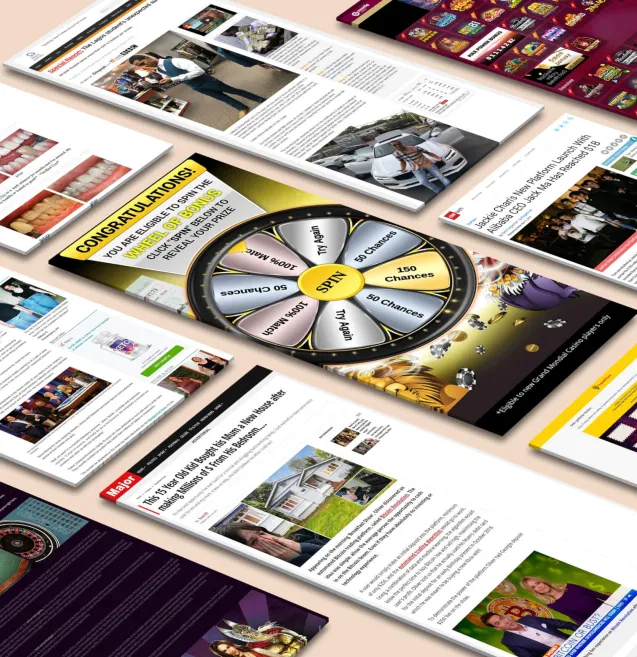
Prompt intelligence can help marketers identify what buyers are asking and which concerns appear in AI-generated answers. Anstrex provides a different but complementary research perspective: visible advertising creatives and landing-page examples across supported advertising sources.
Together, these research inputs can help teams develop and investigate advertising concepts.
The distinction matters:
Competitor ad visibility does not establish that an ad is profitable. Creative persistence, repeated appearances, or estimated activity should be treated as research signals—not verified performance results.
Start with high-value unbranded prompts: questions that describe a problem without mentioning a particular brand.
For example:
"How do I fix a leaking water heater this week without paying an emergency fee?"
This question contains several elements:
The WordStream guide to prompt-based keyword research discusses how conversational prompts can provide more context than short keyword phrases.
A different example might be:
"What should I do if I have received an IRS notice and cannot afford professional tax assistance?"
This prompt introduces a situation, a financial concern, and a need for guidance.
Before turning either example into advertising, verify the claims, applicable regulations, and the advertiser's ability to deliver the promised service. In sensitive areas such as financial services, health, and legal matters, avoid exaggerated outcomes, misleading urgency, or unsupported guarantees.
The research exercise is to identify the buyer's problem and develop an accurate message that addresses it.
Open Anstrex and research relevant advertising examples across the channels available to your account.
Search around the situations, concerns, and desired outcomes identified in your prompt research.
Look for recurring creative structures and landing-page approaches.
Native advertising
Investigate:
Push advertising
Investigate:
Pop advertising
Investigate:
TikTok advertising
Investigate:
These are creative patterns worth examining, not universal formulas for winning campaigns. Anstrex can help you study visible examples, but repeated appearances do not prove that an advertiser has achieved strong return on ad spend or profitable conversions.
Once you have identified a buyer concern and reviewed relevant advertising examples, develop a message that can be adapted to different placements.
For example, consider the general prompt:
"I received an unexpected tax notice and need to understand my options."
A responsible campaign concept could focus on helping people understand available information and next steps, rather than promising a guaranteed financial outcome.
Possible adaptations:
Native headline
"Received a Tax Notice? Understand the Steps You Can Take Next"
The headline reflects the situation and offers an informational direction.
Push notification
Title: "Received a Tax Notice?"
Body: "Learn what to review before deciding your next step."
Pop landing-page hook
"Not Sure What Your Tax Notice Means? Start by Understanding the Details."
The page should clearly explain the service, eligibility, limitations, and next steps.
TikTok opening line
"If you have just received a tax notice, here are three things to understand before responding."
Each format communicates the same underlying topic, but adapts the presentation to the channel.
This is the central combination:
AI visibility gaps can help marketers identify research priorities, but they should not be the only factor used to allocate paid-media budgets.
A prompt where your brand is missing from an AI answer may be worth investigating. However, its commercial value depends on the audience, product, competition, and actual business opportunity.
Rank potential opportunities using three dimensions:
1. Purchase intent
How close is the question to a purchase decision?
A general educational question may require a different campaign approach from a direct comparison between two products.
2. Competitive intensity
Which competitors appear in the tracked answers? What messages and sources are associated with them? Are there clear differences in positioning or product information?
3. Business value
What is the potential value of serving this audience? Consider average order value, customer lifetime value, margin, and the advertiser's ability to fulfill the offer.
For high-priority opportunities, return to Anstrex and investigate:
Do not assume that visible advertising volume reveals private competitor budgets or campaign profitability. Use the observations to develop hypotheses, then evaluate those hypotheses using your own campaign data.
A practical prompt-first advertising workflow can follow this sequence:
This creates a connection between AI-search research and competitive advertising intelligence without confusing market observations with verified performance data.
Instead of asking only which channel to spend more on, marketers can begin by asking which buyer problem is worth addressing, which messages deserve testing, and which advertising formats provide a suitable way to communicate them.
Traditional keyword research remains valuable, but it does not tell the entire story of how customers discover and compare products.
AI prompt research adds another perspective by allowing marketers to examine detailed questions, generated answers, brand mentions, and citations across selected AI search experiences.
For paid-media teams, the opportunity is to turn those observations into practical research:
The most useful competitive intelligence system will not rely on prompt tracking or ad spying alone. It will connect customer questions, AI-search observations, visible advertising examples, and actual campaign performance.
Keywords tell marketers how people describe a search. Prompt research adds context about the questions they ask. Competitive ad intelligence helps reveal how advertisers respond to similar problems.
The advantage comes from connecting all three—and using the resulting insights to make better, evidence-based advertising decisions.
Receive top converting landing pages in your inbox every week from us.
Most Read
Traditional keyword research shows what people search for. AI prompt research can reveal how buyers compare options, express concerns, and evaluate solutions. Learn how to turn those insights into stronger paid-media creative with Anstrex.
Priya Kapoor
7 minNov 14, 2026
How-To
As advertising platforms automate targeting and measurement, competitive intelligence is becoming more important. Learn how to track creative, landing pages, auction signals, and market shifts beyond the walled gardens.
Marcus Chen
7 minNov 13, 2026
Guide
Financial ad verification is changing how advertisers reach customers. Discover how to use Anstrex to research competitor creatives and funnels, identify transparency patterns, and build campaigns with stronger compliance controls.
Samantha Reed
7 minNov 13, 2026