10 minNovember 13, 2026

Our tools monitor millions of native, push, pop, and TikTok advertising campaigns.
Get StartedFinancial advertising is entering a more demanding era. Platforms are expanding advertiser verification, regulators are increasing scrutiny, and automated systems are evaluating more than the words inside an advertisement.
For financial advertisers, staying eligible to advertise increasingly requires attention to the entire customer journey: who is behind the offer, what the advertisement promises, how the landing page explains the product, and whether the experience matches what customers reasonably expect.
Google's Financial Services Verification program is one example of this shift. The company has described verification requirements in the United States, Canada, and additional international markets. Its stated objective is to help ensure that financial services advertisements come from authorized advertisers and reduce exposure to scams. The expansion into additional European Economic Area markets is covered by Search Engine Roundtable, while Google's own explanation of its U.S. and Canadian program is available in its Ads & Commerce update.
Verification is only one part of the challenge. Google's limited ad serving policy has also drawn attention to advertiser content, products, behavior, and user expectations. As Search Engine Journal explains, advertisers need to consider the experience beyond the initial click.
That creates a difficult situation for performance teams. An advertisement may not show an obvious policy disapproval, yet the advertiser may still need to investigate delivery limitations, customer complaints, unclear pricing, or a mismatch between the ad and the landing page.
At the same time, automated campaign features can expand audiences, placements, and creative combinations in ways that require stronger internal controls. A discussion of these risks appears in Search Engine Journal's analysis of AI in regulated paid media.
This is where competitive Anstrex.com/blog/mega-list-of-adspy-tools-both-free-paid-in-2021" target="_blank" rel="noreferrer noopener">ad intelligence can contribute.
Anstrex can help marketers examine visible advertising activity, compare creative approaches, and inspect landing-page experiences. It cannot certify that a competitor is licensed, reveal Google's internal verification status, or explain why a particular advertiser receives a certain level of delivery.
Used appropriately, however, it can help teams identify patterns worth investigating and turn those observations into better questions for their own compliance, creative, and media operations.
Financial advertisers face several overlapping requirements. Understanding the differences between them is essential because verification, ad policy enforcement, and delivery limitations are not interchangeable.
Google's Financial Services Verification program is designed to establish whether advertisers are authorized to promote certain financial products and services in applicable markets.
In its published updates, Google has described a system involving advertiser identity checks and additional financial-services verification. The company has also reported substantial efforts to identify and remove unauthorized financial services advertisements.
The supplied source references Google's claims that more than 97% of ads in the United States and Canada already come from identity-verified advertisers, and that its broader financial verification framework has helped block or remove hundreds of millions of unauthorized financial services ads. These figures should be checked against the latest official documentation before publication.
The expansion into 24 additional EEA markets is discussed in Search Engine Roundtable's coverage.
For advertisers, the practical implication is that identity and authorization need to be considered before campaign launch.
A financial advertiser should be able to establish:
The exact requirements depend on the financial product, market, advertiser role, and applicable platform rules. A company should not assume that verification for one product or country automatically covers another.
Verification does not guarantee unlimited delivery.
Google's limited ad serving policy has raised questions about how advertiser content, products, behavior, and user expectations may affect distribution. Search Engine Journal's analysis of the update discusses the implications for advertisers.
For financial marketers, the important lesson is to look beyond the initial advertisement.
Potential areas for review include:
These are sensible areas for internal risk review. They should not be treated as a definitive list of Google's undisclosed ranking or serving signals.
Google has not publicly provided advertisers with a complete formula for every limited-serving decision. Marketers should therefore avoid claiming that a particular complaint, page element, or competitor pattern directly causes an impression restriction.
Instead, build a review process that checks whether the advertising experience is clear, accurate, and consistent from the first impression through the post-click journey.
Automated campaign systems can expand targeting, select placements, and combine creative assets.
Google's optimized targeting and Meta's Advantage+ are examples of systems that may use automation to extend delivery beyond an advertiser's initial manual assumptions, depending on the campaign settings and product.
In regulated categories, that creates a governance challenge.
An advertiser may approve a message for one audience or market without intending to expose it to every audience or geography that an automated system can reach.
Search Engine Journal's discussion of AI in regulated paid media highlights the importance of reviewing default settings and maintaining control over regulated campaigns.
A practical internal checklist should include:
For creative automation, establish clear rules about which headlines, descriptions, images, and calls to action can be combined. Do not assume that every individually approved asset remains compliant in every possible combination.
Financial advertisers operate inside an advertising ecosystem where platform rules, regulatory expectations, and market structure are evolving at the same time.
The U.S. ad-tech antitrust case involving Google is one example. MarTech's coverage of the decision discusses the court's findings and the remedies that followed.
The broader context matters, but it should not be confused with a direct explanation of an individual advertiser's delivery or verification status.
The practical takeaway is straightforward:
Verification establishes whether an advertiser meets applicable entry requirements. Campaign governance helps ensure that the advertiser continues to communicate and operate responsibly.
Neither should be treated as a one-time checkbox.
Compliance is often treated as a cost center: a process that delays campaign launches, limits creative options, and requires additional legal review.
But in financial advertising, compliance can also influence whether a business is eligible to advertise, whether customers understand the offer, and whether the marketing operation can scale reliably.
That does not mean compliance automatically lowers acquisition costs or improves auction performance. It means that a well-governed advertiser is better positioned to avoid preventable disruptions and build a more trustworthy customer experience.
Two forces make this especially important.
Google's financial verification requirements connect advertiser eligibility to identity and authorization checks. Its official update explains the company's approach to financial services verification and scam prevention.
For advertisers, this creates a practical requirement: documentation and campaign setup need to be aligned before significant media investment begins.
A financial advertiser should not rely on creative optimization to compensate for missing authorization, inaccurate product descriptions, or an unclear business identity.
The same emphasis on transparency is visible in other parts of the ad-tech ecosystem. AdExchanger's reporting on Peer39's program-level reporting work describes efforts to provide buyers with more visibility into the inventory they purchase.
This is not the same as financial advertiser verification, but it reflects a broader industry interest in transparency, context, and quality signals.
For financial marketers, the operational benefits of stronger controls may include:
These improvements can protect campaign continuity, although they do not guarantee lower CPMs, better auction positions, or cheaper conversions.
Financial advertisers need to operate in an environment where policies, enforcement practices, and legal requirements can evolve.
Following the Google ad-tech antitrust decision, industry reactions focused on the importance of enforcing behavioral remedies. VideoWeek's analysis of industry responses discusses this debate.
These developments do not establish that a particular financial advertiser will receive more or less inventory. They do demonstrate why marketers should not build their operating assumptions around an unchanging platform environment.
The expansion of financial verification into additional EEA markets, covered by Search Engine Roundtable, is another reminder that geographic expansion requires market-specific preparation.
Before launching into a new country, teams should check:
Agencies and specialist marketing teams can play an important role in coordinating these requirements. VideoWeek's coverage of Berenberg's analysis of agency groups discusses the growing strategic importance of helping clients navigate a complex marketing environment.
The advantage is not simply knowing how to write a compliant headline. It is coordinating legal review, media planning, creative production, landing-page design, and ongoing monitoring.
A stronger approach is to include compliance requirements in the campaign brief from the beginning.
For example, every financial campaign brief can identify:
This helps prevent a common operational problem: a creative team develops a compelling advertisement, but the legal and product requirements are considered only after production is complete.
Compliance becomes a performance lever when it helps the team launch responsibly, reduce avoidable rework, and maintain a consistent customer experience.
It is not a shortcut to cheaper media. It is part of building a more resilient advertising operation.
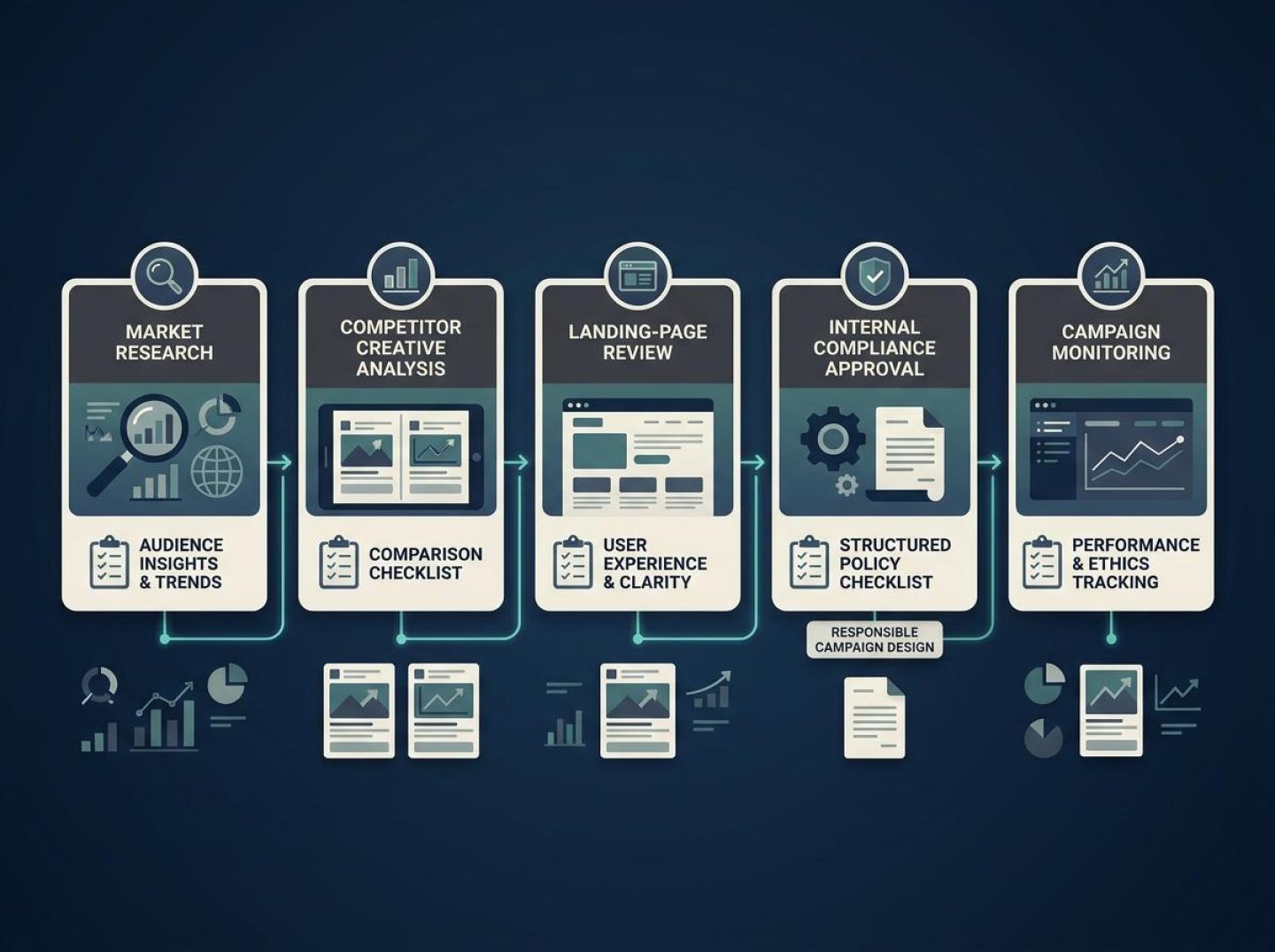
Policy pages explain formal requirements, but marketers also need to understand how financial advertisers present their products in the market.
This is where competitive ad intelligence can support research.
Anstrex can help marketers examine visible advertisements, compare creative approaches, and inspect destination pages in supported sources. These observations can be organized into a research library that helps creative, media, and compliance teams identify questions worth investigating.
The critical distinction is that visible advertising activity is not proof of regulatory approval or platform verification.
An advertisement that appears repeatedly may be part of a legitimate campaign, a test, a syndicated placement, or another form of distribution. Its duration does not establish that the advertiser has passed a specific verification process.
Likewise, an advertisement disappearing from view does not prove that it was rejected or penalized.
Use competitive research to study observable patterns, not to infer private platform decisions.
Start by narrowing your research to the products, markets, and business models that resemble your own.
In Anstrex, use the available filters to organize examples by:
The purpose is to build a relevant comparison set, not to label every advertiser in it as verified.
If you need to confirm a competitor's authorization, check the relevant regulator or public registry directly. If you need to confirm a platform's approval status, use the platform's official verification process or records available to the advertiser.
When reviewing financial advertisements, note how clearly the advertiser identifies itself.
Questions to investigate include:
Google's verification initiative is focused on advertiser identity and authorization. Its Ads & Commerce update provides the platform's explanation of this approach.
A competitor's use of a brand name, company suffix, or registration reference is not proof that the details are valid. Treat these as research observations and verify any factual claims through official records.
Next, review how advertisers describe their products and expected outcomes.
Look for the types of claims used:
Record the exact language and its context.
For example, a rate advertised as “from” or “up to” may depend on eligibility, product conditions, or a limited promotional period. The landing page should explain those conditions clearly.
Pay particular attention to absolute claims such as “guaranteed,” “risk-free,” or “zero loss.” These expressions may create significant regulatory and consumer-protection concerns depending on the product and jurisdiction.
Do not assume that wording is acceptable simply because it appears in a competitor's advertisement.
The goal is to identify how the market communicates financial benefits and where your own messaging needs stronger evidence, qualification, or disclosure.
Risk warnings and material terms should be easy for the intended audience to understand.
When reviewing creative and landing pages, record:
The exact disclosure requirements depend on the product and market. A competitor's layout should never replace legal review.
A useful comparison is to examine whether the main benefit and the relevant qualification appear close enough together for a customer to understand the offer without having to search for important limitations.
The advertisement is only the beginning of the customer journey.
Open the destination page and investigate whether it supports the expectations created by the creative.
Look for:
Search Engine Journal's coverage of Google's limited ad serving update is a useful reminder that advertiser quality and the post-click experience deserve attention alongside the initial ad.
The observations can be organized into an internal reference library.
For each example, record:
| Research field | What to document |
|---|---|
| Advertiser | Brand name and visible business identity |
| Market | Country or region where the example was observed |
| Product | Financial category and offer type |
| Creative | Hook, claim, proof, and call to action |
| Disclosures | Visible qualifications and risk warnings |
| Destination | Landing-page structure and user journey |
| Observation date | When the advertisement and page were reviewed |
| Verification status | Independently confirmed, unconfirmed, or not applicable |
| Research notes | Questions or patterns for further investigation |
This is more reliable than assigning a competitor an “inferred compliance score” based on ad longevity, visibility, or creative appearance.
The research library should distinguish three different things:
Keeping these separate makes the research useful without overstating what an ad spy tool can reveal.
The practical objective is to use competitive intelligence as a research input while keeping actual compliance decisions grounded in official requirements and internal approval.
Anstrex can support the market-observation and creative-research parts of this process. Your legal, compliance, and campaign teams remain responsible for confirming whether the advertiser, product, claims, targeting, and destination are permitted.
Begin with the financial product and target geography.
Do not treat all financial services as one category. Banking, credit cards, personal loans, insurance, wealth management, trading, and cryptocurrency can have different rules and disclosure requirements.
Define:
Use Anstrex's available geography, vertical, network, and placement filters to gather relevant examples.
For the regulatory requirements, consult the applicable official regulator and platform documentation. The competitor research set is not a substitute for confirming that your own business is authorized.
Once you have a relevant research set, compare the advertisements for recurring structures.
On the creative side, record:
Pay attention to the difference between a claim and the evidence supporting it.
For example, an advertisement may state that a product offers a particular rate. Your team should establish whether that rate is current, available to the intended audience, and accurately qualified before using a similar claim.
The aim is to understand how competitors communicate—not to reproduce their language or assume their approach is compliant.
Use Anstrex's available landing-page views and snapshots to examine how the advertisement connects to its destination.
Build an internal review checklist covering:
Advertiser identity
Product clarity
Risk communication
Customer experience
Use competitor examples to identify possible improvements, but have your own pages reviewed against the actual laws and platform requirements that apply to your business.
Translate the research into internal rules.
A useful standard library can include:
This is especially important when using automated campaign formats.
Search Engine Journal's guidance on maintaining control as platforms automate accounts discusses ways advertisers can retain control over automated campaigns.
For regulated products, define which messages must remain fixed, which elements may be changed, and which combinations require additional review.
Do not use small-scale testing as a way to see whether a borderline claim can slip past automated review.
Instead, test legitimate variations within the boundaries established by your compliance team.
Examples include:
Record the version, approval status, destination page, target market, and campaign results.
If a campaign receives a policy warning, serving limitation, or customer complaint, investigate the underlying issue rather than simply changing the wording to avoid detection.
Financial advertising requirements and platform policies can change.
Use a regular review schedule:
Weekly
Monthly
When entering a new market or launching a new product
Anstrex can help maintain visibility into observable advertising patterns and landing-page changes. It should not be used as a substitute for official policy updates, regulator checks, or legal advice.
The strongest process connects competitive research with independent verification and ongoing campaign governance.
Financial advertising is becoming more demanding. Verification requirements, platform enforcement, automated delivery, and customer-experience expectations all influence how advertisers plan and manage campaigns.
The opportunity is not to discover a shortcut around these requirements. It is to build a more disciplined research and campaign process.
Anstrex can help marketers observe how financial advertisers present their products, structure their creative, communicate risk, and organize their landing pages. Those observations can inform better questions and more thoughtful campaign design.
But visible advertising activity does not prove that a competitor is licensed, verified, profitable, or protected from future enforcement.
The responsible approach is to separate market observations from independently confirmed facts, use official sources to verify authorization, and apply internal review before launching or changing financial campaigns.
When compliance is included in research, creative development, landing-page design, and ongoing monitoring, it becomes more than a final approval step.
It becomes part of how a financial advertiser builds trust, protects campaign continuity, and competes responsibly in a changing advertising environment.
Receive top converting landing pages in your inbox every week from us.
How-To
As advertising platforms automate targeting and measurement, competitive intelligence is becoming more important. Learn how to track creative, landing pages, auction signals, and market shifts beyond the walled gardens.
Marcus Chen
7 minNov 13, 2026
Guide
Financial ad verification is changing how advertisers reach customers. Discover how to use Anstrex to research competitor creatives and funnels, identify transparency patterns, and build campaigns with stronger compliance controls.
Samantha Reed
7 minNov 13, 2026
Guide
One strong idea can do more than power a single campaign. Discover how to use spy data, creative testing, and performance insights to adapt winning concepts across social, video, search, native, CTV, and DOOH.
Dan Smith
7 minNov 13, 2026