8 minSeptember 6, 2026

Our tools monitor millions of native, push, pop, and TikTok advertising campaigns.
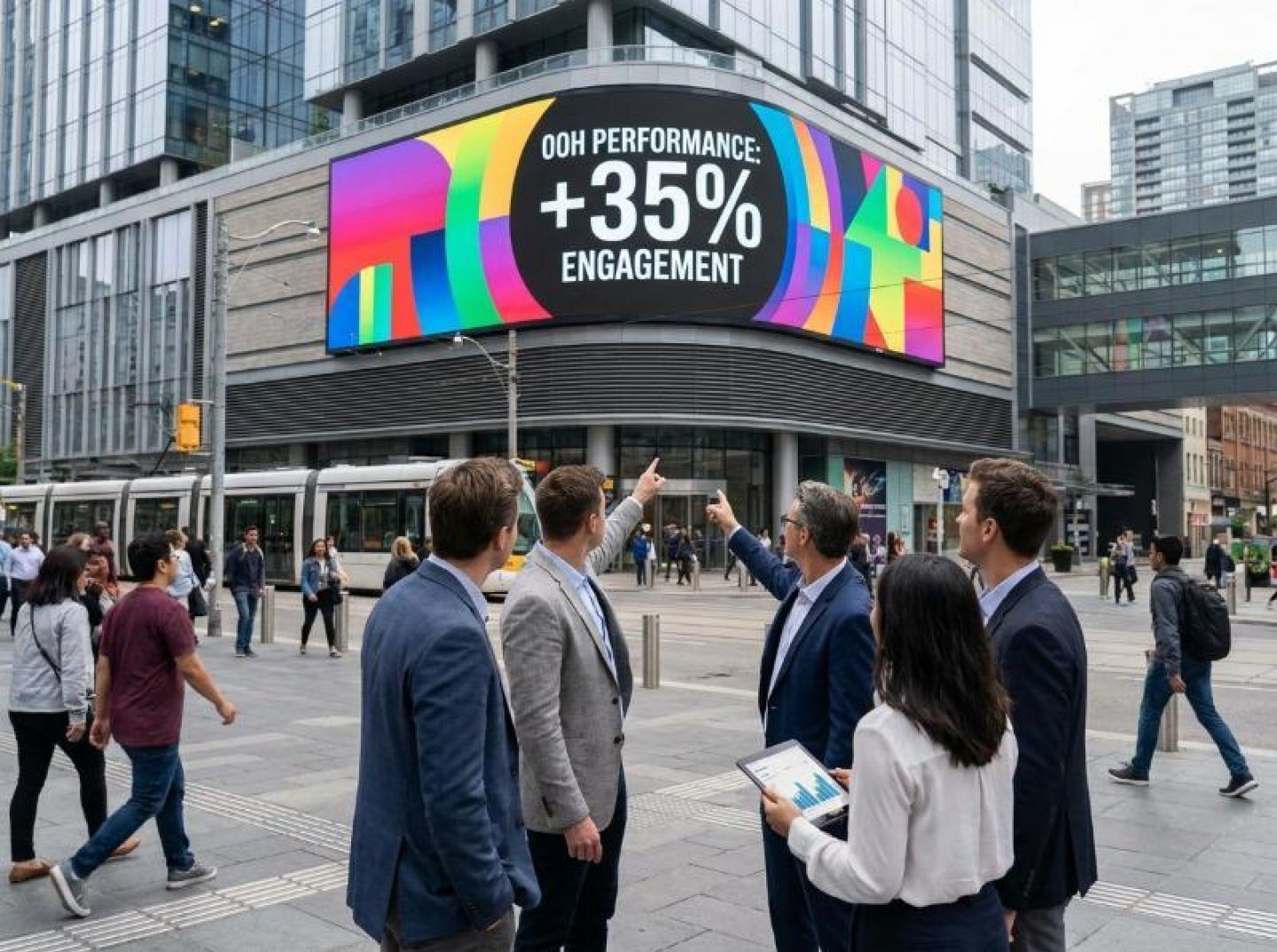
Get StartedOut-of-home has spent decades wearing the “awareness only” label like a bad name tag. You bought billboards, airport trays, and transit media to “be seen,” then handed attribution—and the credit—to whatever digital channel happened to touch the customer last. That story is collapsing.
The real shift is that OOH is no longer just a canvas; it’s becoming an intelligent trigger layer for measurable digital behavior. When a billboard is wired into the same demand signals, identity graphs, and creative systems that power your performance marketing, it stops being a fuzzy top-of-funnel investment and starts acting like a mid‑ and lower‑funnel engine.
You can see this in two converging trends.
First, the industry is finally quantifying how OOH drives digital conversions over time. In a large cross‑media study, Kochava found that as people see more OOH exposures, their digital conversion rates don’t plateau—they climb steadily from 0.24% after one exposure to 1.28% after ten, a six‑fold increase and “the cleanest upward curve of any media type,” as the AdQuick team explains. That curve doesn’t describe vague awareness; it describes people going online and doing things you can count—searching, clicking, buying.
Even more important, OOH does this without the resentment that plagues interruptive digital formats. You can’t skip a billboard, but you also don’t develop the same irritation you feel when an ad follows you around the internet; it lives in the periphery, like someone “whispering a fact in your ear every morning,” rather than spamming your inbox, as AdQuick’s analysis puts it. That makes OOH unusually well suited to high‑frequency messaging that gently conditions intent until a digital action becomes the obvious next step.
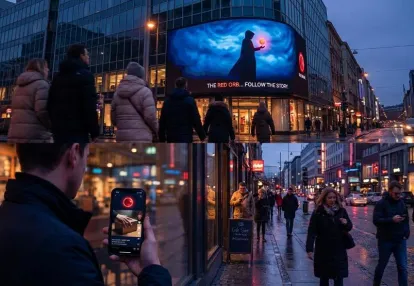
Second, the physical‑to‑digital bridge itself is getting dramatically shorter. The biggest historical complaint about OOH has been attribution: “How do I prove that the person who bought actually saw the board?” QR codes, near‑field identifiers, and mobile triggers are closing that loop. A scan on a highway billboard or a bus shelter instantly moves someone from anonymous passerby into a tracked digital journey, letting you see which location, at what time, yielded a site visit or purchase, turning OOH “from a ‘brand awareness’ play into a performance marketing channel,” as.
Once that bridge exists, you don’t need to wait for a later search or social touch to claim credit. The OOH moment itself captures the lead—often with a contextual incentive like “Scan for 20% off,” which drops a coupon into a mobile wallet and keeps your brand “living” on the device for follow‑up messaging, as the same MyHoardings guide notes. That’s not awareness; that’s commerce infrastructure.
Zoom out and the trajectory becomes even more obvious. In a self‑driving world, out‑of‑home won’t just prime awareness before some future click. It will directly trigger in‑car, in‑phone, and in‑AR interactions. Passing a board will initiate an in‑vehicle offer, load a product carousel, or surface instant booking options so that “outdoor becomes the top‑of‑funnel awareness AND the mid‑funnel conversion mechanism,” as one forward‑looking OOH Today piece predicts. Windows themselves will act as interactive screens, pulling OOH creative into the digital environment and turning passive impressions into shoppable experiences on the spot.
Underneath all of this is a deeper structural change: OOH networks are adding an intelligence layer that closes the historical gap between what happens in the physical world and how digital teams respond. When a digital signage network like Trillboards integrates with a machine‑learning system such as hellOOH, it’s acknowledging that the real constraint is no longer hanging posters—it’s “intelligence asymmetry.” By modeling market behavior and campaign history, these systems turn scattered OOH data into predictive demand signals that can feed your retargeting, creative sequencing, and bidding strategies in almost real time.
In other words, OOH is no longer a static canvas at the top of the funnel. It’s becoming a dynamic signal and trigger layer inside the funnel—one that can both generate demand and immediately hand that demand to your digital stack for high‑ROI retargeting.
The moment someone notices your billboard—or the tray liner under their airport coffee—your job as a performance marketer is to answer one question: “Where does this person go next, and how do I follow them there?” Bridging that “seen in the wild” moment to a fully trackable, digital funnel is where ad spy tools like Anstrex become unfair advantages instead of just curiosity toys.
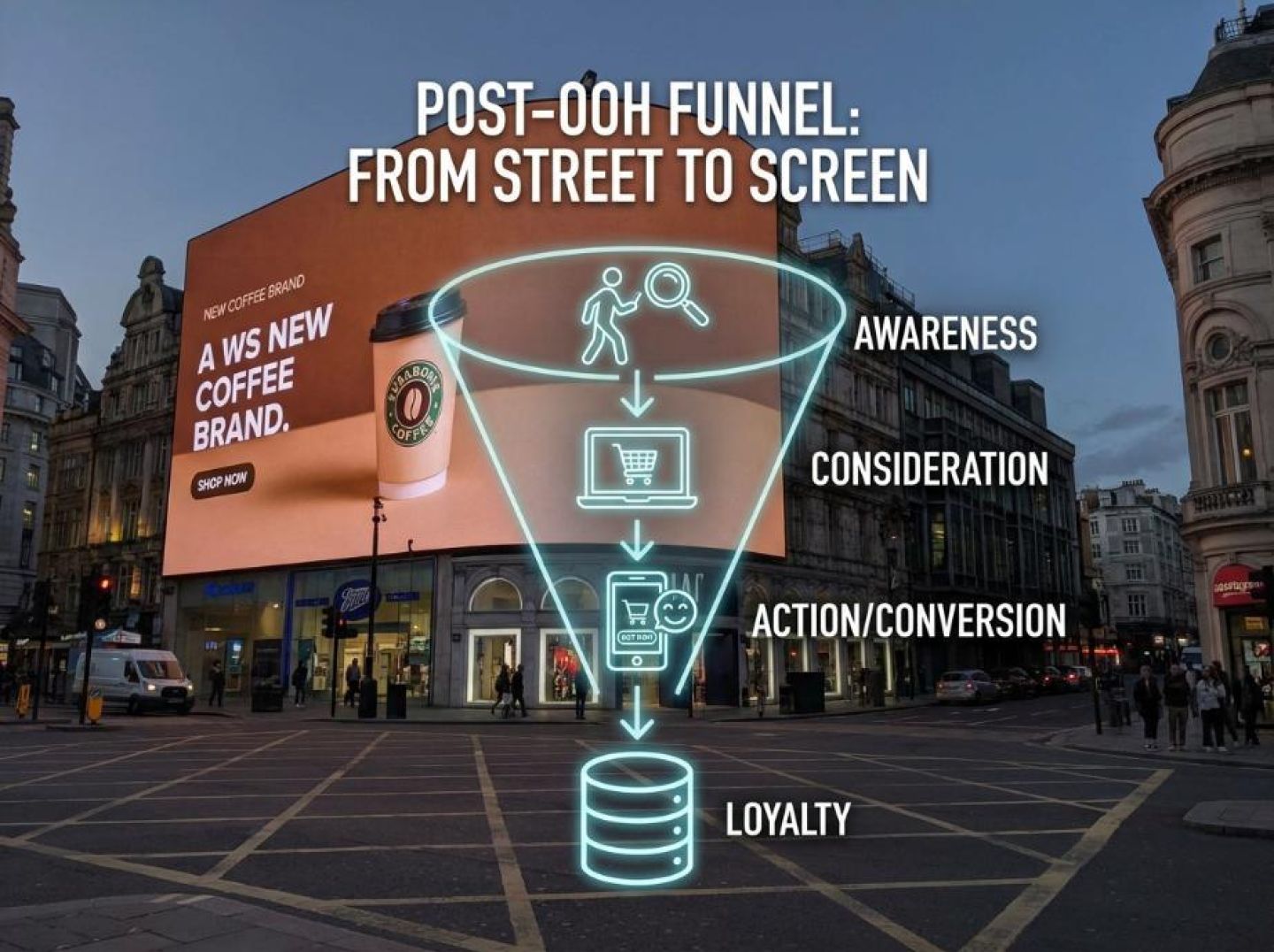
The first step is to recognize that modern OOH already leaves a digital breadcrumb trail. QR-led campaigns are now standard, not experimental. When a commuter scans a code on a bus shelter or freeway board, they drop directly into a tagged environment where you know which creative they saw, where they were, and when they engaged. As the team at MyHoardings describes, that single scan turns a historically opaque medium into a performance channel with board-level attribution and coupon downloads sitting in a user’s mobile wallet.
From there, the trail is almost always the same: QR or vanity URL → landing page → remarketing pool → follow-up offers on social, display, and native. That repeatable shape is exactly what makes the post-OOH funnel discoverable in an ad spy platform.
Here’s the practical workflow:
3. Search Anstrex by copy fragments and brand structure.
In Anstrex, plug in distinct fragments from that landing page—headline phrases, unique benefit lines, or even the exact discount hook. Brands that build QR-driven campaigns tend to mirror that messaging across their native and programmatic buys for consistency, so those phrases often show up in their paid units. Combine that with domain filters and you’ll quickly map which native widgets, pre-landers, and advertorials are being used to warm up the same traffic you saw outdoors.
4. Map the “post-scan” retargeting stack.
Now layer in what we know from cross-media performance. Kochava’s study, as unpacked on the AdQuick blog, shows OOH’s conversion rate climbing steadily with repeated exposures, from 0.24% at one touch to 1.28% at ten. That only happens if brands keep resurfacing themselves in digital after the initial OOH impression. In Anstrex, look for frequency-oriented creative patterns: large sets of small-variant ads, long-running campaigns using the same core hook, and placements across multiple networks rather than a single burst. Those patterns usually indicate a deliberate attempt to “shadow” the user for days after the billboard or airport touchpoint.
5. Use third-party intelligence to validate your hunches.
OOH networks themselves are starting to wire in machine learning layers that tie physical placements to demand signals. Trillboards’ integration with the hellOOH intelligence system is an example: by structuring campaign histories and mapping decision-maker behaviors, they’re effectively pre-qualifying which screens get which types of advertisers and when. When you notice a brand dominating those smart screens, and then see the same brand saturating native placements in Anstrex, you’re not guessing about a coordinated OOH–digital funnel—you’re observing one.
The final step is turning observation into playbook. Once you’ve traced a competitor from physical impression to retargeting swarm, you can:
OOH is no longer a black box that magically “lifts brand metrics.” With QR codes closing the memory gap on the street and intelligence platforms tying screens to demand, the entire post-OOH journey is visible. Anstrex simply lets you zoom out and see that journey at the campaign level, so every billboard, elevator screen, or airport tray you see in the wild becomes a starting point for decoding—and outperforming—someone else’s funnel.
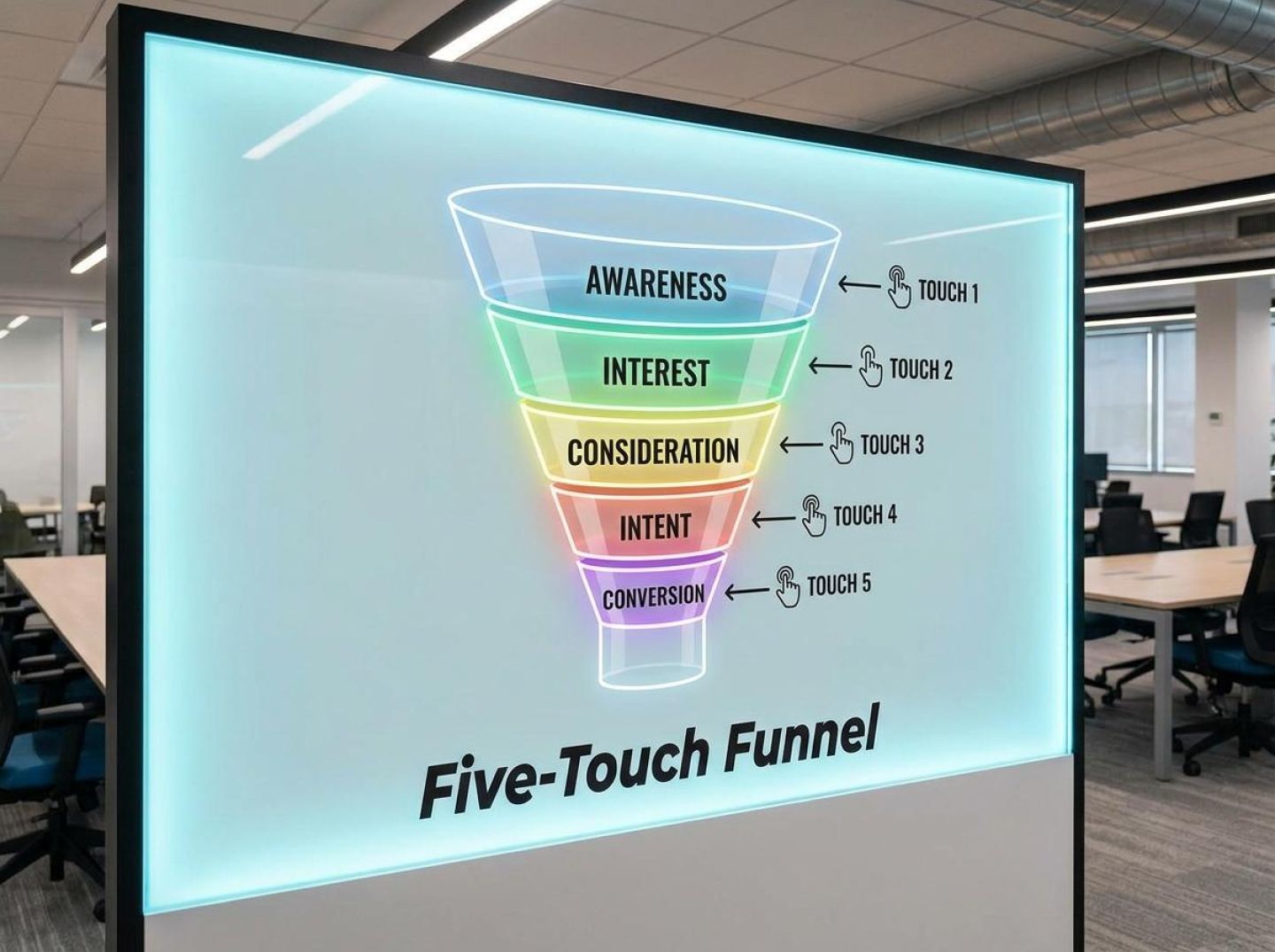
Most brands treat their billboard line like a one-and-done punchline. In a performance world, that same line should be the seed for a five-touch, cross-channel sequence that starts in traffic and ends in revenue.
The key is to design that sequence before you buy the media, then use ad spy tools to reverse-engineer how the best players already do it.
Your first touch is the billboard, airport tray, or transit panel. The goal here is not to explain everything; it’s to create a sticky phrase + asset combo that can follow people home.
OOH’s superpower is cumulative exposure. As analysis of Kochava data shows, conversion rates climb steadily from one to ten exposures instead of flattening out, which means you can afford to be simple and repetitive. Think four to six words, a single hero visual, and one concrete promise.
That line becomes your campaign spine. You’ll reuse it—nearly verbatim—across every digital asset you build.
Next, you need a bridge from “seen it” to “tapped it.” There are two primary paths:
/sleep-better-7ooh_billboard_i95_northboundWhen someone scans, they aren’t “visiting your site”; they’re enrolling in a predesigned funnel whose language and offer mirror that first line.
2. Branded search / vanity URL
Not everyone will scan, especially at highway speed. Your line should be paired with a short, memorable domain or phrase people can Google. Ad spy tools like Anstrex let you see how top DTC brands then retarget off those branded query terms—what copy they use in search ads, which hooks make it into display, and how consistent the phrasing stays over time.
Both routes are about the same thing: capturing intent while the line is still echoing in their head.
Touch three is where you cash in the first promise. The landing page should:
Because QR-enabled OOH creates a fully tracked ecosystem, you can break out performance by board, airport concourse, or mobile truck route. That lets you later tailor landers by location or audience: a commuter-heavy metro platform might push “time saved,” while an airport tray doubles down on “travel comfort.”
Use ad spy tools here to see what high spenders in your category do with headline symmetry. When you notice a brand repeating a peculiar phrase from its OOH creative in its native ads or pre-landers, you’re looking at a deliberately modeled sequence.
OOH’s impact doesn’t vanish when the person walks away from the board; it lingers like what one cross-media study called a “seven-day ghost”. That’s your retargeting window.
Model your next two touches around that week-long halo:
Ad spy tools let you watch this in the wild: which brands hit you immediately after a QR journey, how they adjust copy over a week, and which formats (native, UGC-style, static) they lean on most to close.
Your final touch isn’t just a checkout page; it’s a short retargeting sequence designed specifically for people who entered via OOH.
You might build:
Because modern OOH vendors provide proof-of-performance reporting—GPS logs, time windows, impression estimates—you can align these micro-funnels to specific routes or placements. Then, using your spy tool stack, you benchmark: are your post-OOH sequences as persistent, consistent, and tightly messaged as the best-in-class advertisers you’re watching?
When you design like this, the billboard line stops being “just copy.” It becomes the organizing principle of a five-touch, cross-channel funnel—one that treats OOH as the trigger layer, and your ad intelligence tools as the blueprint for turning that trigger into measurable, repeatable ROI.
You do not buy a billboard for people who are busy.
You buy it for people who are bored.
Stuck in traffic. Creep-crawling past construction. Slumped in an airport seat with a dead laptop and 42 minutes until boarding. That is the real inventory you’re renting: dead time plus wandering attention.
Out-of-home works precisely because it slips into that boredom gap as a low-friction “whisper,” not a demand for focus. As one cross‑media study summarized, OOH lives in the periphery of attention—more like someone quietly repeating a fact over coffee than an email blasted ten times—and that “passive exposure” is exactly why digital conversion rates keep climbing with frequency instead of burning out after a few impressions, according to AdQuick’s analysis of Kochava data. The more often your whisper shows up in those in‑between moments, the more it compounds.
That’s the starting point for your sequence: you are not trying to deliver the whole story on a six‑second drive‑by. You are trying to plant just enough curiosity that a bored brain decides, “I’ll bite—later.”
In static environments—airport security bins, tray tables, ride‑share toppers, metro platforms—the boredom is even more intense and more predictable. People are trapped and looking for something to do. That’s why QR‑driven “wait‑time commerce” has exploded in transit spaces; a brand flashes a pantry restock board or “scan for 20% off” message, and a three‑minute platform wait turns into a shoppable moment, as the team at MyHoardings describes with QR‑enabled transit ads. The scan is not just a click—it is the handoff from analog boredom to a fully measurable digital journey.
For performance marketers, the interruption itself is not the KPI. The real metric is: did I give that bored person a next move that feels obvious and rewarding?
That’s where your copy and your creative have to work like a magician’s misdirection. On the surface, you’re breaking monotony:
Underneath, you’ve engineered a bridge. A QR code or short URL promises a “win”—a discount, a faster path, a cheat sheet—and pulls that attention into an owned, trackable funnel. In 2026, that QR interaction is effectively the “delete” button for the classic “I saw a cool billboard and forgot the brand by the time I got home” problem, as.
Zoom out a few years and that boredom gap only gets more valuable. As vehicles get more autonomous and passenger time shifts away from gripping a steering wheel, attention doesn’t vanish—it rebalances between windows and screens. Analysts of the autonomous future argue that phones and in‑car displays will sync with roadside media, turning billboards into triggers that immediately surface related offers on dashboards and devices, creating what OOH Today describes as a “trigger layer” between physical impressions and mobile commerce. That is not a threat to OOH; it is the logical extension of the scan you are already trying to earn.
So in that billboard or airport‑tray moment, your job is very specific:
Once that scan or type‑in happens, the analog whisper has done its job. The rest of the funnel is digital. And this is where ad spy tools stop being toys and become strategic infrastructure: they let you see exactly how the best advertisers are turning that one bored glance at a billboard into a five‑touch retargeting machine across every channel that person opens next.
Low-friction micro-commitment is where your “whisper in the wild” stops being abstract awareness and becomes a trackable, ownable contact. In OOH, that micro-commitment is almost always one of three behaviors: scan, tap, or type.
The constraint is harsh: you have seconds, not minutes. That’s why the micro-commitment has to be dead simple, context-aware, and obviously rewarding.
Think of the QR code as the delete button on your memory gap. As the team at MyHoardings puts it, a passerby can love your billboard and still forget your name by the time they get home; the QR code turns that fleeting attention into an “active digital lead in under three seconds,” making OOH behave like a performance channel rather than a fuzzy awareness play, as their guide on QR codes on billboards argues. Your job is not to “get a scan” in the abstract. Your job is to package that scan as a tiny, irresistible win that feels appropriate to the boredom moment you’re interrupting.
Practically, that means:
Behind the scenes, this low-friction interaction is where your intelligence layer lights up. Once a user scans or taps, you know which board or tray drove the action, at what time, and in what context. That kills the old attribution headache that made OOH feel like a faith-based investment. When a brand knows exactly which physical unit generated the lead, they can treat OOH as a dial they turn up or down with the same confidence they apply to paid social, matching the data-driven rigor that AdQuick describes when OOH conversions climb predictably with repeated exposures in their cross-media study.
This is also where ad spy tools become non-negotiable. Instead of guessing what offer copy, code placement, or landing experience will feel “small enough” to accept in a bored moment, you can watch how sophisticated OOH buyers have already solved it. Look at brands whose billboards consistently show up in spy feeds with QR-heavy creative. What’s the promise above the code? Is it a discount, a quiz, a tool, a waitlist, a “track my order” utility? How much text do they give to the offer versus the brand line? Which variants survive multiple flight rotations, hinting at a winner?
Layer that observation with where OOH is headed. In a future where billboards trigger in-car offers and windows become interactive screens, as an analysis of self-driving environments in OOH Today predicts, the micro-commitment won’t always be a manual scan. It might be a tap on a car display, a voice command, or a context-aware “Add to cart” suggestion the system surfaces the moment the billboard enters view. The principle, though, stays the same: make the first digital action effortless, obvious, and rewarding.
Your creative brief for this touch should be brutally narrow: “What is the simplest possible action someone can take in three seconds, from where they are, that gives them a win and gives us a trackable identity?” Once you can answer that in a sentence, the OOH unit stops being a poster and starts being a lead-gen surface that your retargeting engine can actually see.
Here’s the fastest practical win you can steal from this whole playbook: turn your next OOH placement into a live retargeting seed generator in under an hour.
You don’t need new martech. You don’t need a 40-slide strategy deck. You need one simple, incentivized scan that drops people into a trackable audience you can attack later with your ad spy–informed creative.
Think of it as a “billboard-to-browser” starter pack.
A naked QR code that dumps people on your homepage is dead on arrival. People scan for a win, not for a tour of your navigation. As the team at MyHoardings points out, the modern QR is the “delete button” for the memory gap — but only if it delivers instant value in under three seconds, usually in the form of a contextual discount or perk tied to the moment they see it, like a “Scan for 20% off your first order” hook that lands straight in their mobile wallet as a persistent reminder of your brand living on their phone.
So for your next billboard, airport tray, or transit screen, swap the generic URL for a single, sharp promise that fits the environment:
The reward is the bait. The scan is what you’re actually after.
Behind that QR, don’t just drop people onto a landing page. Drop them onto a tagging page engineered purely for data capture:
From that moment on, those IDs sit in their own segment: “OOH-engaged — Billboard A,” “Airport Tray B — Terminal 3,” and so on. This is where the magic starts, because once that user is in your ecosystem, they behave more like a performance prospect than a brand-awareness bystander. The cross-media work that AdQuick highlighted with Kochava showed OOH driving a clean, compounding lift in digital conversion rates as frequency increased, with performance climbing sharply between one and ten exposures; in other words, these “bored-time” contacts are disproportionately likely to convert once you follow them home with digital.
Now you have an OOH-born audience. You don’t guess what to show them next — you steal from the winners.
Use your favorite ad spy platform to:
Then build a small creative stack specifically for your OOH segment that riffs on these proven patterns. Because you’re retargeting a warm, context-rich audience, you can be more direct and more offer-led than you would in cold prospecting.
Stand up a tiny, tightly scoped campaign aimed only at people who hit your QR-based tagging pages in the last 30–60 days. Cap spend. Let it run for a week.
You’ve now converted an “unmeasurable” billboard into:
The broader OOH ecosystem is already moving this way. Networks like Trillboards are wiring in machine-learned intelligence layers such as hellOOH to close the loop between screens and demand, turning physical impressions into modeled, predictive signals. You don’t need their infrastructure to start playing the same game. A single smart QR, a clear incentive, and a retargeting pool tied to ad-spy-validated creative is enough to turn “just a billboard” or “just an airport tray” into a small but very real high-ROI retargeting machine by this time next week.
Receive top converting landing pages in your inbox every week from us.
Most Read
Discover how performance marketers can build cross-channel verification journeys that turn skeptical prospects into confident buyers across TikTok, native, push, and pop advertising. Learn how to coordinate creative messaging, reinforce trust at every touchpoint, and measure the hidden influence of fragmented customer journeys using competitive ad intelligence.
Elena Morales
7 minOct 20, 2026
Recently Updated
Discover how creepy out-of-home advertising, TikTok micro-stories, and AI-powered creative tools can turn isolated ads into high-performing serialized campaigns. Learn how to map competitor ad sequences with Anstrex, build story-driven funnels, measure performance across multiple touchpoints, and optimize creative for stronger conversions and ROI.
Samantha Reed
7 minOct 18, 2026
Most Read
Discover why viral TikTok ads don't always translate into profitable, sustainable campaigns. Learn how performance marketers can use Anstrex ad intelligence to identify winning hooks, map audience motivations, manage brand-safety risks, and turn cultural trends into repeatable advertising strategies.
David Kim
7 minOct 17, 2026