9 minAugust 4, 2026

Our spy tools monitor millions of native ads from over 60+ countries and thousands of publishers.
Get StartedFor more than two decades, keyword research operated on a deceptively simple premise: a user types a query into Google, scans a page of blue links, clicks the most relevant result, and moves toward a conversion. Search volume became the universal proxy for demand. If a keyword registered 10,000 monthly searches, you could reasonably assume that optimizing for it would put your brand in front of roughly 10,000 moments of intent. The entire infrastructure of SEO and paid search — the tools, the bidding models, the editorial calendars — was engineered around that assumption.
That assumption has structurally broken.
The fracture runs along two fault lines simultaneously. The first is the rise of zero-click search. AI Overviews, featured snippets, and conversational engines like ChatGPT and Perplexity now resolve queries before a user ever reaches a website. A Bain and Dynata study found that 80 percent of consumers now rely on zero-click results for at least 40 percent of their searches, cutting organic traffic by up to 25 percent across industries. That means a keyword showing 10,000 monthly searches in your favorite research tool may now generate roughly 2,500 fewer clickable opportunities than it did just two years ago — not because demand evaporated, but because the answer arrived without a click. The search happened. The visit didn't.
The second fault line is platform fragmentation. Even the clicks that do survive are no longer concentrated on a single surface. As Neil Patel has documented, a user researching something like "best email marketing tool" might search Google, watch comparison videos on YouTube, follow threads on Reddit, scroll TikTok for creator recommendations, and then ask ChatGPT for a final opinion before making a decision. Each of those touchpoints represents a genuine moment of demand — yet traditional keyword tools only capture one of them. You can rank on page one for your target term and still be invisible to a significant share of the audience that is actively evaluating your category.
These aren't incremental headwinds that a smarter content strategy can absorb. They represent a broken-instrument problem. The core measurement device — search volume mapped to clickable demand — no longer reliably measures what it claims to measure. It's like reading a thermometer that hasn't been calibrated in years: the numbers still move, but the temperature they report has drifted from reality.
Consider the downstream consequences. When 37 percent of consumers now start their searches with AI tools instead of traditional engines, and when AI Overviews can cut the click-through rate on a top organic listing by roughly a third, the gap between reported keyword volume and actual available traffic becomes a strategic blind spot. Media plans, content budgets, and performance forecasts built on uncorrected keyword data don't just underperform — they misallocate resources toward a shrinking pool of clicks while ignoring the surfaces where purchase decisions are actually forming.
This is the reality that marketers need to internalize before anything else in this conversation matters: the keyword isn't dead as a concept, but its role as the primary unit of demand intelligence has expired. Typed queries still happen. People still search. But the linear model — query to click to conversion — has splintered into a web of conversational prompts, AI-mediated answers, and cross-platform discovery paths that no keyword spreadsheet can faithfully represent. If the instrument is broken, the question isn't how to read it more carefully. It's what to replace it with.
The marketing industry hasn't been asleep at the wheel. As AI search reshapes discovery, a wave of new methodologies has emerged to fill the gap left by traditional keyword research. Answer Engine Optimization, prompt-based keyword research, conversational query mapping — these frameworks represent a genuine attempt to help brands stay visible in a world where users speak to machines in full sentences rather than typing fragmented phrases into a search bar. And for content marketers and brand builders, these adaptations are a legitimate evolution. But for performance marketers — the affiliates, media buyers, and growth teams whose budgets live or die by return on ad spend — these new approaches suffer from a flaw that's disturbingly familiar.
They still measure what people ask, not what people buy.
Consider how the new paradigm redefines success. As HubSpot's AEO keyword research guide lays out in a comparison table, traditional SEO keyword research tracked rankings, impressions, clicks, and click-through rate, while AEO keyword research shifts the goalposts to "mentions, citations, visibility, conversions." That last word — conversions — is doing enormous rhetorical heavy lifting, because the first three metrics in that list are fundamentally awareness metrics. Being cited by ChatGPT or mentioned in an AI Overview tells you that your brand appeared in an answer. It tells you nothing about whether that appearance generated a sale, a lead, or even a qualified visit. For a content marketer building topical authority, citation frequency is a meaningful signal. For a performance marketer allocating a six-figure monthly media budget, it's a vanity metric dressed in new clothes.
The underlying data problem runs even deeper. Even the most sophisticated keyword tools are built on a foundation that wasn't designed for commercial prediction. As the Semrush Blog acknowledges, keyword databases are generally constructed on organic search data, and while metrics like volume and intent are useful for basic filtering, "they don't give you the level of detail you need" to truly meet user needs — let alone forecast purchasing behavior. This is a remarkable admission from one of the industry's largest keyword intelligence platforms, and it highlights a structural limitation that no amount of conversational query mapping can fix. You can reformat your keyword list from "best CRM software" to "What's the best CRM for a 50-person sales team that integrates with HubSpot?" and you'll have a more naturalistic prompt. But you still won't know whether the person asking that question has budget approval, is actively evaluating vendors, or is a student writing a comparison blog post for a marketing class.
The new keyword research community is, in effect, replacing one proxy with an even softer one. Traditional keyword research used search volume as a stand-in for demand — imperfect, but at least grounded in observable behavior with two decades of conversion data to calibrate against. AEO optimization uses AI mentions and citations as a stand-in for visibility, which is itself a stand-in for demand, which is itself a stand-in for revenue. Each layer of abstraction moves further from the signal that performance marketers actually need: proven commercial intent backed by real spending data. Visibility is not conversions. A brand mentioned in every AI Overview on the internet still needs to know which product categories are attracting competitive ad dollars right now, which landing pages competitors are funding with real budgets, and which offers are converting at scale.
For content strategy and brand positioning, optimizing for AI citations is smart, forward-looking work. But performance marketers need something harder — a signal rooted not in what audiences ask, but in what advertisers are willing to pay for. That signal already exists. It's just not where most marketers are looking.
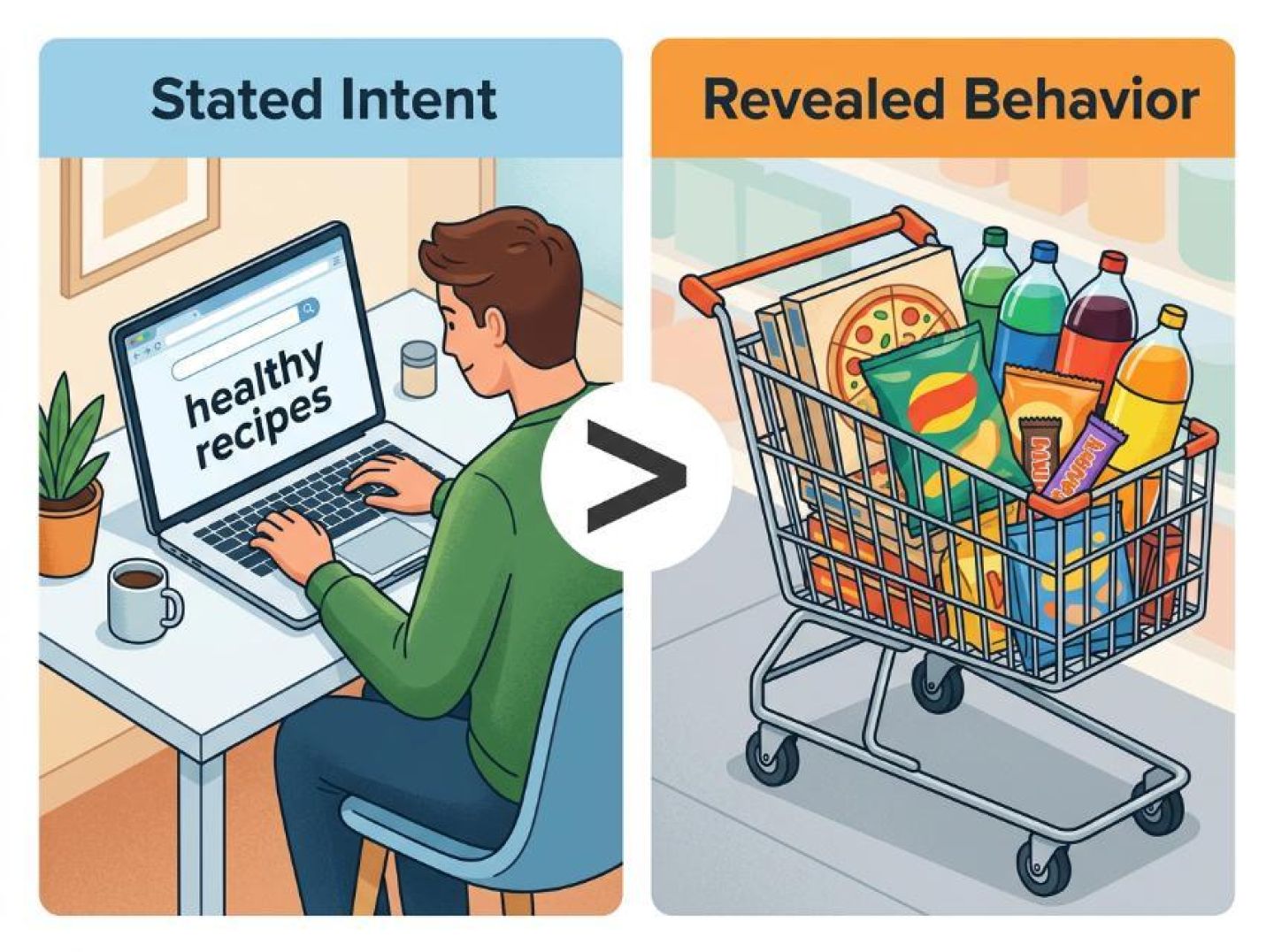
In economics, there's a distinction between what people say they want and what they actually spend money on. Stated preference is the survey answer, the focus group response, the self-reported intention. Revealed preference is the credit card swipe — the moment someone puts real resources behind a decision. Economists have understood for decades that revealed preference is the stronger signal because it carries actual cost. People can say anything, but spending is commitment made visible.
This framework maps directly onto the intelligence problem facing performance marketers today. Traditional keyword research, for all its sophistication, is fundamentally a stated-preference tool. It tells you what people typed into a search bar — an expression of curiosity, not necessarily a validated willingness to act. And as we've established, even the newer AEO-informed approaches still operate at the level of inferred intent: tracking which brands AI systems mention, monitoring which competitors appear alongside your brand for high-intent prompts, and optimizing content to earn citations in generated answers. These are meaningful activities, but they still measure visibility, not validated commercial demand.
Competitive ad intelligence operates on an entirely different plane. When a competitor scales an ad creative across three native networks for thirty consecutive days, they aren't stating a preference — they are revealing one with real budget. That sustained spend tells you the offer behind the creative is converting, the angle is resonating with a specific audience segment, and the economics of the funnel work at scale. No keyword volume metric carries that level of commercial validation. You aren't guessing at intent. You're observing monetized demand in motion.
This is the core thesis: ad creatives are the new keywords. They are discrete, trackable units of market demand — each one encoding an offer, an audience, an angle, and a funnel in a single observable artifact. Just as keyword researchers once cataloged search queries to map the landscape of consumer intent, performance marketers can now catalog competitor creatives to map where money is actually flowing and why.
The parallel to the fragmentation problem is also important. Neil Patel has pointed out that demand now lives across platforms and most keyword tools only capture a single touchpoint, leaving brands invisible to significant portions of their audience even when they rank well on Google. AEO practitioners responded to that fragmentation by expanding their tracking beyond traditional search into AI-generated answers. Performance marketers need an equivalent expansion — but instead of tracking mentions and citations, they should track where advertising dollars are being deployed and sustained. A competitor running the same VSL angle on native, push, and pop networks simultaneously isn't just testing; they're broadcasting a validated playbook across the exact channels where keyword data has no reach.
This reframing matters because the signals are fundamentally asymmetric. A keyword with 10,000 monthly searches and declining click-through rates tells you that interest may exist but the path from query to conversion is eroding. A competitor creative that has been running continuously, with fresh variations, across multiple traffic sources tells you that a specific combination of message, audience, and offer is generating profitable returns right now. One signal is ambient and decaying. The other is active and financially accountable.
Where AEO gave content marketers a way to adapt to the new discovery layer, Competitive ad intelligence gives performance marketers the same adaptation — not by chasing where AI surfaces brands, but by following where real money validates demand. The keyword isn't dead so much as it has been superseded by a higher-resolution signal: the funded creative, running at scale, proving its thesis with every dollar spent.
Knowing that competitive ad intelligence matters is one thing. Knowing what to actually do with it every morning when you sit down at your desk is another. So let's make this tactical.
The workflow starts with five dimensions that performance marketers and affiliates should monitor continuously. First, ad creatives — the actual images, headlines, and copy angles competitors are running. These reveal positioning strategy faster than any brand audit. Second, landing pages and offer flows — the post-click experience tells you what's converting, how aggressively competitors are qualifying traffic, and what price points or hooks are testing well. Third, traffic sources and geo-targeting — understanding whether a competitor is scaling on native, social, push, or programmatic (and in which countries) dictates where opportunity gaps exist. Fourth, ad longevity — how long a specific creative has been running serves as a reliable proxy for profitability, because no rational media buyer keeps spending on an ad that bleeds money for weeks. And fifth, volume signals — how many placements or publishers a creative appears across indicates the scale of investment and the confidence behind a given angle.
This is a fundamentally different motion than traditional keyword research, and the distinction mirrors one that Semrush draws between keyword research and keyword strategy: "Keyword research surfaces data on what people search for, how competitive those terms are, etc. A keyword strategy accounts for that data and your business goals, your resources, and how realistic a given opportunity actually is for you." The same layered thinking applies here. Seeing a competitor's ad is raw data — the equivalent of pulling a keyword's search volume. The strategy is interpreting why that creative is scaling, whether the angle translates to your offer, and whether you can profitably enter that traffic source given your margins and capabilities.
Without that interpretive layer, you're just collecting screenshots. With it, you're building a media buying thesis.
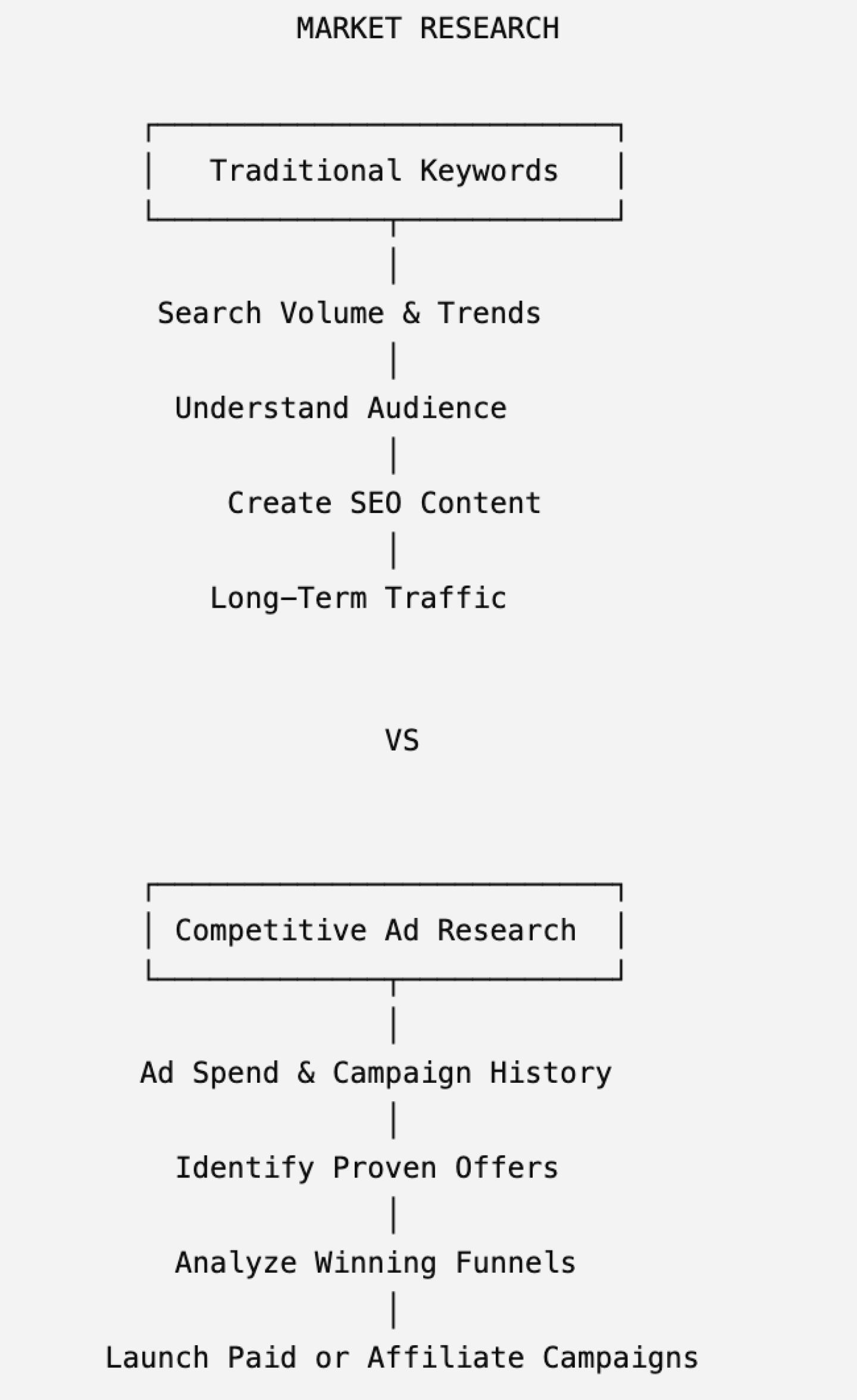
To make the contrast concrete, here's how the two workflows map against each other:
The left column isn't wrong — it's incomplete. As Marketing Dive reported, 60% of searches now end without a click, which means a growing share of the "stated interest" captured by keyword volume never materializes into a site visit, let alone a conversion. Competitive ad intelligence sidesteps that leakage entirely. If a competitor has been running the same advertorial-style landing page for 90 days across three geos and dozens of placements, you don't need to guess whether demand exists. Demand has been monetized. The funnel is proven. Your job is to determine whether you can build a better version of it — or find the adjacent angle they haven't tested yet.
This doesn't mean you should abandon keyword research wholesale. Brand queries, navigational intent, and long-tail educational content still matter for building the kind of authority that AI systems increasingly reward. But for performance marketers whose job is to deploy capital efficiently and find winning offers fast, the competitive ad intelligence workflow provides something keyword data structurally cannot: a window into where real money is already changing hands.
Every time someone advocates for competitive ad intelligence, the same objection surfaces like clockwork: "Isn't this just spying on competitors and copying their ads?" It's a fair concern, and dismissing it would be intellectually dishonest. If all you do is screenshot a rival's top-performing Facebook creative and swap in your logo, you deserve every bit of creative fatigue, margin erosion, and brand dilution heading your way. But that shallow caricature misrepresents the actual discipline — and confusing imitation with validation is a costly mistake.
The distinction is subtle but critical. Copying means reproducing a competitor's execution — their hook, their visual style, their offer structure — and hoping to siphon their results. Validation means observing where real money is flowing to confirm that a market, a positioning angle, or a pain point actually converts paying customers. The first is creative theft. The second is demand intelligence, and it's something economists and strategists have relied on for generations. Remember: ad spend is revealed preference. When a competitor sustains budget behind a specific angle for months, they're confirming that a segment of the market responds to that message with real dollars. Your job isn't to parrot the message; it's to understand the underlying demand signal and craft a differentiated response to it.
Think of it the way Neil Patel's team frames multi-platform keyword research — the goal isn't to replicate the exact query a competitor ranks for, but to ask where demand actually lives and whether your brand shows up when people explore that topic. Competitive ad intelligence works the same way. You're mapping demand topography, not tracing someone else's homework.
This reframe also dismantles the "race to the bottom" fear. When multiple advertisers copy each other's creatives wholesale, audiences see interchangeable pitches and stop responding — classic creative fatigue. But when you treat competitor data as a validation layer rather than a template, you diverge instead of converge. You know the pain point resonates, so you attack it from a completely different angle: a different format, a contrarian position, a deeper level of specificity that the incumbent ad never bothered to reach. The competitor's ad proves the demand exists. Your ad proves your brand understands it better.
There's a useful parallel in how MarTech describes the evolving nature of trust in AI search: brands with strong digital credibility are the ones AI systems choose to surface and recommend. The same principle applies to paid media. Audiences don't reward the brand that echoes what they've already seen — they reward the brand that demonstrates deeper understanding and authority. Competitive intelligence gives you the map of proven demand; differentiation is the vehicle you drive across it.
There's also a practical safeguard against the "just copying" trap: time-layered analysis. If you only look at what competitors are running today, you'll always be reactive. But if you study creative evolution over weeks and months — which hooks they tested and abandoned, which landing page structures they iterated toward, which offers they scaled — you extract strategic patterns, not surface-level assets. You learn what the market has already absorbed and rejected, which means you can leapfrog rather than follow.
So the next time someone accuses your team of "just copying competitors," correct the framing. You're not stealing creative. You're validating demand, identifying whitespace, and using the market's own spending behavior as a compass. The difference between plagiarism and intelligence has always been what you do after you gather the data.
Receive top converting landing pages in your inbox every week from us.
Must Read
AI-powered ad platforms can optimize campaigns efficiently while quietly steering budgets toward narrow, platform-defined outcomes. Learn how to use Anstrex as an outside-in audit layer to uncover machine bias, compare real market behavior, and build AI media plans with stronger guardrails, audit loops, and human overrides.
Liam O’Connor
7 minSep 16, 2026
Recently Updated
Agentic AI is changing how performance marketers manage bids, budgets, creative, and emerging ad surfaces such as ChatGPT and AI-native media. This guide shows how to use competitive intelligence, sandbox testing, and Anstrex-style research to study these systems without putting today’s media budget at unnecessary risk.
Marcus Chen
7 minSep 15, 2026
Most Read
Mass reach can generate impressive numbers without delivering meaningful revenue. This guide shows how competitor intelligence can uncover high-intent micro-audiences and help marketers build focused campaigns that prioritize conversion, relevance, and ROI over vanity metrics.
Samantha Reed
7 minSep 12, 2026