

12 minSeptember 12, 2026

Our spy tools monitor millions of native ads from over 60+ countries and thousands of publishers.
Get StartedMass reach looks glamorous—viral TikToks, airport-bookstore bestsellers, billboards on every highway—but impressions that never buy are just very expensive applause. As marketers grapple with wasted spend and “black box” media in channels where billions vanish into low-quality inventory each year, as Marketing Dive has reported, the smartest performance teams are quietly doing the opposite of going viral: they’re using competitor intelligence to uncover tiny, high-intent micro-audiences that never trend on social, rarely spike top-line traffic, but, like the concentrated care seekers in a single cluster of digital out-of-home screens that outperformed busier locations in JOLT’s audience-first analysis, consistently convert, compound, and print ROI while everyone else chases vanity metrics like raw reach, follower counts, and virality rates that even the Semrush social media guide warns can become “spinning wheels” when they’re not tied to business outcomes.
The obsession with “more eyeballs” is really an obsession with the wrong math. Viral visibility maximizes the cheapest metric in marketing—impressions—while the business cares about the most expensive one: revenue. Somewhere between those two, most mass-reach campaigns simply evaporate.
You can see the cracks in the model wherever performance is actually measurable. Programmatic is the most glaring example. An estimated $26.8 billion in global programmatic spend disappears every year into redundant supply paths, measurement gaps, and low-quality inventory, according to the Association of National Advertisers as reported by Marketing Dive. That number doesn’t just reflect shady ad exchanges; it reflects an underlying strategy problem: buying anonymous reach and hoping a sliver of it turns out to be the right people at the right time.
The same pattern shows up in “viral” social media. Platforms like Meta aggressively boost formats like Reels to maximize views and time-on-platform; its algorithm is fine-tuned to push short-form videos to as many users as possible and then monetize that attention through ads, as the Brax blog notes. That’s great for Meta’s revenue, but not necessarily for yours. A million people watching your founder lip-sync to an audio trend does almost nothing if they’re not in-market, not qualified, and not moving into your funnel.
What’s really happening in these viral moments is metric mismatch. At the top of the funnel, visibility metrics like reach, impressions, and even raw engagement look healthy. In fact, they’re supposed to be big. But when those same metrics are used as proxies for success deeper in the journey, you’re rewarding the creative and channels that entertain the most people, not those that move the right people closer to purchase. The HubSpot Marketing Blog points out that treating all funnel stages with the same optimization levers is a direct path to wasted spend; you can’t grade a purchase-intent campaign on impressions any more than you’d grade a brand campaign on last-click ROAS.
This is why viral visibility so rarely maps to revenue in a straight line. The composition and context of the audience matter more than how many of them saw you. In digital out-of-home, for example, the highest-traffic location is often not the highest-value one; what drives outcomes is where a brand’s specific high-intent audience actually concentrates and how close those screens are to moments of intent, as Marketing Dive’s coverage of DOOH audience planning makes clear. A crowded highway billboard might win on impressions; a screen near a specialist clinic might win on booked appointments.
The same logic applies to your digital campaigns. A broad social audience may generate cheap reach and a flashy engagement rate, but that doesn’t mean they’re the customers who will buy in the next 30 days. By contrast, smaller, tightly defined micro-audiences—segmented on behaviors, needs, and context instead of just demographics—convert at far higher rates. Research highlighted by Convince & Convert shows that 80% of consumers are more likely to purchase from brands delivering personalized experiences, which is simply another way of saying that relevance at the micro-audience level beats exposure to the crowd.
Mass reach also creates a dangerous illusion of product–market fit. Viral campaigns can trick leadership into thinking “the market loves us” when, in fact, a tiny subsegment is doing all the buying and the rest are just clapping from the cheap seats. Without intent and audience composition data, you can’t see the difference. Intent-light metrics like click-through rate at the awareness stage—what HubSpot recommends tracking for early search discovery—are valuable as directional signals. But you only create revenue when those signals are followed downstream into high-intent behaviors, not celebrated in isolation because the numbers are big.
In short, “more eyeballs” is the wrong north star because it optimizes for spectacle, not specificity. Revenue flows from being disproportionately visible to the few who are ready—or nearly ready—to act, not from being vaguely familiar to everyone else. The task isn’t to win the attention Olympics; it’s to find and dominate the right micro-markets, then measure success by the depth of their intent, not the width of your reach.
Mass reach treats attention as if it were all the same. In reality, a thousand distracted scrollers are not worth one buyer who’s actively hunting a solution and already halfway through their decision process. High-intent micro-audiences outperform big, blurry audiences not because they’re large, but because they’re dense with buying energy.
The shift to AI-mediated discovery is quietly proving this. As AI assistants and recommendation engines take over more top-of-funnel exploration, the people who actually land on your properties are showing up further along the journey and with clearer purpose. When repeat-visit rates rise and visitors consume more pages per session—even as total traffic falls—it’s a signal, as MarTech explains, that your site has become a destination for qualified, informed buyers, not random passersby. In other words, you’re already dealing with a narrower, intent-rich niche whether you’ve planned for it or not.
This is why applying the same metrics across all stages of the funnel is such an expensive mistake. At the awareness stage, optimization is about reach and light engagement—metrics like impressions, video views, or basic click-through rate. But by the time a lead has done their homework and is comparing options, the relevant signals are entirely different. The most effective campaigns align channel and measurement with the buyer’s state of mind; as the HubSpot marketing team notes, trying to manage every stage by the same “more eyeballs” KPIs guarantees wasted spend and blurred insight. You end up optimizing for attention volume instead of decision velocity.
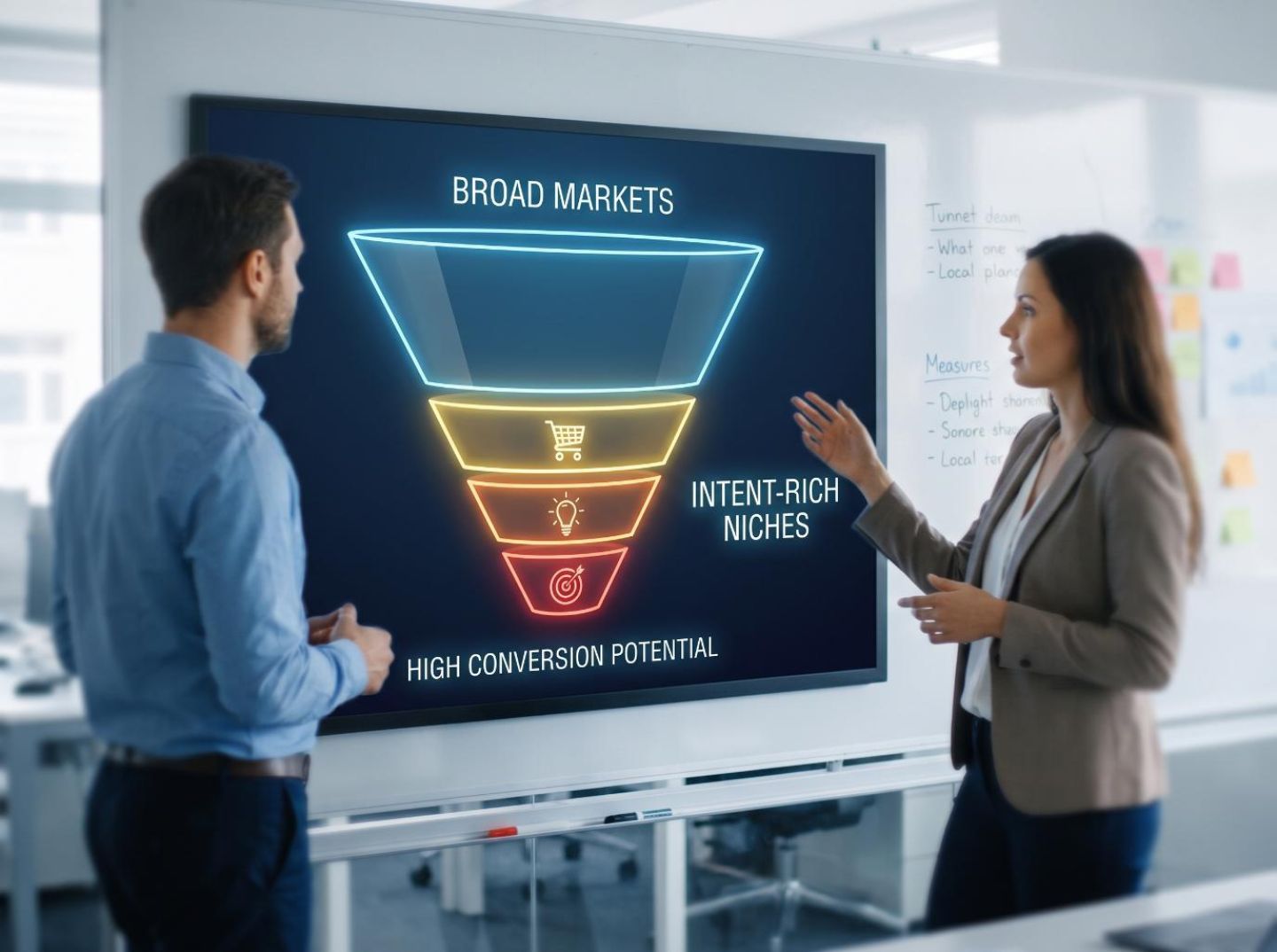
Tiny, intent-rich niches flip that dynamic. Instead of broadcasting a generic message that fits no one perfectly, you design for a specific, concrete context: “RevOps leaders at SaaS companies between Series B and D who are ripping out a legacy CRM this quarter,” or “IT managers in healthcare networks who must prove HIPAA-compliant logging in their next audit.” These audiences may number in the thousands, not millions, but nearly every impression is a live wire.
This is where micro-targeting and enhanced segmentation move from “nice to have” to core strategy. With big data and behavioral analytics, brands can now carve their total addressable market into precise clusters that share not just demographics, but pains, triggers, and buying timelines. As the team at Brax describes, micro-targeting lets you go beyond broad personas and speak almost one-to-one, turning advertising into a direct, relevant conversation rather than ambient noise. The goal is not more people; it’s fewer, but unmistakably the right people.
Niche audiences also bring a structural advantage that vanity reach can’t buy: emotional investment. People organized around a tight problem, identity, or worldview are more likely to engage, remember, and advocate. Research cited by Convince & Convert shows that 80% of consumers are more likely to purchase from brands that personalize experiences, and 88% expect brands to remember their history and context. That expectation is almost impossible to fulfill at the level of “everyone who might someday buy software,” but it becomes manageable—and powerful—inside a defined micro-audience where patterns and preferences are consistent.
High-intent micro-audiences also compress the path from attention to revenue. Someone watching a generic, top-of-funnel Reel about “improving productivity” might be years away from buying anything. But a prospect who searches for comparison content, explores pricing tools, or downloads technical integration guides is signaling what MarTech calls “downstream intent.” If your campaigns are designed to reach and serve that sliver of the market, even modest traffic can translate into robust pipeline, because every touchpoint is closer to the moment of commitment.
The net effect is that smaller, sharper audiences consistently beat larger, blurrier ones on the only metrics that matter to the business: qualified pipeline, close rate, deal velocity, and lifetime value. Mass visibility might still win you superficial awareness and the occasional lucky conversion. But in a world where discovery is filtered by algorithms, attention is fragmented, and buyers are already halfway done researching before they meet you, the real leverage sits with those tiny pockets of people who are not just looking—but ready.
For decades, media strategy was a real-estate game. You bought the biggest billboard on the busiest road, the prime-time TV slot, the homepage takeover—then trusted that sheer volume would do the heavy lifting. Location and reach were proxies for relevance because that was all you could practically buy.
That logic is collapsing.
The shift from billboards to browsers hasn’t just digitized ad inventory; it’s inverted the starting point. Instead of asking “Where can we get the most eyeballs?” smart marketers now start with “Which specific people are we trying to move, and what are they doing right before and after they see us?” Media is no longer a map of locations; it’s a map of audiences and intent.
You can see this most clearly in how formerly blunt channels are being rebuilt around audience intelligence. Out-of-home used to mean renting the busiest intersection and hoping your customer walked past at some point. Now, platforms like JOLT’s Spark Intelligence begin not with a map of screens but with behavioral, purchase, and movement data to pinpoint where a brand’s target audience is most concentrated, then recommend only those screens that over-index for that group, as Marketing Dive describes. In one Atlanta campaign, screens were chosen not for traffic volume but for an average audience concentration of 66.29% likely care seekers—an audience-first lens bolted onto a “traditional” medium.
The lesson is blunt: the highest-traffic location is no longer the default winner. Audience composition, context, and proximity to moments of intent have more impact on performance than raw impression volume. That’s audience-first thinking in action: the media plan is an output of who you’re targeting and what they’re trying to do, not a collection of arbitrarily “big” placements.
Digital has been quietly pushing marketers in this direction for years, but many teams still treat every channel like a digital billboard—optimizing for cheap impressions or generic engagement instead of aligning tactics to intent. When that happens, funnel stages blur, metrics get misapplied, and budgets evaporate into noise.
An audience-first approach forces you to connect channel, content, and KPIs to where someone actually is in their journey. At the awareness stage, social can legitimately play a reach role—short-form formats and broad targeting make it efficient to spark first exposure. But even here, the metric that matters isn’t just impressions; it’s early resonance. As the HubSpot marketing team notes, engagement rate at the top of the funnel is a better leading indicator than raw reach, and low click-through rate on broad search keywords is a signal that your message isn’t aligned to the weak intent those queries carry.
As buyers move into consideration, the same channels behave differently because the audience is different. Social shifts toward deeper formats like stories and educational video, where completion rate becomes a proxy for genuine evaluation, not idle scrolling, according to their breakdown of mid-funnel metrics. Search narrows to mid-funnel keywords. Email stops blasting lists and starts segmenting by behavior. In each case, channel strategy isn’t “What’s cheapest?” but “What best matches the granularity of intent we’re seeing?”
Audience-first thinking is also redefining where brands even bother to show up. A modern social strategy doesn’t start with “We need to be on every platform.” It starts with “Where does our specific audience actually spend time—and in what mindset?” Using behavioral tooling, marketers can see not just demographics but which platforms their exact audience over-indexes on, and how competitors are already engaging them. The Semrush social media guide emphasizes that not every brand should be everywhere their audience could possibly be; you select platforms based on audience behavior and your ability to consistently show up in a way that aligns with how people use that environment.
Notice the throughline: from DOOH to social to search, the winning strategies are no longer inventory-first, they’re intent-first. You still care about scale, but it’s scale within the right micro-environments—screens with disproportionate concentrations of likely care seekers, feeds where buyers browse in a purchase mindset, queries that signal a problem definition instead of vague curiosity.
“From billboards to browsers” isn’t just a channel shift; it’s a mental model shift. The most sophisticated marketers aren’t asking, “How do we reach as many people as possible?” They’re asking, “Where are the small clusters of people who are already leaning toward a decision—and how do we architect media around those high-intent paths?” Audience-first strategy is how you stop renting generic visibility and start buying relevance.
Competitor intelligence is the fastest way to discover micro-audiences you’d never think to brainstorm in a conference room, because your competitors are already doing the expensive part for you: testing messages, offers, and channels against the market in real time.
Instead of starting from a blank canvas, you can reverse‑engineer where buying energy is already concentrated and which narrow segments are quietly driving revenue.
When you look at a rival’s presence across search, social, email, and AI‑mediated discovery, you’re not just “spying on ads.” You’re watching a live experiment in segmentation and intent.
Marketers are already using big data and analytics to carve audiences into ever finer slices; enhanced customer segmentation is now the norm, not the exception, as Brax points out. That means your competitors have likely identified hundreds of micro‑segments—some you share, some you’ve completely missed.
Every time they spin up a new landing page (“for dental practices with multiple locations”), a niche lead magnet (“pricing checklist for SOC 2 audit readiness”), or a tightly scoped retargeting ad, they’re placing a bet on a micro‑audience. They’re telling you, in public, “We think this slice of the market is worth money.”
Systematically harvesting those clues turns competitor monitoring into a shortcut to hidden, high‑intent clusters.
If you treat competitor activity as structured data rather than random noise, several rich seams appear:
As AI assistants take over top‑of‑funnel discovery, the people who actually land on competitor properties are disproportionately high intent. They’ve already done much of their research elsewhere and are now engaging in deeper content consumption—product tours, comparison pages, pricing tools—the very behaviors MarTech flags as new downstream intent signals.
That creates a powerful feedback loop for your intelligence work:
Instead of casting wide nets and praying for relevance, you can use those breadcrumbs to identify small, dense pockets of demand—and then build campaigns designed to win those pockets outright. Competitor intelligence, used this way, isn’t just “keeping tabs on the market.” It’s a shortcut to the exact micro‑audiences who are already in motion, already comparing options, and already signaling they’re ready to buy.
Most marketers never see micro‑niches because they’re looking at campaigns the wrong way. They scan competitor ads at the surface level—headline, image, offer—and miss the far more valuable layer: who this ad must be working for in order to justify its continued existence.
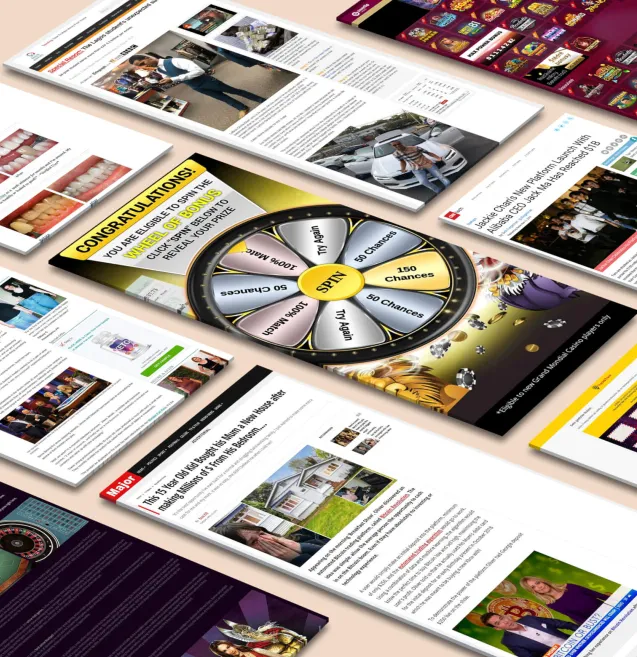
“Quiet winners” are those native and push campaigns that aren’t flashy, viral, or loudly hyped in case studies—but keep getting budget month after month. Your job is to reverse‑engineer the tiny pockets of intent they’re quietly monetizing.
When a competitor is paying to run a weirdly specific angle over and over, assume it’s attached to a micro‑audience they’ve already validated.
In native and push networks, look for:
Every time you see that kind of specificity, ask: “What has to be true about this audience for this hook to be profitable?” That question reveals the hidden micro‑niche.
Anyone can test a quirky angle once. Quiet winners show up week after week.
Borrow a page from how Semrush’s Social Tracker analyzes competitors’ posting frequency and top content: construct a similar lens for native and push. Don’t just catalog creatives—track:
If a seemingly narrow angle persists across formats and time, that’s a strong signal the advertiser has found a micro‑audience with repeatable economics.
On native and push, where an ad runs tells you as much as what it says.
Similar to how JOLT’s Spark Intelligence uses behavioral and movement data to locate “where a brand’s target audience is most concentrated” rather than just picking the highest‑traffic screen, as described by Marketing Dive, you can treat publisher and widget choices as a map of intent density.
Look for:
Micro‑niches rarely reveal themselves fully in the ad unit. You uncover them by walking the entire path from impression to conversion.
Click through competitor native and push ads systematically and log:
Document these elements across multiple competitors in your space. When you see the same pattern of specificity, placement context, and funnel structure surface repeatedly, you’ve likely found a micro‑audience the market is already rewarding—without ever needing to go viral.
Receive top converting landing pages in your inbox every week from us.
Most Read
Mass reach can generate impressive numbers without delivering meaningful revenue. This guide shows how competitor intelligence can uncover high-intent micro-audiences and help marketers build focused campaigns that prioritize conversion, relevance, and ROI over vanity metrics.
Samantha Reed
7 minSep 12, 2026
In-Depth
AI automation can dramatically improve advertising efficiency, but using it everywhere can create generic creative, weaken brand differentiation, and hurt performance where human judgment matters most. This guide uses competitive ad intelligence to identify where automation pays off across the funnel and how marketers can balance AI-driven scale with human-led strategy.
Dan Smith
7 minSep 12, 2026
Most Read
Clicks, coupons, and last-touch conversions can create the illusion of performance while hiding whether customers actually intend to buy. This guide shows how to build a real-intent data layer using behavioral signals, competitive ad intelligence, revenue-linked scoring, and continuous validation to improve performance optimization.
Rachel Thompson
7 minSep 11, 2026








)