6 minJune 12, 2026

Our spy tools monitor millions of native ads from over 60+ countries and thousands of publishers.
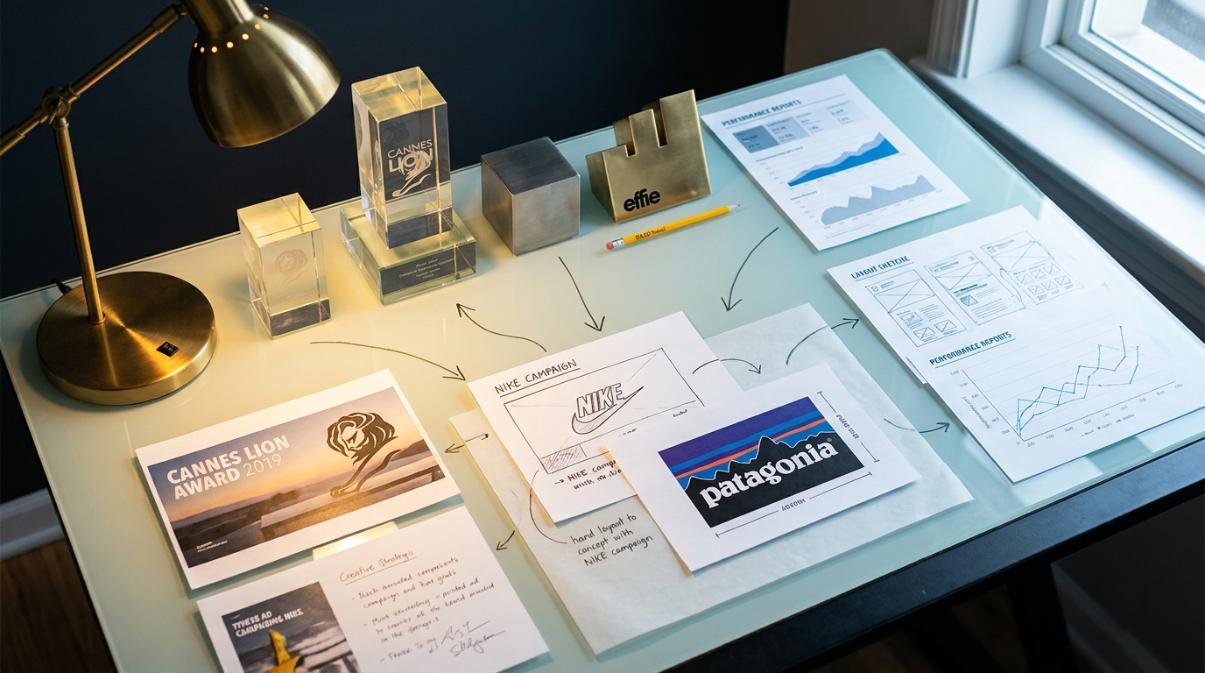
Get StartedEvery June, the advertising world descends on the Côte d'Azur to celebrate the year's most inventive work at Cannes Lions. Months later, D&AD hands out its coveted Pencils, and The One Club crowns its own winners. To the performance marketer grinding through A/B tests on Taboola or Outbrain, these ceremonies can feel like dispatches from a parallel universe — glossy brand films with million-dollar budgets and no visible call to action. But dismissing award-show creative as irrelevant to native advertising is a costly mistake. The trends that sweep elite juries today reliably forecast what will move click-through and conversion rates in performance channels six to eighteen months later, and understanding the mechanism behind that trickle-down is the first step toward exploiting it.
The pipeline works because award juries are, in effect, sophisticated focus groups for cultural mood. When judges at Cannes begin rewarding a particular aesthetic — say, stripped-back photography that lets an image speak without typographic clutter — they are codifying an emotional preference that already exists in audiences but hasn't yet been operationalized at scale. That preference doesn't stay confined to sixty-second Super Bowl spots. It migrates into the feeds, widgets, and recommendation engines where native ads live. Taboola's own trend data for the U.S. market confirms this dynamic: images without overlaying text deliver a 19% higher CTR than busier alternatives, a finding that mirrors the minimalist visual storytelling Cannes has championed in recent cycles. The creative direction doesn't trickle down by accident; audiences simply begin expecting the same sophistication everywhere they encounter branded content.
Platform algorithms accelerate the process. Networks like Taboola and Outbrain optimize delivery toward engagement signals — time on page, scroll depth, click-through — which means ads that align with emerging audience preferences earn more impressions at lower cost. When a fresh creative direction resonates emotionally, the algorithm rewards it mechanically, creating a compounding advantage for early adopters. Waiting until a trend is obvious enough to appear in a competitor's thumbnail means you've already surrendered that advantage.
This is why creativity in native advertising is not a "nice to have" grafted onto media buying. As Voluum's native advertising best-practices guide puts it bluntly, "you and your competitor get the same amount of pixels for an ad — what differentiates you from others is your creativity." When inventory is commoditized and targeting options are largely identical across advertisers in the same vertical, the creative itself becomes the primary lever for performance. The same guide emphasizes the need to focus on added value — giving users something genuinely interesting to read, look at, or experience — and notes that sixty-one percent of consumers don't mind sponsored content as long as the message is good. Award-winning work, by definition, has been vetted for exactly that quality: the ability to deliver value that transcends the transaction.
Think of annual winner lists, then, not as trophy cases but as trend-scouting dossiers. Each winning campaign encodes a hypothesis about what audiences are ready to feel, see, and click on next. The native advertiser who studies those patterns — the shift toward authentic photography, the rise of humor rooted in vulnerability, the preference for visual simplicity over information density — and translates them into thumbnail images, headlines, and landing pages gains a structural timing advantage over competitors still recycling last year's playbook. In a domain that is in constant flux, where trends and best practices evolve rapidly, the earliest curated signal of what works next is hiding in plain sight on award-show stages. The rest of this article will show you exactly how to decode it.
Award shows don't crown trends at random. When D&AD Pencils and One Club Cubes cluster around similar creative strategies year after year, they reveal something deeper than aesthetic fashion — they expose the psychological levers audiences are responding to right now. Three macro trends dominate recent winner lists, and each one maps directly onto a native ad tactic that can lift click-through and conversion rates when applied with discipline.
Radical Minimalism: Cutting Through the Content Wall
Scroll through recent D&AD winners and you'll notice a striking pattern: stripped-back typography, monochrome photography, and compositions that leave more negative space than they fill. This isn't lazy design — it's strategic restraint. In a feed environment where every publisher widget competes for peripheral attention, a thumbnail that breathes stands out precisely because it refuses to shout. The psychology is simple: cognitive load theory tells us that the brain processes simpler visuals faster, which means a single, focused image with one legible text overlay will register before a cluttered competitor even gets decoded.
For native campaigns, this translates into concrete moves. Swap busy lifestyle stock photos for tight, single-subject compositions — one face, one object, one color field. Write headlines that subtract rather than add: "One habit. Better sleep." outperforms "Discover the 7 Amazing Nighttime Habits That Could Transform Your Sleep Quality Forever" because brevity mirrors the minimalist thumbnail and creates a coherent visual-verbal signal. On the landing page, carry the restraint forward: generous white space, a single column of editorial-style copy, and one clear call to action. As the Brax blog notes, A/B testing headlines and images — say, a vibrant, cluttered photo against a minimalist, black-and-white alternative — is exactly how you validate whether restraint outperforms noise for your specific audience.
Emotionally Vulnerable Storytelling: Building Trust in Three Seconds
The campaigns sweeping awards lately don't lead with product features; they lead with an uncomfortably honest human moment — a parent's quiet doubt, an athlete's unseen failure, a community's unspoken grief. Vulnerability works because it triggers mirror neurons and reciprocal disclosure: when a brand admits imperfection, the audience lowers its guard. In native advertising, where the entire format depends on earning attention inside someone else's editorial environment, that trust transfer is currency.
Apply this by rewriting headlines from a first-person or confessional angle: "I spent six months getting this wrong before it clicked" invites curiosity without clickbait. Thumbnail images should favor candid over polished — real expressions, imperfect lighting, unposed moments. The landing page should read like a personal essay before it reads like a sales page. Remember that 61% of consumers say they don't mind sponsored content as long as the message delivers genuine value — and raw, honest storytelling is one of the highest forms of value a brand can offer in a feed full of hollow superlatives.
Purpose-Driven Cause Alignment: Signaling Shared Identity
From climate-action print campaigns to disability-inclusion experiential work, cause-aligned creativity now dominates nearly every major award category. The underlying psychology is identity signaling: audiences click — and convert — when a message reflects a value they already hold, because engaging with it reinforces their self-concept.
For native advertisers, this doesn't mean slapping a sustainability badge on an irrelevant offer. It means anchoring the headline in a value the audience already identifies with: "Built by the communities it serves" or "The refill program your bathroom has been waiting for." Thumbnails can feature real stakeholders rather than models, and landing pages should lead with the mission narrative before introducing the product. The key is building what Brax describes as a seamless journey from ad click to conversion — every touchpoint reinforcing the same cause-driven story so the reader never feels a jarring shift from editorial inspiration to transactional pitch.
All three trends share a common denominator: they succeed because they treat the audience's attention as something to be earned through substance, not seized through gimmickry. Award juries and real-world consumers are, it turns out, evaluating creative work on remarkably similar criteria.
Admiring a Cannes Lion winner is easy. Turning that admiration into a repeatable, revenue-generating workflow requires a layer most marketers skip entirely: competitive intelligence. The gap between inspiration and strategy is filled by systematic monitoring — knowing not just what the award-winning trends are, but when deep-pocketed performance advertisers in your vertical start deploying those same creative patterns in native placements. That timing signal is everything.
Start by building a daily ritual around native ad spy tools like Anstrex, AdPlexity, or PowerAdSpy. Each platform lets you filter by vertical, network, geo, and — critically — by ad spend or run duration, which serves as a proxy for performance. Set up saved searches tied to the macro trends you identified in award-show analysis: emotionally raw UGC-style imagery, data-forward storytelling, or editorial-feel layouts that strip away text overlays. When you begin seeing those aesthetics surface in creatives from the top-spending advertisers in your category — brands running six- and seven-figure monthly budgets on Taboola or Outbrain — you've found proof that the trend is migrating from brand advertising into direct-response territory. That transition is your green light.
The optimal adoption window opens when big-budget players have validated a creative pattern but mid-market competitors in your niche haven't caught up yet. If every supplement brand or fintech startup in your spy-tool feed is already running the same stripped-down photo style, you've arrived too late; audiences are saturated and the pattern has become wallpaper. But if only the category leaders are experimenting — while your direct competitors still rely on stock-photo carousels and clickbait headlines — you have a brief, exploitable edge. Seizing it requires speed.
This is where centralized campaign management platforms become indispensable. As the Brax blog explains, tools that let you create, monitor, and manage campaigns across multiple advertising networks from a single dashboard provide the real-time data and performance trends you need to act within that narrow window. Instead of logging into Taboola, Outbrain, and MGID separately — uploading creatives, configuring bids, and waiting for data to trickle in — you launch test variants simultaneously across every network, compressing what used to be a two-week rollout into a matter of hours.
Once live, the monitoring cadence matters as much as the launch speed. Checking performance data daily and maintaining rigorous whitelists and blacklists ensures your award-inspired creatives appear only on placements that match their editorial tone, preventing premium-looking ads from being dragged down by low-quality publisher contexts. Split testing should isolate one trend variable at a time — swap a traditional product shot for an unpolished, UGC-style image while keeping the headline constant, or test a data-driven headline against an emotional one while holding the visual steady. This disciplined approach turns competitive observations into statistically defensible insights rather than hunches.
Because native advertising thrives on relevance and blending seamlessly with surrounding editorial content, the creative patterns that win at Cannes or D&AD often translate more naturally to native formats than to display or social. Award juries reward work that feels organic, not interruptive — precisely the quality that drives higher click-through rates in a content feed. Competitive intelligence simply tells you when that organic quality has been proven in a performance context, so you can adopt it with confidence rather than hope.
Build this workflow once — spy-tool alerts, trend-pattern tagging, centralized deployment, daily optimization — and you transform award-season coverage from passive entertainment into a structured pipeline for creative advantage.
Spotting a trend is only half the equation. A Cannes-worthy visual direction or a breakout emotional hook means nothing to your bottom line until you prove it performs inside your vertical, against your audience, on the cramped real estate of a native ad unit. The gap between trend inspiration and revenue impact is bridged by a single discipline: rapid, structured creative testing. Here is a four-stage loop — trend hypothesis, creative batch, rapid split test, scale or kill — designed to compress that validation into days rather than months.
Stage 1: Formulate the Trend Hypothesis. Start by distilling the trend you identified into a single, testable statement. For example: "Replacing our product-centric thumbnail with an unposed, documentary-style image (mirroring the authenticity trend dominating recent award work) will increase CTR by at least 15 percent among our 35–54 health-supplement audience." A clear hypothesis prevents you from chasing aesthetics for their own sake and gives your test a measurable pass/fail threshold before a single dollar is spent.
Stage 2: Produce a Creative Batch. Native ads live or die in a thumbnail-plus-headline combination, so each variation must be purpose-built for that format. Produce a minimum of four to six creative sets that interpret the trend differently — vary the image composition, the headline angle, and the emotional register while keeping a single variable isolated per pair so you can attribute lifts cleanly. As Taboola's latest USA-geo data shows, even granular choices like using color photography over black-and-white can swing CTR by 49 percent, so every thumbnail decision matters. Remember, you and your competitor get the same handful of pixels; what separates you is the creative interpretation layered on top of the trend.
Stage 3: Run Rapid Split Tests — and Refresh Relentlessly. Launch the batch as a structured A/B (or A/B/C/D) test, allocating even traffic across variations. This is where most teams under-invest in tempo. According to Voluum's native advertising guide, there is a strong correlation between regularly refreshing ads and sustained performance, and no creative should run longer than three months — but in practice, fatigue sets in far sooner. Add new image and headline variations every few days, and check data daily, especially during the first week, so you can pause underperformers before they drain budget. Split testing alongside whitelist and blacklist management lets you isolate top-converting segments and placements simultaneously, compressing your learning curve.
Stage 4: Diagnose, Then Scale or Kill. After gathering statistically meaningful data — typically 48 to 72 hours on moderate budgets — apply a two-layer diagnostic. If click-through rates are low, the problem lives in the ad unit itself: revise the headline framing, swap the thumbnail, or test a different emotional entry point drawn from the same trend. If CTR is healthy but conversions lag, the disconnect almost certainly sits at the landing page. Native audiences arrive expecting the editorial, story-driven experience the ad promised; a hard-sell product page shatters that continuity. Ensure your landing page mirrors the trend's emotional promise — the same visual tone, the same narrative register, the same vulnerability or aspiration the thumbnail hinted at. This ad-to-landing-page alignment is where trend-inspired campaigns most often break down, because teams treat the creative and the destination as separate workstreams instead of a single persuasion arc.
The critical mindset shift is this: trend-inspired creatives are not "set and forget" assets. They are living experiments with a built-in expiration date. The loop — hypothesize, batch, test, diagnose — should restart the moment a winning variation begins to plateau. By treating every award-season insight as raw material for this disciplined cycle, you transform fleeting creative inspiration into a compounding performance advantage that renews itself every few days.
Every creative trend follows a predictable arc, and your profitability depends on recognizing exactly where on that arc you're standing before you commit budget. The lifecycle looks something like this: a novel creative approach debuts at an award show — say, Cannes Lions or The One Show — where it earns press coverage and industry admiration. Within months, prestige brands with large agency rosters adapt the concept into polished campaigns. A quarter or two later, top-spending performance advertisers in DTC, fintech, and health verticals notice the elevated engagement those campaigns generate and begin reverse-engineering the pattern for direct-response objectives. Then comes mass adoption: mid-market brands, affiliates, and programmatic buyers flood in-feed placements with their own versions. Finally, audience fatigue sets in. Click-through rates erode, CPAs climb, and the once-fresh trend becomes invisible wallpaper that users scroll past without a flicker of recognition.
Understanding this curve matters more now than at any previous point in digital marketing history. With native advertising spend projected to surge 372% from 2020 to 2025, reaching a global value of $402 billion, the sheer volume of advertisers competing for attention inside in-feed placements is staggering. Creative differentiation doesn't just get harder — it becomes exponentially more expensive to achieve once a trend slides past the performance-adoption phase into saturation. The advertisers who win aren't just trend-aware; they are trend-timed.
So how do you diagnose which phase a trend currently occupies? Start with signal density. If you're seeing a creative pattern only in award show case studies and agency portfolio pieces, you're in the prestige phase — the highest-risk, highest-reward window. Adopting here means you'll face minimal competition and maximum novelty, but you'll also lack performance benchmarks. If your competitive intelligence tools (the spy platforms and ad libraries discussed in earlier sections) reveal that three or more well-funded competitors in your vertical are running recognizable variations of the same trend, you've entered the performance-adoption phase. This is often the sweet spot: there's enough market validation to justify investment, but the audience hasn't been overexposed yet. When you see the trend replicated across dozens of advertisers on multiple networks — when even low-budget campaigns are imitating the style — you've hit mass adoption. At this stage, iterating on the trend with a distinctive twist can still work, but riding the original wave will likely deliver diminishing returns.
The final signal is performance decay in your own data. As Brax emphasizes, the world of digital advertising is dynamic and ever-changing, making it vital to stay adaptable by adjusting strategy based on the latest trends, audience preferences, and performance data. When a creative variant that performed well three weeks ago starts showing declining click-through rates and rising cost per acquisition despite no changes to targeting or bid strategy, the audience is telling you the trend has aged out. That's not a signal to optimize harder — it's a signal to pivot.
The most sophisticated native advertisers operate on a rolling timeline. They're testing prestige-phase concepts in small, controlled cells while scaling performance-phase trends across their core campaigns and simultaneously sunsetting mass-adoption creative that has begun to fatigue. This layered approach ensures you're never fully dependent on a single trend's momentum. You always have a next wave warming up in the testing framework while the current wave still delivers volume.
Timing, ultimately, is a competitive moat. You can't control when a trend emerges or how fast competitors copy it. But you can control how quickly you spot it, how rigorously you test it, and how decisively you move on when the data tells you the moment has passed. In a market where in-feed formats and programmatic native continue to accelerate the speed at which creative gets distributed — and exhausted — the ability to read the trend clock accurately is what separates the advertisers who scale profitably from those perpetually chasing yesterday's breakthrough.
Receive top converting landing pages in your inbox every week from us.
How-To
Discover how marketers can use retail media, connected TV (CTV), and checkout advertising to uncover promising holiday campaign angles before scaling into native, push, pop, and TikTok traffic. Learn how to analyze winning messages, offers, creative formats, and funnel sequences with competitive ad intelligence and apply those insights to faster, more disciplined campaign testing.
Liam O’Connor
7 minOct 25, 2026
Must Read
Learn how to build a responsible competitive ad intelligence workflow for an advertising landscape increasingly shaped by AI-generated creatives, disclosure labels, and digital watermarks. Discover how to analyze competitors’ AI usage, identify creative patterns, and develop ethical guardrails that support transparent, compliant, and differentiated campaigns.
Dan Smith
7 minOct 23, 2026
Most Read
Discover how performance marketers can build cross-channel verification journeys that turn skeptical prospects into confident buyers across TikTok, native, push, and pop advertising. Learn how to coordinate creative messaging, reinforce trust at every touchpoint, and measure the hidden influence of fragmented customer journeys using competitive ad intelligence.
Elena Morales
7 minOct 20, 2026