10 minNovember 6, 2026

Our spy tools monitor millions of native ads from over 60+ countries and thousands of publishers.
Get StartedA competitor's advertisement keeps appearing in your research results. It has an interesting headline, a strong visual, and a landing page that looks carefully designed. You save a screenshot, add it to your swipe file, and start thinking about how to create something similar.
But what if the advertisement is only one small part of a much larger system?
A visible creative does not tell you everything about the campaign behind it. It does not reveal the audience, targeting conditions, optimization settings, conversion data, or follow-up strategy that may have contributed to its performance.
This is why obsessing over individual "winning creatives" can lead marketers in the wrong direction.
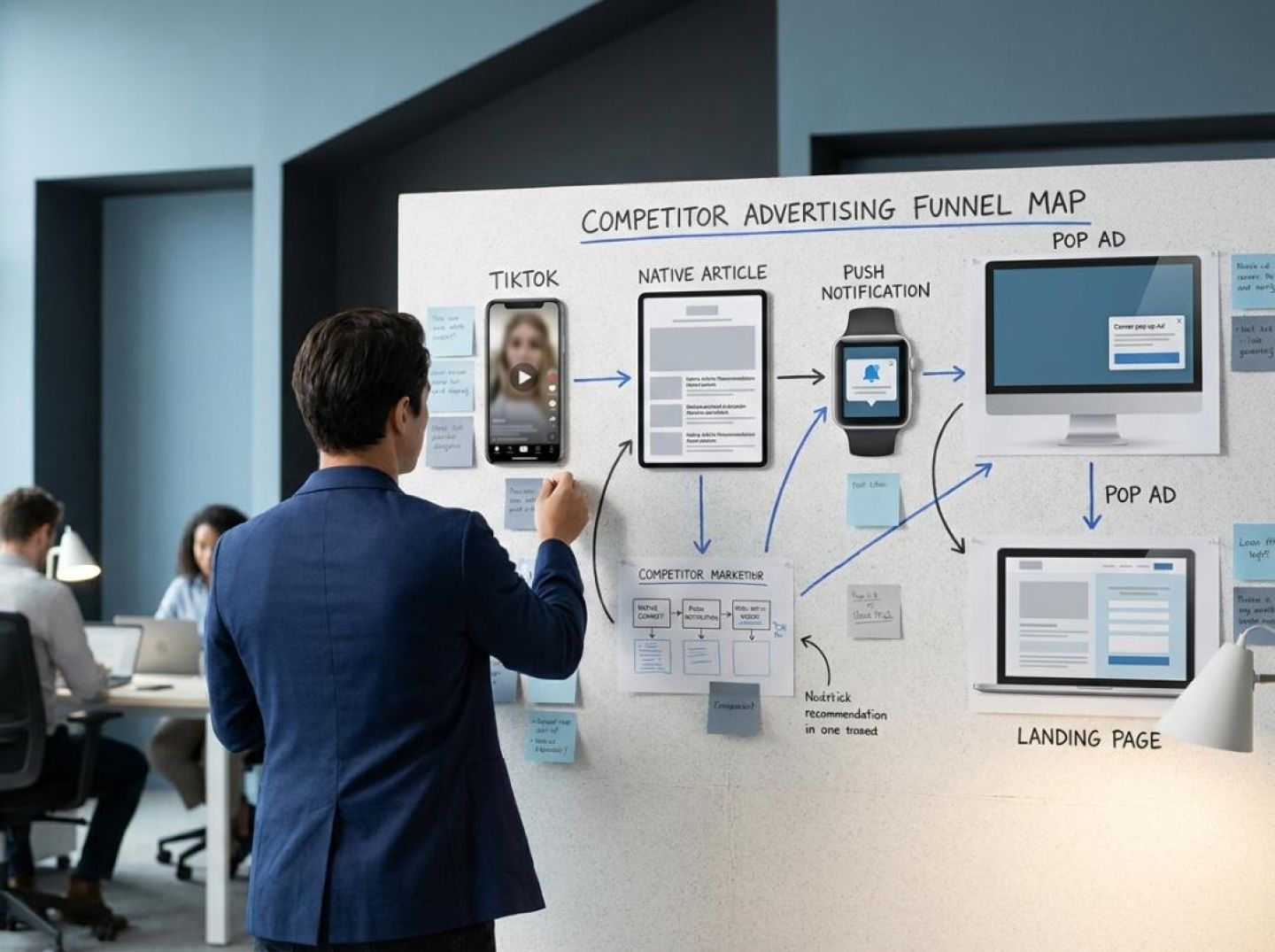
Instead of collecting isolated advertisements, competitive research should investigate how campaigns connect: where traffic goes, how users are introduced to an offer, what creative messages repeat across channels, and how advertisers appear to test and refresh their campaigns.
With Anstrex, marketers can investigate advertising activity across Native, Push, Pop, and TikTok environments. The opportunity is to move from collecting attractive advertisements to understanding the broader patterns behind competitor acquisition strategies.
"Winning creative" sounds like a strategy. In practice, it can become a shortcut for avoiding more difficult questions about measurement, audience behavior, and campaign structure.
The industry often treats a successful advertisement as if its performance belongs entirely to the creative itself. Marketers screenshot a popular TikTok video, copy a native headline, or recreate a push notification because it appears frequently in competitor research.
But an advertisement does not operate independently.
Its results may depend on the audience, placement, offer, timing, landing page, and optimization system supporting it. Copying the visible asset without understanding those conditions means copying only one part of the campaign.
Creative effectiveness has historically been difficult to separate from the media environment in which an advertisement appears.
The work involving DAIVID and ADIN.AI, discussed in Search Engine Journal's coverage of AI-generated creator networks, illustrates the broader challenge of evaluating creative at scale and connecting creative insights with media outcomes.
The same issue becomes more important as advertising production expands.
A single marketing team can now generate dozens of native headlines, hundreds of push variations, or large batches of short-form video concepts in a relatively short period.
When creative production grows faster than the ability to evaluate it, identifying a few individual winners becomes increasingly difficult.
A screenshot cannot tell you why an advertisement received more delivery, whether its audience was qualified, or whether its results translated into profitable customers.
Another problem is treating the best-looking return on ad spend as proof that a particular creative or channel created the demand.
Last-click reporting gives credit to the final measurable interaction. That is useful, but it does not necessarily explain what introduced the product or encouraged the user to consider the offer.
For example, someone may discover a product through TikTok, research it through an editorial article, and eventually convert after clicking a push notification.
If the push notification receives the final attribution credit, that does not automatically mean it created the entire journey.
This measurement challenge is explored in AdExchanger's analysis of the W3C's approach to measuring advertising effectiveness.
For marketers, the lesson is to distinguish demand creation from demand capture rather than automatically favoring whichever channel sits closest to the conversion.
Customer journeys increasingly cross platforms and formats.
A person might discover a product through a TikTok video, read a native advertorial, receive a push notification, and return through a different device.
This makes rigid channel categories less useful as a complete description of customer behavior.
In AdExchanger's coverage of the fluid-funnel approach discussed by Digitas, the focus is on connected experiences rather than treating every advertising channel as an isolated line item.
The practical implication is that competitive research should investigate how different advertisements and destinations may support a broader journey.
TikTok illustrates this shift particularly well.
Advertisers can use creative production tools, platform automation, and CRM integrations to develop and evaluate a broader supply of advertising assets.
The HubSpot guide to running TikTok campaigns discusses the relationship between TikTok campaigns, creative approaches, and marketing systems.
The important distinction is that a campaign's performance may depend on more than its opening hook. Creative supply, conversion signals, audience quality, and follow-up can all contribute.
A single winning advertisement is therefore better understood as one observation within a larger process.
Swipe files are useful for inspiration. The problem begins when they become the entire research method.
Many marketers collect screenshots of TikTok videos, native banners, and push notifications, then call the collection competitor analysis.
But an advertisement is only the visible output of a process.
A better approach is to investigate the possible system behind that output.
Instead of asking only, "What did this ad say?", investigate three broader questions:
These questions help turn a collection of creative examples into a structured research process.
As automation becomes more important across advertising platforms, the message itself can influence who responds to an advertisement and what the platform learns from those interactions.
MarTech's discussion of AI making creative the new targeting explores this relationship between creative messaging and automated audience discovery.
Consider two TikTok advertisements.
One begins with a general product introduction. The other opens with a specific problem experienced by a particular customer group.
Even without access to the advertiser's internal targeting settings, you can investigate how the two messages differ in the audiences they appear designed to attract.
The creative may be communicating more than a product benefit. It may also be qualifying the intended audience.
TikTok's AI-assisted production tools provide another example.
As described in Social Media Examiner's discussion of AI and TikTok advertising, tools such as Symphony Creative Studio can support the production of advertising concepts using brand inputs and available creative resources.
From the outside, you might observe a group of videos with similar structures but different opening hooks, product angles, or calls to action.
That pattern could indicate a structured creative testing process.
However, visible variations do not prove that a competitor is using a particular AI tool or testing workflow. Treat them as clues to investigate rather than confirmation of private operations.
A more useful competitor research framework considers four connected activities:
The relationship between creative effectiveness and media execution is also discussed in Search Engine Journal's coverage of DAIVID and ADIN.AI.
For competitive researchers, the important point is not to assume that every visible pattern reveals an advertiser's internal system. It is to develop better questions about the relationships between the observable pieces.
When researching Native, Push, Pop, and TikTok advertisements, look beyond the individual creative.
Record:
Swipe files preserve advertisements. Systems thinking helps you investigate the mechanics surrounding them.
Most ad spying workflows encourage marketers to collect interesting advertisements and save them for later.
Anstrex can support a more structured approach.
The objective is to investigate how competitors appear to acquire attention, introduce offers, and move users toward conversion across Native, Push, Pop, and TikTok advertising.
Instead of asking, "What is their best advertisement?", ask:
"What patterns connect their advertisements, destinations, and offers?"
Here is a practical framework.
A landing page often reveals more about an advertiser's offer strategy than a headline alone.
Begin by exploring the Native, Push, and Pop advertisements available for your niche in Anstrex.
Where destination URLs are available, examine the pages behind the advertisements.
Group the destinations by offer type:
Then look for destinations that appear across multiple advertising formats.
For example, if similar native advertisements and pop campaigns lead to the same quiz or pre-sell page, that may indicate that the destination is an important part of the advertiser's acquisition approach.
It does not prove that the campaigns are coordinated, but it gives you a concrete pattern to investigate.
This destination-first approach also helps distinguish campaigns that appear designed to introduce an offer from those that send users directly toward an action.
AdExchanger's discussion of advertising effectiveness measurement provides additional context for why the final click should not be treated as the entire customer journey.
Next, examine how advertisements introduce the offer before the final destination.
For Native advertising:
For example, one advertiser might introduce a health product through an educational article, while another uses a product comparison or lifestyle-focused story.
For Push advertising:
For Pop advertising:
You are building a research table that connects:
Pre-sell archetype → Traffic source → Final offer
This provides a more useful view than a collage of unrelated headlines.
TikTok should not be treated as just another advertising placement.
Its short-form video environment gives advertisers opportunities to introduce problems, demonstrate products, and attract viewers through highly specific opening messages.
As MarTech explains in its discussion of creative as targeting, the relationship between an advertisement's message and the audience it attracts is becoming increasingly important in automated advertising environments.
Use Anstrex's TikTok research capabilities to investigate:
Classify opening hooks according to their apparent purpose.
For example:
Then examine where each message leads.
Does the advertisement send viewers to an educational page, a lead form, a product page, or a booking experience?
This helps you understand the different conversion paths associated with the creative.
TikTok's integration with CRM tools is another useful research topic. HubSpot's TikTok campaign guide discusses the relationship between advertising and broader marketing workflows.
However, seeing different creative messages does not confirm that a competitor is using CRM-based audience segmentation. That requires evidence beyond the visible advertisements.
The most valuable findings often emerge when you compare what appears across different formats.
Within your Anstrex research, tag advertisements according to:
Then look for repeated themes.
For example, a particular product benefit may appear in:
These repeated messages may suggest that the advertiser is using a consistent creative theme across multiple environments.
You can then investigate three elements:
Core offers: Which products or lead-generation offers appear repeatedly?
Recurring narratives: Which customer problems and benefits are used to introduce those offers?
Channel roles: How do different advertising formats present the same offer?
This is how you move from reviewing individual advertisements to investigating a possible acquisition system.
Once you stop treating advertisements as isolated assets, their messages become useful clues about the audience and action an advertiser may be pursuing.
Creative can reveal what problem the advertiser wants to address, which customer situation it emphasizes, and how much commitment it expects from the viewer.
But there is an important distinction: visible creative can suggest an audience hypothesis. It cannot independently confirm the competitor's actual targeting settings, CRM data, or bidding strategy.
Consider a TikTok advertisement that opens with:
"POV: You're stuck at $10K MRR and paid ads have plateaued."
This message is clearly designed to speak to a particular business problem. It is not a generic introduction to marketing software.
The advertiser appears to be addressing founders or operators who already understand the problem and may be looking for a solution.
Similarly, a message such as "New subscribers get early access" communicates a different customer situation from a broad promotional headline.
These details help you understand how advertisers position messages for different levels of awareness and intent.
Compare two native headlines:
Both relate to home buying, but they introduce different customer situations.
The first is educational. The second speaks more directly to someone considering a purchase.
Push notifications can communicate a similar distinction.
A general notification such as "Big sale today!" is broad. A message such as "Your saved items are now on sale" is more specific and implies a previous interaction.
That specificity may suggest the advertiser is using some form of behavioral personalization, but the message alone cannot prove which tracking or segmentation technology is involved.
When you see many advertisements with similar structures but different hooks, audiences, or product benefits, you may be observing a creative testing pattern.
For example:
These messages appear to address specific audience situations.
The research opportunity is to identify which audience problems and creative themes recur, rather than assuming that the advertiser has a particular CRM or automation setup.
A large number of related video advertisements may suggest that the advertiser prioritizes creative variation and frequent testing.
Tools such as TikTok's Symphony Creative Studio can support AI-assisted production, as discussed by Social Media Examiner.
But visible creative families do not prove which production tool was used.
Instead, document what can be observed:
This gives you a useful picture of the advertiser's observable creative activity.
A campaign may appear to move from broad curiosity-driven messaging toward more specific product benefits and direct calls to action.
For example:
This sequence suggests different levels of commitment.
It may represent a planned funnel, separate campaigns, or simply different creative experiments. You cannot know which explanation is correct from the advertisements alone.
Still, tracking these shifts can help you understand the range of messages competitors use to attract and convert potential customers.
Think of Native, Push, Pop, and TikTok as different instruments in one marketing system.
Instead of asking which channel is the winner, ask what role each channel can play and how the customer experience should connect from one interaction to another.
This is the idea behind cross-channel orchestration.
The customer journey may be fluid, but marketers can still design a coherent experience.
Each format creates a different advertising experience.
Pops — Immediate exposure
Pop and pop-under advertisements can create a landing-page visit with little prior context.
Because the interaction can be interruptive, the destination needs to explain the offer quickly and clearly.
A quiz or short qualification page may be one possible approach, depending on the product and traffic environment.
Push — Short-form reminders
Push notifications can deliver concise messages to users who have opted in to receive notifications.
They are useful for communicating updates, reminders, and offers, provided the messaging is relevant and the notification experience respects user expectations.
Native — Curiosity and education
Native advertising can introduce a story, product benefit, or problem through a placement that fits the surrounding content environment.
Its format can provide more room for an educational or editorial-style pre-sell experience.
TikTok — Discovery and demonstration
TikTok provides a short-form video environment where products and problems can be introduced through demonstrations, creator content, and specific opening hooks.
Its creative approach can help advertisers communicate a product's value quickly.
A connected campaign should maintain consistency between the advertisement and the destination.
For example:
The important thing is that each touchpoint delivers a coherent experience.
The message should not suddenly change into an unrelated offer or make promises that the destination cannot support.
When investigating competitor advertisements, look for repeated messages and destinations across formats.
You might observe:
These observations may indicate a coordinated strategy, but they could also reflect independent campaigns using the same product messaging.
Treat them as evidence of creative consistency, not definitive proof of shared audience data or coordinated delivery.
Advertisers do not necessarily run one channel at a time.
They may operate several campaigns simultaneously, each with a different purpose.
A hypothetical structure might look like this:
The challenge is to make those experiences consistent and measurable.
Customer relationship management tools can help advertisers organize leads, track lifecycle stages, and manage follow-up.
The HubSpot guide to TikTok campaigns provides context on the relationship between TikTok advertising and CRM workflows.
For your own campaigns, consider how your systems could connect:
When investigating competitors, distinguish between what you can observe and what you can only hypothesize. Different messages may suggest segmentation, but they do not reveal the actual CRM fields or automation rules.
Experienced advertisers do not necessarily find one advertisement and run it indefinitely.
Creative production, testing, and refresh cycles can form an ongoing process. The visible advertisements in competitor research may provide clues about that process.
The key is to stop collecting isolated screenshots and start observing groups of related creative assets over time.
A competitor may test different hooks, formats, and messages before investing more heavily in a particular concept.
On TikTok, this might appear as a group of videos featuring the same product but different introductions, demonstrations, or calls to action.
In native advertising, you might notice multiple headlines and thumbnails leading to a similar article or offer.
In push advertising, several notification variations may point toward the same landing page.
These patterns can suggest structured testing.
However, the visible variations do not confirm the advertiser's actual testing budget, experiment design, or winning version.
Your research task is to catalog related creative assets as families.
For each family, record:
This makes it easier to compare creative patterns rather than treating every variation as a separate campaign idea.
Competitor research cannot show you an advertiser's internal performance dashboard.
But repeated creative patterns can provide clues about what the advertiser may consider worth continuing.
For example, you may notice:
These patterns are worth investigating because they show which concepts remain visible in the advertising environment.
But persistence is not proof of profitability. An advertisement may remain active for reasons unrelated to strong conversion performance, including campaign structure, testing schedules, or other business considerations.
Use repeated visibility to generate hypotheses, not declare winners.
A practical analysis might look like this:
This turns competitor observation into a starting point for your own experiments.
Another useful research signal is how creative variations appear and disappear over time.
You may observe:
These patterns can suggest that the advertiser is refreshing its creative supply.
But do not assume that every disappearing advertisement failed or that every persistent advertisement is profitable.
Campaigns can disappear for many reasons, including budget changes, seasonal activity, creative approvals, campaign pauses, or changes in the research data available.
The useful exercise is to track the pace of visible changes.
For example:
Over time, these observations can help you understand how competitors manage their visible creative inventory.
A creative concept may appear in one format and later become visible in other advertising environments.
For example:
This may indicate that an advertiser is adapting a successful message across different channels.
It may also reflect independent creative work built around the same core product benefit.
Either way, the repeated theme is useful research information.
Instead of copying the advertisement, investigate the underlying idea:
The most useful lesson is not to reproduce a competitor's apparent testing system exactly.
It is to develop a repeatable process for your own campaigns.
A practical workflow looks like this:
This is where competitive intelligence becomes genuinely useful.
Anstrex helps you investigate the visible patterns. Your own advertising data tells you whether your ideas work.
The biggest mistake in ad spying is assuming that the most visible advertisement contains the entire strategy.
A creative is only one piece of a broader advertising experience.
The landing page, offer, pre-sell content, channel choice, message variations, and customer follow-up may all contribute to how a campaign works.
That is why competitive research should investigate relationships rather than simply collect attractive examples.
With Anstrex, you can build a more structured research process:
The goal is not to prove that a competitor has a particular CRM, targeting system, or optimization rule. It is to understand what can be observed, identify patterns worth investigating, and use those findings to make better decisions.
A winning advertisement might attract your attention, but the system behind it deserves your research.
Stop collecting screenshots as if they were strategies. Start mapping the connections between creative, traffic sources, landing pages, offers, and customer actions.
Don't just find the ads competitors are running. Investigate the systems that may be making their campaigns work.
Receive top converting landing pages in your inbox every week from us.
Editor’s Pick
More competitor data does not automatically lead to better campaigns. Discover how performance marketers can use Anstrex as an intelligence input for AI-assisted monitoring, creative and funnel clustering, market-change summaries, and prioritized testing hypotheses.
Samantha Reed
7 minNov 7, 2026
Announcement
Generic holiday marketing advice can quickly become outdated. Learn how to use competitive ad intelligence to study competitor campaigns, uncover creative and funnel patterns, and turn those observations into structured experiments for the 2027 holiday season.
Rachel Thompson
7 minNov 7, 2026
Most Read
A single high-performing advertisement rarely tells the whole story. Learn how to use Anstrex to investigate the systems behind competitor campaigns — from landing pages and pre-sell experiences to creative testing, channel sequencing, and optimization patterns.
David Kim
7 minNov 6, 2026