12 minSeptember 12, 2026

Our spy tools monitor millions of native ads from over 60+ countries and thousands of publishers.
Get StartedThe term “AI slop” didn’t come out of nowhere. It was minted in exasperation — the collective eye-roll of a culture drowning in content that feels beige, bloodless, and strangely interchangeable. When Merriam‑Webster declared “AI slop” its 2025 Word of the Year, the phrase crystallized a broader anxiety: the sense that the internet is being quietly overrun by machine‑made filler that nobody really wants to read, watch, or share.
As Jeff Bullas argues, the core problem isn’t that AI exists; it’s that so much of what we publish with it has been “statistically averaged into existence.” Half the content online, he suggests, is now assembled and optimized by systems that have never felt anything or risked anything. The edges have been sanded down. It’s safe. It’s “polite.” And it leaves audiences cold.
That “Politeness Trap” is important, because it exposes what’s really going on. Marketers talk about AI as a tech challenge — prompt engineering, detection, model choice — but beneath that is something closer to a courage deficit. Hitting “generate” and accepting the first pass is easier than putting a human point of view on the line. You don’t offend. You also don’t resonate. And your content is quietly banished to what Bullas calls the “algorithm badlands,” where it technically exists but does not matter.
Advertisers are living a parallel version of this crisis. Cruddy AI-generated content is now so ubiquitous that media buyers see it as a structural quality issue. At AdExchanger’s Programmatic AI conference, panelists described “AI slop” as a new force reshaping what even counts as “premium” inventory, because the ad ecosystem is now saturated with low‑effort AI pages and videos that still manage to attract impressions and budget. As one AdExchanger analysis notes, the industry’s working definition of “premium” is quietly drifting from production value toward whatever keeps users engaged long enough to serve another ad — regardless of whether the underlying content is meaningful.
The supply glut is staggering. Research cited by AdExchanger points to an internet where AI content is becoming the default, not the exception: Ahrefs estimated that 74% of new websites created in April 2025 contained AI-generated content, while Graphite found that by October 2025 roughly half of all online articles were machine‑written. At the same time, consumers are getting more skeptical. Around 30% of Gen Z and millennials now say they feel negatively about AI‑generated ads, up sharply from 18% the year before, according to that same programmatic report. People may not always be able to prove something was created by AI, but they sense when it’s hollow.
Yet the story isn’t just “AI bad, humans good.” The detection panic proves how messy the boundary has become. As one Search Engine Journal piece points out, we’ve reached the absurd point of deploying one set of AI systems to judge whether another set of AI systems sounds “too human,” even though sounding human was the goal all along. Detectors struggle to reliably distinguish human from assisted writing, yet platforms are already experimenting with social labeling — LinkedIn’s “seems like AI slop” button being a prime example — and public shaming. The result is a new kind of FOW: Fear of Writing. Creators second‑guess every sentence, marketers add vague disclosures, and teams waste cycles arguing about what “counts” as AI‑free instead of asking whether the work actually moves the needle.
When you zoom out, “AI slop” is less a technical failure and more an authenticity collapse. Automation has made it trivial to publish something, so many brands are publishing anything. They chase efficiency metrics — more URLs, more placements, more assets per week — while eroding the one advantage they still own: a distinctive, human point of view about their market and customers.
This is where competitive ad intelligence becomes the pivot from panic to ROI. You don’t have to guess whether your space is flooded with slop or where authenticity still cuts through; you can see it in the wild. Which competitor is blanketing the web with samey AI‑ish landing pages? Who’s running a thousand tiny, templated variants of the same ad? Who’s winning share of attention with lean but unmistakably human creative? Once you can answer those questions with data, “Should we use AI?” stops being a philosophical debate and becomes a sharper one: “Where does automation actually improve performance — and where would it quietly push us into the slop pile our customers are already learning to ignore?”
If you want to know where AI actually pays off, stop reading vendor one‑pagers and start reading the auction.
Competitive ad intelligence turns the abstract “AI vs. human” debate into hard, comparative data: Who is winning, where, and with what mix of automation and judgment. When you watch the auctions over time, you see clear patterns in how the best performers deploy AI – and just as clearly, where they refuse to hand the keys over.
One of the sharpest signals is consistency of efficiency. In categories like insurance, competitive auction data shows that certain players aren’t just outspending rivals; they’re outbuying them – sustaining lower CPMs and stronger CTRs across both social and programmatic. That kind of durable edge rarely comes from a one‑off creative win. It points to an AI‑driven buying system that’s doing the grunt work machines are good at: continuously reallocating budget, testing placements, and tuning bids across thousands of micro‑decisions a day.
In other words, winners use AI in the plumbing of media buying. They let algorithms read the firehose of auction data, react to shifting costs, and surface anomalies – the invisible “why” behind a sudden drop in CPM or a spike in response. Platforms like Polaris AI, which ingest cross‑channel signals and translate them into hypotheses about competitor strategy, make this visible by turning opaque auction behavior into patterns you can interrogate in plain language. You see which brands lean on automation to optimize the media math, not to auto‑generate everything that touches the customer.
That line – between back‑end optimization and front‑end experience – is exactly where the slop backlash is drawing new boundaries. As Tiffany Hsu reported in a piece on “slop antibodies,” platforms from Spotify to LinkedIn are no longer willing to carry the cost of junk created by people who treat generative AI as a volume machine, a pattern that Search Engine Journal connects directly to how SEOs over‑automate content. For performance advertisers, that shows up in competitive data as sudden bursts of near‑identical creatives, broad‑match everything, and spray‑and‑pray audience strategies that briefly flood placements, then quietly disappear as costs climb and engagement falls.
Side‑by‑side, the winners look very different. Their ad intelligence profiles show:
The throughline is the same one Lily Ray and others have emphasized in the context of search: AI is powerful when it amplifies judgment, not when it replaces it. Competitive ad intelligence gives you a scoreboard for that principle in practice. It reveals that the real divide isn’t “AI vs. no AI.” It’s between brands that use automation as an internal advantage in targeting and optimization – largely invisible to the user – and brands that outsource their voice, perspective, and positioning to the same generative engines everyone else has.
If you’re trying to decide where to lean into automation, look to where the winners concentrate it in the auction data: behind the scenes, in the math, in the monitoring. Where their competitive signal is strongest – the clarity of their story, the originality of their creatives, the coherence across channels – you’ll find a human in the loop.
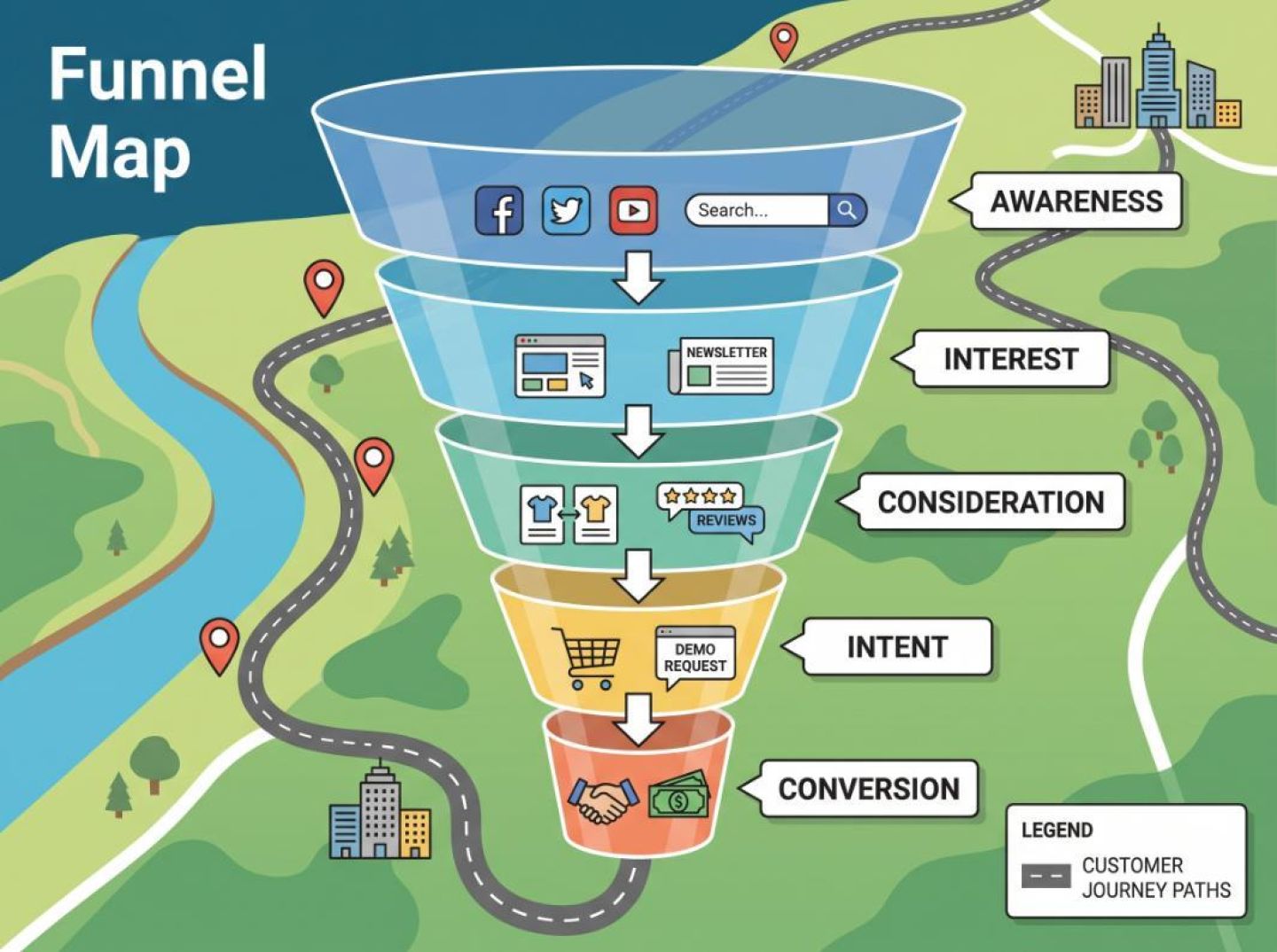
If Section 2 is about reading the auction, this section is about sketching the battlefield: a simple funnel map showing where AI slop is survivable (even profitable) versus where it quietly strangles your brand.
The pattern you see in competitive ad intelligence isn’t that “AI is bad.” It’s that there are zones of the funnel where generic, automated output is economically rational—and zones where it gets punished hard.
Think of three layers:
Across accounts, the most aggressive automation shows up in broad discovery: dynamic search and Performance Max assets, programmatic display, and short, highly templatized social ads. Here, the economic logic is brutal: you’re trying to match a wide variety of intents with a wide variety of micro-messages at the lowest cost per impression or click.
In this zone, AI-generated “slop with guardrails” is often not just tolerated; it’s rewarded—if it hits a few thresholds:
Competitive auctions show top spenders letting machines crank out and test hundreds of micro-variants of headlines, CTAs, and image overlays, then pruning ruthlessly. Nobody expects these ads to be quotable; they just need to pull attention and sort the vaguely‑interested from the completely‑uninterested.
This is the part of the funnel where AI can safely generate:
The reason this works is that top-of-funnel content is judged more by signal density than by soul. Platforms care that it’s not spam, users care that it’s not confusing, and your CFO cares that CPAs are trending down. As long as your AI output clears the “not obviously junk” bar that platforms are now enforcing, you can lean into automation here.
And that bar is getting higher. LinkedIn’s own crackdown on “polished-sounding, generic, and hollow” content shows how quickly the platforms are building detectors for AI slop. But note the nuance in that change: LinkedIn is not banning AI; it’s suppressing low-quality AI that lacks original perspective. Which means your top-of-funnel automation is mostly safe if:
Move down the funnel and the economics change. Now you’re in explain, compare, and persuade territory: paid social sequences, lead‑nurture emails, comparison landing pages, and content promoted via native or paid search that’s meant to be read, not just glanced at.
This is where competitive intelligence starts to show a split:
As Lily Ray has argued in her research on AI-assisted SEO, the winners are the ones whose AI-supported content still carries “unique insights, firsthand expertise, and original perspectives” that can’t just be pasted from a generic model. That pattern shows up in ad performance, too. Mid‑funnel assets that read like averaged‑out Wikipedia pages may still get cheap clicks, but they underperform on time-on-page, scroll depth, demo requests, and pipeline.
You can still reap AI’s efficiency here—but as an assistant, not an engine. The safer uses mid-funnel are:
Competitive campaigns that win at this layer tend to show repetition with variation: the same core angles and proof stories, expressed in many creative and copy formats. AI can handle the variation. Humans must own the angles.
By the time a prospect is deep in comparison mode, booking a call, or weighing renewal, AI slop stops being merely inefficient and becomes actively dangerous.
This is where:
In this zone, the kind of homogenized content that Jeff Bullas described as “statistically averaged into existence by a machine that has never felt anything” does more than bore people; it erodes trust at the exact moment you need to earn it. Users are already on high alert for signs of automation; they know when they’re being handed safe, sanded-down boilerplate instead of real answers.
Platforms are implicitly reinforcing this distinction. As Search Engine Journal has pointed out, Google and others have made it clear that the issue isn’t who wrote the content, but whether it’s “helpful, reliable, and high quality.” Those are precisely the attributes that matter most at the bottom of the funnel—precisely where generic AI is weakest.
So, your funnel map should be blunt:
Competitive ad intelligence doesn’t just tell you who is winning; it tells you where they’re willing to tolerate a little slop to buy scale—and where they draw a hard line in favor of signal. Your job is to copy that map, not their mistakes.
There are parts of your funnel where AI slop isn’t just suboptimal — it’s actively corrosive. Competitive ad intelligence makes these “no-go zones” painfully obvious, because this is where the winners keep humans clearly in the loop while the laggards quietly hand the keys to automation.
Let’s look at the three zones where generic automation most reliably kills performance.
Top competitors don’t let a model write the moments where trust is on the line.
When you analyze brands that tried to let AI take over their core narrative, you see the same pattern: a fast spike, then a long, grinding decline. One IT software competitor that rapidly scaled AI-written content briefly hit page-one dominance — then slid back to where they were a year earlier because the content “didn’t have enough/strong of a purpose or tie to their core brand,” as one case study on human-led SEO shows. The content volume was impressive; the signal was gone.
That same shape appears in auction data. You’ll see:
When you compare them to the category leaders, the difference isn’t spend or even AI usage — it’s whether humans are editing for “unique insights, firsthand expertise, and original perspectives that competitors can’t also copy-paste from an LLM response,” as Lily Ray’s research on AI-supported content puts it.
Automating here doesn’t just cap performance; it muddies the brand’s position in every other channel. Once your mid-funnel messaging is beige, your retargeting, email, and landing pages all start to converge into the same inoffensive sludge.
The second no-go zone is where you decide where to place your bets.
From the outside, it’s tempting to believe your strongest competitors just “let the algorithm learn.” But when you watch how they move in the auctions, that myth falls apart. The most valuable signals are not in the creatives themselves — they’re in “media allocation decisions, efficiency trends, placement strategies and channel shifts” that only surface in auction data, as one analysis of competitive signals points out.
In categories like insurance, the data doesn’t show the winner simply outspending rivals; it shows them outbuying them. Their CPMs fall while share of voice rises. Budget migrates into new placements before competitors arrive. Geographic focus tightens around pockets of incremental efficiency. Those are not moves a generic bid strategy makes on its own.
This is where fully automated decisioning becomes dangerous:
As one critique of pre-AI-era tools notes, AI that simply “accelerates incomplete analysis” without unified, cross-channel data just helps you make the wrong call faster, turning automation into a multiplier for bad strategy rather than a faster route from question to answer.
The top performers use AI to surface questions — “Why did their CTV spend jump in Germany while social spend compressed in the UK?” — then apply human judgment to reallocate media. The teams losing ground are the ones letting automated systems move millions without anyone actually looking at the pattern.
Finally, the most lethal no-go zone: any asset that is supposed to signal authority, originality, or leadership.
The cultural tide has turned hard against obviously machine-made output. Mentions of “AI slop” exploded ninefold in a single year, with negative sentiment leading the conversation, while more than half of all new English-language articles were estimated to be AI-generated, according to one analysis of the emerging AI slop crisis. Users may not be able to articulate how they know, but they feel when your content has been statistically averaged into existence.
In competitive intelligence, this shows up as:
The net effect: your presence across search, social, and recommendation surfaces communicates that you’re generic. As one exploration of the “human edge” in SEO argues, search visibility is really about how consistently you project coherent editorial judgment across surfaces — from AI overviews to social search — and that’s not something you can outsource to a tool.
Automating thought leadership doesn’t just fail to move the needle; it actively trains your market to ignore you.
In all three zones, the pattern from competitive ad intelligence is consistent: the brands winning the auctions use AI as radar and drafting assistant — not as pilot. When you see a rival’s performance plateau or decay despite aggressive automation, it’s usually because they’ve crossed one of these invisible lines, trading human judgment for slop in a part of the funnel where the market still punishes shortcuts.
If the “no-go zones” are where AI quietly eats your brand, this is the opposite: the places in your funnel where automation can print money when you use it deliberately.
Competitive ad intelligence gives you the map. When you study high‑spend advertisers across native, push/pop, and TikTok, you see the same pattern again and again: winners don’t ask “Should we automate?” in the abstract. They decide what to automate, when, and how hard, stage by stage.
Let’s build that map.
Native is where AI can safely run hot — if you keep it fenced.
On platforms like Taboola and Outbrain, top spenders often run hundreds of headline–thumbnail combos per offer. That combinatorial testing is exactly the kind of pattern‑heavy work AI is good at. You’ll see clusters of near‑synonymous headlines, tiny angle shifts, and endless thumbnail variants, all pushing people into the same 2–3 proven landers.
The smart pattern here:
Use ad intelligence tools to reverse‑engineer this setup. When a competitor runs 60 native headlines all pointing to the same long‑running pre‑sell, assume:
Your move: point AI at the grid (ad variants, image permutations, minor copy tweaks), and keep human judgment on the parts that actually frame belief.
Push and pop are even more automation‑friendly — and more dangerous if you get lazy.
Because push/pop traffic is cheap and interruption‑based, the top advertisers you’ll see in competitive tools often behave like quants: huge creative matrices, tiny text payloads, and an emphasis on novelty and CTR over nuance.
Here, AI can safely own:
The risk is that when everything is machine‑generated, you drift into exactly the kind of statistically averaged, beige messaging that users and platforms are rebelling against. As Jeff Bullas pointed out, half of what’s published online now is essentially “assembled” output — optimized, sanded, and emotionally dead. Push/pop users have even less patience for that than searchers do; they’re one thumb‑flick away from gone.
So the stage‑by‑stage map for push/pop looks like:
Use ad intelligence to watch lifespan. If you see a competitor’s push creatives burning out in days while stronger players keep variants alive for weeks with small, precise edits, that’s a tell: the winners are combining AI‑scale iteration with human‑guided pruning, not letting a text model free‑spin.
TikTok is where undifferentiated AI slop dies fastest — and where automation can quietly drive massive profit behind the scenes.
Influence‑heavy short‑form platforms reward what Jeff Bullas describes as “raw or human,” not homogenized, risk‑free content. Your For You feed is a slop detector with billions of human antibodies. If your video feels like stock B‑roll over AI‑voiced platitudes, it will sink.
But look at the best TikTok advertisers through a competitive intelligence lens and you’ll notice something else: the workflow around the creative is deeply automated.
Break it down stage by stage:
So your TikTok automation map is:
Across all three channels, the pattern is the same one ad intelligence platforms are waking up to: AI is the multiplier after you’ve built a solid, human‑designed foundation. Automate the obvious, pattern‑driven work at each stage of the funnel; guard the narrative, framing, and brand promises like they’re radioactive. That’s how you stay in the signal — and keep AI slop confined to the parts of your system where it actually pays.
Receive top converting landing pages in your inbox every week from us.
Most Read
Mass reach can generate impressive numbers without delivering meaningful revenue. This guide shows how competitor intelligence can uncover high-intent micro-audiences and help marketers build focused campaigns that prioritize conversion, relevance, and ROI over vanity metrics.
Samantha Reed
7 minSep 12, 2026
In-Depth
AI automation can dramatically improve advertising efficiency, but using it everywhere can create generic creative, weaken brand differentiation, and hurt performance where human judgment matters most. This guide uses competitive ad intelligence to identify where automation pays off across the funnel and how marketers can balance AI-driven scale with human-led strategy.
Dan Smith
7 minSep 12, 2026
Most Read
Clicks, coupons, and last-touch conversions can create the illusion of performance while hiding whether customers actually intend to buy. This guide shows how to build a real-intent data layer using behavioral signals, competitive ad intelligence, revenue-linked scoring, and continuous validation to improve performance optimization.
Rachel Thompson
7 minSep 11, 2026