
12 minSeptember 2, 2026

Our tools monitor millions of native, push, pop, and TikTok advertising campaigns.
Get StartedOut-of-home has quietly crossed a threshold most of the industry hasn’t fully processed yet: it’s no longer a “dumb,” analog awareness channel. It’s a live, data-generating system that behaves a lot more like programmatic display than a vinyl poster on the highway.
On the supply side, operators and intermediaries now sit on an enormous stream of signals: impressions modeled from mobility data, hourly play logs, price curves, share-of-voice estimates, creative rotation, even the “halo effect” OOH has on adjacent digital campaigns, as the team at AdQuick describes. Their platform ingests consumer, demographic, and behavioral data, then uses machine learning to evaluate “trillions of possible combinations of OOH units” to place every dollar as precisely as possible. OOH, in this view, isn’t a hunch; it’s an optimization problem.
At the same time, the transactional layer has largely standardized. Inventory systems are universal, pipes between SSPs and DSPs are in place, and programmatic DOOH buying now looks and feels like any other performance channel. When an OOH-focused network like Trillboards can position itself as a “software-first digital signage network” that seamlessly bridges SSPs and DSPs, the medium is effectively operating at digital speed, not real-estate speed, as their announcement in OOH Today makes clear.
But that’s precisely where the invisible gap opens up.
As execution has become commoditized, the bottleneck has moved upstream: from “Can we run this campaign?” to “Do we actually understand the market well enough to run the right campaign, at the right time, in the right place, against the right competition?” In the Trillboards–hellOOH partnership, you can see that shift named explicitly: they argue that OOH’s limiting factor is no longer workflow infrastructure, but “intelligence asymmetry” — the lag between what’s happening in the market, when sales or ops notice it, and when anyone actually acts on it. hellOOH’s pitch is not better trafficking; it’s a “machine learning–driven intelligence system” that structures fragmented demand signals into predictive visibility on what will be needed next, not just what’s running now, as outlined in the same coverage.
This is the quiet revolution: OOH is awash in data, but starved for structured, actionable intelligence — especially competitive intelligence.
Other channels have already internalized this shift. In social and programmatic, the most valuable competitive signals don’t show up in press releases; they appear first in the auction. As one analysis in AdExchanger puts it, the real story is hidden in media allocation decisions, efficiency trends, and subtle shifts like a competitor’s CPM dropping, a budget tilting toward new placements, or a sudden concentration in a specific geography. Individually, those are observations. Interpreted together, they’re a story about strategy.
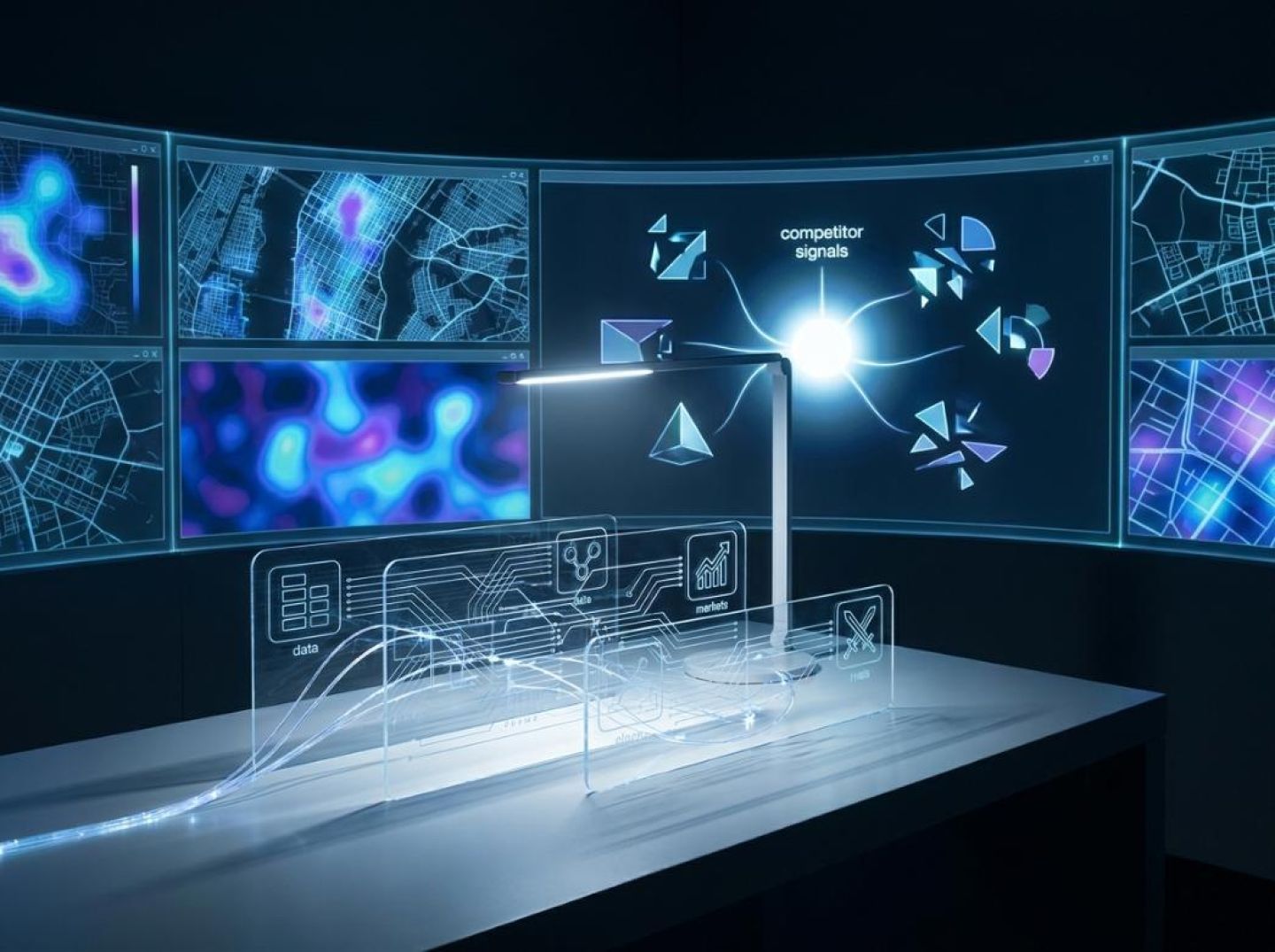
Tools like Polaris AI exist precisely because marketers realized their traditional competitive sweeps missed this layer. Instead of tracking only messaging and spend totals, Polaris reconstructs competitor strategy from live metrics like CPM, CTR, share of voice, and spend efficiency across channels, then adds an AI layer that continuously surfaces anomalies and can be questioned in natural language, as described in that same piece. In other words, “Who’s winning?” is becoming a data science question, not a gut check.
The broader marketing ecosystem is reorganizing around this reality. Competitive intelligence stacks in mature categories now explicitly separate monitoring (what changed) from synthesis (what it means). As one playbook in MarTech notes, platforms like Crayon, Klue, and Kompyte are built to watch everything from pricing pages to sales calls, then feed sales and product teams with real-time, AI-assisted context. The assumption is no longer that a human analyst can track every move across a crowded field; AI is expected to keep up, and to translate noise into insight.
Contrast that with the way most OOH teams still operate. They have real-time delivery data, exposure estimates, and even cross-channel performance lift in platforms like AdQuick. They can see their own campaigns with a level of granularity that would have been unthinkable a decade ago. But when it comes to the competitive landscape — who is saturating which corridors, which formats are suddenly over-indexed for a rival, where pricing is quietly softening because a competitor pulled back — the discipline is still largely tribal knowledge, brokered relationships, and anecdotes.
OOH is, in short, data-rich and intelligence-poor. The systems to capture signals exist. The machine learning infrastructure to model demand — and even predict it — is emerging in offerings like hellOOH. What’s missing is the layer every other sophisticated channel now takes for granted: a dedicated, AI-powered competitive intelligence function that treats OOH not just as a medium to optimize, but as a market to understand and outmaneuver.
Open any senior OOH job description today and you’ll see the same reassuring cluster of phrases: “data-driven,” “audience insights,” “advanced analytics,” “programmatic DOOH,” “measurement and attribution.” On paper, it looks like the industry has fully internalized the idea that out-of-home is now a performance channel. In reality, those descriptions draw a hard, invisible line: data is in scope; competitive intelligence is not.
That line is strange when you look at what’s actually happening in adjacent channels. In paid social, competitive signals have become a first-class input to strategy. As one analysis of auction behavior put it, the most valuable modern signals are “hidden in media allocation decisions, efficiency trends, placement strategies and channel shifts” that show up first in the auction, not in press releases or investor decks, because they’re baked into what brands actually buy and where they pull back in real time, as one AdExchanger deep dive on social auctions argues. That entire article is, essentially, a playbook for turning rivals’ media buying behavior into continuous competitive intelligence.
Meanwhile, look at how OOH roles are framed. A major platform like AdQuick promotes its ability to ingest mobility, demographic, and behavioral datasets to analyze “trillions of possible combinations of OOH units,” promising that every dollar is placed with surgical precision and that OOH now sits “in parity with modern performance channels,” as its own description of AI‑powered OOH optimization makes clear. The mandate in the jobs that support that promise is: structure data, optimize plans, improve ROI. What you almost never see is: mine that same data to understand where competitors are winning, test hypotheses about their strategy, or detect early shifts in category positioning.
The result is an odd asymmetry. On the systems side, OOH is racing toward intelligence. When a sales intelligence platform like hellOOH pitches itself as “a machine learning system for market understanding” that can turn “fragmented market activity into a system that can actually be learned from and acted on,” it is describing precisely the infrastructure you would build if you cared about competitive intelligence, as the Trillboards announcement on OOH Today’s coverage of their partnership makes explicit. But on the talent side, the language in OOH hiring is still about inventory, yield, and campaign execution. Competitive questions—Who’s overpaying where? Who’s quietly flooding which corridors? Whose CPMs are falling in lockstep with ours?—are treated as “nice to have,” if they’re mentioned at all.
Part of the problem is measurement culture. As Jawad Hassan notes in his analysis of OOH metrics, the sector still leans on “legacy methodologies, estimated audience models, and post-campaign reporting frameworks,” which were built for static posters and limited data, not for dynamic, AI-augmented buying environments, as his argument for a single source of truth in OOH measurement underscores. When success is defined narrowly as “did we hit the impression forecast and stay on budget,” the job descriptions follow suit: they optimize for operational certainty, not market outmaneuvering.
Contrast that with how marketing leaders are now being told to think about intelligence more broadly. In an emerging AI‑powered stack, competitive work is not a separate, occasional deliverable; it’s a continuous layer that watches “where they’re pulling back,” “what conversations they’re sitting out,” and then surfaces those openings at a cadence no human analyst could maintain, as one MarTech overview of modern competitive intelligence tooling describes. The software world is building teams and toolchains around exactly that idea. OOH is building similar toolchains—but staffing them as if their sole purpose were internal optimization.
That is the invisible line embedded in current OOH job specs: you’re hired to make smarter decisions about your own inventory and buys, not to systematically decode anyone else’s. And as long as that line holds, the industry will keep leaving value on the table—because the same data that can tell you how to place a better campaign can also tell you, earlier than any quarterly report, who you’re really up against and where they’re already one move ahead.
Digital performance marketers live in a world where “data-driven” is table stakes—but the way they use data is fundamentally different from how most OOH teams do. They aren’t just measuring their own campaigns; they are treating every auction, every CPM shift, every placement decision as a live feed of competitive intelligence.
In paid social and programmatic, this is now standard operating procedure. When a rival’s CPM suddenly drops or their spend migrates into a new format, it isn’t just a media metric—it’s a strategic tell. As one analysis of social ad auctions put it, the most valuable signals today are “hidden in media allocation decisions, efficiency trends, placement strategies and channel shifts,” and they surface first in the auction, not in press releases or earnings decks, where traditional intel teams tend to look. Platforms like the competitive-intel engine Polaris AI scan social and open-web media buys continuously, exposing real-time patterns in competitors’ CTRs, CPMs, share of voice and spend efficiency, then translating those into hypotheses about why one brand is outbuying another, not just outspending them in a category like insurance. In that ecosystem, “who’s winning” is a live question answered daily through competitive performance data.
Digital performance marketers also build dedicated stacks around this. Competitive intelligence isn’t a side project that gets squeezed in between QBRs; it has its own tools, workflows and owners. Modern CI systems combine broad monitoring with synthesis: a platform like Crayon tracks everything from pricing-page edits to feature-description tweaks, while tools such as Klue push contextual battlecards and live competitive notes directly into sales workflows. The point isn’t just to know that a rival changed their product or positioning; it’s to close the loop between what the market is doing, where spend is moving and how front-line teams react.
Now contrast that with how OOH typically uses data.
On the surface, OOH has raced to catch up with digital. Sophisticated planning platforms market themselves as “universal adapters,” promising to plug into mobility, demographic and behavioral datasets so that every board can be scored, ranked and optimized. One such system describes how it analyzes “trillions of possible combinations of OOH units,” blending consumer and location signals so buyers can reach “the right audience, in the right place, at the right time,” and trumpets the fact that OOH data is now delivered in real time, “bringing OOH into parity with modern performance channels.” That’s a massive leap from the days of traffic counts and gut feel.
Industry voices echo this transformation, arguing that digital formats, rich data feeds and AI are pushing OOH toward a future that looks “closer in capability to digital media than at any point in its history.” At the same time, these same observers point out that measurement frameworks remain fragmented, stitched together from legacy audience models and inconsistent post-campaign reports that were never designed for an always-on, data-saturated channel. That fragmentation is described not just as a technical nuisance but as a strategic constraint: it limits cross-channel comparability, complicates allocation decisions and blunts pricing sophistication across operators.
Digital performance marketers have already solved that problem once. They operate in unified auction environments where competitive and performance data share a common language: impressions, CPM, CPA, ROAS, frequency, share of voice. A Facebook impression, a YouTube view and an open-web display ad might not be identical, but they roll up into a coherent, comparable view of spend and efficiency that CI tools can mine for strategic signals.
OOH, by contrast, has poured its recent energy into understanding its own performance—reach curves, lift studies, halo effects on adjacent digital channels—without systematically wiring in the competitive layer. The industry is starting to wake up to the power of machine-modeled demand; when a software-first network like Trillboards plugs into an intelligence system such as hellOOH, it’s explicitly to resolve “intelligence asymmetry” and move from human-interpreted market anecdotes to predictive demand signals based on structured campaign history and buyer behavior. But those systems are overwhelmingly inward-facing: they forecast which advertisers will buy, not what competitors are signaling with their buys.
Digital performance teams see media buying data as a battlefield map. OOH, even at its most “data-driven,” still treats it primarily as a scorecard. Until OOH leaders start using their new datasets the way digital performance marketers do—watching rivals’ allocation shifts, efficiency trends and geographic concentrations, not just their own lift curves—they will keep missing the invisible competitive edge that’s been hiding in plain sight in every other channel.
When you strip out the buzzwords, the cost of ignoring competitors in OOH boils down to one thing: you’re operating on a slower intelligence loop than the people you’re trying to beat.
In paid social and programmatic, performance teams treat the media marketplace itself as a live diagnostic of who’s winning and why. Every time a rival’s CPM drops, they scale into a new format, or they suddenly cluster spend in a specific region, that behavior becomes a signal. As one analysis of auction dynamics put it, the most valuable competitive clues are hiding in shifts in media allocation, efficiency trends, placement strategies and channel moves, long before any of it shows up in an earnings call or press release. Digital marketers don’t wait for quarterly recaps; they watch the auction and adjust in real time.
Now contrast that with how most OOH organizations still operate, even the ones boasting “real-time” dashboards. Platforms like AdQuick have already shown that OOH can be instrumented at the same speed as digital, with planning and buying engines that analyze trillions of unit combinations and deliver performance data in real time. But in practice, the industry mostly uses that horsepower to optimize its own buys in isolation. It’s table stakes performance analytics without the competitive lens.
That blind spot is expensive in at least four ways.
First, you lose the compounding advantage of “fast intelligence.” When operators like Trillboards reframe their constraint as intelligence, not infrastructure, and adopt machine learning systems designed to structure fragmented market behavior into predictive demand signals, they’re not just getting cleaner reports. They’re shortening the time between “something changed in the market” and “we changed what we’re doing about it.” In a world where inventory, automation, and programmatic pipes are quickly commoditizing, that speed becomes the main differentiator. If your hiring, tooling, and processes never mention competitive intelligence, you are implicitly accepting longer feedback loops than the networks and agencies you’re pitching against.
Second, you misread performance and over-credit your own brilliance. When a brand’s OOH ROAS spikes in a given quarter, was it your spectacular location strategy—or the fact that a rival pulled back spend in that geography, ceding mental availability and share of voice? In digital, tools like Polaris AI interpret signals such as a competitor’s falling CPMs and rising efficiency to infer that someone has quietly unlocked a more precise, diversified media mix. Without analogous competitive context in OOH, you risk optimizing around artifacts of your competitors’ decisions rather than your own skill. That leads to the third cost: you start learning the wrong lessons from your data.
Third, you leave entire categories of opportunity on the table because you don’t see positioning gaps until they’re obvious. Competitive intelligence practitioners in broader marketing circles explicitly look for where rivals are pulling back, changing emphasis, or sitting out conversations and use those absences as the map for their next moves. In OOH, that could mean understanding which verticals are quietly freezing OOH budgets in certain DMAs, which creative narratives your competitors have stopped paying to put in the physical world, or which programmatic screens are seeing an unexplained lull from category leaders. If you only monitor your own fill rates and impressions, you never see the negative space—the unclaimed attention—that fast-moving teams exploit.
Finally, you devalue OOH inside the broader marketing organization. Modern brand and performance leaders increasingly expect cross-channel intelligence, not channel silos. They are used to asking their digital teams questions like “Who’s outbuying us on young homeowners this week, and where?” and getting an answer before lunch. When your OOH team can’t say who is outbidding you on key corridors, which competitor has quietly ramped up DOOH share of voice in your top five markets, or how your roadside coverage compares to the category, OOH becomes the least informed line item in the mix. In a budget meeting, the least informed channel is always the easiest to cut.
The irony is that the infrastructure for “fast intelligence” in OOH is already emerging. Market-facing systems are being built specifically to turn raw OOH signals into structured, machine-modeled understanding of demand, just as AI-driven platforms in digital have turned auctions into continuous competitive x-rays. Meanwhile, measurement-first platforms are proving that OOH can match digital on speed and granularity of performance data, putting it “into parity with modern performance channels.”
What’s missing is not capability; it’s intent. As long as job descriptions for OOH sales, planning, and strategy roles omit competitive intelligence as a core responsibility, the default will remain: use data to optimize yesterday’s plan, not to outlearn the brands and networks bidding against you today. In a “fast intelligence” world, that gap isn’t academic—it’s forfeited revenue, lost share, and a growing asymmetry between the companies that treat OOH as a competitive battlefield and those that treat it as a reporting problem.
If OOH wants to operate on the same “fast intelligence” loop as performance channels, it’s not enough to bolt some dashboards onto the same job description. You have to design a role whose core mandate is to turn the OOH marketplace into a continuous stream of competitive advantage.
That starts with flipping the usual brief. Instead of “run campaigns and report on them,” the job should read more like: “treat every impression, auction, and rate card as data about how the market works and where rivals are vulnerable.”
Concretely, a data‑first, competitor‑literate OOH role should own three things.
1. A single source of truth for OOH performance and context
You can’t do competitive interpretation if you’re still guessing at your own numbers. The first responsibility of this role is to build and maintain a unified OOH measurement environment: standardized metrics, consistent audience definitions, and integrated feeds from placements, movement data, and outcomes.
This isn’t just a nicer dashboard; it’s what OOH Today described as a “single source of truth” where asset performance, campaign delivery, and result metrics are compared on equal footing. Within that system, the OOH lead should be able to answer, on demand:
Once that baseline exists, the same structure can be used to overlay competitive observations, not as anecdotes but as comparable data points.
2. Interpreting the OOH market as a competitive signal stream
The second pillar is borrowing the playbook from performance marketers who already treat auctions and placements as livecompetitive intelligence.
In social and programmatic, teams watch when a rival’s CPM suddenly falls, when they surge into a new placement type, or when spend concentrates in a specific geography. As AdExchanger’s analysis of social ad auctions pointed out, those moves are not trivia; they are early signals of strategy shifts long before they show up in earnings calls or case studies.
Your OOH role should be tasked with building an equivalent habit set:
This isn’t about spying for its own sake. It’s about connecting marketplace behavior (they’re suddenly all over transit shelters in secondary cities) to strategic questions (are they chasing lower‑cost reach, or following a new audience migration pattern we haven’t priced in?).
AI‑powered tools make this scale possible. Just as platforms like Polaris AI synthesize creative performance, CPMs, and share of voice across social channels, your OOH lead should be comfortable using similar monitoring and synthesis layers—whether that’s category‑wide spend tracking, location intelligence, or automated capture of competitor flighting—to move from raw observations to ranked, interpretable signals.
3. Turning intelligence into planning and product decisions
Finally, this job cannot live in a reporting cul‑de‑sac. The output has to change how you plan, price, and package OOH.
On the planning side, the role should own a feedback loop with your buying stack. If platforms such as AdQuick’s AI‑driven planner can analyze trillions of OOH unit combinations by audience, behavior, and context, someone has to decide which of those combinations to explore based on where competitors are over‑fishing or conspicuously absent. That means encoding competitive rules into your briefs:
On the product side, the same person should be feeding insights into how you package and sell inventory. When CI platforms like Crayon or Klue flag pricing and positioning shifts in adjacent SaaS and media categories, teams use that to redesign offers and enable sales. Your OOH role should do the equivalent: identify where competitor weakness (inconsistent measurement, inflexible packaging, absence in key verticals) can be turned into new bundles, guarantees, or narratives for your sales team.
To work, this has to be explicit in the job design. Title it like a strategic function (Head of OOH Intelligence, Director of OOH Strategy & Competitive Insights), give it ownership over a clear measurement stack, and measure success not by “number of decks created” but by how often their intelligence changes a decision: a buy you didn’t make, a unit you repriced, a corridor you claimed before anyone else noticed it was undervalued.
Receive top converting landing pages in your inbox every week from us.
Must Read
Discover how AI-generated ad fatigue is making native, push, and TikTok campaigns increasingly look alike, weakening engagement and reducing competitive advantage. Learn how to use competitive ad intelligence tools to identify repetitive creative patterns, develop more distinctive ads, and stand out in AI-driven advertising auctions.
Liam O’Connor
7 minOct 14, 2026
How-To
Learn how to connect out-of-home (OOH) advertising with digital performance campaigns to create measurable cross-channel funnels. Discover how to plan LED truck routes, coordinate search and social ads, optimize mobile landing pages, and track conversions so physical advertising drives measurable business results.
Samantha Reed
7 minOct 13, 2026
How-To
Discover how big-brand sports sponsorships use fan behavior, geographic targeting, and cross-channel advertising to reach high-intent audiences beyond celebrity endorsements. Learn how to reverse-engineer sponsorship strategies, validate audience segments with competitive intelligence, and build cost-effective campaigns around local fandom, CTV, mobile, and creator content.
Dan Smith
7 minOct 12, 2026









)