12 minSeptember 30, 2026

Our tools monitor millions of native, push, pop, and TikTok advertising campaigns.
Get StartedThe most powerful person in tomorrow’s agency won’t be the creative genius who can sell a big idea over martinis. It will be the unnervingly calm operator who can read a chaotic ad account like a crime scene – cross-referencing campaigns, auctions, audiences and anomalies the way an analyst pores over satellite imagery.
AI has already melted down the old hierarchy. When Meta can auto-generate hundreds of ad variants at the click of a button – sometimes hallucinating products, or dropping a man into the hero role of a women’s networking ad, as Meta’s own AI misfires have shown – the question is no longer “Who has the freshest concept?” It’s “Who is actually watching the machines?” Meta’s terms politely shrug that “AI can make mistakes” and it’s on advertisers to catch them. Translation: the platforms are happy to fly the plane; if it nosedives, that’s your problem.
At the same time, media buying itself is being handed to “agents” – automated systems that will soon be able to run the full loop of planning, buying and measuring. Yet, as one agency leader put it, these agents still can’t tell a genuine performance spike from a measurement glitch without human context, meaning buyers have to become “decision makers and managers,” relentlessly interrogating every outlier and recommendation, not passively approving them as automation spreads through the media investment process.
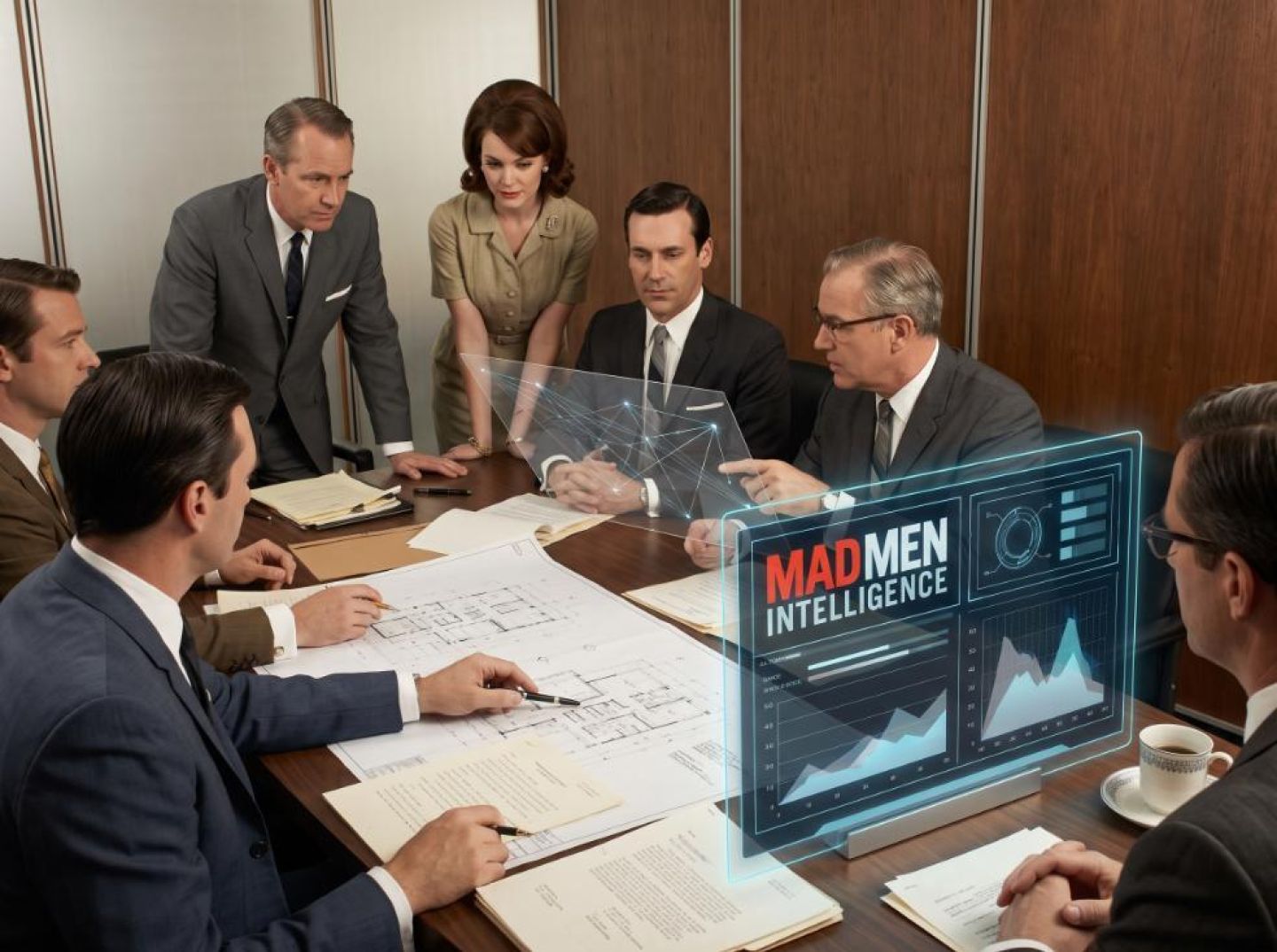
This is where the next-generation Managing Director emerges – not as Don Draper, but as the most obsessed media buyer in the room.
The fluid, always-on funnel has already killed the comfort of neat channel silos. Consumers don’t stroll politely from TV awareness to social consideration to search conversion. They jump from a creator’s TikTok to a CTV ad to a marketplace checkout in minutes. As Digitas’ Liane Nadeau argues, the classic channel plan – the TV budget, the search budget, the audio budget – simply no longer maps to how people behave; instead, you have to architect “networked experiences” that track people across environments and optimize in real time, treating programmatic as a mechanism, not a channel, in what she calls the “fluid funnel” era.
If the funnel is fluid, leadership has to be forensic. The winning MD doesn’t just approve a media plan; they stalk the category’s ads daily, reverse-engineer funnels from competitor landing pages, and read log-level data like an intelligence brief. They want to know not only who’s bidding where, but what quality of environment those bids are landing in, and how that’s silently compounding performance. When programmatic flattens everything into CPMs and completion rates, it hides whether your “cheap” video is actually attached to cluttered pages, unsafe content or off-screen impressions – the kind of blind spot that turns low prices into “expensive waste,” as Guerillascope’s Max Kelvin warns in his critique of how programmatic can erase crucial context signals.
This is not a side hobby; it’s the job. A World Federation of Advertisers study found that “strategic thinking” is now the industry’s biggest talent gap, a conclusion Omar Oakes frames as less a shortage of smarts and more a shortage of courage – the willingness to do the hard, analytical work instead of hiding behind templates and wishful thinking, as he argued in his piece on why strategy has always been scarce on bravery, not ideas. In a landscape where AI can spit out creative and agents can place your buys, the hard work is no longer access or execution. It’s surveillance, interpretation and selective aggression.
The agencies that thrive in this environment will look less like brainstorming studios and more like war rooms. Their leaders will spend more time in dashboards than in mood boards, more time in competitor ad libraries than on Cannes case studies. The modern MD is not an occasional tourist in media performance; they are its chief interrogator. They don’t ask, “What’s our big idea?” until they’ve answered a more uncomfortable question: “What are our rivals doing right now that we haven’t even noticed yet?”
The old job description for a media director was simple: own the TV budget, own the search budget, own the banners budget. You were effectively a portfolio manager of disconnected pots of money. But that model belongs to an era when “awareness” happened on TV, “consideration” lived on desktop, and “conversion” waited politely at the bottom of a funnel that moved in weeks, not seconds.
That world has dissolved.
Consumers now slide from discovery to purchase in a single scroll, swipe or tap. As Digitas’ Liane Nadeau argued in a Cannes conversation about the “fluid funnel”, the awareness–consideration–conversion journey hasn’t died; it has simply outrun the org chart. People discover a product in a creator’s Reel, compare prices in a marketplace, read reviews in a publisher article and hit “buy” in an in-app checkout — all before the legacy media plan has even loaded its next slide.
In that context, “channel planning” in the old sense — the TV budget, the search budget, the audio budget — is a comforting fiction. Programmatic stops being a “line item” and becomes a mechanism, not a channel. CTV, retail media, creator content, paid search and shoppable social are just different on-ramps and exits on the same networked journey.
The next-generation managing director is therefore less Don Draper and more media intelligence officer. Their first defining trait is the ability to see across channels as one connected experience. They don’t ask, “What’s my CTV plan?” They ask, “What’s the shortest, least-cluttered path from the moment someone first sees us to the moment they act — and how do all these surfaces cooperate to make that path feel inevitable?”
Attention research is making those paths visible. Work by Mail Metro Media and Lumen, reported in a recent VideoWeek round-up, showed that premium digital environments with lower ad loads drove 1.6x higher attention and 2.4x higher spontaneous recall than cluttered pages. An obsessed media MD doesn’t treat that as an interesting slide; they treat it as a warrant to redraw the plan. If low-clutter paths earn disproportionate attention, those become the backbone of the journey. Everything else must justify its existence against that benchmark.
Which leads to the second defining trait: courage.
The industry does not suffer from a shortage of strategy decks; it suffers from a shortage of people willing to make hard, focused bets. As Omar Oakes put it in his analysis of a WFA report on talent gaps, strategic thinking is now marketers’ number-one deficit — not because ideas are scarce, but because real strategy demands “choosing, specialising, and making hard choices that carry risk”. The pain of saying “no” keeps leaders clinging to bloated channel mixes and legacy line items that exist mainly to avoid internal conflict.
AI only sharpens that tension. Most marketers are happy to let algorithms crank out content variations or run post-campaign analysis, but they pull back when the machine gets too close to the money. As one AdExchanger round-up noted, a clear majority of marketers use AI for social and retail campaigns’ data analysis and creative, yet barely a third are willing to hand it the steering wheel for actual buying decisions. They intuitively sense that real accountability still sits with a human. When the placement is catastrophic or the performance craters, “the AI did it” is not a career-safe answer.
The obsessed media MD leans into that responsibility instead of hiding from it. They use AI and tools to surface competitive intelligence — who is flooding which auction, which creators are quietly driving incremental sales, where attention is cheapest and where it’s wasted — but they refuse to let the dashboard become a shield. They are willing to act on what they see.
That means cutting entire paths that look busy on a flowchart but dead on an attention map. It means walking into a client’s boardroom and saying, “We are going to halve the number of channels we buy and double down on these three, because that is where we and our rivals are actually winning.” It means diverting budget away from politically protected formats into the slightly weird, high-leverage moments — show-level CTV placements, pause ads, retail media endcaps — where the battle is genuinely being fought.
In a fluid-funnel world, access to data and tools is table stakes. The true bottleneck is strategic courage: the willingness to see the journey as one networked system, to parse the competitive signals in that system, and then to bet real money on the few paths that matter — even if it means killing the ones that make your slideware look impressive.
Automation didn’t make human obsession obsolete. It made it the only thing standing between your brand and a very public, very expensive mess.
You can see this playing out in real time on Meta. In its rush to normalize AI creative, the platform has already served a now-infamous REI ad with a bike sporting two sets of handlebars and a campaign for a women’s networking group fronted by a man, alongside generative variants that quietly distorted actual products, according to reporting on Meta’s “slop” problem. When pressed, Meta didn’t promise perfection; it pointed back to its terms: “AI can make mistakes and it is the advertiser’s responsibility to review the AI outputs.” Translation baked into the legalese: the machine will ship whatever it ships — quality control is your job.
That caveat is the new ground truth of automated media. Platforms will increasingly hand you “done-for-you” creative, auto-expanding audiences, and agentic buying that can execute the full loop from bid to measurement. The risk isn’t that you’ll underuse these tools. It’s that you’ll over-trust them.
The obsessed media managing director behaves less like a Mad Man signing off on storyboards and more like a flight captain running checklists. They don’t assume the instruments are right; they assume something might be off, and work systematically to prove otherwise.
When a platform agent reports a sudden spike in performance, the non-obsessed leader celebrates the win and moves on. The obsessed one treats it as a crime scene. They pick apart where that performance came from and whether it’s even real — is this a genuinely efficient pocket of supply, or a measurement glitch, or a change in dynamic take rates that quietly shifted bids into lower-quality impressions, of the sort sell-side analysts are warning about? They cross-reference platform dashboards with independent analytics, log data, and what they’re physically seeing in the wild via ad spy tools.
This is where the “media intelligence officer” mindset becomes non-negotiable. Programmatic and algorithmic systems are built to make everything look comfortably normal — CPMs within range, completion rates fine, frequency “controlled.” But as Guerillascope’s Max Kelvin notes, programmatic’s smoothing effect can flatten the very quality signals that matter, making cheap inventory look deceptively efficient while masking issues with context, supply paths, and attention, a pattern he describes as “cheap inventory becoming expensive waste”. If your leaders aren’t obsessed with the underlying mechanics, automation will happily optimize you into a false sense of safety.
The next-gen MD also understands that “agentic” doesn’t mean “autonomous.” AI agents can rebalance budgets, test formats, and tweak bids at a pace no human can match — but they can’t yet contextualize politics, regulation, or nuance. A spike in conversions around kids’ content might look like a win to the machine; an obsessed human knows there are LHF rules, watershed restrictions, and brand adjacency concerns that can put a campaign on the wrong side of an industry regulator overnight, as recent rulings against food advertisers on UK broadcast and digital restrictions made painfully clear.
So the job of the modern media boss is not to override machines, but to relentlessly interrogate them. They:
What separates the obsessed MD from everyone else isn’t paranoia for its own sake; it’s the recognition that in a world where “AI can make mistakes,” as Meta itself reminds advertisers in its terms of service, obsession is the last defensible advantage. It is the human quality-control layer that turns automation from a liability into leverage — and it’s fast becoming the line between brands that quietly compound performance and brands that wake up one morning to discover their logo on the latest AI slop meme.
Principal media and opaque inventory deals didn’t appear because agencies suddenly got sneakier; they emerged because advertisers became obsessed with outcomes in a system that refuses to show its working. When your bonus, your CMO’s tenure, and your brand’s valuation all hinge on performance dashboards, it’s easy to be seduced by a model that promises “more efficient” media in exchange for letting the agency become your counterparty. As coverage of principal media makes clear, agencies argue that bulk commitments and proprietary inventory give clients better pricing and results, while critics point out the obvious conflict: when you’re both broker and owner of the media, the incentive is to clear what you’ve already bought, not necessarily what’s best for the brand.
That structural opacity is why the next‑gen managing director treats ad spying as a core leadership discipline. If principal media and labyrinthine supply paths are the black box, spying is the flashlight. A genuinely obsessed media leader is constantly mapping where competitors actually run: which publishers and placements, what level of ad load, whether the environment is premium or long‑tail sludge. When Max Kelvin talks about cheap inventory turning into “expensive waste” once quality signals vanish, he’s describing exactly the problem ad spies are built to surface. If your reports show heroic completion rates, but your rivals are concentrating spend in high‑attention, low‑clutter environments, you’ve just learned that your “efficient” CPMs may be a very pretty way of buying garbage.
The point isn’t to rubberneck competitors’ creative for ideas; it’s to reconcile three realities that rarely match: (1) what your dashboards say, (2) what your partners claim, and (3) what the live auction appears to reward. An obsessed MD uses competitive tracking tools and manual sweeps to identify which creatives, angles, and offers actually sustain volume over time. If a performance brand is running the same offer on the same placements week after week at visible scale, the market is telling you that combination is working. If your own principal deals are delivering entirely different inventory from what winning advertisers favor, you’ve found a governance problem, not just a planning quirk.
This is where ad spying stops being a “tactic” and becomes a control function. You can’t see your agency’s profit margin on a principal buy, but as Jon Mandel argued in an interview on outcomes‑obsessed agency models, you absolutely have the right to inspect the quality of the media. Systematic spying is how you exercise that right at scale. You compare the domains, apps, and CTV shows your money actually hits with the visible paths your competitors lean on. You check whether the “exclusive” CTV package you were sold resembles the environments where category leaders run, or whether you’ve been quietly parked in remnant ad breaks with brutal frequency caps.
The same discipline applies to your own AI optimizations. Platforms are racing to normalize auto‑generated creative and black‑box bidding, and they are very happy for you to treat the model’s output as a law of nature. But when Meta’s automation can confidently serve an REI bike with two sets of handlebars and call it progress, a sober MD should ask: “Does my supposedly smart buying behavior look anything like what the best advertisers in my category are actually doing?” Ad spying answers that by cross‑checking AI‑driven placement patterns against the real behaviors of proven winners. If your machine keeps steering you into inventories or formats where serious players are conspicuously absent, that isn’t innovation; it’s a red flag.
Crucially, this isn’t something you delegate to a junior trader to compile once a quarter. In a “fluid funnel” world where discovery, consideration, and purchase collapse into a single scroll, leaders like Digitas’s Liane Nadeau argue that media must be planned as networked experiences that adapt in real time, not siloed channel budgets inherited from TV‑search‑display orthodoxy. As her Cannes discussion underscores, that kind of orchestration demands an operating‑system mindset, not a buying‑house mentality. Weekly leadership‑level ad spy reviews become the meeting where that operating system is debugged: the MD and senior team walk through competitor funnels, dissect landing page flows, note shifts in offers and formats, and pressure‑test their own supply paths and AI choices against what the market is actually rewarding.
The standard is ruthless: a modern MD must know their competitive set’s funnels as well as, and often better than, their own. Which hooks open the scroll? Which sequences get people to act? Where does CTV hand off to search, or social hand off to first‑party CRM? Each insight becomes both a performance lever and a governance checkpoint. If you see a rival dialing down exposure in high‑clutter environments just as studies on lower ad loads and higher recall gain traction, and your stack is still optimising blindly for the lowest CPM, you’re not just leaving money on the table—you’re failing in your fiduciary duty as a media leader.
In that sense, ad spying is less about voyeurism and more about courage. It gives you the evidence base to say “no”: no to pretty reports that don’t line up with what the market is doing, no to principal deals that serve the supplier first, no to AI optimizations that can’t be reconciled with observed reality. It is a leadership discipline precisely because it forces the hard, strategic choices so many agencies have historically dodged, and it keeps those choices grounded in what’s actually live in the wild, not what’s convenient in the boardroom.
Most dashboards still behave as if every impression is created equal. A skippable pre-roll jammed between two mid-tier creator clips is logged in the same CPM row as a single ad in a pristine, low-clutter news environment. Programmatic’s great trick, as Guerillascope’s Max Kelvin notes in a recent interview, is “flattening of quality” so everything looks comparable on cost and completion rate, while obscuring context, ad load, and supply path – the variables that actually dictate whether an ad has any chance of working in the real world, or quietly decays into “expensive waste” in a programmatic report.
The obsessed media-buying MD refuses to accept that flattening. They treat attention as a measurable resource, not a philosophical talking point. When Mail Metro Media and Lumen collaborated with Havas on a simulated Daily Mail environment, they found that premium pages with radically lower ad loads drove 1.6x higher attention and 2.4x higher spontaneous recall than the cluttered norm, where users were bombarded with up to fifteen ads per page. Those findings, published in VideoWeek’s coverage of the “Centre for Attention: The Premium Edition”, don’t just make a nice conference slide — they are a direct indictment of any plan that chases cheap impressions in chaotic feeds while claiming to be “data-driven.”
The next-gen MD behaves more like an intelligence analyst than a traditional channel planner. They don’t start from “video vs. display vs. CTV.” They start from “where, in this journey, is attention actually available?” and then force their tools and teams to wrap around that question. On one screen they’re running Anstrex In-Stream, dissecting which shows, creators, and placements competitors favour; on another, they’re mapping those placements against attention curves from eye-tracking and viewability studies, plus publisher-level insights into ad density, scroll speed, and audience mindset.
This is where ad spying graduates from tactical curiosity to strategic doctrine. If Anstrex shows a rival scaling hard into mid-rolls on mid-tier inventory with heavy ad clutter, the obsessed MD doesn’t just copy the buy. They ask: Is that choice driven by true performance, or by a pricing deal and a dashboard that can’t tell the difference between an ignored impression and a deeply seen one? They overlay that intelligence with research on premium environments, like the Mail Metro–Lumen work that directly links lower ad loads to stronger brand recall and purchase intent, and recalibrate their own mix toward “high-attention nodes” while competitors drown each other in noise.
Because most platforms are racing to automate buying and measurement, this contextual judgement is quickly becoming the last defensible human advantage. As one activation lead told AdExchanger, AI agents can already execute end-to-end investments, but they still need humans to spot when a spike in performance is real, or just a glitch in the measurement system. The obsessed MD leans into that role. They don’t just QA the agent’s work; they interrogate whether the inventory being algorithmically favoured is contextually capable of delivering attention, or simply cheap enough to win auctions at scale.
In practice, this turns the MD into a context strategist. They brief teams not with abstract GRP goals, but with maps of where attention is provably highest along the funnel: lightly loaded news and magazine environments for early-stage framing; premium long-form series and CTV events for emotional storytelling; focused, utilitarian search and product-review moments near conversion. They then orchestrate creative and offers to match those environments — quiet, high-value placements get more nuanced narrative or high-consideration offers, while noisier environments are used surgically, if at all, for hard-hitting direct response.
This is not nostalgia for “premium” as a logo on a media pack. It’s a demand, echoed in Kelvin’s call for “evidence-based differentiation,” to know exactly what surrounded the ad, how heavy the ad load was, and whether the impression was even on a real TV screen or just masquerading as one in a reporting dashboard. The MD who thinks like an ad spy doesn’t merely place media; they design a sequence of high-attention encounters, each intentionally matched to the creative, the offer, and the psychological state of the consumer. In a market where automation keeps driving more and more impressions into the same flat rows, that contextual intelligence is the difference between leading the category and just adding to the slop.
Everyone says they want “better strategy.” Very few are willing to pay the psychological price of actual choice.
Strategy, as Omar Oakes argues, has never really been in short supply; courage has. The pain isn’t in frameworks or funnels, it’s in what Richard Rumelt calls “the pain of choosing” – the willingness to disappoint some people, reject comfortable revenue, and stop pretending you can be all things to all clients. The next‑gen media MD doesn’t win by having the prettiest deck; they win by institutionalising that courage.
That starts with positioning. An obsessed media leader chooses a lane and burns the map to all the others. They decide, for example, “We are an outcomes‑verified, context‑first performance shop for X categories,” and then actually say no to briefs that demand a concierge model: bespoke reporting stacks, pet channels, opaque arbitrage, and “can you just run our principal media deal too?” They understand that every “yes” to misaligned work is a “no” to depth, focus, and the forensic habits that make an obsessed media culture possible.
The hardest “no” is to easy money. Principal media exists because an outcomes‑obsessed market is willing to trade transparency for apparent efficiency. When an agency pre‑buys inventory, marks it up and then “recommends” it to clients, the P&L quietly sits in the room every time a plan is reviewed. Dave Mandel’s point that marketers should at least demand verifiable inventory quality – even if they never see the agency’s margin – is more than a compliance note; it’s a cultural one. If your teams know that steering spend toward proprietary deals makes you richer regardless of client outcome, no amount of values posters will stop the drift.
An obsessed MD flips that script by redesigning incentives from the ground up. They don’t just talk about outcomes; they hard‑wire them:
In this model, spying beats spinning. Teams are praised for digging through log‑level data, auction dynamics, and competitor footprints to prove that a beloved tactic is actually expensive waste. The senior planner who proves that the “too cheap to ignore” principal video deal is inflating completion rates while tanking attention – because, say, an alternative premium environment with lower ad load delivers 1.6x higher attention and 2.4x higher recall, as recent research into premium digital inventory suggests – should be promoted, not sidelined.
This is why the obsessed media buyer can’t be treated as a lone maverick. They are the prototype for an entirely different talent stack. You don’t hire “channel planners” who think in TV vs. search vs. social; you hire context strategists who understand what Liane Nadeau describes as the fluid funnel, and can follow people across blurred boundaries with a spy’s paranoia about what else is on the screen. You don’t hire pure quants or pure creatives; you build hybrid roles that blend:
Training then becomes less about tool certifications and more about three disciplines: how to make hard strategic choices, how to investigate markets like an analyst, and how to call out misaligned incentives without fear. Measurement follows suit: case studies that celebrate turning work down, reallocating budget away from opaque deals, or proving a board‑level belief wrong are given as much stage time as Cannes trophies.
Courage, in this world, is no longer a personality trait possessed by a few “brave” buyers. It’s an operating system. The obsessed media MD’s real job is to set that operating system so that the only way to win inside the agency is to act like an ad spy in service of the client, not a Mad Man in service of the margin.
Receive top converting landing pages in your inbox every week from us.
Recently Updated
Discover why the next-generation Managing Director is becoming an obsessed media buyer who treats advertising like an intelligence operation. This guide explores how ad spying, automation oversight, attention data, competitive intelligence, and strategic courage can reshape modern media leadership.
Liam O’Connor
7 minSep 30, 2026
Guide
Mondiad’s MCP connector lets media buyers connect their ad account to AI assistants such as Claude, ChatGPT, and Cursor. This guide explains what the connector can do, its limitations, and how to connect it for managing campaigns through a chat interface.
Dan Smith
7 minSep 16, 2026
Must Read
Agentic AI is rapidly transforming media buying, promising autonomous budget allocation, campaign optimization, and creative testing. But despite the hype, today's systems remain heavily dependent on historical data and human oversight. Their greatest limitation is that they optimize yesterday's winners—not tomorrow's opportunities. The marketers who outperform in this new era won't be those who automate everything, but those who combine AI execution with human-led competitive intelligence. By identifying emerging trends, competitor pivots, and creative gaps before algorithms detect them, marketers can feed AI better strategic inputs and create advantages that automation alone cannot replicate.
Dan Smith
7 minJul 8, 2026