11 minAugust 2, 2026

Our spy tools monitor millions of native ads from over 60+ countries and thousands of publishers.
Get StartedAsk any marketer how trust is built and you'll hear a version of the same sermon: it takes years, it can't be rushed, and it compounds through countless micro-interactions — a responsive customer service exchange, a transparent pricing page, a brand voice that never wavers. The orthodoxy is so deeply embedded that questioning it feels almost sacrilegious. Stream Companies, in a widely shared piece on the subject, frames trust as something "built in the small moments" — an asset forged through patience, consistency, and an unwillingness to cut corners. In a companion article, they argue that trust and conversion are inextricably linked, that without a bedrock of credibility no amount of clever creative will move the needle.
They aren't wrong. Not exactly.
The evidence supporting this view is substantial, and it keeps accumulating. As AdExchanger has argued, the premium media owners who will survive the generative-AI onslaught are those who have invested in a self-reinforcing "Trust Loop" — a model in which audience relationships deepen continuously because the publisher earns its credibility at every touchpoint, not just at the point of sale. Meanwhile, the Edelman 2024 Trust Barometer registered the lowest recorded levels of trust in digital media content since tracking began, suggesting that audiences are punishing exactly the kind of shortcut-driven, high-volume content strategy that tries to bypass the slow work of earning credibility. And Marketing Dive has called trust not merely a component of growth strategy but the growth strategy itself, especially during the high-stakes "Transaction Moment" when a shopper has already committed and expects the brand to handle that confidence with care.
So the establishment case is real. Brand trust — the deep, relationship-grade kind — cannot be microwaved. Anyone who claims otherwise is selling something.
But here is where the industry's thinking develops a blind spot wide enough to drive a media budget through.
Marketers have taken the rules governing brand trust — the multi-year, relationship-driven, compounding variety — and applied them wholesale to transactional trust, which is an entirely different psychological threshold. Transactional trust is not about whether someone would recommend your company to a friend. It is about whether someone encountering your ad for the first time feels enough confidence to click, to watch, to enter an email address, to add something to a cart. It is the micro-permission granted in seconds, not years.
These two constructs share a name, but they operate on different timescales, respond to different signals, and are governed by different cognitive mechanics. Brand trust is a relationship. Transactional trust is a judgment call — rapid, heuristic-driven, and far more influenced by the immediate creative environment than most brand strategists would be comfortable admitting.
The marketing establishment has conflated these two thresholds so thoroughly that the distinction has become nearly invisible. When someone says "you can't shortcut trust," they're invoking the weight of the relationship-grade version to shut down any conversation about the transactional one. And in doing so, they've created a strategic gap — one that the best performance advertisers exploit daily, often without even articulating the psychology behind what makes their ads work.
The rest of this article is about that gap, and the specific mechanisms that allow a single winning ad to manufacture enough transactional trust to convert a complete stranger.
The numbers paint a picture that should unsettle every marketer still running on autopilot. According to the 2025 Trust Barometer, trust now ranks equal to price and quality in purchase decisions — a first in the survey's history. That's not a soft sentiment metric buried in a brand health dashboard. It means a prospect weighing your product against a competitor's is giving your trustworthiness the same decision-making weight as your price tag and your feature set. Meanwhile, trust in social media has cratered to an all-time low of 42%, and the share of people who believe business leaders deliberately lie surged twelve percentage points in a single year.
The consequences of failing in this environment are brutally concrete. McCann's Truth About Global Brands study, which surveyed more than 20,000 people across twenty markets, found that 69% of consumers have already abandoned brands they no longer trust — not "would consider leaving," but have actually walked away. The flip side is equally stark: 80% said they'd actively choose brands they do trust. And AI is pouring accelerant on the fire. As McCann global CEO Tyler Turnbull told Adweek, there's a "yearning amongst consumers worldwide to find the truth," but it's harder than ever amid AI-generated content, with 76% of respondents fearing they'll soon be unable to distinguish real humans from computer-generated ones.
Most marketers read this data and reach the predictable conclusion: slow down, invest in long-term brand building, and wait for trust to compound. That's the conventional interpretation, and it's not wrong in the abstract. But it misses a critical strategic implication hiding inside the same numbers.
When trust is scarce, it doesn't just become important — it becomes disproportionately powerful. Think about the economics of scarcity in any market. When supply drops and demand stays constant, even a modest amount of the scarce resource commands outsized returns. The same principle applies here. In an environment where consumers are starving for credibility signals and most brands are fumbling the delivery, the advertiser who deploys the right trust cues with precision — social proof, specificity, transparency about AI use — doesn't just earn a marginal edge. They capture attention and belief at a rate that would be impossible in a high-trust environment where everyone's credibility baseline is already met.
This is the contrarian read that matters: the trust crisis isn't a reason to retreat into years-long brand-building cycles before you dare run acquisition campaigns. It's a structural market opening. When strong reputations turn paid media into amplification rather than persuasion, and when most competitors are either ignoring trust mechanics or burying them inside five-year plans, the advertiser who engineers credibility into the ad itself — right now, at the point of first contact — gains a compounding head start.
The crisis doesn't demand patience. It demands precision. And precision starts with understanding exactly which trust signals move people, and where in the journey they need to appear.
Every brand marketer knows the textbook trust playbook: earn it slowly through consistency, transparency, and years of customer experience. But the top-performing ad creatives running right now didn't have years. Many of them were launched by brands you've never heard of, and they're outperforming household names because they've encoded trust directly into the creative itself — structurally, not sentimentally.
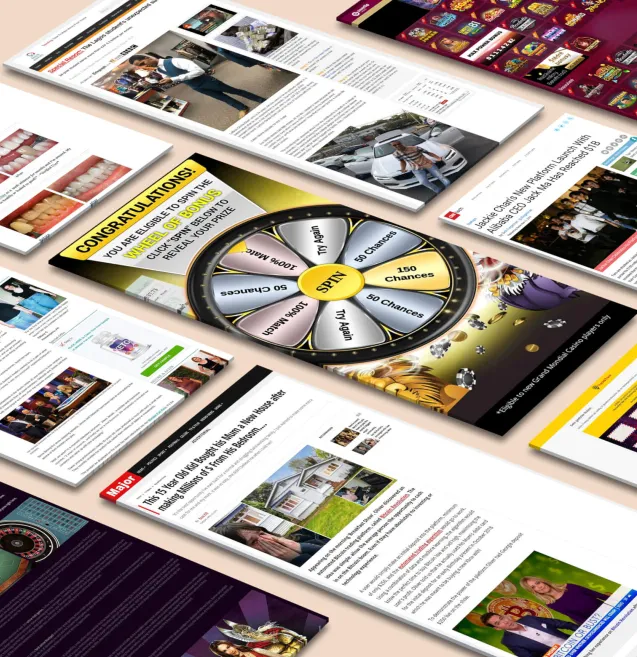
Look at any competitive intelligence tool that surfaces winning native, push, or paid social ads, and you'll notice the same architectural patterns repeating. Testimonial-style headlines that read like someone's lived experience rather than a copywriter's pitch: "I was skeptical until day three." Specific numbers that create credibility through granularity — not "thousands of customers" but "127,341 orders shipped since January." Urgency mechanisms that don't just manufacture scarcity but signal social consensus, implying that the crowd has already validated this choice for you. And visual formats deliberately designed to feel editorial rather than commercial — a phone screenshot of a text conversation, an unpolished selfie-style image, a chart that looks pulled from a report rather than a design studio.
These aren't random creative choices. They're trust architectures, and they work because they mirror the signals humans have always used to evaluate credibility: the specificity of someone who's actually been there, the social proof of a crowd already in motion, the visual grammar of authenticity over polish. As MarTech has argued, the scarce trust signals audiences now reward are "relatability and lived specificity" — the exact qualities that mass-produced, AI-generated content strips away. Top-performing ad creatives have been encoding these signals for years, long before the broader marketing world started worrying about AI-driven content commodification.
The competitive intelligence layer is what makes this actionable. When you use spy tools to study ads that have been running for months — the ones with sustained spend, which indicates sustained performance — you're not just collecting creative inspiration. You're reverse-engineering pre-validated trust language. You can see which emotional triggers your specific audience responds to, which proof structures earn clicks, which visual patterns stop the scroll. You're borrowing from campaigns that have already done the expensive work of testing what resonates.
This matters more now than it ever has. Neil Patel's analysis of Google I/O and Marketing Live 2026 makes the case that as AI collapses the traditional funnel — compressing the journey from research to purchase into a single interaction — trust signals become more important than ever. When a consumer asks an AI agent for a recommendation and gets an instant answer, there's no time for a seven-touch nurture sequence. The brand that wins is the one whose trust signals are already embedded in the moment of discovery.
This is the dirty secret that performance marketers have understood intuitively but rarely articulate: you don't need your own trust history when you can model the trust language your audience already responds to. The winning ad creative isn't building credibility from zero. It's deploying a trust architecture that was validated by someone else's spend, refined through someone else's iterations, and proven against someone else's audience — an audience that overlaps with yours. When McCann's global study found that 69% of consumers have abandoned brands they no longer trust while 80% actively choose the ones they do, the implication is clear: trust isn't just a retention lever. It's an acquisition weapon, and the fastest way to wield it is to study the creative patterns already winning that battle in the wild.
The brands that understand this aren't waiting to earn trust organically. They're studying what trust looks like when it converts, then building it into every headline, image, and call to action from day one.
There's an obvious objection to everything I've laid out so far, and it deserves a direct answer: if trust can be compressed structurally, what stops bad actors from weaponizing that compression to sell garbage?
Nothing, technically. And that's exactly the problem.
The strategy of borrowing proven trust formats — testimonial structures, specific claims, narrative arcs that mirror lived experience — works because audiences have learned to associate those patterns with credibility. But that association is a borrowed resource, not an owned one. Every advertiser who fabricates a testimonial, invents a result, or manufactures a human signal that doesn't exist is drawing down a collective trust account they didn't deposit into. And the balance is already dangerously low.
McCann's global study of more than 20,000 consumers makes the stakes visceral: 69% of respondents said they'd abandoned brands they no longer trust, while 80% said they'd actively choose brands they do. That's not a sentiment gap — it's a behavioral cliff. Consumers aren't just feeling distrustful; they're acting on it, redirecting spend in real time. And the AI anxiety compounds everything. The same study found that 76% of consumers fear they'll soon be unable to distinguish real humans from computer-generated ones — which means audiences are arriving at your ad already primed for suspicion. Every fake review, every staged "authentic moment," every invented specificity ("I lost 12 pounds in 8 weeks" when nobody actually did) confirms the suspicion and raises the drawbridge higher.
This is where the ethical line sits, and it's sharper than most advertisers acknowledge. Using a testimonial format because social proof converts is smart advertising. Fabricating the testimonial itself is fraud — not metaphorically, but often literally, as the FTC and NAD have made increasingly clear through enforcement actions against deceptive endorsements. Using specificity because detailed claims feel more credible than vague ones is good copywriting. But the claim has to be true. The shortcut is structural, not ethical. You can compress the trust timeline by deploying proven trust formats. You cannot compress trust by lying.
And the consequences extend far beyond regulatory risk. As MarTech has warned, "the instant a human signal can be manufactured at scale, audiences start hunting for the genuine, and a backlash builds against anything that feels like a shortcut." That backlash doesn't just punish the bad actor — it poisons the entire ecosystem. When consumers start assuming every specific claim is fabricated and every testimonial is staged, the trust formats that legitimate advertisers rely on lose their structural power. The conversion advantage disappears for everyone.
This is why the distinction between modeling and manufacturing matters so much. When you study a winning ad and replicate its trust architecture — its use of narrative specificity, its proof sequencing, its earned authority cues — you're modeling a structure that works because it mirrors how humans naturally evaluate credibility. The underlying offer still has to deliver. The claims still have to hold up. The human signals still have to connect to something real.
The advertisers who understand this distinction will keep compounding the advantage. The ones who don't will find themselves on the wrong side of a consumer backlash that's already building — and in an environment where today's shoppers are more skeptical, more privacy-conscious, and quicker to abandon experiences that feel manipulative, the cost of getting caught isn't a slap on the wrist. It's extinction.
Here's the tension at the heart of everything I've argued so far: structurally compressed trust — the kind baked into winning ad creatives — works brilliantly for acquisition, but it's not a long-term brand strategy by itself. And long-term brand trust, the kind built through years of consistency and transparency, doesn't solve the problem of getting a stranger's attention in the first three seconds of a feed scroll. You need both. The mistake most marketers make is treating these as opposing philosophies when they're actually complementary layers of the same system.
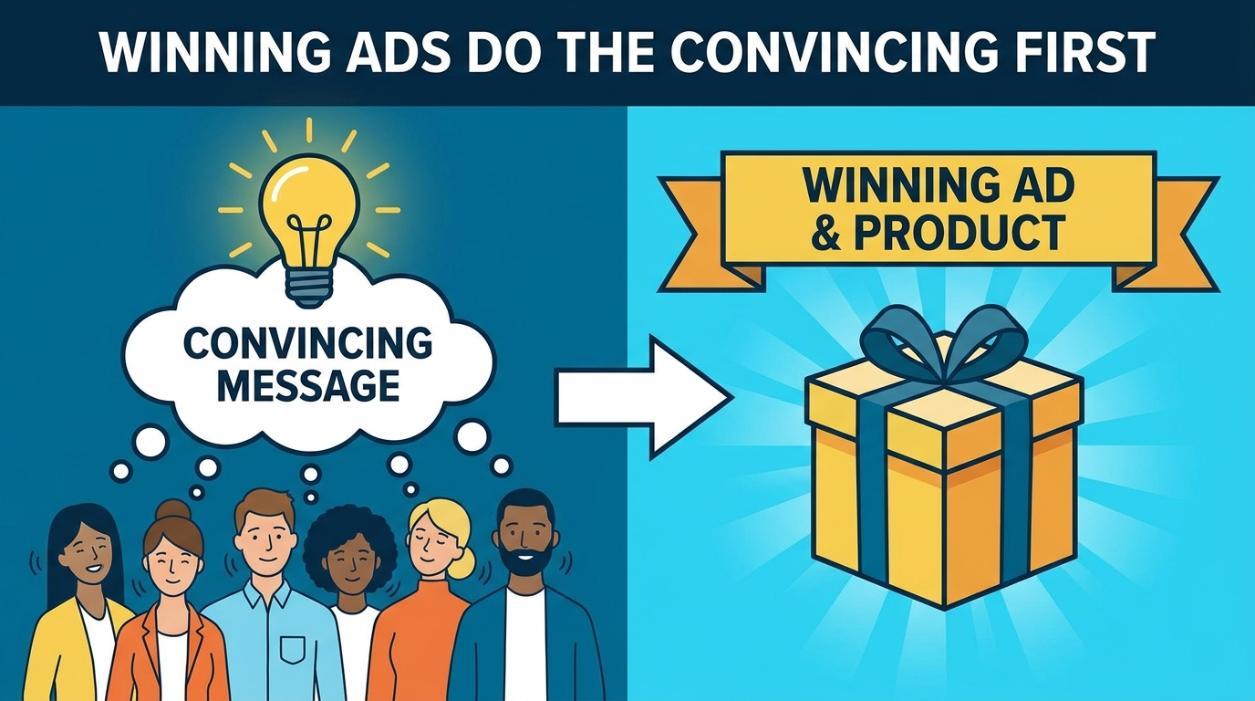
Think of it as two mechanisms operating on different timescales. The Trust Sprint is what happens at the front end of acquisition. You study what's already winning — the ad structures, proof formats, and narrative arcs that competitors have validated with real spend — and you deploy those patterns to compress the believability gap with cold audiences. This is the competitive intelligence layer, the part where letting winning ads do the convincing first saves you months of expensive testing. It gets people through the door.
The Trust Loop is what happens once they're inside. As Stream Companies has articulated, trust isn't built through grand gestures but through hundreds of interactions where people learn they can count on you. It's consistency over time — delivering on promises, being transparent when things go wrong, treating the post-purchase experience with the same care as the pre-purchase pitch. This loop doesn't have a finish line. It compounds or it decays.
Where most frameworks fall apart is in the handoff between these two layers. A brand runs high-converting ads that borrow proven trust structures, acquires customers efficiently, and then drops them into a mediocre post-purchase experience that contradicts every signal the ad communicated. The sprint worked, but the loop never started. Conversely, brands with exceptional reputations and deep customer loyalty often struggle with acquisition because they refuse to engage with the tactical, creative-level work of encoding trust into ad formats that actually stop thumbs.
The integration point is simple in concept and hard in execution: every trust signal you deploy in acquisition must be a promise you can actually sustain in the relationship. The testimonial structure in your ad should reflect real customer experiences that new buyers will also have. The specificity of your claims should match the specificity of your delivery. The narrative arc of transformation should be one your product consistently produces.
When this alignment exists, something powerful happens. Strong reputations turn paid media into something closer to amplification than persuasion, meaning customers click faster, convert at higher rates, and require fewer touches before committing. The sprint feeds the loop, and the loop makes the sprint more efficient over time. Your cost per acquisition drops not because you found a better targeting hack, but because the market increasingly believes you before your ad even finishes loading.
This is also why Neil Patel has argued that brand may matter more than ever as AI collapses traditional marketing channels together — strong brands generate more searches, earn more mentions, and create trust at scale, which is exactly what AI systems are trying to model when they recommend products.
So the practical framework looks like this: use competitive ad intelligence to sprint toward initial trust. Use every interaction after that to loop trust into something self-reinforcing. And never let the sprint promise something the loop can't deliver. That's not just a marketing framework. It's an integrity framework — and in a market where 69% of consumers say they've abandoned brands they no longer trust, integrity isn't optional. It's the only durable competitive advantage left.
Receive top converting landing pages in your inbox every week from us.
Must Read
AI-powered ad platforms can optimize campaigns efficiently while quietly steering budgets toward narrow, platform-defined outcomes. Learn how to use Anstrex as an outside-in audit layer to uncover machine bias, compare real market behavior, and build AI media plans with stronger guardrails, audit loops, and human overrides.
Liam O’Connor
7 minSep 16, 2026
Recently Updated
Agentic AI is changing how performance marketers manage bids, budgets, creative, and emerging ad surfaces such as ChatGPT and AI-native media. This guide shows how to use competitive intelligence, sandbox testing, and Anstrex-style research to study these systems without putting today’s media budget at unnecessary risk.
Marcus Chen
7 minSep 15, 2026
Most Read
Mass reach can generate impressive numbers without delivering meaningful revenue. This guide shows how competitor intelligence can uncover high-intent micro-audiences and help marketers build focused campaigns that prioritize conversion, relevance, and ROI over vanity metrics.
Samantha Reed
7 minSep 12, 2026