6 minJune 25, 2026

Our spy tools monitor millions of native ads from over 60+ countries and thousands of publishers.
Get StartedEvery May, the advertising world gathers to celebrate itself. Agencies send their finest work to be judged not by the marketplace, but by fellow creatives — peers who evaluate entries on criteria that would look alien on any media buyer's dashboard. Understanding what those criteria actually reward, and what they conspicuously ignore, is the first step toward understanding why award-winning creative so rarely translates into performance-winning creative.
Take D&AD, one of the industry's most venerated institutions. When president Lisa Smith reflected on the 2026 winners, she didn't mention a single commercial outcome. No sales lifts. No conversion rates. No return on ad spend. Instead, she praised "the sheer creative bravery and excellence on display," celebrating teams "pushing into genuinely new territory, from storytelling and traditional craft to emerging technologies and new forms of expression." The work that earned Pencils, she said, "moved the standard of creative excellence forward." It's a revealing choice of words: the scoreboard isn't whether a campaign moved product — it's whether it moved the standard.
The institutional incentives reinforce this orientation. D&AD measures its own success not by the commercial impact of awarded work, but by the expanding geography of its entrants — entries arrived from 89 countries in 2026, up from 86 the previous year, "the highest in D&AD's history." The fastest-growing discipline? Culture, with entries surging 49% year over year. Three brand-new categories — Sport Entertainment, Cultural Influence, and Brand Transformation — debuted this cycle, none of which are defined by bottom-line metrics. The organization is expanding its surface area for peer admiration, not building a framework for measuring whether awarded campaigns actually worked.
Now contrast that vocabulary with the language performance marketers speak every day. When practitioners track native advertising campaigns, they inhabit an entirely different lexicon: click-through rates, conversion rates, cost-per-click, and other key performance indicators that reduce creative to its measurable economic output. Success in that world means setting specific goals like "generating leads, getting more sales, boosting website traffic, or increasing brand visibility," as Voluum's native advertising guide puts it — objectives that are inherently quantifiable and tied to business outcomes.
These two ecosystems aren't just using different metrics; they're playing entirely different games. The award-show circuit optimizes for originality, craft, and what juries perceive as cultural significance. A Super Bowl spot for Anthropic earns a Yellow Pencil because it's controversial and conversation-starting. A Columbia campaign wins because it's an "Expedition Impossible" — the ambition itself is the point. Whether those ads drove app installs, lowered customer acquisition costs, or generated a positive ROAS is genuinely irrelevant to the judges holding the ballots.
This isn't a flaw in the system. Award shows exist to celebrate the art of advertising, to push the medium forward aesthetically, and to create a reputational currency that agencies can trade for new business pitches. That's a perfectly legitimate function. But it means that performance marketers who turn to Pencil-winning case studies for creative inspiration are reading a textbook written for a different exam. The principles that earn standing ovations at Cannes — boundary-pushing concepts, experimental formats, brand-level storytelling arcs — are structurally misaligned with the principles that earn profitable CAC ratios in a paid media account. Recognizing that misalignment is not cynicism. It's clarity.
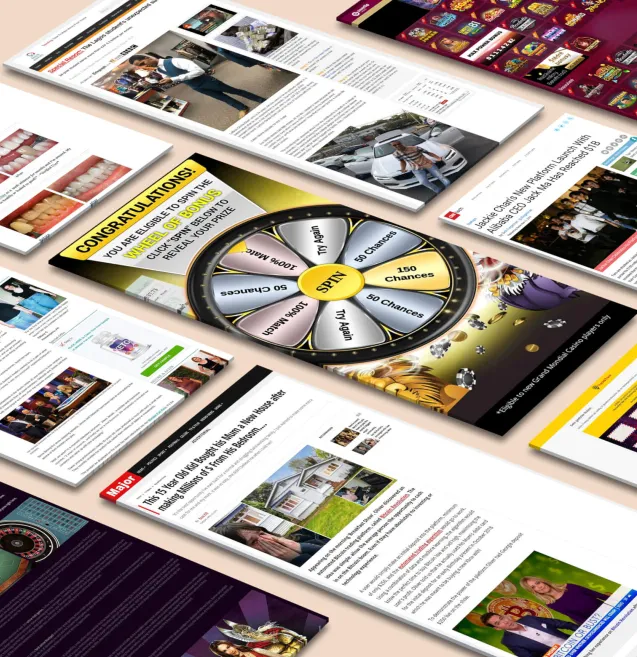
There is a parallel advertising universe that no creative director would ever submit to D&AD, no jury would ever shortlist, and no trade publication would ever celebrate with a breathless headline. It is the universe of native ads, push notifications, and pop placements — the formats that quietly generate the bulk of performance marketing revenue across the open web. If you've ever scrolled past a thumbnail on a news site that read "Doctors Are Speechless: This Simple Trick Could Transform Your Sleep" and felt a small, involuntary tug of curiosity, you've already encountered this universe. You probably didn't recognize it as advertising. That was the point.
The highest-converting native ads are engineered to be invisible. They borrow the publisher's typeface, match the surrounding editorial grid, and use images that look like they were pulled from a journalist's photo file rather than a brand's asset library. Where a Pencil-winning campaign demands that you stop and admire the craft — the unexpected visual, the provocative copy, the unmistakable signature of a famous agency — a winning native ad demands precisely the opposite. It asks you to keep scrolling in the same cognitive mode you were already in, absorbing content, until the line between editorial and promotion dissolves entirely. These are fundamentally opposing design philosophies, and the native approach, while unglamorous, is the one actually generating measurable conversions at scale.
The economics reinforce this invisibility. As the Voluum Blog explains, advertisers running native campaigns on a CPM model can compound ROI dramatically once they identify their best-performing creative sets — because each additional click makes the offer more popular while the cost per thousand impressions stays flat or even decreases. A beautifully shot brand anthem might win a standing ovation at Cannes, but it doesn't enjoy this kind of self-reinforcing efficiency. The native creative that quietly outperforms its cohort gets scaled, duplicated across geolocations, and iterated with minor headline variations until every dollar of margin has been extracted. No one applauds. The dashboard does the celebrating.
What makes these ads work is not laziness or a lack of imagination — it's a precise understanding of user psychology. The curiosity-gap headline, the editorial thumbnail, the blended placement: each element is calibrated to reduce the friction that traditional advertising creates. And the data suggests consumers are more receptive to this approach than the industry often assumes. Research cited in Voluum's native advertising overview found that 61% of consumers don't care whether content is sponsored by a brand, as long as the message itself delivers genuine value. That finding should unsettle anyone who believes creative distinction is the primary driver of engagement. For the majority of users, relevance beats originality.
This doesn't mean native ads are immune to bad execution. The formats demand their own kind of rigor — audience profiling, relentless A/B testing, and an almost editorial sensibility for what a given publisher's readers will find credible. As even brand-side marketers are beginning to acknowledge, the most results-oriented perspective often comes not from high-production experiential branding but from data-driven creative iteration. The agencies that still treat performance creative as beneath them are ceding an enormous amount of revenue to buyers who understand that the best ad is frequently the one nobody remembers seeing — only acting on.
The invisible portfolio will never hang in a gallery. But it will always outperform the work that does.
Award annuals teach you what a jury of twelve creative directors admired in a room. Spy tools teach you what millions of real humans clicked on with their actual thumbs. If you accept that distinction — and the previous two sections should make it hard not to — then the question becomes practical: where should a performance marketer actually study?
The answer is a curriculum that no advertising school offers, built from three interlocking resources: competitive intelligence platforms, ad network benchmark reports, and your own tracker data. Together, they form a living syllabus of what converts, updated not once a year at a gala in the south of France, but continuously, in real time, across every vertical, geography, and device type that matters to your bottom line.
Start with spy tools like Anstrex and AdPlexity. These platforms crawl native, push, and pop ad networks around the clock, cataloging every live creative, landing page, and offer they find. When you open one, you are not looking at a curated gallery of "brave" concepts. You are looking at a survivorship index — the ads that are still spending money are, by definition, the ads that are still making money. Sort by longest-running campaigns and you have an instant education in what works: which headline structures generate clicks, which thumbnail compositions stop a scroll, which angles a competitor in your vertical has been profitably scaling for six months straight. No jury deliberation required. The market already voted.
Next, layer in platform-level benchmarks. As Brax notes in its guide to tracking native ad performance, Taboola regularly publishes benchmark reports broken down by industry, giving marketers a way to compare their CTRs, CPCs, and conversion rates against the broader competitive landscape. This is essentially competitor analysis at scale — you are measuring yourself not against one rival's leaked deck, but against the aggregate behavior of every advertiser in your category. The same guide rightly cautions that these are averages, not absolutes; your specific product, audience, and geography will shift the numbers. But averages give you a baseline that no Pencil-winning case study ever will: a concrete standard against which to measure whether your creative is underperforming, and by how much.
Finally, your own analytics dashboards — whether inside a tracker like Voluum, a native platform's reporting suite, or a custom BI stack — complete the picture. This is where benchmarks and competitive intelligence meet your actual spend. You learn that a specific headline structure outperforms another by 2.3x, not because a panel found it "culturally resonant," but because the data says so across fifty thousand impressions. You discover that image-based creatives in the finance vertical on mobile in Germany convert at half the rate of text-heavy variants, a finding that is worth more to your P&L than every D&AD entry from the last decade combined.
This kind of granular, data-driven decision-making empowers marketers to identify gaps and design better strategies, turning every campaign into both a revenue event and a research project. And while D&AD's president may celebrate work that "moved the standard of creative excellence forward", the performance marketer's version of excellence is quieter, less photogenic, and ruthlessly honest: did the creative beat the control, and can you prove it?
The point is not that award shows are worthless. The point is that they are someone else's curriculum. Performance marketers should be treating their spy tools, benchmarks, and tracker dashboards with the same rigor and curiosity a Cannes juror brings to a case study video — studying every data point as if their next campaign depends on it, because it does.
Both worlds worship the same word, but they kneel at very different altars. When D&AD president Lisa Smith praised the 2026 winners for "pushing into genuinely new territory", she was articulating the award world's foundational belief: creativity means originality, a leap into the unprecedented, work that "moved the standard of creative excellence forward." That definition has powered decades of breathtaking campaigns — and it is almost entirely useless to the person managing a native ad account with a daily budget and a conversion target.
Performance marketing also tells its practitioners to be creative. The Voluum blog, in its guide to native advertising best practices, offers advice that could easily be mistaken for a line from a Cannes keynote: "you and your competitor get the same amount of pixels for an ad — what differentiates you from others is your creativity." Strip away the context and it sounds like an invitation to dream big, to shock, to pioneer. But read it in context — sandwiched between directives to know your audience demographics and set measurable performance goals — and the meaning shifts entirely. What Voluum is really saying is this: within the ruthlessly constrained canvas of a thumbnail and a headline, your survival depends on out-thinking the competition at the pixel level. Not through novelty for its own sake, but through sharper value propositions, more psychologically precise imagery, and better alignment between what the user sees and what the user wants.
This is where the two definitions of creativity diverge so sharply that they barely belong to the same vocabulary. In the award world, a creative idea is validated once — by a jury, at a ceremony, with a pencil or a lion. In performance, a creative idea is validated continuously, in fractions. You find a winning headline, then you test forty variations of it: different adjectives, different numbers, different emotional registers. You swap the thumbnail from a close-up face to a product shot. You A/B test a question mark against a period. As Brax's guide to tracking native ad performance emphasizes, success in this world lies "not just in the act of placing ads, but in the art of understanding how they are doing" — a perpetual feedback loop where every creative decision is either confirmed or killed by data within hours.
The craft here is iterative, not revolutionary. It rewards pattern recognition over pattern breaking. A performance creative who discovers that images with warm lighting outperform cool tones by 0.3 percent on CTR has unearthed something genuinely valuable — not because it is novel, but because it is true, tested, and immediately profitable at scale. Multiply that 0.3 percent across ten million impressions and the decimals start looking like serious revenue.
This reframing matters because too many performance marketers carry an unspoken inferiority complex. They look at the Pencil-winning work — the cinematic brand films, the installations, the experiences that generate standing ovations — and feel like tradespeople in a room full of artists. But the comparison is false. Award creativity optimizes for memorability among peers. Performance creativity optimizes for behavior change among strangers, measured in real time, with real money on the line. One is judged by applause; the other is judged by the click, the conversion, the cost-per-acquisition that either sustains a business or doesn't. The feedback loop is faster, more honest, and infinitely more brutal. No jury gives you a second chance when your CPA blows past breakeven.
So when someone tells you to "be creative," ask the only question that matters: creative by whose definition, and measured by what?
The goal was never to burn the award annuals. It was to read them differently.
Performance marketers who dismiss Pencil-winning work entirely are making the same mistake as the creatives who dismiss click-through rates: they're confusing the scoreboard with the game. The best award-winning campaigns contain specific, transferable mechanics that can improve any ad — even one destined for a 1080×1080 Instagram placement with a "Shop Now" button bolted to the bottom. The trick is knowing what to extract and what to leave on the gallery wall.
Start with emotional storytelling. When Mother London's Super Bowl spot for Anthropic earned a Yellow Pencil, it wasn't rewarded for the media buy or the brand lift study. It was rewarded for a narrative structure that made millions of viewers feel something specific about artificial intelligence — a subject most people experience as vaguely threatening abstraction. The performance marketer doesn't need sixty seconds of cinematic storytelling. But they desperately need the underlying architecture: a tension, a character the viewer identifies with, and a resolution that makes the product the hinge. That three-beat structure works in a six-second bumper ad. It works in a carousel. It works in a single static image if the headline creates tension and the visual delivers resolution. What you leave behind is the runtime, the production budget, and the assumption that emotional resonance requires a director's reel.
Next, study visual hierarchy and craft. The Yellow Pencil awarded to Evil Ray's brand identity and Uncommon's work for The Ordinary both demonstrate something performance creatives chronically undervalue: the disciplined arrangement of elements so the eye moves exactly where it should. In performance, most creative testing focuses on what is in the frame — product shot versus lifestyle image, model versus no model. Award-winning work reveals that where things sit in the frame matters just as much. A headline placed twelve pixels higher. A product image given breathing room instead of being crammed against a price callout. These are free improvements that require zero additional budget, only the willingness to treat a feed ad with the same compositional seriousness as a print campaign.
Then there's cultural timing. The D&AD's Culture discipline saw entries surge 49% year over year, with brand-new categories for Sport Entertainment and Cultural Influence debuting in 2026. Award juries are explicitly rewarding work that reads the room — that meets an audience inside a moment they already care about. Performance marketers can steal this instinct wholesale. The Voluum Blog makes a deceptively simple point that applies here: when it comes to advertising, content is king, and the first step is understanding what problems your audience is trying to solve and what they would genuinely value. Cultural moment marketing is just that principle accelerated — matching your message not only to a demographic profile but to the specific emotional weather of a given week, trend, or conversation.
Finally, borrow the commitment to added value. Sixty-one percent of consumers say they don't mind sponsored content if the advertising message is good enough. Award-winning work earns attention by deserving it. Performance work too often tries to hijack it. The gap between those two approaches is where most scroll-past behavior lives. You don't need a Pencil to close it. You need the discipline to ask, before every creative ships: does this give the viewer something — a laugh, a surprise, a piece of useful information — or does it only take their time?
Reverse-engineer the mechanics. Ignore the trophies. That's the entire curriculum.
Receive top converting landing pages in your inbox every week from us.
Editor’s Pick
Discover how to turn food, sports, and tech trends into structured creative testing hypotheses instead of one-off ad ideas. Learn how to build vertical-specific blueprints, test them across Native, Push, Pops, and TikTok, and use performance data to continuously improve your creative strategy.
Dan Smith
7 minSep 20, 2026
Guide
Award-winning ads can inspire powerful performance creative, but they need to be rebuilt for the way algorithms, feeds, and users behave across Native and TikTok. This guide shows how to reverse-engineer high-profile creative into scalable hooks, angles, formats, and AI-driven testing systems that can improve performance.
Elena Morales
7 minSep 19, 2026
In-Depth
Discover how city-level ad intelligence can help marketers build campaigns that feel local while scaling globally. Learn how to use Anstrex to uncover geographic, language, creative, and funnel patterns across Native, TikTok, Push, and Pops, then turn those insights into repeatable localized campaigns.
Elena Morales
7 minSep 16, 2026