10 minAugust 7, 2026

Our tools monitor millions of native, push, pop, and TikTok advertising campaigns.
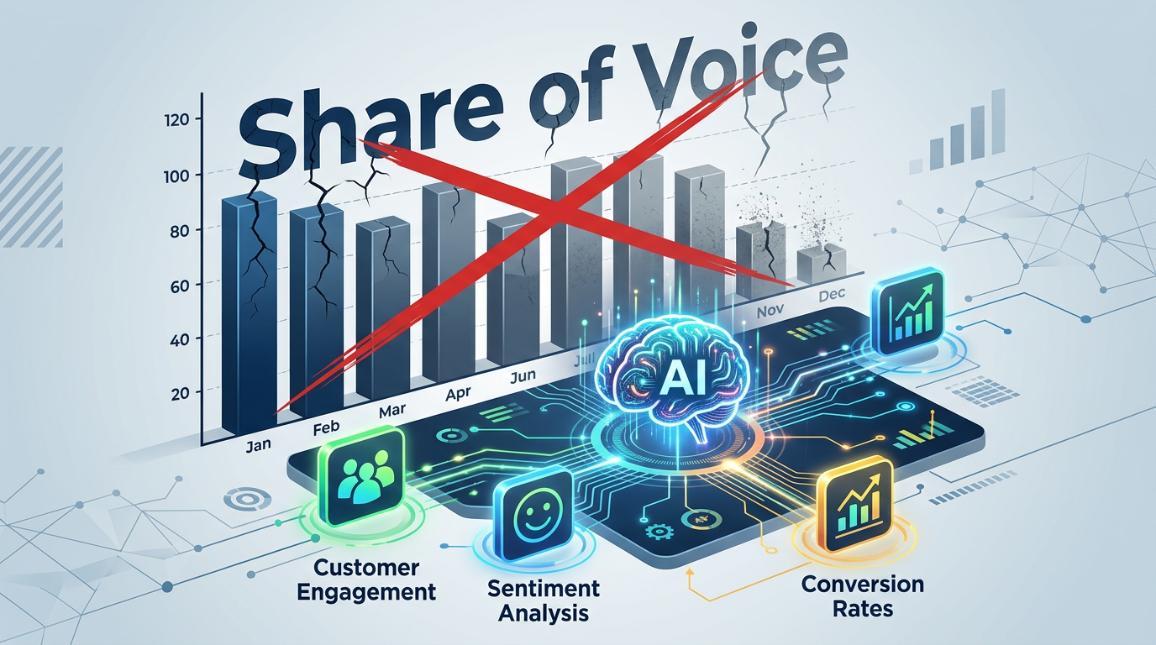
Get StartedIf you've opened a marketing newsletter in the last six months, you've seen the pitch: AI Share of Voice is the new rank tracking. The idea is straightforward and, on its surface, compelling. Instead of asking "where do we rank for this keyword?" you ask "how often does our brand appear when an AI model answers a question in our category?" A wave of tools now automates that measurement — firing structured prompts into ChatGPT, Perplexity, Google's AI Overviews, and Gemini, then tallying how frequently a brand is mentioned, how prominently it's positioned in the response, and whether the AI cites the brand's owned domains as a source.
The framework has real depth to it. As Semrush explains in its visibility measurement guide, the metrics worth tracking include share of voice (how prominently your brand is mentioned alongside competitors), visibility breadth (how consistently you surface across platforms and prompt categories), sentiment accuracy (whether the AI describes your product correctly), and citation share (how often your domains are referenced). Taken together, these metrics form a layered picture of how a brand shows up in AI-generated answers — and whether that presence is accurate enough to help rather than hurt.
The strategic case for caring about these numbers is equally well-articulated. MarTech argues that the shift from "position" to "visibility" reflects a genuine change in how discovery works: AI summaries now answer questions directly, often blending product data, reviews, and third-party commentary into a single synthesized response. In that environment, a number-one organic ranking doesn't guarantee you're even mentioned. Citation share, in this framing, acts as a trust signal — it measures not just whether a brand appears, but whether the system trusts it enough to reference as a source. Visibility rate, meanwhile, functions as a "synthetic share-of-voice for AI and personalized search," capturing how much answer space a brand owns across many scenarios rather than a single query.
None of this is wrong. For brand marketers, content-led SEO teams, and anyone whose growth model depends on organic discovery and consideration-set inclusion, these metrics genuinely matter. If your goal is to ensure that when a potential customer asks ChatGPT "what's the best project management tool for remote teams?" your product appears in the answer — and appears favorably — then tracking AI Share of Voice is a rational, useful practice. The chain Semrush lays out is sound for that motion: AI visibility increases lead to branded search growth, branded search brings high-intent visitors, and high-intent visitors convert at higher rates because they already know who you are.
But notice what every data point, every tool feature, and every use case in these frameworks assumes. They assume you're trying to be discovered. They assume your growth model runs through awareness, then consideration, then branded search, then conversion — a funnel that begins with someone who doesn't yet know your name. They assume the value of appearing in an AI answer is upstream: planting a seed that may, over multiple reporting cycles, generate enough branded search lift to justify the investment.
That is an organic-first, brand-building motion. And for performance marketers — the people accountable for cost per acquisition, return on ad spend, and pipeline generated this quarter — it describes someone else's job. The metrics are real, the measurement is sound, but the operating model they serve is fundamentally different from the one where you're buying clicks, running experiments, and reporting revenue impact in weeks, not quarters. That distinction matters more than any dashboard can show, and it's where the conversation needs to pivot.
Performance marketing is not a brand game. It is an arbitrage game. The people who live inside it — affiliates, media buyers, dropshippers, lead-gen agencies — operate on a growth model that has almost nothing in common with the brand marketers who are rightfully excited about AI Share of Voice. Understanding why requires looking at how performance marketers actually make money.
A media buyer at a lead-gen agency wakes up, scans dashboards for cost-per-lead trends, identifies which offers are converting across which geos, tests new angles and creatives against those offers, and scales spend on whatever is working before the competition catches up and margins compress. A dropshipper does roughly the same thing with product offers instead of lead forms, cycling through winning SKUs on Meta, TikTok, and Google Shopping. An affiliate finds an advertiser's offer, drives traffic to it through paid or owned channels, and earns a commission on every conversion. In every case, revenue is a function of three things: finding a winning offer, outbidding or out-angling competitors for the right ad slots, and scaling spend across networks and geographies before the economics decay. None of these activities are influenced, even slightly, by whether an LLM mentions the marketer's brand in a conversational answer.
The structural mismatch becomes obvious once you name what AI Share of Voice actually measures. As HubSpot explains, share of voice in this context tracks "how often your brand surfaces compared to competitors when buyers ask category questions" inside AI answer engines. That is demand capture in conversational interfaces — intercepting a user who already has a question and making sure your brand appears in the response. It is a valuable signal for SaaS companies, D2C brands, and anyone whose growth depends on being discovered and trusted during a research phase. But performance marketers are not trying to be discovered. They are creating demand through interruptive paid media and arbitraging the difference between their traffic cost and conversion value. These are fundamentally different games, and applying the wrong scoreboard leads to wasted attention.
Semrush's own team articulated the principle cleanly when reflecting on their AI visibility strategy. They acknowledged that usage isn't positioning, and positioning is what moves buying decisions. That insight is exactly right for a software brand competing in a consideration-set battle inside AI answers. But for performance marketers, the pivot goes one step further: ad presence is positioning. The buying decision that matters is not made by an end consumer browsing ChatGPT for product recommendations. It is made by the media buyer deciding which creative to push, which audience segment to target, and which platform to pour budget into at 6 a.m. on a Monday. No LLM citation influences that decision. CPMs, CTRs, conversion rates, and payout structures do.
This is not a knock on AI SoV as a metric. It is a category error to apply it universally. The entire framework assumes a world where a potential customer asks an AI a question and the AI's answer shapes what they buy. Performance marketers short-circuit that journey entirely. They place an ad in front of someone who may never have asked the question, create desire or urgency on the spot, and convert them before any research phase begins. Tracking how often an LLM mentions your brand in that context is like tracking your baseball batting average to evaluate your chess game — the numbers are real, they just belong to a different sport.
Performance marketers who rely on a single metric to evaluate their competitive landscape are making the same mistake that Semrush's reporting framework warns against on the organic side. Their team argues that you should pair metrics to avoid overreporting numbers that don't show real progress — citation frequency alone is hollow without citation share, mention count is meaningless without sentiment accuracy. That logic is sound, and it translates directly to paid channels. The problem is that no one has built the equivalent compound framework for the media buyers, affiliates, and lead-gen operators who live inside ad platforms rather than AI answer engines. So let me propose one: competitive ad presence.
Competitive ad presence is not a single number. It is a compound metric built from three dimensions, each of which gives you a signal that AI Share of Voice structurally cannot.
Dimension one: which advertisers are running ads. Before you care about impression share or cost-per-click trends, you need to know who is actually in the auction. For any given offer, keyword, or vertical, the roster of active advertisers tells you whether you're competing against well-funded brands, scrappy affiliates testing a new angle, or agencies scaling a proven funnel. This is the equivalent of what HubSpot describes as identifying which competitors are pulling ahead when you audit AI search visibility — except here, you're auditing ad slots, not answer citations. The roster itself is the first actionable data point: a sudden influx of new advertisers signals a heating vertical, while a thinning field often means the offer economics have deteriorated.
Dimension two: campaign longevity. How long has each competitor's ad been live? This is the single most underused proxy in performance marketing, and it is brutally reliable. No rational media buyer keeps an unprofitable campaign running for months. If you see a competitor's creative that has been in rotation for sixty or ninety days, you are looking at a campaign that almost certainly clears its CPA target. Campaign longevity functions like the "run length" metric that Neil Patel's team includes as a secondary indicator when assessing whether AI visibility numbers are stable or volatile — except in paid, longevity doesn't just indicate stability, it indicates profitability. A three-day ad tells you someone is testing. A three-month ad tells you someone is printing money.
Dimension three: geographic spread. How many geos or markets is a competitor actively buying traffic in? Geographic breadth is a proxy for scalability and offer robustness. A campaign that runs only in a single country might be exploiting a temporary arbitrage window. A campaign that runs across fifteen countries with localized creatives has been stress-tested against different audience behaviors, regulatory environments, and payment ecosystems. It has survived. Geographic spread is the paid-channel equivalent of tracking visibility across multiple AI platforms — the same principle that Search Engine Journal highlights when arguing that single-platform prompt tracking gives you a dangerously narrow picture.
Now pair these dimensions the way Semrush pairs organic metrics. Ad longevity plus geo count tells you whether a campaign is both profitable and scalable. Creative volume plus landing page variation tells you whether a competitor is in testing mode or in scaling mode. Network breadth plus spend persistence tells you whether they've found a durable channel mix or are still rotating through traffic sources hoping one sticks. Each pair eliminates a blind spot that either metric would create on its own.
Tracking impression share alone — the paid-channel equivalent of tracking raw mention count — is exactly the kind of single-metric trap that leads to what Semrush calls overreporting without showing real progress. Competitive ad presence gives you the compound view. And unlike AI Share of Voice, every dimension maps directly to a decision you can make this week: which offers to test, which creatives to study, and which markets to enter next.
Performance marketers live and die by signal quality. A signal that changes its mind every week isn't a signal — it's noise with a dashboard. And that distinction is exactly what separates competitive ad intelligence from AI Share of Voice as an operational input.
Start with campaign longevity, the single most undervalued data point in competitive analysis. If a competitor's ad has been running continuously for 90 days or more, you are not looking at an experiment. You are looking at a profitable funnel. No rational media buyer keeps spending on a campaign that bleeds money for three months. The ad is live because the unit economics work — the CPA is below the allowable, the landing page converts, and the back-end monetization supports the front-end spend. That longevity is a high-conviction signal you can act on immediately: study the creative, reverse-engineer the funnel architecture, identify the offer angle, and test your own variation. An ad running for 120 days tells you more about market viability than any prompt-tracking tool ever will, because it reflects real dollars flowing through a real system.
Geographic spread compounds that conviction. When a competitor launches an offer in the United States and then, over the following weeks, expands to the United Kingdom, Australia, Germany, and Canada, you're watching proof that the offer has cleared multiple regulatory, cultural, and economic hurdles. Different markets have different CPMs, different consumer expectations, and different compliance environments. Expansion across five or more geos isn't a guess — it's a calculated scaling decision backed by validated unit economics in each market. For a performance marketer, that geographic footprint is a roadmap: it tells you which markets are already proven for a given offer type and where your own test budget is most likely to find traction.
Now contrast these stable, high-fidelity signals with the underlying mechanics of AI Share of Voice. In Semrush's study of 230,000 prompts across ChatGPT, AI Mode, and Perplexity, ChatGPT's citation of Reddit plummeted from nearly 60% of responses to around 10% in a matter of weeks. That is not a gradual trend you can plan around. That is a platform-level earthquake that renders any single AI SoV reading almost meaningless as an action trigger. Even Semrush's own team acknowledged the core problem: AI platforms are non-deterministic, returning different responses to the same prompt within a single day.
To their credit, practitioners have tried to impose discipline on this chaos. Semrush's reporting framework recommends committing to a fixed prompt set to avoid inflated metrics — a sensible guardrail that reduces some variability. But fixing the prompt set doesn't fix the platform. The underlying instability is baked into how large language models generate responses. You can standardize your measurement instrument perfectly and still get wildly different readings because the thing you're measuring won't hold still.
This is where the contrarian insight lands: stability of signal is itself a feature. An ad that has been running for 120 days across eight geos is a low-noise, high-conviction indicator of market opportunity. An AI citation score that swings 50 percentage points in weeks is a high-noise indicator that demands constant re-measurement and still may not correlate with revenue. Performance marketers should follow the money — the durable, observable, falsifiable evidence of what's actually working in the market — not the mentions. Campaign longevity and geographic spread won't get you a speaking slot at an AI marketing summit, but they will get you closer to profitable scale, which is the only metric that pays your bills.
The gap between knowing what your competitors are doing and actually using that knowledge comes down to structure. Most performance marketers have some version of a competitive swipe file — screenshots in a Slack channel, bookmarked ad library links, occasional check-ins when a campaign tanks. That's reconnaissance, not intelligence. Here's how to turn it into a repeatable system.
Step 1: Define your competitor set with intention. Start with your five to seven direct competitors — the brands bidding on the same keywords and targeting the same audiences. Then add three to five adjacent-vertical players: brands that don't sell what you sell but compete for the same attention. A DTC supplement brand, for instance, should track wellness apps and fitness influencer brands running paid media, not just other supplement companies. The same logic that Neil Patel's team applies to structured prompt sets — building inputs around real buyer personas rather than generic category terms — works here. Your competitor set should mirror how your customers actually shop, not how your org chart categorizes the market.
Step 2: Choose your tracking dimensions. At minimum, cover four axes: networks (Meta, Google, TikTok, and at least one native platform like Taboola or Outbrain), geographies (start with the countries or regions where you spend the most, then expand to markets where competitors appear but you don't), creative types (static image, video, carousel, UGC-style, long-form advertorial), and landing page structures (direct-to-product, listicle, quiz funnel, editorial lander). Each dimension tells you something different. Network presence shows channel strategy. Geo spread reveals expansion intent. Creative types signal messaging hypotheses. Landing pages expose conversion architecture.
Step 3: Establish a review cadence. Weekly sweeps should take no more than 90 minutes and focus on what's new — fresh creatives, new geos, paused campaigns. Monthly trend analysis goes deeper: which ads survived from last month, which angles are being scaled, and which competitors entered or exited. This mirrors the principle Semrush's reporting framework emphasizes when they recommend pairing metrics to avoid overreporting numbers that don't show real progress. A weekly sweep without monthly synthesis is just activity logging.
Step 4: Build a simple scoring model. Assign each competitor's ad or campaign cluster three scores on a 1–5 scale: longevity (how many weeks it's been running), geo spread (how many distinct markets it appears in), and creative volume (how many variations exist). Multiply them together to generate an opportunity score. An ad running for eight weeks across four countries with twelve creative variants scores much higher than a week-old single-market test with two variants. High opportunity scores point to proven demand — these are angles and markets where someone else has already paid for your market research.
Step 5: Turn signals into action. Use opportunity scores to make three types of decisions. First, when to enter a market: if two or more competitors maintain high-scoring campaigns in a geo where you're absent, that geography has validated demand. Second, when to test an angle: if a specific messaging hook — say, a "clinically proven" claim or a UGC testimonial format — keeps appearing across competitors with high longevity scores, it's worth building your own variant against. Third, when to pull back: if competitor ad volume in a particular channel suddenly spikes while your CPMs rise, you're likely entering an auction-inflation cycle and should reallocate budget to a less contested network or geo.
The dashboard itself can live in a spreadsheet, Notion, or Airtable — the tool matters far less than the discipline of updating it. What matters is that every data point connects to a decision. If a row in your tracker can't tell you whether to spend, test, or wait, delete it.
Receive top converting landing pages in your inbox every week from us.
Featured
AI-driven ad intelligence is changing how brands evaluate creative, shifting the focus from individual creative leaders to scalable, data-driven systems. This guide explores how competitive ad intelligence, automated testing, and large-scale advertiser data can help teams generate, evaluate, and optimize creative faster.
Samantha Reed
7 minSep 21, 2026
Quick Read
OOH is increasingly becoming a measurable performance channel, but many industry roles are still built around selling inventory rather than outcomes. This guide explores how OOH careers can evolve toward performance marketing through attribution, ad intelligence, funnel design, landing-page data, and measurable campaign optimization.
David Kim
7 minSep 20, 2026
Featured
Testing only inside Google Ads and TikTok can hide platform bias, attribution problems, and misleading performance signals. This guide shows how to combine spy-tool intelligence with controlled experiments across Google, TikTok, Native, Push, and Pops to identify which creative and funnel patterns actually drive incremental results.
Priya Kapoor
7 minSep 18, 2026