10 minOctober 22, 2026

Our tools monitor millions of native, push, pop, and TikTok advertising campaigns.
Get StartedAI search is no longer just reading your blog posts and counting backlinks—it’s watching which ads and landing pages actually make real people click, stay, and buy, then folding those anstrex.com/blog/intent-signals-are-shifting-from-keywords-to-conversations-heres-what-that-means-for-your-native-ad-targeting#entry:1197916@1:url" target="_blank" rel="noreferrer noopener">behavioral signals into how it decides who the “expert” is. While most marketers are still chasing classic “link authority” and brand mentions as trust signals, like the ones HubSpot notes can boost both SEO and AI visibility, the bigger AI-era opportunity is hiding in plain sight: reverse‑engineering your competitors’ best-performing paid campaigns to build what I call your ad graph authority.
In the same way that AI systems lean on consistent, frequently cited information to decide which brands deserve a mention in an answer box, as both Backlinko’s work on AI-ready authority and Neil Patel’s analysis of AI-shaped PR budgets make clear, they’re also exposed to a constant firehose of performance data from the ad ecosystem—who bids on which queries, which creatives earn the click, which pages convert, and which brands keep showing up in the winner’s circle. That network of relationships between prompts, ads, landing pages, and outcomes is your ad graph, and if you’re only optimizing for links and press, you’re ignoring the part of the map where AI can see who is actually closing the deal.
Traditional SEO was built on a simple assumption: if enough credible sites point to you, algorithms will treat you as an authority. Backlinks, domain authority, and structured content are still table stakes, but AI search has quietly shifted the center of gravity from link graphs to behavior graphs. Large language models don’t just ask, “Who links to this brand?” They ask, “When people encounter this brand in the wild—ads, articles, comparison pages—do they actually choose it, engage with it, and succeed with it?”
In other words, AI systems are evolving from evaluating references to evaluating outcomes. Where PageRank modeled how information flows between documents, AI search is starting to model how attention and intent flow between people, channels, and offers. That’s the essence of what this article calls the “ad graph”: a map of which messages, formats, and funnels reliably turn impressions into satisfied users, and which brands show up most often at the end of that journey.
You can already see this shift in how experts describe AI search. In their 2026 outlook on AI-powered SEO, the team at TopRank Marketing notes that authority now compounds through an integrated mix of third‑party citations, internal structure, and earned media, all of which feed AI systems looking for “trusted sources,” not just high link counts. They emphasize that the brands pulling ahead are those investing in differentiated authority signals that AI or competitors can’t easily replicate—original research, expert validation, and consistent on‑page organization that together form a coherent narrative of expertise.
But authority in an AI answer box is no longer just about who sounds authoritative; it’s about who consistently proves it across the full search and media ecosystem. As one analysis of AI visibility in Marketing Dive argues, search has effectively become a single, integrated system that blends paid search, organic SEO, and AI-generated answers. In that system, AI doesn’t reward raw popularity. It rewards probability—how confident the model can be that your claims match reality based on cross‑checked product specs, consumer reviews, and credible third‑party sources.
Here’s where the “ad graph” comes in. Every time a user sees a YouTube pre‑roll, a paid social carousel, or a search ad and then actually clicks, scrolls, compares, and converts, that sequence generates behavioral evidence. At scale, those sequences form patterns: this message moves people off the SERP, that price point drives trial, this landing page has low bounce for a specific segment, this brand’s offer tends to get chosen when stacked against certain competitors. AI interfaces increasingly sit on top of, and learn from, these patterns.
Crucially, AI search doesn’t see your PPC activity as an isolated budget line. It sees a blended tapestry of signals: your paid campaigns drive users into your content; your content earns coverage and mentions via digital PR; those mentions are exactly the kinds of sources AI engines over‑index on when composing answers. As the team at Semrush points out in their 2026 link‑building guide, digital PR campaigns that generate coverage in high‑authority publications don’t just build links—they create brand associations and context that AI systems retrieve when comparing options in your space, even when no link is present.
Meanwhile, AI‑augmented PR strategies are being re‑architected around this same dynamic. According to Neil Patel, brands are redirecting PR budgets precisely because AI search now leans so heavily on authoritative third‑party information as an interpretive layer for brand claims. Always‑on digital PR isn’t just about awareness; it’s about saturating the external evidence field that AI uses to decide whose narrative to trust.
Put these threads together, and backlink‑centric “authority” looks incomplete. AI search builds an internal confidence score for your brand based on: whether trusted publications and communities corroborate your story; whether your funnels convert meaningfully when users meet you via ads or AI‑driven recommendations; and whether people who choose you stay, engage, and succeed. The ad graph is the missing connective tissue: a behavioral authority layer that captures how real humans respond to your messaging across paid, owned, and earned touchpoints, then feeds those outcomes back into how AI systems rank, recommend, and even pre‑select brands before a user ever types a query.
In the link-graph era, Google mainly asked, “Who’s vouching for this page?” In the ad‑graph era, AI asks a sharper question: “What actually persuades people when money is on the line?”
Paid creatives are where that question gets answered in real time. Every impression, scroll, click, and conversion tied to an ad is a high‑resolution behavioral signal. And those signals increasingly flow into the same systems that power AI search.
Traditional link signals are still critical. Linkable assets like tools, guides, and calculators that attract thousands of referring domains, such as the compound interest calculator highlighted on the Semrush blog, are still a backbone of authority. But for AI systems, that off‑page authority is now just one layer in a much richer behavioral stack.
Where backlinks say, “this is worth citing,” paid creatives say, “this is what real people choose.” When an ad unit, keyword, and landing page combination consistently produces strong click‑through rates, healthy time on site, and profitable conversion rates, it manufactures a pattern of proof: in this context, for this audience, this promise and page “work.”
That pattern is exactly the kind of probabilistic evidence AI systems look for. As one overview of AI visibility noted, these systems don’t reward pure popularity; they reward probability that a claim is reputable and will satisfy the user’s intent. Performance media is a laboratory for that probability.
Think of each paid campaign as a mini A/B test of your expertise narrative:
All of that is logged, modeled, and fed back into bidding algorithms and ranking systems. In the same way answer engines now look beyond raw backlink count to assess whether content is current, structured, and topically consistent, as the HubSpot marketing team points out, they can treat high‑performing paid journeys as proof that a brand can reliably fulfill specific intents.
This is where the idea of an “ad graph” comes in. Instead of just mapping which domains link to each other, platforms can map which ad concepts reliably move specific audiences from awareness to action. An ad graph connects:
Over time, that graph tells a powerful story: “People like this, in moments like that, tend to trust messages like these, from brands like yours.” When those same people later ask an AI assistant for help choosing a vendor or solution, the model doesn’t start from zero. It can lean on patterns already validated by ad performance, combined with offsite authority signals like third‑party coverage and community discussion that, as one Marketing Dive analysis notes, heavily influence AI confidence scores.
Competitors’ winning campaigns are an especially rich part of this ad graph. When another brand spends months (and millions) refining a creative pattern that consistently converts, they’ve effectively trained the system on what resonates in your category. If their ads and landing pages are also being cited, linked, or discussed across the web — like digital PR campaigns that earn coverage on high‑authority publishers described on Backlinko’s digital PR guide — those paid patterns are reinforced by offsite validation.
That is a very different kind of authority than traditional “link juice.” It’s dynamic, context‑specific, and deeply tied to commercial outcomes. The brands that understand this shift stop treating paid media as a siloed acquisition channel. Instead, they see every successful creative and landing page as a data point in a broader ad graph that teaches AI which narratives, formats, and experiences deserve to be surfaced — not just in sponsored slots, but in the organic, AI‑generated answers that buyers increasingly see first.
Most marketers still treat competitor ads as “creative inspiration” at best and noise at worst. That’s a miss. In an AI‑first search landscape, your competitors’ best‑performing campaigns are effectively pre‑tested training data — not just for their conversion rates, but for how models learn what “works” in your category.
Think about what has to be true for an ad to keep running at scale. It has survived aggressive A/B testing, cleared rising CPMs, and generated real sales under real performance pressure. Every winning ad, landing page, and offer is the output of hundreds or thousands of micro‑experiments where audiences have already voted with their attention, clicks, and wallets. That behavior is exactly the kind of probabilistic signal AI systems prize. As one recent analysis put it, AI doesn’t reward popularity so much as probability — how confident the model is that a claim is reputable and will satisfy user intent.
Now layer in the broader ecosystem those ads live in. Performance creatives don’t exist in isolation; they’re wired into landing pages, comparison content, social proof, and follow‑up emails. When a competitor finds a message that converts, they reinforce it everywhere: in their blog posts, advertorials, webinars, influencer integrations, and PR pitches. Over time, that repetition creates a dense mesh of brand mentions and third‑party coverage — the exact off‑site authority signals that AI systems lean on to decide which brands to surface.
Research into digital PR shows that coverage which grows out of these performance‑tested narratives is disproportionately influential. Original data campaigns or sharp category angles that attract press generate links from high‑authority sites and unlinked mentions that models repeatedly encounter as they crawl the web. In AI search, those earned signals matter more than your own claims; one study found that AI answers overwhelmingly cite third‑party, earned media rather than brand‑owned pages. In other words, the story your competitor proves in ads is the same story the press amplifies — and the same story AI learns to associate with leadership in your space.
At the same time, modern search engines treat both linked and implied mentions as indicators of trust. When a successful ad narrative spills into Reddit threads, reviews, and roundup articles, it inflates your competitor’s share of voice in the places AI engines and users check before they buy. Brand monitoring experts note that unlinked brand mentions still function as authority cues, and that consistency of those cues across channels directly improves AI visibility. From an “ad graph” perspective, that means every high‑spend campaign your rival runs is also a distribution engine for the language, claims, and positioning that AI tools will later echo back to users as “the best options” in your category.
This is why ignoring competitor creatives is so dangerous. When you let them run hundreds of tests unchallenged, you’re not just surrendering short‑term clicks. You’re allowing their copy, frames, and proof points to become the de facto schema for your niche in the eyes of large language models. Their hooks become the default answers. Their feature names become the generic vocabulary. Their comparisons become the canonical “map” of the market.
Marketers obsess over stealing keywords, yet overlook that in an AI‑mediated world, you also need to steal winning concepts — the pre‑validated claims, proof structures, and audience frames that are already being rewarded by both humans and machines. Competitors have done the expensive part: they’ve paid to discover which angles convert, then pumped budget into amplifying them until the web — and by extension, AI systems — internalize those patterns.
Seen through that lens, competitor ads are no longer just ideas you can copy or “one‑up.” They are a real‑time, fully funded R&D lab mapping the behavioral territory AI relies on to decide whose answer looks most trustworthy. If you’re not mining that lab, you’re letting your rivals train the models to recommend them — and to forget you.
If “ad graph authority” is the new game, Anstrex is the scouting report that tells you exactly how it’s being played in your category.
Most people open Anstrex, sort by “gravity” or “days running,” steal a few angles, and call it a day. That’s leaving 90% of the strategic value on the table. What you actually want is a way to reconstruct the persuasion system behind your competitors’ best ads — and then plug that system into your own AI‑era authority strategy.
Here’s a practical playbook.
In Anstrex, filter for your geography and vertical, then:
An ad that’s been funded for weeks across multiple placements isn’t just “working” — it’s sending strong reliability signals into the broader search ecosystem. As Marketing Dive explains, AI systems effectively assign “confidence scores” based on consistent, verifiable presence across trusted sources. A campaign the brand keeps paying to show is almost certainly aligned with the narratives they’re reinforcing elsewhere (PR, content, landing pages, reviews).
You’re not just finding “winning creatives.” You’re identifying the stories the market is already rewarding with attention and money.
Pick a top‑performing ad and reverse‑engineer the entire journey:
What you’re looking for is how a single ad promise propagates across properties into an authority footprint. Modern SEO/AEO isn’t just about a page ranking; it’s about cross‑channel consensus. As the TopRank team describes, AI‑driven answers increasingly favor brands backed by “earned mentions” and a coherent internal linking and topical structure. Your competitors’ funnels show you exactly which messages they’ve wired into that structure.
Turn each reconstructed funnel into a mini “persuasion map” with:
Those maps become templates for your own ad‑to‑authority journeys.
Next, look at your competitors’ top ads as training data, not taglines.
Inside Anstrex, catalog:
Group these into a category lexicon. This is the language that’s being repeatedly associated with conversions, which means it’s also shaping how AI tools learn to talk about — and rank options within — your space. As the Moz blog points out, search behavior is fragmenting across Google, LLMs, Reddit, TikTok, and more; the brands that win show up with consistent, recognizable narratives wherever people (and models) encounter them.
Your goal is not to copy that lexicon, but to:
Feed that refined language into both your paid campaigns and your on‑site content so every new impression and crawl reinforces the same differentiated story.
Anstrex doesn’t show you PR placements directly, but your competitors’ ads usually reveal who they’re leaning on for credibility:
Cross‑reference those with simple searches and social checks to see where those third‑party mentions actually live. This matters because AI engines are far more likely to trust and cite premium publisher and community content than your own copy, which aligns with how Marketing Dive describes AI tools favoring external validation over brand‑owned narratives.
Then ask:
This is where you connect competitive ad intelligence to your digital PR roadmap. Persistent, “always‑on” PR is becoming a core AI‑visibility tactic; consistent third‑party coverage builds the information footprint models use to evaluate brands, as Neil Patel’s team notes. Your competitors’ creatives tell you which hooks already resonate; your job is to turn those into differentiated research, commentary, and campaigns that earn coverage of your own.
Finally, you turn insights into your own compounding authority engine:
Each iteration that works doesn’t just lower your CAC; it also adds another brick to your ad graph authority — reinforcing the same high‑conversion narratives in your ads, your content, your PR, and, ultimately, in the way AI systems learn to talk about your category.
The real leverage from competitors’ winning ads isn’t in copying their hooks; it’s in letting those hooks rewire how your SEO, PR, and paid programs work together.
If “ad graph authority” is the network of creative, claims, and proof points models see repeated across the open web, then every top‑performing ad you spy is a live signal about what deserves to be turned into an authority asset: something that can rank, get cited, and be trusted by AI systems and humans.
Here’s how to operationalize that.
First, treat paid performance as your upstream insight layer. When a competitor keeps a specific angle in rotation for months — say “fastest compliance automation for banks” — that’s more than a CPC win. It’s evidence that this claim clears legal review, resonates with buyers, and is profitable enough to scale. In other words, it’s already the kind of repeatable, verifiable statement AI models look for when assigning confidence scores, much like the way AI engines weigh consistency and credibility across sources in the “marketing trifecta” of paid, owned, and earned media that.
Instead of letting that stay trapped in the media team’s dashboard, you build a simple, shared “Ad Insights → Authority Assets” pipeline:
This is where the idea of “AI‑ready assets” from Backlinko’s work on PR and SEO collaboration matters. An AI‑ready asset isn’t just a long blog post — it’s a piece of content engineered to be extracted: headings that mirror real prompts, front‑loaded stats, single‑focus sections, and tables or bullets that make the logic easy for models to parse. Your goal is to turn validated ad angles into this kind of structured, reusable canon.
Take a competitor ad that wins on “cut churn by 27% in 90 days.” That single message can spawn a unified asset stack:
Notice what you’ve done: a theme that started as a competitor’s winning ad is now a cluster of assets that can earn backlinks, get quoted by journalists, and be recognized as a consistent, externally verified claim in AI search.
To keep this system tight, you need feedback loops. Tools that expose AI‑era demand — like prompt‑level visibility in suites such as Semrush’s AI Visibility Toolkit referenced by Backlinko — show you which questions competitors are already being cited for. When those prompts line up with messages your paid team knows perform, you have a high‑priority brief for SEO and PR: build something better, then over‑distribute it.
This is also why always‑on earned media is non‑negotiable. As Neil Patel argues about AI reshaping PR budgets, the brands that treat digital PR as an ongoing investment in credibility — not a sporadic stunt — accumulate a thicker information footprint for AI to learn from. Your ad‑informed authority assets give that always‑on PR machine sharper, more commercial stories to tell, grounded in angles you already know drive revenue.
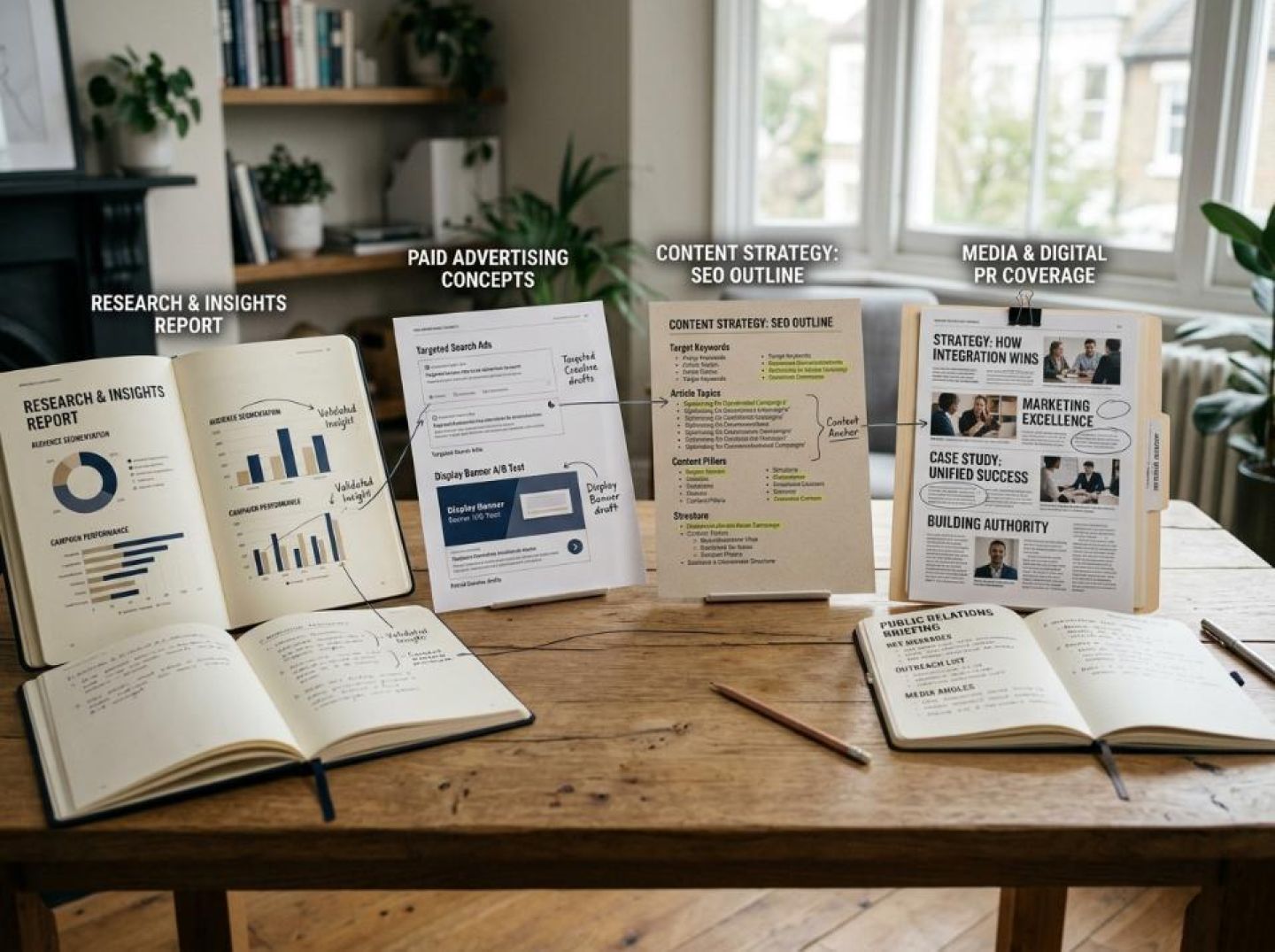
Finally, structure your campaigns so each discipline reinforces the others in the broader ecosystem Moz has described: SEO pages become the canonical sources your ads deep‑link to, PR pitches cite those same pages as the home of your proprietary data, and paid social or search tests new narratives before you commit to full research or thought‑leadership builds.
When you do this well, you’re no longer running isolated channels. You’re running a single authority engine where paid ads discover the stories, SEO and content canonize them, PR broadcasts them through third‑party validators, and AI systems start to see your version of the category as the default answer.
Receive top converting landing pages in your inbox every week from us.
Recently Updated
Discover how competitive ad intelligence helps marketers move beyond generic AI messaging and build more credible, differentiated advertising strategies. Learn how to analyze competitors’ creatives, uncover proven messaging patterns, and use Anstrex insights to develop AI-assisted campaigns grounded in market evidence and stronger trust signals.
Rachel Thompson
7 minOct 23, 2026
Guide
Discover how answer engine arbitrage helps performance marketers capture valuable clicks by combining AI search insights with competitive ad intelligence. Learn how to uncover hidden buyer intent, identify decision drivers, and turn proven ad creatives into targeted campaigns and landing pages that convert AI-informed audiences into customers.
David Kim
7 minOct 23, 2026
Recently Updated
Discover how AI citation intelligence can help performance marketers uncover high-intent buyer journeys, identify winning messaging, and improve paid media performance. Learn how to turn AI search citations into actionable creative angles, conversion-focused landing pages, and scalable campaigns that connect AI visibility with measurable revenue.
Elena Morales
7 minOct 22, 2026