8 minOctober 28, 2026

Our spy tools monitor millions of native ads from over 60+ countries and thousands of publishers.
Get StartedProducing more advertisements is not necessarily the fastest path to better campaign performance. Marketers can test dozens of hooks, headlines, and visual formats and still struggle to improve acquisition costs if the landing experience, traffic quality, and conversion process remain unchanged.
The bigger opportunity is to connect creative intelligence with the rest of the advertising funnel.
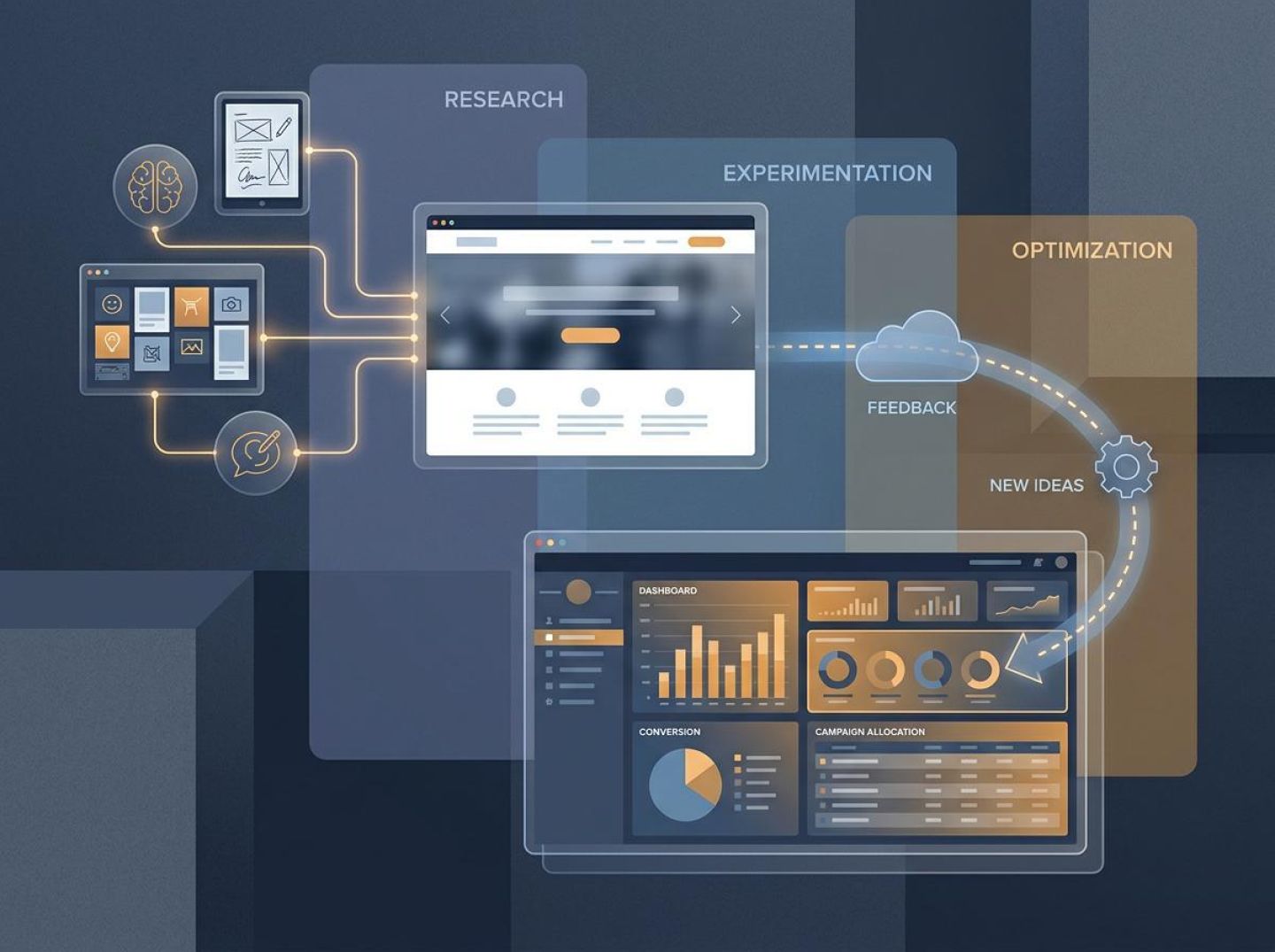
By combining competitive research, landing-page analysis, AI-assisted creative generation, structured experimentation, and campaign measurement, performance marketers can build a system that learns from real results instead of relying on isolated creative wins.
Anstrex can support the research stage by helping marketers investigate advertising creatives and the landing pages associated with observed campaigns. AI can help transform those observations into new hypotheses and variations. Landing-page testing and campaign analytics then help determine which ideas deserve further investment.
The goal is not to copy competitors or hand every decision to automation. It is to create a repeatable workflow that connects research, execution, and measurement while keeping profitability, quality, and human oversight at the center.
Creative performance matters, but it is only one component of an advertising system.
A strong hook may attract clicks while the landing page fails to explain the offer. A compelling product demonstration may generate engagement without attracting buyers who can convert profitably. A campaign may also lose efficiency as audiences become saturated, competition increases, or the cost of acquiring traffic changes.
These problems cannot always be solved by producing another advertisement.
A more complete performance marketing system connects four activities:
Each stage informs the others. If a particular creative attracts visitors who consistently abandon the landing page, the answer may involve improving message alignment or targeting a more relevant audience rather than generating more variations of the same ad.
Likewise, a landing page that converts one audience well may require a different opening message for another traffic source.
AI-assisted advertising tools can help accelerate creative development, organize research, generate variations, and support campaign optimization. Some systems also offer more automated workflows for testing and allocation.
TikTok's official Symphony Agent announcement, for example, describes AI-assisted workflows for developing TikTok-oriented videos, analyzing creative patterns, and discovering relevant creator content. The available features and access may vary, so marketers should verify current product documentation before planning a workflow around a specific capability.
The important distinction is between generating an asset and improving a business outcome. AI can help create more options, but the value of those options depends on the quality of the underlying strategy, the accuracy of the claims, and the evidence used to evaluate performance.
Instead of asking only which ad won, ask what the result suggests about the audience, message, offer, and destination.
Document those observations so they can inform future tests. Over time, the accumulated learning can become more valuable than any single creative because it helps the team make better decisions across multiple campaigns.
The competitive advantage comes from the feedback loop—not simply from having access to an AI generator.
Competitive advertising research becomes more useful when it goes beyond collecting screenshots.
An ad can reveal a headline, visual, or offer. The associated landing page can reveal how the advertiser explains the product, introduces proof, handles objections, and encourages the next action.
When you compare those elements across multiple observed campaigns, you can develop hypotheses about how different advertising messages and funnel structures are being used.
Anstrex can support this research by helping marketers explore available ads and investigate associated landing-page experiences. The goal is to create a structured research process rather than a collection of unrelated examples.
Before searching, define the product category, audience, or campaign problem you want to investigate.
For example, you might want to understand how advertisers introduce a complex product to cold audiences, how comparison-led landing pages present an offer, or how different creative approaches lead into a quiz or lead form.
A specific question makes it easier to organize observations and decide which examples are relevant.
Depending on the data available in the tool, examine factors such as:
Treat these as research clues, not proof of profitability. An ad that remains visible for a long period may have reasons unrelated to strong returns, and a creative's apparent presence across placements does not reveal the advertiser's full economics.
For each useful example, document three stages.
1. Advertisement to pre-sell page
What expectation does the ad create? Does the landing page continue the same story, or does it introduce a different promise? How much explanation does a visitor receive before the main offer appears?
2. Pre-sell page to offer
How does the page transition from problem or product education to the proposed solution? Does it use a demonstration, comparison, quiz, customer evidence, or direct product presentation?
3. Offer to conversion
What action is requested? Is the form or checkout process easy to understand? Does the page provide enough information for a visitor to make an informed decision?
Record what you can observe, and label assumptions clearly. You generally cannot infer the advertiser's conversion rate, exact targeting strategy, or profit from the visible funnel alone.
Research becomes actionable when you translate it into a question you can test with your own campaign.
For example:
This approach is consistent with the broader theme of combining automation, product information, and cross-channel acquisition discussed in StoreYa's overview of ecommerce customer acquisition.
Use competitor research to define the testing space, then let your own results determine which direction is worth pursuing.
Once you have a useful set of observations, the next challenge is converting them into original creative ideas at a manageable pace.
Simply asking an AI tool to generate dozens of advertisements can produce volume without improving the underlying strategy. A better approach is to describe the structure of a creative concept, define the intended audience and objective, and set clear constraints for the output.
For each researched campaign, record the elements that may explain its approach:
These fields make it easier to compare creative concepts without copying their wording or distinctive execution.
You can also classify each concept by awareness stage. Someone unfamiliar with a product may need a clear explanation of the problem, while a returning visitor may need a comparison, a demonstration, or an answer to a specific objection.
A blueprint describes the role of each part of the advertisement.
For example:
An AI tool can use that structure to develop several original executions suited to different audiences and formats.
The same principle applies to landing pages. Rather than reproducing a competitor's page, identify its broad functional elements and develop a page that reflects your own product, evidence, audience needs, and brand voice.
Creative generation should operate within defined boundaries.
Your instructions may cover tone, platform format, brand language, prohibited claims, required disclosures, product specifications, and acceptable evidence. Claims about health, finance, or other sensitive subjects may require additional review.
AI-generated copy should not invent customer testimonials, performance statistics, endorsements, guarantees, or product capabilities. If evidence is missing, the workflow should flag the claim for verification instead of filling the gap with plausible-sounding details.
Creative analytics can help teams understand which elements appear associated with stronger outcomes. Marketing Dive's coverage of Kroger and Vidmob's use of AI-powered creative analysis offers an example of connecting creative attributes with commercial measurement.
For a smaller operation, the same principle can be implemented with a well-maintained spreadsheet. Tag each asset by hook, benefit, format, audience, and destination, then record the metrics relevant to its purpose.
Over time, the library can help you prioritize new hypotheses. It should not be treated as a universal prediction engine: results may change across products, audiences, placements, and market conditions.
AI can organize information and accelerate production, but a human reviewer should check whether the creative makes sense, matches the offer, respects the intended audience, and follows applicable policies.
The objective is to scale the quality of decision-making alongside the quantity of assets.
AI-assisted creative tools can reduce repetitive work, but the degree of automation differs by platform and product.
Some tools help generate scripts, videos, and variations. Others support campaign setup, creative analysis, or optimization suggestions. More autonomous systems may be able to execute specific actions within a connected workflow.
These capabilities should be evaluated individually rather than assumed to exist in every advertising platform.
TikTok's Symphony creative tools provide one example of AI-assisted production for TikTok-oriented content. Their availability and exact features should be checked against current official documentation.
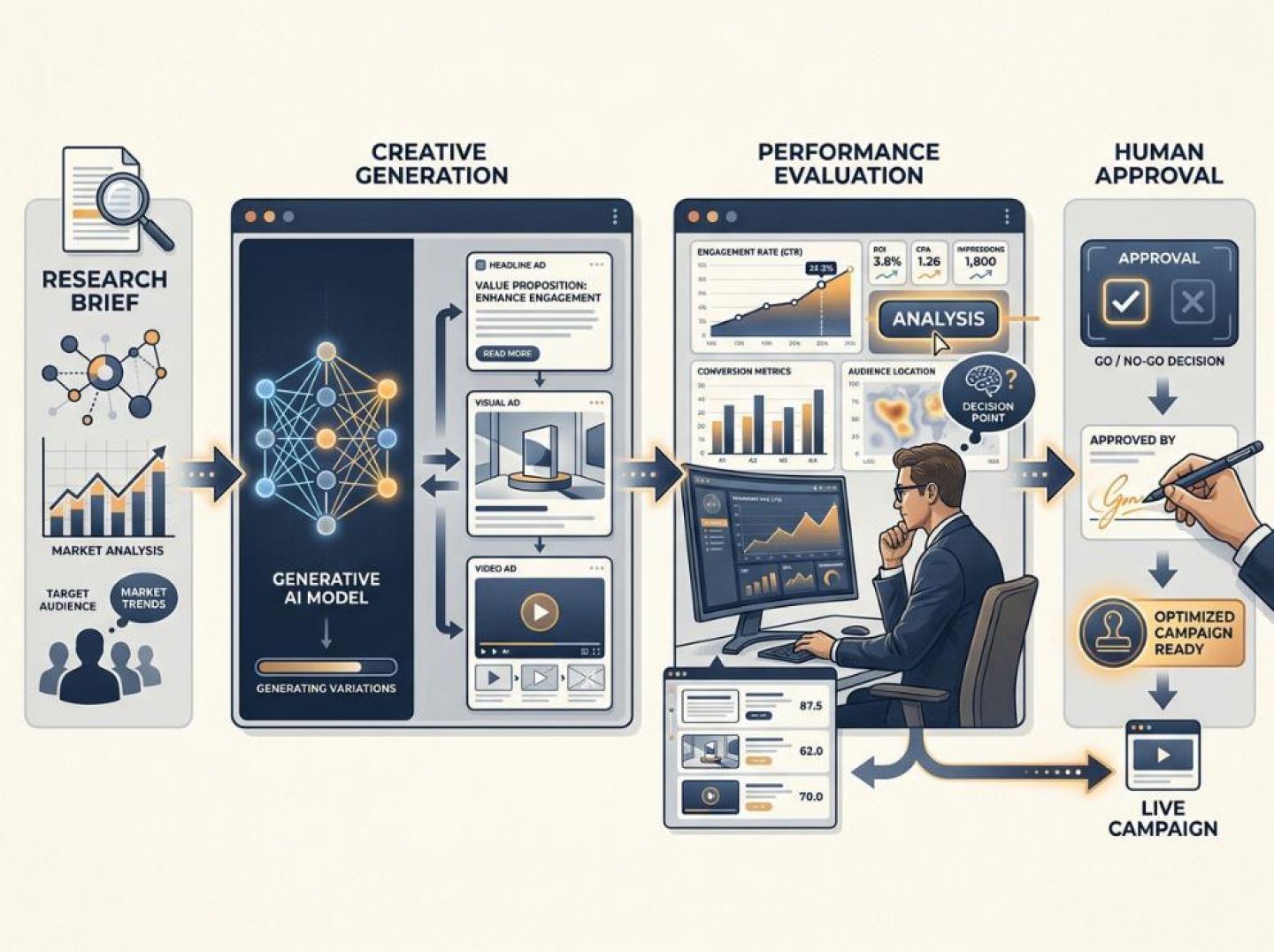
Start with a structured brief containing the audience, objective, product information, supporting evidence, desired creative structure, and landing-page destination.
An AI assistant can help summarize research, group related observations, and turn the brief into a list of creative concepts. Keep the underlying evidence available so reviewers can trace where product claims and recommendations originated.
Generate variations that explore meaningfully different hypotheses, not just minor wording changes.
For example, a product may be presented through a practical demonstration, a comparison, or an objection-handling message. Each variation should have a reason for existing and a defined audience or funnel role.
Before launch, review accuracy, format, readability, brand consistency, and platform requirements.
Set up reporting that distinguishes early creative indicators from actual business outcomes.
Depending on the campaign, you may monitor:
Define decision thresholds before the test starts. For example, specify the amount of data or spend required before comparing variants, and determine what would justify pausing, revising, or extending a test.
Avoid letting an automated system increase spend based on a temporary spike or an incomplete conversion signal.
Automation should operate within clear limits.
Set boundaries around maximum budget changes, acceptable acquisition costs, claim approval, privacy requirements, and platform compliance. Require human review for high-risk changes, sensitive claims, and major strategic decisions.
Maintain records of what the system changed, why it changed it, and which results informed the decision. If an automated action produces an unexpected outcome, the team should be able to investigate and reverse it.
The aim is governed automation: faster execution with enough visibility and control to protect the business.
An advertisement can earn the click, but the landing experience influences what happens afterward.
For performance marketers, landing pages should not be treated as finished assets that remain unchanged while the team continuously produces new creatives. They are part of the same experimentation system.
A better approach is to use page behavior and conversion outcomes to identify where the customer journey needs improvement.
Start with observable evidence.
If visitors leave quickly, investigate whether the landing page matches the ad's promise, loads properly, and explains the offer clearly. If people scroll but do not act, the page may need stronger product information, more relevant evidence, or a more appropriate next step.
If users begin a form but do not complete it, examine whether the process requests unnecessary information or introduces unexpected requirements.
These patterns can guide hypotheses, but they do not prove the cause. Use focused tests to determine whether the proposed change actually improves performance.
Depending on the page, useful test variables may include:
Test changes that have a clear rationale. Changing too many unrelated elements simultaneously can make results difficult to interpret.
Landing-page performance may differ by traffic source, device, audience, geography, and funnel stage.
Where the sample size supports it, examine those differences rather than relying only on a single overall conversion rate. A page that performs well for visitors arriving from a detailed native article may behave differently for people coming from a short social video.
Avoid creating too many tiny segments, however. Small samples can produce misleading apparent winners.
A higher click-through rate or longer session does not necessarily mean a more profitable funnel.
For an advertising-supported page, relevant metrics might include page revenue, RPM, viewability, and the effect of ad placement on user experience. For a lead-generation funnel, qualified leads and downstream sales may matter more than raw form submissions. For ecommerce, purchase conversion, returns, and contribution margin are important.
Choose metrics that reflect the business model, and account for the effects that matter to users and advertisers.
For each test, record the hypothesis, change, audience, measurement window, result, and limitations.
If a result is inconclusive, retain that conclusion rather than declaring a winner prematurely. If a variation works under a specific condition, document the condition so the team does not assume the same result will apply everywhere.
This is how landing-page intelligence becomes a useful internal asset: the business accumulates evidence about its own customers rather than repeatedly starting from generic best practices.
For additional context on AI-driven advertising and dynamic optimization, see illumin's overview of AI in AdTech.
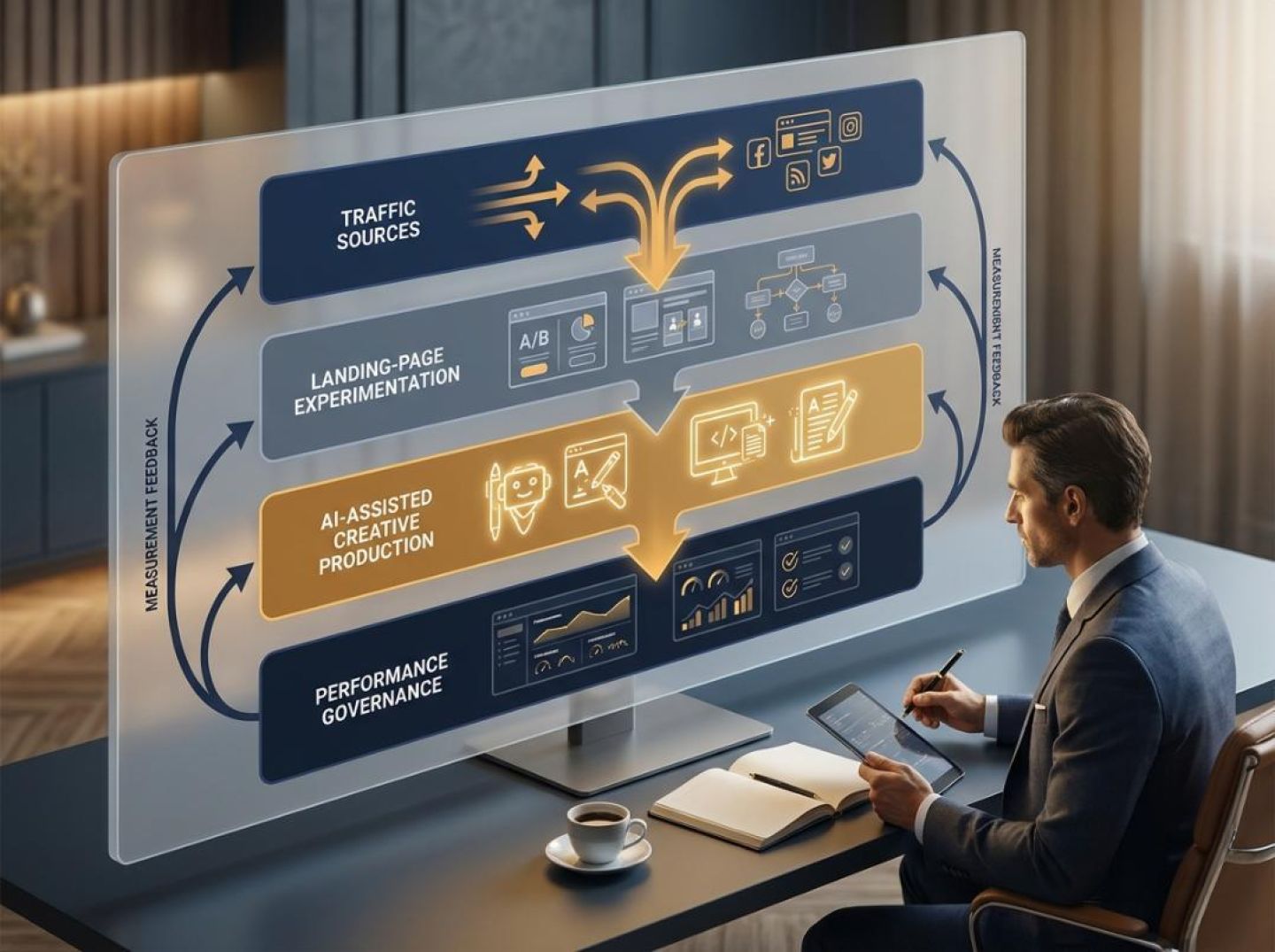
The complete system connects traffic, creative, landing pages, and measurement in a continuous feedback loop.
It does not need to begin as a complex autonomous platform. A small team can start with structured research notes, a creative library, consistent campaign tracking, and a simple testing backlog, then automate the repetitive work as the process becomes clearer.
Define the purpose of each channel. One source may be used for prospecting, another for retargeting, and another for testing a new audience or offer.
Compare channels using consistent business outcomes. Do not shift budget solely because one source reports cheaper clicks or a short-term increase in attributed conversions.
Account for attribution differences, conversion delays, traffic quality, and the costs associated with each channel.
For a broader discussion of multi-channel user acquisition, see AppSamurai's guide to multi-channel user acquisition.
Maintain a collection of relevant landing-page templates and experiments. Record which traffic source, creative promise, and audience each page was designed to serve.
Use the results to identify where message alignment, page structure, or the offer may need improvement.
The output should be documented learning, not simply a list of page variants labeled “winner” or “loser.”
Feed the most relevant insights into new creative briefs. Generate original variations, review them, and test them under controlled conditions.
Maintain a library that links each asset to its intended audience, message, destination, and observed results. This creates continuity between creative production and landing-page experimentation.
Use a central reporting process to review the outcomes that matter across the entire funnel.
A practical review should cover:
Automated systems can help surface anomalies and propose actions. Human operators should define the limits within which those actions are allowed.
A useful initial workflow can be organized into five steps:
Automate a step only when its inputs, outputs, and decision rules are understood well enough to manage its risks.
The system should also have a clear pause mechanism. If tracking breaks, a claim becomes questionable, a traffic source changes materially, or performance falls below a defined business threshold, the workflow should be able to stop or request human review.
Creative production is important, but sustainable advertising performance depends on how well creative decisions connect to the rest of the funnel.
Anstrex can help marketers investigate observed advertising patterns and landing-page structures. AI can help organize those insights and develop original creative options. Landing-page experiments and campaign analytics can then show which hypotheses deserve more attention.
The key is to preserve the connection between every stage. Research should inform the brief. The brief should guide production. Tests should measure meaningful outcomes. Results should improve the next round of decisions.
Automation can accelerate this process, but it should not replace evidence, governance, or human judgment.
The strongest full-funnel arbitrage system is not the one that generates the most ads or makes the most automatic changes. It is the one that learns reliably, allocates resources responsibly, and uses its own performance data to make increasingly informed decisions.
Tags
Receive top converting landing pages in your inbox every week from us.
Most Read
Creative production is only one part of performance marketing. Discover how to use competitive intelligence to map funnel patterns, turn research into AI-assisted ad concepts, test landing pages continuously, and connect campaign decisions to measurable profitability.
Priya Kapoor
7 minOct 28, 2026
In-Depth
AI search is changing how buyers discover and compare products before visiting a website. Learn how to map related buying questions, track brand visibility in AI answers, and use Anstrex to investigate competitors’ ads, landing pages, and funnel strategies. Combine these insights to find content gaps, develop differentiated offers, and build a more connected competitive intelligence workflow.
Dan Smith
7 minOct 27, 2026
In-Depth
Discover how out-of-home (OOH) job listings reveal the future of performance marketing, from data-driven media sales to programmatic digital billboards. Explore how sales, operations, creative production, and real estate roles are evolving as OOH becomes a more measurable, automated, and performance-focused advertising channel.
Elena Morales
7 minOct 11, 2026