9 minNovember 5, 2026

Our spy tools monitor millions of native ads from over 60+ countries and thousands of publishers.
Get StartedPerformance marketing has always faced an ethical challenge: the pressure to prioritize results can make questionable tactics look attractive.
AI makes that challenge more complicated.
Marketers can now generate large volumes of creative variations, automate campaign adjustments, and test different messages at a speed that would have been difficult to manage manually. These capabilities create opportunities for faster experimentation, but they also make it easier for misleading claims, questionable targeting, and inconsistent brand messaging to spread before anyone notices.
A campaign can meet a platform's basic requirements and still damage consumer trust. A headline can attract clicks while exaggerating what a product delivers. A landing page can technically contain a disclosure while making it difficult to notice. An automated creative system can produce dozens of variations that gradually drift away from the brand's actual positioning.
This is why ethical AI content cannot stop at writing guidelines or generic instructions to avoid misleading claims.
Brands need a practical way to observe the advertising environment, recognize risky patterns, and translate those observations into rules that guide their own campaigns.
Competitive ad intelligence can help provide that visibility.
With Anstrex Native, Push, and Pop, marketers can examine the advertising tactics circulating in their markets, study the funnels behind them, and identify examples they should adopt, review, or avoid.
The goal is not to imitate everything that appears successful. It is to understand what is happening in the market while keeping performance, transparency, and brand integrity aligned.
Performance marketing has traditionally rewarded measurable outcomes. Marketers monitor click-through rates, conversions, acquisition costs, and return on ad spend to determine which campaigns deserve more budget.
Those metrics are important, but they do not measure everything that makes an advertisement responsible or sustainable.
A campaign can generate conversions while relying on exaggerated promises, unclear disclosures, or creative that misrepresents the product. If the only optimization target is a lower CPA, these problems may remain invisible until customers complain, a platform takes action, or the brand suffers reputational damage.
Modern advertising systems increasingly use automation to adjust bids, allocate budgets, and test creative combinations.
As the discussion of AI-native advertising by MarTech explains, AI-native advertising involves systems that can experiment continuously with less manual intervention.
That can improve campaign efficiency. It also creates a governance challenge.
When automated systems make or recommend more decisions, marketing teams need to understand which decisions are being made, what objectives are guiding them, and whether the resulting advertisements remain consistent with the brand's standards.
The issue is not that automation is inherently unethical. It is that a system optimized primarily for performance does not automatically understand the broader responsibilities attached to a brand.
A message that generates clicks may still be:
Human oversight must therefore extend beyond checking whether a campaign has passed a basic platform review.
The same problem appears in SEO and content production.
AI tools can help teams identify topics, create outlines, and produce content at scale. But producing more content does not necessarily create more meaningful visibility.
In its discussion of human-led SEO, Neil Patel's team emphasizes the importance of human judgment in deciding which opportunities genuinely fit a business.
The lesson applies to advertising as well.
A competitor's popular message may not fit your product. A creative format that attracts attention may not communicate your value accurately. A trend that looks attractive today may weaken the brand's distinctiveness if every campaign starts to resemble the same collection of AI-generated advertisements.
The goal should be to use automation to strengthen a clear strategy—not to let automation replace the strategy.
Another risk appears when different teams adopt AI independently.
One employee may use AI for social content, another for email, and another for paid advertising. Without shared training, approved tools, or clear governance, each person may develop a different understanding of what information can be shared and what types of content are acceptable.
MarTech's discussion of moving beyond AI adoption toward solving business problems highlights the importance of addressing AI literacy, security, and organizational processes rather than simply encouraging employees to use more tools.
For marketing teams, this means establishing rules for:
The ethical concern is not limited to an AI system producing a questionable advertisement. It also includes the human processes surrounding that system.
A campaign's dashboard may show more impressions, clicks, or conversions, but those results do not necessarily indicate that consumers trust the brand.
Research discussed in MarTech's coverage of AI adoption and consumer concerns points to skepticism about AI-generated content and concerns about quality.
That creates a practical challenge for advertisers.
If every brand produces more content using similar tools, generic messaging becomes easier to recognize. Audiences may begin to question whether advertisements are credible, whether testimonials are authentic, and whether product promises are supported by evidence.
The problem is not simply that AI-generated content can look artificial. It is that increased production volume can make it easier to publish messages without sufficient attention to accuracy, originality, and audience expectations.
"Copy what works" has long been a familiar idea in competitive marketing.
Study advertisements in your category, identify successful hooks, understand their messaging, and develop your own versions.
Competitive research is still valuable. The problem is treating visible advertising activity as permission to reproduce every tactic.
That becomes especially risky when AI makes creative production faster and campaign testing more automated.
Modern advertising platforms encourage advertisers to test different creative approaches and allow algorithms to distribute delivery across variations.
As discussed in Social Media Examiner's coverage of newer Facebook advertising tools, creative testing and platform automation have become important parts of modern advertising workflows.
AI can accelerate that process by helping teams generate more headlines, images, hooks, and message variations.
But a larger number of creative options does not automatically produce better advertising.
If teams generate variations without checking the claims and implications behind them, the result may be a large collection of advertisements that repeat the same exaggerated promises or questionable persuasion techniques.
The challenge is no longer just identifying what gets attention. It is deciding which approaches deserve to become part of your brand's advertising strategy.
TikTok and other advertising research environments make it easier to study creative patterns across categories and locations.
The Social Media Examiner discussion of AI and TikTok advertising describes the growing accessibility of advertising research and creative tools.
These resources can help marketers understand what is circulating in the market. However, an advertisement appearing frequently or remaining visible does not establish that its claims are accurate, its disclosures are sufficient, or its creative is appropriate for every brand.
When multiple advertisers study the same examples and feed similar references into AI tools, creative approaches can become increasingly repetitive.
This creates a dangerous shortcut:
The resulting creative may look familiar and persuasive, but it may also inherit the original advertisement's weaknesses.
The Good Good x Callaway advertisement discussed in Adweek's coverage of the campaign illustrates why creative evaluation needs to consider more than attention or previous campaign performance.
The coverage describes how the advertisement received negative reactions in testing, including concerns about believability, relevance, and brand fit.
The broader lesson is that a creative concept can appear attractive from a performance or format perspective while still creating problems for the brand.
It is important not to treat synthetic audience testing as a replacement for real consumer research or human review. However, the example reinforces the value of evaluating how an advertisement may be interpreted before committing to a large campaign.
Competitive intelligence should therefore evolve from identifying what competitors are doing to understanding what your brand is willing to do.
This means tracking more than headlines and creative formats.
Look at:
The same principle applies to AI-era brand visibility. AdExchanger's discussion of AEO tactics raises questions about manipulative approaches to influencing AI-generated answers.
Meanwhile, Marketing Dive's analysis of unpaid media and AI visibility discusses the role of external coverage and third-party sources in brand discoverability.
The practical takeaway is straightforward: a brand's claims should be consistent with the evidence and reputation that exist beyond its own advertisements.
The objective is not to copy the most aggressive competitor. It is to identify the tactics your brand can defend, substantiate, and sustain.
An honest-by-design workflow is not simply a statement that the company values ethical advertising.
It is a practical set of rules that influences how campaigns are researched, created, reviewed, and scaled.
For teams working with Native, Push, and Pop advertising, Anstrex can provide an external view of the tactics circulating across their competitive landscape.
Instead of using competitor advertisements only as creative inspiration, use them as examples to evaluate.
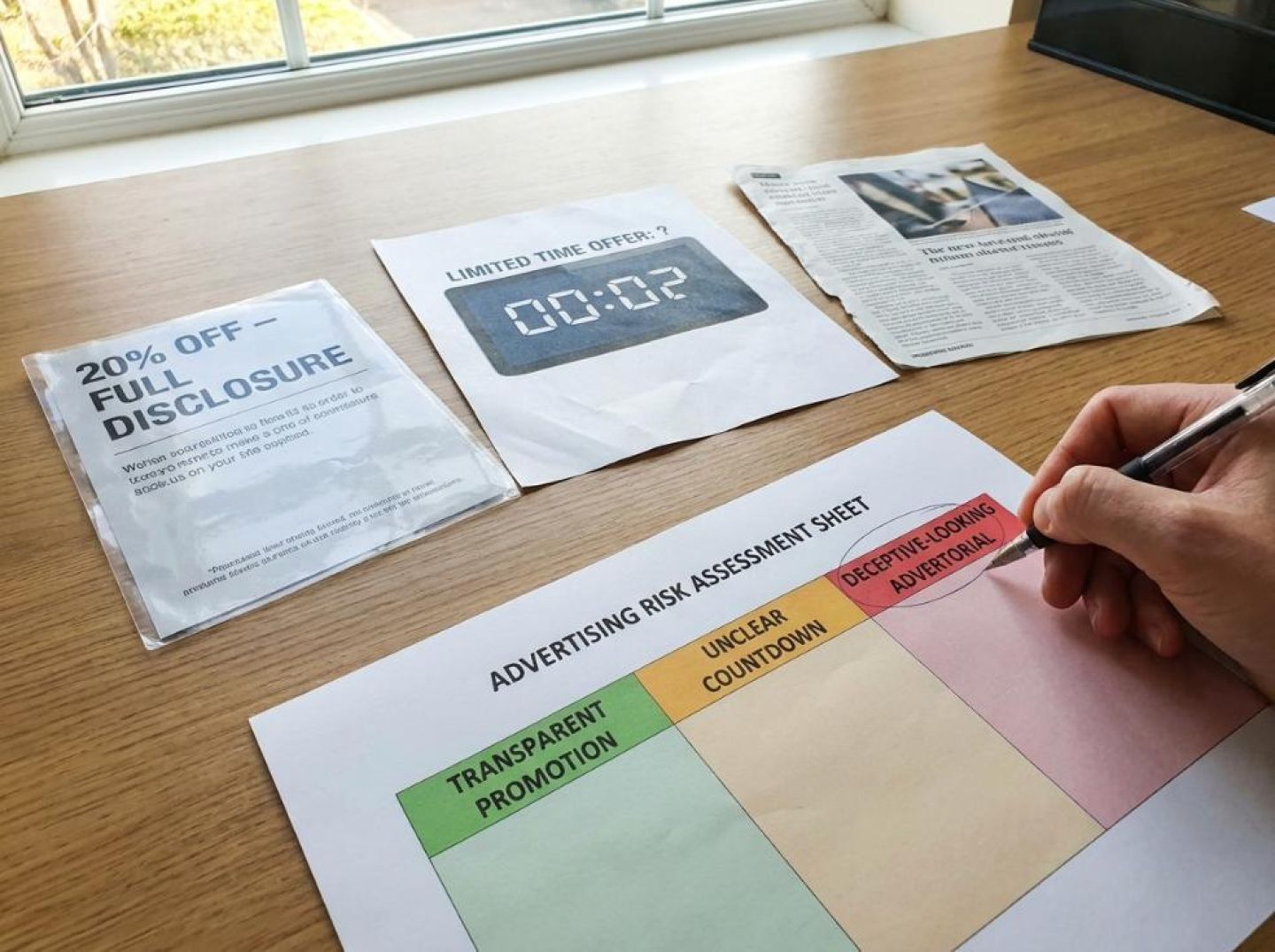
Start by dividing the advertising patterns you discover into three categories.
Green zone — Acceptable patterns
These are approaches that appear consistent with your brand standards and can be considered for adaptation.
Examples:
Yellow zone — Patterns requiring review
These approaches may have legitimate uses but can become misleading when presented without enough context.
Examples:
Red zone — Prohibited patterns
These are tactics your brand has decided not to use.
Examples:
These categories should be based on your organization's actual policies, applicable laws, platform requirements, and risk tolerance—not simply on whether a competitor appears to be using a particular tactic.
Start by researching the advertisements running in your relevant verticals, countries, and traffic types.
Do not limit your review to the most attractive creatives.
Look for patterns that deserve caution, including exaggerated claims, unclear disclosures, and landing pages that communicate something different from the original advertisement.
For each example, capture:
A competitor's questionable advertisement can be just as useful to your research as a well-structured creative.
It shows your team what to avoid and gives AI-assisted content workflows concrete negative examples.
AI can help organize large collections of advertisements.
For example, it can group creatives by:
But the final decision should remain with a responsible human reviewer.
MarTech's discussion of the marketing AI skills challenge emphasizes the importance of skills beyond simply deploying AI tools.
In practice, your team should define rules such as:
"We can use specific outcome language, but we cannot use unsubstantiated guarantees."
"We can communicate real promotional deadlines, but we cannot use countdowns that reset automatically."
"We can use customer testimonials, but we must preserve the context and avoid implying that exceptional results are typical."
These rules make it easier for both people and AI-assisted workflows to recognize the difference between persuasive advertising and misleading communication.
Each advertising format presents different opportunities and risks.
Native advertising
Native creatives often use headlines, editorial-style layouts, and advertorial narratives to attract attention.
Review whether:
External credibility also matters. Marketing Dive's analysis of unpaid media and AI visibility discusses how third-party coverage and broader online reputation can contribute to how brands are represented in AI-powered discovery.
Push advertising
Push notifications are concise and designed to attract immediate attention. This makes clear identification and honest urgency especially important.
Review whether:
MarTech's discussion of consumer distrust around AI and data use provides additional context for why transparent communication and responsible data practices matter.
Pop advertising
Pop formats can create a more disruptive user experience, particularly when they use aggressive interstitials or redirects.
Review whether:
The point is not that every aggressive format is automatically unethical. It is that your brand should define which execution methods are acceptable before optimizing them for short-term results.
Competitive research should not end when a campaign launches.
Regularly compare your live advertisements with the patterns appearing in Anstrex and review whether your own messaging remains consistent with the evidence available across your website, reviews, and third-party coverage.
If your advertising promises something that your landing page, customer feedback, or public information cannot support, investigate the gap.
Anstrex can help surface the competitive patterns that deserve attention. Your internal review process determines what action to take.
Before creating internal guardrails, you need to understand the advertising environment in which your brand competes.
A landscape scan gives your team a structured view of the claims, layouts, and persuasion techniques appearing across your vertical and target geographies.
The objective is not to reproduce the market's most aggressive examples. It is to make the patterns visible so your team can evaluate them consistently.
Use Anstrex Native, Push, and Pop to collect relevant advertisements and their destination pages.
Narrow your research using:
Review the complete destination experience whenever possible.
A headline alone may not reveal whether the offer is transparent. The landing page may contain the conditions, disclosures, pricing, or claims that determine how the advertisement should be evaluated.
Build a working sample of advertisements and funnels for each major market you research.
The original workflow suggests collecting 50–200 examples per major geography. Treat that as a starting point for a sufficiently broad research sample, not a universal requirement. The appropriate volume depends on your category, available results, and review capacity.
A collection of screenshots is difficult to use unless the team can search and compare the examples.
Create a tagging system that captures the tactics appearing in your market.
Scarcity and urgency claims
Record messages such as "limited spots," "ends tonight," and "only a few left."
Then determine whether the limitation is supported by a real deadline, inventory threshold, or promotional condition.
Pseudo-editorial layouts
Identify promotional pages that resemble news articles or independent reviews.
Look for mastheads, bylines, breaking-news labels, and comment sections. Record whether the commercial relationship is clearly disclosed.
Advertorial disclosures
Document the wording, size, contrast, and placement of labels such as "Advertisement," "Sponsored," or "Paid partner content."
A disclosure that exists but is difficult to notice may still create a poor user experience and require further review.
Before-and-after imagery
For categories involving physical transformations, home improvements, beauty, or financial outcomes, record the use of comparison images and progress claims.
Check whether the presentation includes relevant context, supporting evidence, and appropriate qualifications.
Timers and dynamic counters
Record countdowns, viewer counts, and inventory widgets.
Distinguish genuine deadlines or inventory limits from elements that appear to reset or change without a clear reason.
Where appropriate, technical tools can help identify certain elements in landing-page code or page content. However, automated detection should be treated as an initial screening step. A human reviewer still needs to understand the context.
Once the patterns are tagged, add the available observations that help prioritize them.
These may include:
These signals should not be confused with verified campaign results.
An advertisement's duration or visibility does not prove profitability. Similarly, the presence or absence of third-party coverage does not independently establish whether a claim is true.
Use the information to decide which examples deserve closer review.
The final output should be a usable reference for the people and systems creating your advertisements.
Create two working lists:
Patterns your brand may adapt
Patterns your brand should avoid
These lists become the foundation for creative briefs, AI prompts, and campaign approval checklists.
After collecting and tagging competitor advertisements, organize the findings into a risk map.
This helps everyone involved in campaign creation understand which tactics can be considered, which need additional review, and which are not allowed.
Green-zone patterns are those your organization has reviewed and considers acceptable under its brand standards and applicable requirements.
Examples may include:
For example, a promotion stating "Save 20% this week" should have a genuine offer, clear conditions, and an accurate end date.
An advertorial should make its commercial nature clear rather than relying on readers to discover it later.
These are the kinds of patterns your team can use as reference examples when developing creative templates.
Yellow-zone patterns are those that may be legitimate in some circumstances but could easily become misleading.
Examples include:
These patterns should trigger additional review.
Sometimes the issue can be resolved by making the deadline accurate, improving disclosure visibility, or changing an exaggerated claim into a more precise statement.
For example, instead of promising a guaranteed result, the creative might explain what the product is designed to help users achieve—provided that the revised statement accurately reflects the available evidence.
Red-zone tactics are those your brand has explicitly decided not to use.
Examples include:
The same principle applies to attempts to manipulate AI-generated recommendations through fabricated reviews, artificial discussions, or manufactured authority.
AdExchanger's discussion of AEO tactics explores why manipulative attempts to influence AI visibility can undermine the credibility of a brand's broader information footprint.
A red-zone tactic should remain prohibited regardless of how frequently it appears in competitor research or how attractive its apparent performance may be.
The risk map should determine what happens next:
| Risk category | Required action |
|---|---|
| Green | Eligible for adaptation, subject to normal review |
| Yellow | Human review and supporting evidence required |
| Red | Excluded from briefs, prompts, and campaign execution |
This makes the risk map more than a classification exercise.
It becomes a practical decision system that guides the way your team uses competitor intelligence.
A risk map is useful only if the team knows how to apply it.
The next step is to turn the classifications into a written standard that creative teams, media buyers, affiliates, and AI-assisted workflows can follow.
A practical starting point is a three-part document: Allowed, Conditional, and Banned.
This category includes tactics that meet your brand standards and have the necessary supporting evidence.
Examples might include:
For example, if a benefit statement is supported by documented product information or credible customer evidence, your guidelines should explain what wording is acceptable and which proof must be retained.
The objective is to make good advertising easier to reproduce consistently.
Some tactics are not inherently inappropriate but require stronger controls.
Examples include:
Time-sensitive promotions
Only use deadlines or inventory claims when they are genuine and can be verified.
Where possible, connect time-sensitive information to an approved promotional calendar or accurate inventory data. Ensure that the conditions are visible in the advertisement and on the landing page.
Superlative claims
Claims such as "#1," "best," or "fastest" need clear definitions and reliable supporting evidence.
Do not assume that a competitor's use of a superlative makes it acceptable for your own brand.
Before-and-after imagery
Require appropriate context, evidence, and qualifications. Depending on the category and jurisdiction, additional compliance review may be necessary.
Strong testimonials and transformation claims
Check that the experience is authentic and that the presentation does not imply results that are unsupported or unrepresentative.
Comparison advertising
Make sure comparisons are accurate, relevant, and based on a fair representation of the products or services being compared.
Conditional tactics should have a documented approval process, including who reviews them and what evidence is required.
The banned category is where leadership makes the clearest decisions.
Examples include:
These rules should apply even when competitors use the tactics or a campaign appears to benefit from them.
The purpose is to prevent short-term performance pressure from changing the brand's standards one campaign at a time.
To make the policy useful, include three elements for each rule:
For example, a conditional time-limited promotion might require an approved promotion schedule, a verified end date, and confirmation that the landing page displays the same conditions.
A strong product claim might require product documentation, substantiation, or legal review before publication.
This is especially important when multiple teams, agencies, affiliates, or automated workflows contribute to campaign production.
AI can assist with pre-launch checks by flagging:
However, these checks should not be treated as legal approval or a guarantee that an advertisement is compliant.
Human reviewers must retain the authority to reject, revise, or escalate creative that raises concerns.
The Callaway and Good Good example discussed in Adweek's campaign analysis reinforces why creative review should consider believability, relevance, and brand fit—not just whether an idea is attention-grabbing.
The same principle applies to AI-generated advertising.
If AI can amplify your creative output, your brand standards must be clear enough to guide that output before it reaches consumers.
AI has made it easier to generate advertisements, test variations, and optimize campaigns at scale.
But greater production speed also increases the importance of clear standards.
When performance is the only objective, misleading claims, aggressive urgency, and confusing promotional experiences can become tempting shortcuts. Without consistent oversight, those tactics can gradually become part of a brand's normal advertising process.
Competitive ad intelligence offers a way to approach this challenge more systematically.
With Anstrex Native, Push, and Pop, marketers can examine the advertisements and funnels circulating in their markets, identify recurring persuasion techniques, and recognize patterns that deserve closer scrutiny.
The value is not simply knowing which competitors are getting attention.
It is knowing which approaches are worth learning from, which require additional proof, and which your brand should refuse to adopt.
Build the landscape scan. Create the risk map. Establish written brand and legal rules. Then use AI to support the process while keeping human judgment responsible for the final decisions.
The strongest advertising strategy is not the one that copies every tactic that appears to work. It is the one that can scale performance without sacrificing the trust that makes the brand worth choosing.
Receive top converting landing pages in your inbox every week from us.
Guide
AI makes it easier to produce and scale advertising, but faster execution also increases the risk of misleading claims, hidden disclosures, and brand-inconsistent creative. Learn how competitive ad intelligence can help teams identify risky patterns and build practical guardrails before campaigns go live.
Priya Kapoor
7 minNov 5, 2026
In-Depth
Learn how to combine Anstrex ad intelligence, AI tagging, and campaign performance data into a shared knowledge system that helps paid media teams turn creative research into repeatable learning.
Elena Morales
7 minNov 3, 2026
In-Depth
AI can accelerate marketing research and production, but faster output does not guarantee better decisions. Discover how performance marketers can use ad spy tools to benchmark AI-generated creatives, inspect competitor funnels, challenge internal assumptions, and build a more accountable process for testing and optimization.
Dan Smith
7 minOct 26, 2026