8 minNovember 21, 2026

Our tools monitor millions of native, push, pop, and TikTok advertising campaigns.
Get StartedMost comparison posts didn’t die because of AI. Many were already hollow traffic plays dressed up as content, and the AI era simply exposed the problem. As answer engines increasingly draw on structured comparisons, credible experience, and external evidence, brands can no longer rely on generic listicles created just to capture rankings. The opportunity is to rebuild comparison content around monetization data, competitive intelligence, and the actual buying behavior behind the clicks.
Listicles aren’t dead; lazy listicles are.
The AI era didn't kill “10 Best X for Y” posts so much as it exposed which ones were propped up by thin content, aggressive anchor text, and a forgiving algorithm. What's actually changed is the job we're hiring comparison content to do.
For a decade, most “best” and “vs.” pages were built as pure acquisition plays. They targeted bottom-funnel modifiers like “best [category] software” or “X vs Y” and competed by being first, comprehensive, and moderately optimized.
As AI Overviews and answer engines became more prominent, marketers tried to extend that same playbook: publish a self-awarded “best [your own tool]” page, fill it with semi-generic copy, and hope to influence AI-generated recommendations.
According to an analysis of self-promoting “best [X] software” pages, this tactic was adopted at scale by B2B brands once marketers realized it could influence AI responses. The practice subsequently attracted conference discussions and media coverage.
That arbitrage window is becoming less reliable.
Generative search results create a visible incentive for brands to publish biased comparison content, giving search platforms a reason to improve how they evaluate self-promotional claims. At the same time, AI systems need structured comparative information that can help answer complicated buying questions.
The format isn't the problem. The intent and quality are.
The job of comparison content has shifted from “rank for one query and grab the click” to “act as a reusable decision model for humans and machines.”
That shift is reflected in how answer engines discover and cite information. HubSpot's research on brands earning citations in AI search explores how structured, authoritative content can contribute to AI visibility. ChatGPT and other answer engines also frequently draw on comparison pages, reviews, and clearly sourced material when answering product-selection questions.
In other words, the same “Best X” page that once lived or died by blue-link rankings can now also become a source of information for multi-step AI answers.
This is why simply declaring yourself the winner on your own list is increasingly counterproductive.
When a brand publishes a “best [category] tools” article and automatically crowns itself number one, the page may provide little useful decision support. Even if it gains short-term visibility, its lack of independent evidence can make it less credible to readers and less useful as a source for answer engines.
As Search Engine Journal's analysis of self-promotional listicles illustrates, brands need to consider whether their comparison content actually helps buyers evaluate alternatives or simply promotes their own products.
Modern listicles and comparison pages have to do three things simultaneously.
Google's emphasis on experience and expertise is not just a content guideline. It is an important principle for producing useful comparison material.
As TopRank's AI search guidance explains, original data, visible expertise, and specific implementation details can help create content that generic AI-generated material cannot easily replicate.
A comparison that transparently explains where your product wins, where it loses, and where it isn't a good fit gives readers something more valuable than a list of features.
It provides a credible explanation of how different products perform in actual situations.
Answer engines need clear information they can locate, interpret, and reuse.
That means labeled sections, explicit trade-offs, and clearly defined verdicts.
HubSpot's work on AI content gaps highlights how relevant information can be overlooked when it is difficult for search systems to locate and interpret.
The AI-era comparison page should be designed with a clear information structure:
The goal is to make important information understandable without forcing a reader or retrieval system to interpret an entire page of undifferentiated prose.
Hollow listicles exist in isolation.
Durable comparison content is supported by a wider network of evidence: customer reviews, analyst reports, partner case studies, independent benchmarks, and relevant community discussions.
The brands earning AI visibility often have a broader authority footprint beyond their own websites. HubSpot's research on AI search citations discusses the role of authoritative sources and external references in this changing search environment.
This does not mean every comparison needs dozens of external links. It means the claims that matter should be supported by credible, independently verifiable information.
So no, you don't need to abandon listicles, roundups, or versus pages.
You do need to retire the idea that their primary job is to rank for one head term and funnel everyone to a demo form.
In the AI era, comparison content is decision infrastructure. It supports human researchers, search systems, and answer engines by explaining how a market works and what buyers should consider.
Its new mandate is to encode your market's decision logic so clearly and credibly that when someone asks, “What's the best option for me?” your work can provide a useful, defensible answer.
AI engines don't “like” your content the way a human does. They retrieve, rank, compare, and synthesize information based on how their search and reasoning systems are designed.
Comparison content happens to fit many of those requirements.
Modern answer engines rarely depend on a single search query. They can expand one prompt into multiple related searches, a process often described as query fan-out.
A broad question such as “What are the best email marketing platforms?” can lead to related questions:
In his analysis of ChatGPT's source preferences, Neil Patel discusses how query expansion can lead answer engines to explore several related questions before producing a response.
This is where declining traditional rankings can be deceptive.
Traffic to your “best X” page might be flat or even declining, while your brand gains visibility inside AI-generated answers that are not fully reflected in traditional Search Console reporting.
Answer engines still retrieve and rank documents, but users do not necessarily see those rankings directly. Instead, systems synthesize information from multiple sources into a single response.
Strong comparison pages can become useful because they address several related questions at once:
Retrieval approaches such as Reciprocal Rank Fusion can combine results from multiple searches. A source that appears across several related queries may therefore have more opportunities to contribute to the final answer than a page optimized for only one narrow keyword.
Neil Patel's discussion of query fan-outs and source preferences provides useful context for understanding why comprehensive comparison resources can be valuable in this environment.
AI engines also use comparison content because it addresses a practical human need: making a decision.
As Ahrefs' AI search strategy guidance explains, useful content needs to move beyond generic pros and cons and clarify who each option is best for, where it falls short, and what trade-offs buyers should understand.
That maps naturally to experience and trustworthiness.
A comparison written from actual operator experience, grounded in specific scenarios, gives both readers and AI systems more meaningful information to work with.
Consider the difference between these two statements:
The second statement is more useful because it explains the conditions behind the recommendation.
It gives the reader a reason to choose one option rather than simply asking them to accept a ranking.
Well-built comparison pages are also easier to navigate and interpret.
Technical SEO foundations remain important:
Semrush's SEO strategy guidance provides broader context for the technical and content foundations that help search systems understand web pages.
Extractability matters because AI systems may use different portions of a page for different questions.
A comparison table might provide information for “Is Tool A cheaper than Tool B?” while a separate “Who should choose this?” section may contribute to a recommendation for a specific industry.
Each clearly labeled information block can serve a different decision-making purpose.
Finally, answer engines can draw on multiple sources to evaluate whether a claim is credible.
That makes external validation important.
According to TopRank's AI-powered search guidance, brands should combine on-site expertise with offsite proof, including citations, third-party reviews, and community references.
A transparent comparison that acknowledges when competitors are stronger, links to relevant independent reviews, and includes real customer experiences is more useful than a page that pretends to be completely objective while promoting only its own product.
The point is not to manufacture neutrality.
It is to make the reasoning behind your recommendations visible.
So even as blue-link rankings fragment and traffic attribution becomes more complicated, comparison content remains strategically valuable.
Not shallow listicles padded to reach a word count, but structured, evidence-backed explanations of a market.
Build those well, and you're no longer just chasing rankings. You're creating resources that can help answer the questions sitting between your buyer and their final decision.
Keyword tools used to be the starting point.
You would export the “best [category] software” variations, sort them by search volume, and brief a writer to create a page for each modifier.
That approach is incomplete.
In an AI-first search environment, starting with keywords instead of monetization and competitive intelligence can lead to beautiful content that attracts attention but contributes little to business results.
The new workflow starts with a different question:
Where is money already moving, and what can I learn from it?
Not simply, “Where is there search volume?”
Instead, ask, “Where are buyers already comparing options, and what are they choosing?”
Your real seed list is often hidden in your own and your competitors' revenue mechanics.
Start with information such as:
Instead of brainstorming “{tool} vs {tool}” pairs, examine your CRM, payment processor, and affiliate dashboards to identify which products and solutions reliably precede revenue.
Those product pairings and upgrade paths can become the foundation of your comparison roadmap.
This aligns with the distinction between what a business owns and what it earns, a concept explored in Semrush's SEO strategy guidance.
Your website, content, and offers are owned assets. Visibility, citations, and traffic are outcomes you work to earn.
If a comparison page generates visibility but consistently sends buyers toward higher-value competitor offers, you may be optimizing attention for somebody else's business.
The commercial purpose of each comparison should therefore be clear before production begins.
Once you know what makes your business money, use competitive intelligence to understand where the market is already comparing alternatives.
This is where spy tools become more than research utilities. They become a way to discover commercial narratives, recurring buyer objections, and content opportunities.
SEO intelligence
Use tools such as Ahrefs, Semrush, or Similarweb to analyze competitor and marketplace domains.
Look for:
When Ahrefs analyzes AI search and comparison content, it provides useful context for evaluating how comparison pages can influence visibility for the products they mention.
Your own research should identify which matchups matter in your specific market and whether the existing content genuinely answers buyer questions.
Ad intelligence
Use advertising intelligence tools to study competitor messaging across Meta, TikTok, YouTube, and search advertising.
Look for:
For example, a competitor may run a series of ads around a message such as “Why we switched from Brand A to Brand B.”
That is a useful signal that the comparison narrative may matter to its marketing strategy.
It is not proof of profitability or conversion performance. Ad visibility alone cannot reveal the advertiser's actual return. But repeated campaign activity can help identify the messages and market segments worth investigating further.
This is where Anstrex can support the research process: use competitive ad intelligence to observe visible advertising strategies, creative approaches, offers, and messaging patterns, then connect those observations with your own revenue and search data.
Marketplace and review intelligence
Review platforms and marketplaces provide another important source of comparison signals.
Explore platforms such as G2, Capterra, Amazon, and niche review websites to identify:
This information can help you understand how real customers describe the trade-offs.
It is also the kind of firsthand and third-party evidence that makes comparison content more useful than an imagined matchup based on keyword volume alone.
As TopRank's AI search guidance discusses, original expertise and external validation can strengthen the credibility of content intended to appear in AI-powered search.
Traditional content prioritization usually weighs search volume, keyword difficulty, and cost per click.
In the AI era, two additional considerations are useful.
1. Answer density
How much consolidated, authoritative explanation already exists for this matchup?
If the search results are filled with repetitive content, an evidence-backed resource may provide a meaningful alternative.
As Search Engine Journal's analysis of self-serving best-brand pages illustrates, publishing another biased listicle is not necessarily the best way to compete.
2. Evidence richness
How much unique proof can your organization bring to the comparison?
Ask:
A matchup with moderate search volume but strong proprietary data and meaningful commercial value may be more worthwhile than a high-volume, generic category listicle that is already saturated.
Spy tools should not only tell you what to cover. They can also reveal how buyers frame the trade-offs.
Analyze:
You can then build an outline around actual decision factors rather than keyword-stuffed H2 headings.
For example, a comparison between two marketing platforms might need sections on:
The structure should reflect the actual questions buyers need answered.
Only after these steps should you open your keyword tool—not to invent the content strategy, but to refine the language.
Use keyword research to:
The result is comparison content built around commercial evidence, structured around real buyer decisions, and supported by information that can be independently evaluated.
You're no longer asking a keyword tool what to write.
You're using monetization data and competitive intelligence to determine which comparisons are worth creating in the first place.
Most comparison pages are treated like brochures: one-time assets that a business creates because it needs them for SEO.
In an AI-led search environment, they need to be treated more like performance infrastructure—built to be understood, quoted, evaluated, and trusted by both answer engines and buyers.
The structure is where that shift begins.
Answer engines and human readers benefit from pages that behave like decision workflows rather than sales pitches.
That means leading with a clear verdict instead of a generic introduction.
Start with a short “Who this is for” section that states the use case and decision fork.
For example:
“If you're a small team that needs simple setup and affordable pricing, Tool A may be the better fit. If you're managing complex workflows across multiple departments, Tool B may offer more suitable capabilities.”
This answer-first framing makes the recommendation easier to understand because the conditions behind it are immediately visible.
Instead of treating the comparison as one long article, divide it into clearly labeled sections that each answer a specific question.
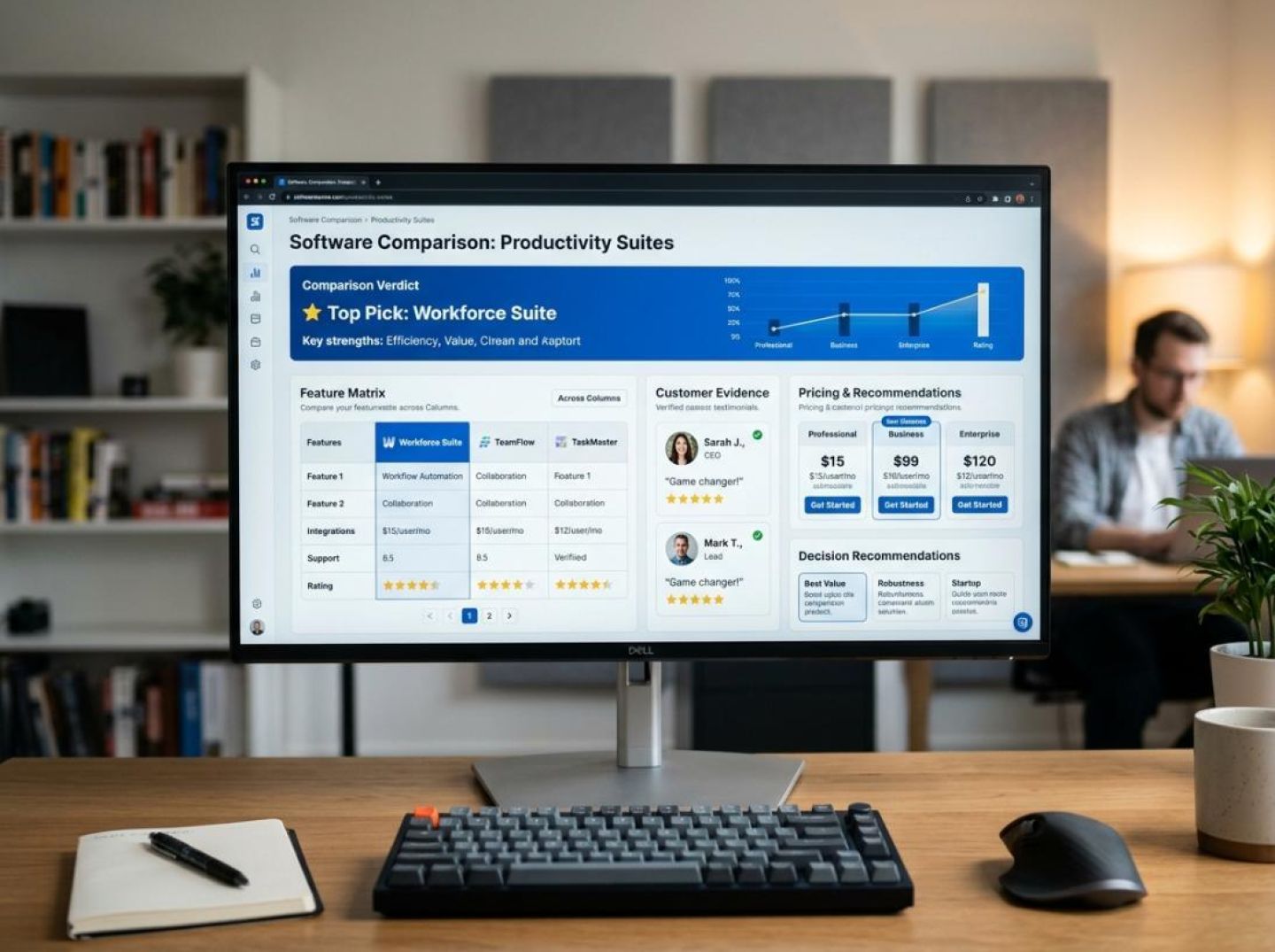
A useful comparison page should include:
1. Quick verdict
A concise summary explaining the main difference and who each option is best suited for.
2. Feature matrix
A side-by-side table mapping important capabilities to each product, including limitations and missing features.
3. Pricing and total-cost snapshot
A clear pricing comparison with relevant usage assumptions, plan limitations, and additional costs.
4. Who should choose X versus Y
Scenario-based recommendations that explain which option makes sense for different customer types.
5. Real-world results
Short, attributable case studies and customer experiences that show how each option performs in practical situations.
Each module provides useful information independently while contributing to the overall comparison.
HubSpot's research on brands earning AI search citations provides context for why clear, authoritative, structured content matters in the changing search environment.
Framing is where many brands sabotage their own comparison pages.
Self-promotional listicles and “everyone else is terrible” articles can make buyers skeptical.
They can also make the content less useful as an independent source of information.
If your company produces Tool A, say so.
For example:
“We make Tool A, but this comparison includes the areas where Tool B may be a better choice.”
Then support that statement with actual product differences.
An experiment discussed on the Ahrefs Blog highlights how biased comparison content can create opportunities for the competitors mentioned within it.
The lesson is not that every comparison must avoid promoting its own product.
It is that recommendations should be supported by transparent reasoning rather than unsupported claims of superiority.
A comparison page should not simply describe why one option is better. It should demonstrate the basis for its conclusions.
1. Usage-backed comparisons
Instead of writing “better onboarding,” explain what that means and provide evidence.
For example:
“Customers in this study reached their first successful workflow faster after implementation.”
If you have reliable data, provide the actual measurement, sample size, time period, and methodology.
Do not publish a precise statistic unless it can be verified.
TopRank's guidance on expertise and original content discusses why firsthand knowledge and original data are valuable differentiators in search content.
2. Customer outcomes
Turn generic testimonials into short case studies connected to the comparison.
For example:
“Why ACME switched from Vendor X to Vendor Y.”
Include:
This provides more context than a generic statement that one product is better.
3. Third-party validation
Include relevant and dated information from:
Keep sources and dates visible so readers can evaluate the evidence themselves.
Freshness can matter, especially when products, pricing, and platform features change frequently. However, updates should reflect genuine changes rather than simply changing the publication date.
A comparison page should not be published and forgotten.
Treat it like a product: measure it, test it, and improve it.
At a minimum, connect it to three feedback loops.
AI citation and visibility tracking
Monitor whether your comparison page is appearing in relevant AI-generated answers and which questions or sections are associated with that visibility.
Use repeatable prompts and track the date, answer engine, query, cited sources, and changes over time.
AI citation tracking is still an evolving measurement area, so avoid treating any single visibility score as a complete representation of performance.
HubSpot's AEO resources provide additional context for evaluating AI visibility.
Conversion analytics
Measure how people interact with the page.
Track:
If visitors leave before reaching the proof sections, the introduction or framing may need improvement.
If readers consistently jump to the “Who should choose what?” section, consider moving that decision block closer to the top.
Refresh cadences
Create a scheduled review process based on meaningful product and market changes.
Review:
A comparison page that contains outdated prices or discontinued features can quickly lose its usefulness.
When you stop treating comparison pages as keyword-driven listicles and start designing them as performance assets—modular, transparent, and evidence-rich—they become a stronger connection between AI answers, buyer confidence, and revenue.
Most comparison copy is still written like a traditional long-form blog post: introduction, background, body, and conclusion.
AI answer engines may process that information differently.
They retrieve and organize information around questions, direct answers, entities, attributes, pros and cons, and supporting evidence.
Your job is to make those elements easy to identify without sacrificing the quality of the full article.
Answer engines and readers both benefit when a page provides a direct answer before expanding into supporting details.
This mirrors a principle used in conversion-focused content: establish the promise, provide evidence, and then explain the details.
For comparison pages, restructure important sections around a repeatable pattern.
Question as H2
“Is Tool A or Tool B better for enterprise teams?”
Direct answer
Provide two to four sentences explaining which option is more suitable for the stated use case.
For example:
“If your organization prioritizes simple setup and lower initial costs, Tool A may be more suitable. If you need advanced reporting and complex integrations, Tool B may offer a stronger fit.”
Evidence block
Use bullets, feature comparisons, pricing details, and clearly labeled differences.
Proof snippet
Add a relevant customer quote, verified statistic, product documentation reference, or case study that supports the recommendation.
This answer-first structure helps readers understand the recommendation quickly while providing enough detail to evaluate the reasoning.
Semrush's SEO strategy guidance provides broader context for the importance of content organization, clear heading structures, and information that can be understood by search systems.
AI systems do more than read individual words. They need to understand the entities being discussed and the relationships between them.
If your “Tool A vs Tool B” page is one long wall of text, important details may be harder to identify.
Instead, make the comparison structure explicit.
On the page, use:
For example, every product in a comparison might have the same set of fields:
| Attribute | Tool A | Tool B |
|---|---|---|
| Best for | Small teams | Larger organizations |
| Starting price | Verified price | Verified price |
| Main strength | Ease of use | Advanced controls |
| Main limitation | Fewer advanced options | More complex setup |
| Integrations | Verified integrations | Verified integrations |
The values must be checked against current product information before publication.
Under the hood, structured data can help search systems interpret the information on the page.
Use appropriate schema types where they accurately describe the visible content, such as:
ProductItemListReviewOrganizationArticleBreadcrumbListDo not assume that a custom or unsupported schema type such as ProductComparison is automatically recognized by search engines.
Schema should reflect what readers can actually see on the page. It should not be used to introduce ratings, prices, reviews, or claims that are not visible and verifiable.
The goal is to give search systems two consistent ways to understand the same information:
When both align, the content is easier to interpret and less ambiguous.
Structured data does not guarantee AI citations or higher rankings, but it can support a clearer technical representation of your content.
In the AI era, a single “Tool A vs Tool B” page is only one part of a broader content strategy.
What matters is the surrounding network of related information.
Neil Patel's analysis of ChatGPT's query preferences discusses how AI search systems can expand a broad question into several related searches before producing an answer.
Your comparison strategy should reflect that behavior.
Build a content cluster with four main components.
1. Hub page
A broad category page such as:
“Best [Category] Tools for [Year]”
Break it into meaningful segments:
2. Spoke comparisons
Dedicated pages that explore individual matchups:
These pages should focus on real differences rather than repeating the same generic product descriptions.
3. Use-case explainers
Create pages addressing specific buyer situations:
4. Supporting content
Publish resources that answer related questions:
Connect these pages using descriptive internal links.
For example:
“See our full comparison of Tool A vs Tool B.”
A well-connected cluster helps readers explore the market without starting their research from scratch on every page.
It also creates a broader body of content addressing the related questions that can appear during AI search retrieval.
Finally, bake AI readability into the briefing and quality assurance process.
Every comparison page should meet a consistent standard:
TopRank's AI search guidance reinforces the importance of content that demonstrates real expertise and provides useful evidence.
Structuring your comparisons for machines—through answer-first copy, accurate schema, and tightly connected content clusters—is not about writing exclusively for AI.
It is about making your information clearer, more useful, and easier to evaluate.
That is how you turn static versus posts into persistent content assets that can support organic search, AI visibility, and informed buying decisions.
The future of comparison content is not about publishing more listicles.
It is about making every comparison more useful.
AI search has changed how people discover products and evaluate alternatives. Buyers can now ask complex questions, compare several options, and receive synthesized recommendations without visiting every website in the traditional search results.
That makes generic, self-promotional listicles less defensible.
Brands need a better approach.
Start with monetization signals to identify which comparisons have genuine commercial value. Use SEO and advertising intelligence to understand what competitors are promoting and how buyers frame their decisions. Then build comparison pages around real product differences, customer evidence, pricing, implementation details, and transparent recommendations.
Anstrex can support the competitive research stage by helping marketers observe advertising strategies, creative approaches, offers, and messaging patterns across advertising channels. Those observations can then be combined with first-party revenue information, customer feedback, and search intelligence to identify stronger content opportunities.
The complete process looks like this:
Monetization Signals → Competitive Intelligence → Comparison Opportunities → Evidence-Rich Content → AI-Readable Structure → Performance Measurement
The important distinction is that spy-tool data should inform the research, not replace actual customer evidence or independent product verification.
A competitor's advertising activity can reveal what messages and offers are being tested. It cannot, by itself, prove that those campaigns are profitable or that a particular product is objectively better.
The strongest comparison content combines multiple sources of evidence and makes its reasoning transparent.
That is the opportunity in the AI era.
Stop creating pages just to rank for “best” and “versus” keywords. Start building decision assets that help buyers understand their options, help answer engines interpret your expertise, and connect content performance to real business outcomes.
Receive top converting landing pages in your inbox every week from us.
Recently Updated
Google’s anti-scraping defenses and the fragmentation of online discovery are changing how marketers measure visibility. Explore how a cross-channel truth layer can combine platform-native analytics, SERP intelligence, AI search visibility, and creative-level insights to build a more reliable picture of what is actually working.
Dan Smith
7 minNov 21, 2026
Recently Updated
Traditional listicles are no longer enough. Discover how to use revenue data, spy-tool intelligence, real buyer insights, and structured comparisons to create content that earns trust from both people and AI answer engines.
Rachel Thompson
7 minNov 21, 2026
Featured
Discover how specialized AI agents can work together to monitor competitors, turn insights into experiments, launch campaigns, and scale winning strategies while keeping human oversight and governance in place.
David Kim
7 minNov 20, 2026