12 minNovember 21, 2026

Our tools monitor millions of native, push, pop, and TikTok advertising campaigns.
Get Started“Poisoned SERPs” aren’t a conspiracy theory or a rare edge case anymore. They’re productized behavior — a defensive feature of the modern search stack — and if you’re still treating scraped Google data as a ground truth, you’re already flying blind.
Over the past few months, multiple rank trackers and SEO platforms have documented a wave of “impossible” movements: entire domains blinking in and out of the top 10 for a day, competitors from the wrong geography suddenly ranking in local packs, and keyword reports that bear no resemblance to what human users see. When consultants like Brodie Clark and platforms like Nozzle dug in, they traced the pattern to Google’s escalating war on bots. As Clark put it, Google appears to be deliberately “poisoning results” for suspected scrapers – injecting bad URLs, swapping rankings, and mixing in businesses from the wrong city – with tools like Ahrefs at times reporting data that was “completely inaccurate” for those polluted checks, as one analysis of rank trackers summarized.
This isn’t a minor technical nuisance. Scraped SERPs are the data exhaust that powers an entire ecosystem of SEO dashboards, AEO tools, and “spy on your competitors” products. The AdExchanger round-up on Google’s newest bot defenses goes further: when Google is confident a non-human client is running a query, it may not just block the request, but actively “inject bad data” into the response to poison rivals that scrape and resell those answers, particularly API brokers like SerpApi that were already the target of a failed lawsuit that Google has since refiled with a new angle. Rank trackers and visibility tools are simply collateral damage caught in the same blast radius.
Layer this on top of Google’s own internal data labyrinth and you start to see why a “truth layer” can’t come from Mountain View alone. What we experience as “a Google result” is already the surface expression of multiple overlapping models and graphs. The modern Shopping Graph, for instance, tracks more than 50 billion product listings, with over 2 billion refreshed every hour, assembled from Merchant and Manufacturer Center feeds, brand sites, product pages, reviews, lab tests, and even signals extracted from YouTube videos. Those product facts are then reconciled against broader entities in the Knowledge Graph. How conflicting signals are weighted and resolved across those layers is not public, but we know one thing for sure: Google is already operating its own internal “truth reconciliation” engine, and it is messy.
That mess is about to matter a lot more. With agentic commerce features like agentic checkout — where a user sets a target price, waits for a drop, and lets Google autonomously complete the order through Google Pay — the system needs a real-time, authoritative view of price, availability, images, and eligibility for every SKU. As coverage of Google’s hidden data layer pointed out, that end-to-end picture is currently stitched together from fragmented feeds, inconsistent schemas, and teams that rarely speak to each other. The cost of that fragmentation goes up exponentially when the “user” is an agent that never double-checks its cart.
Meanwhile, the macro environment is pushing brands to obsess over the wrong dashboards. AI search isn’t “killing” traditional search; both are growing at similar rates quarter over quarter, according to Q2 data dissected in a recent MarTech deep dive on AI search myths. What is shrinking is the share of clicks to non-Google properties as AI overviews and rich result units soak up user intent. In other words: surface-level SERP visibility metrics are becoming less reliable just as the behavioral meaning of those metrics is changing.
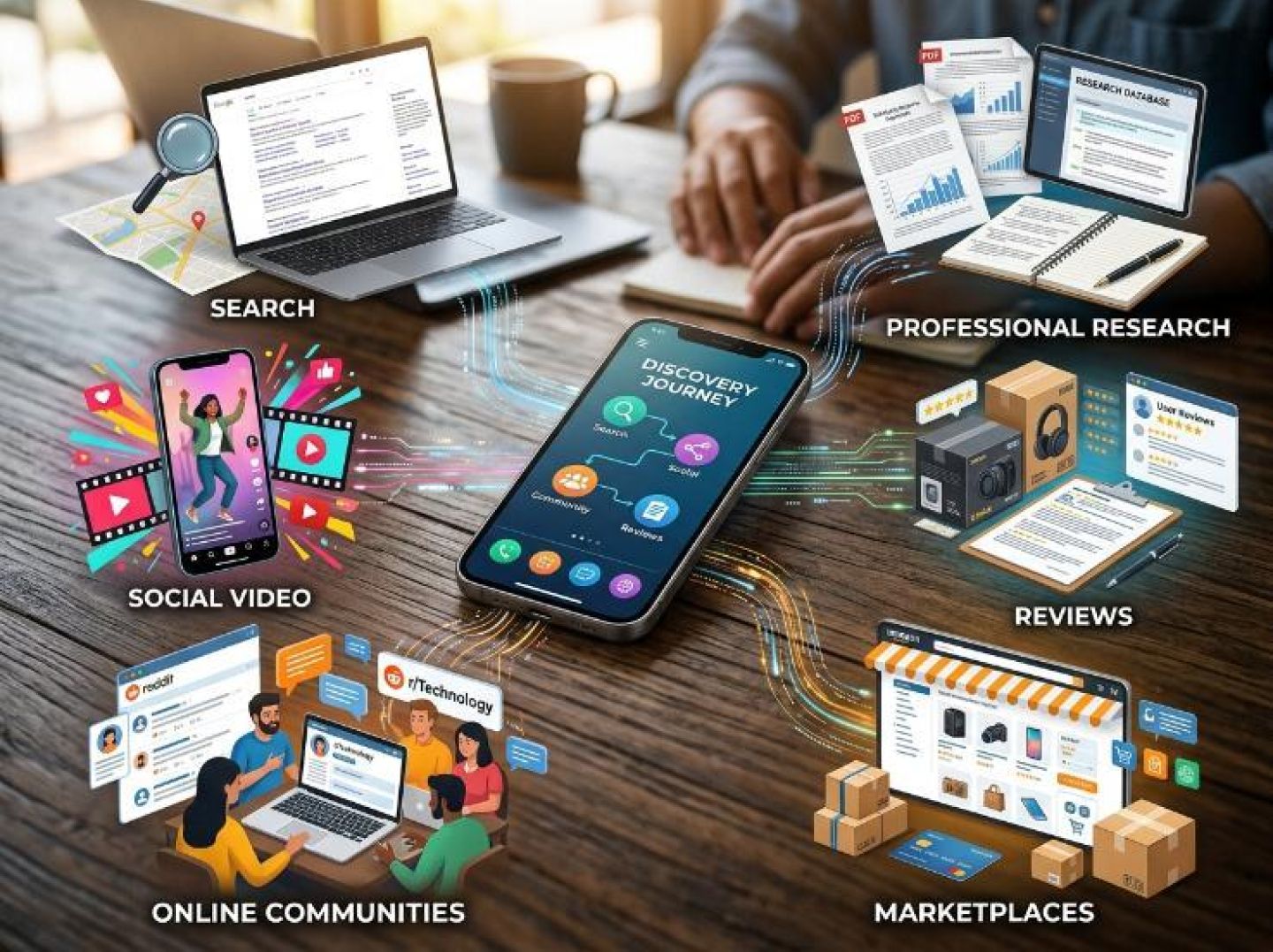
Zoom out again and the problem gets even more existential. Users no longer discover brands in a neat linear path from Google query to website visit. A sizable chunk of Americans now start their journey on LLMs, and younger audiences are overwhelmingly discovery-first on TikTok, Instagram, Reddit, and YouTube, as a recent Moz analysis of multi-channel authority underscored. The practical result: there is no single “search engine” to spy on anymore, and there is no singular SERP snapshot that can tell you how (or where) you are winning.
Taken together, these shifts explain why “poisoned SERPs” shouldn’t be treated as an anomaly to be filtered out of your rank tracker. They’re a symptom of a deeper reality: Google’s public interface is now an actively adversarial environment for anyone trying to reconstruct its internal state from the outside. If your intelligence stack is still built on scraping SERPs and assuming they reflect user reality, you don’t have a measurement problem; you have an epistemology problem. The only viable way forward is to construct your own cross-channel truth layer that can sit above hostile SERPs, reconcile noisy signals from multiple platforms, and tell you what’s actually happening — even when Google, by design, is trying to make sure you can’t see it.
Search volume isn’t collapsing; it’s metastasizing.
When you zoom out from the drama around poisoned rank trackers, the bigger story is that “search” is no longer just a Google-shaped box with ten blue links. People are still searching — they’re just doing it in more places, with more intent states, and on more devices than your SEO dashboard is capable of admitting.
Recent data on AI search adoption shows this clearly: usage of conversational tools and answer engines is surging, but so are classic search sessions. As one analysis of the “AI is killing search” narrative put it, both AI-driven and traditional search are growing at “about the exact same rate” quarter over quarter, which means AI platforms are adding a new layer of search on top rather than cannibalizing it outright, even as clicks to external sites soften and more answers stay on-platform (MarTech). In other words, demand for answers is up; your visibility just isn’t concentrated in one channel anymore.
Serious buyers have internalized this reality faster than most marketers. If you talk to actual high-intent prospects in B2B, health, finance, or politics, they don’t “Google something” and call it a day. They:
That multi-channel behavior is even more extreme in high-stakes domains like elections. Political media strategists are blunt that reaching persuadable voters in 2024 and 2026 will require “more than just running ads in their markets,” and that campaigns need to get “as strategic as possible” about putting messages in front of fragmented audiences across social, CTV, open web and walled gardens in an environment flooded with misinformation (Basis Native). That isn’t a special case; it’s just the political version of what’s already true for every expensive, complex purchase.
What’s breaking is not search, but the old measurement model that assumes one search engine, one SERP, one truth.
Google’s own interface changes are accelerating this fragmentation. The rollout of generative search UI, “AI Mode,” and persistent information agents is compressing what used to be three or four distinct queries into a single evolving conversation, while simultaneously keeping more of the interaction inside Google’s walls. Forward-looking SEO practitioners are already urging brands to adapt to “the new SERP reality” by doubling down on bottom-funnel coverage and content that AI systems can confidently cite as an answer, not merely rank as a blue link (TopRank Blog). That guidance quietly acknowledges a structural shift: the SERP you see, the SERP your buyer sees, and the SERP your scraper thinks it sees are now three different artifacts.
Layer on top of that the fact that Google is actively manipulating what automated systems can see. Anti-scraping tactics like super-wide IP blocking, heavier captchas, and even injecting “bad data into suspect SERPs” mean any single-source rank report is increasingly a work of fiction (Search Engine Roundtable). Tools can and do misreport full-site wipeouts that never happened, while the real buyer journey continues uninterrupted in places your dashboards barely measure.
If you’re still treating “Google rankings” as a proxy for “how visible we are when people are deciding what to buy,” you’re modeling the world as it looked five years ago. Today’s serious buyers are naturally multi-channel; they triangulate. They expect to find you — or at least find corroboration about you — in:
This is why a cross-channel “truth layer” isn’t a nice-to-have analytics project; it’s simply recognizing how decision-making already works. Your job is no longer to dominate a single results page. It’s to reconstruct, with as much fidelity as possible, the composite reality your best buyers see when they stitch together half a dozen channels and ask, “Who can I actually trust?”
Google’s “truth layer” isn’t one thing; it’s a stack of overlapping graphs and feedback loops that try to reconcile billions of messy, conflicting signals into something that looks like a coherent answer. Once you see how those layers work — and how they’re being weaponized in the current scraper wars — it becomes obvious why scraped SERPs are now, at best, a distorted shadow of what Google actually believes.
At the foundation sits the Knowledge Graph: Google’s evolving map of entities, attributes, and relationships. It’s what lets the engine “know” that a person, a product, and a podcast episode are all separate but related nodes, and that a query about “Biden climate record” is probably political, high‑risk, and subject to guardrails. On top of that, newer commercial layers like the Shopping Graph model products, offers, and merchants — a living catalog that tries to reflect real‑time availability, pricing, and popularity. The TopRank team is right to emphasize technical structure and schema as table stakes; without clean, structured signals, your brand never even gets properly committed into those graphs, let alone surfaced as a “source of truth” for AI‑heavy features.
But here’s the twist: the SERP you see, the rankings your tools scrape, and the beliefs encoded inside those graphs are no longer the same artifact.
Under intense pressure from AI agents and industrial scrapers, Google has started to differentiate sharply between “what we actually think is true” and “what we’re willing to show this specific requestor.” According to Search Engine Roundtable, Google is now taking a three‑pronged approach to hostile scraping: wide IP blocking, aggressive captchas, and something more insidious — injecting “bad data” into suspect result sets. Rank‑tracking tools are seeing apparently normal pages where the blue links have been silently swapped out. Historic leaders fall out of the top 10, social forums and random domains rush in, and then, within days, the anomaly disappears.
In other words, Google is serving one reality to its human‑like users and a booby‑trapped decoy to anything it suspects is automating requests at scale.
That decoying isn’t limited to rank trackers. Reporting on the same trend, AdExchanger notes cases where intent was clearly understood (“baby stroller” in Portuguese) yet the page scraped by rivals featured irrelevant dental supplies instead. The linguistic ambiguity (“carrinhos”) isn’t the point; Google’s own systems correctly infer the shopping intent, but the response fed to suspected scrapers is deliberately polluted. And as another AdExchanger dispatch points out, Google’s duel with commercial scrapers like SerpApi has escalated from blocking to active misinformation — poisoning the very metrics those rivals resell.
Now layer that on top of Search Console outages and instrumentation gaps. Even historically “first‑party” telemetry isn’t perfectly stable: the same AdExchanger coverage flags an unusually long Search Console Performance report outage — precisely the kind of blip that makes nervous SEOs fall back on third‑party rank trackers as a sanity check. In 2026, that fallback is a trap. The more aggressively a tool behaves like a bot, the more likely it is being routed into the decoy maze.
All the while, Google’s internal graphs keep learning from an entirely different stream of signals: authenticated user behavior, Chrome and Android telemetry, YouTube watch data, commercial conversion signals, and licensed third‑party datasets that never pass through the public SERP at all. Political and “high‑risk” content is further filtered through trust and safety layers that, despite downsizing in the broader industry, are still central to how platforms like Google and YouTube claim to manage misinformation in elections, as Basis outlines for 2024‑cycle advertising. For those queries, what appears in your scraped report is often the output of an additional policy filter, not a pure ranking of “best answers.”
The result is a three‑way split:
If your competitive intelligence is built on that last layer, you’re not simply missing nuance; you are modeling your strategy on an intentionally falsified map. To understand where you truly stand — and what’s actually winning — you have to stop treating scraped Google output as a unified truth and start building your own cross‑channel “truth layer” that can reconcile Google’s conflicting signals with what’s happening in Shopping, YouTube, social, and beyond.
Designing your own cross-channel “truth layer” starts with accepting a hard constraint: you will never get clean, complete data from any one platform again. Google is poisoning rank trackers, social networks are throttling political reach, and AI search is hoarding clicks. The point of a truth layer is not to recreate perfect telemetry; it’s to build a resilient model of reality that stays usable even when individual sensors are jammed.
The first design choice is philosophical, not technical: treat every channel as biased, and make the bias part of the data. When Semrush’s analysis showed that Google was returning “bad” SERPs to suspected bots, the error wasn’t random; it was systematically aimed at scrapers and proxy ranges. That means a “truthy” system can’t simply store rankings; it has to store how they were collected (IP class, user agent, timing, CAPTCHA events) and score each reading by its likelihood of being weaponized output rather than user reality. Your truth layer doesn’t trust a rank; it trusts a rank plus corroborating evidence from Search Console, ad impression logs, and paid traffic trends.
The same attitude has to extend beyond Google. Political advertisers already know that relying on a single channel’s feed is suicidal in an environment where trust and safety teams are understaffed and recommendation rules change weekly. As Basis Native’s guide to political advertising points out, Meta now downranks vast swaths of “potentially political” content while still gladly accepting political ad dollars, and platforms are leaning on opaque AI moderation to decide what voters see. A campaign-level truth layer therefore needs to track not just performance metrics (CPM, CTR, completion rate) but also where your message is structurally allowed to spread versus where it’s being quietly suppressed.
Practically, you’re assembling four kinds of signals into a single spine:
To make this actually function in an arms race, you borrow a page from Google’s own SAFE system for fighting coordinated video spam. In that system, described by Search Engine Watch’s coverage of SAFE, Google doesn’t try to prove each video is bad in isolation; instead, it examines clusters of channels, upload times, device fingerprints, and behavioral similarities to infer coordinated abuse. Your truth layer should treat campaigns and narratives the same way. Instead of obsessing over whether one ad’s reach report is inflated, you look at the cluster: which creative concepts, accounts, and placements tend to appear together, at what cadence, and with what combined effect on polls, donations, and search interest.
Operationally, that means designing your truth layer more like an intelligence graph than a dashboard. Nodes are things you care about — issues, personas, hooks, creative formats, domains, influencer accounts, LLM citations — and edges represent observed relationships: “this frame appears in this TikTok cluster,” “this domain is cited in this AI answer,” “this PAC’s spending spike coincided with this search trend among persuadables.” You don’t treat any single edge as certain; you look for dense regions of agreement across messy, biased inputs.
In an era of scraper warfare, spying on winning campaigns is less about beating Google’s anti-bot checks and more about out‑modeling everyone else’s confusion. A cross-channel truth layer earns its keep not by being perfectly accurate, but by being structurally skeptical: always asking, “Who is trying to fool this sensor?” and “What do all the other sensors say?” When you build that reflex into your data, you stop chasing phantom rank drops and phantom virality, and start tracking the only thing that still matters: which stories are actually winning minds.
Operationalizing a cross-channel truth layer is less about tools and more about discipline. Media buyers and competitive “spies” need repeatable playbooks that treat every platform as a partial witness, not a source of gospel. Here’s how to turn the concepts from earlier sections into day-to-day workflows that actually survive scraper warfare.
Start by dividing your operation into three concurrent loops: capture, corroborate, and counter-model.
Assume every “single source of truth” is compromised or incomplete. Your job is to assemble overlapping fragments:
The outcome of the capture loop is not “truth,” it’s a multi-angle recording of what different systems are willing to show you.
Once you have raw feeds, you need structured interrogation. A simple weekly cadence can work:
This is where you surface the hidden data-layer issues: places where Google’s reconciliation of your entity data, described in its hidden verification layer, diverges from what you think you’re publishing.
Once you can see cross-channel discrepancies, you can weaponize them.
For competitive spying, the same frameworks apply: you’re capturing rival footprints, corroborating which narratives and offers truly scale across channels, and then counter-modeling by building creative and bidding strategies that attack their most defensible positions. The game isn’t “who has the cleanest scrape”; it’s who can stitch together the messiest signals into a working, falsifiable picture of reality — and then reload that picture every week before the platforms change the rules again.
Detection doesn’t start in your dashboard; it starts with the first “that’s interesting” hit from anywhere: a TikTok that won’t leave your FYP, a sudden wave of Reddit chatter, a weird spike in branded search, a creative you keep seeing in Meta’s Ad Library, or a spy-tool alert that something just jumped 40 positions overnight.
Your job at this stage is not to verify or explain. It’s simply to capture and tag the anomaly fast enough that you can cross-check it later—before platforms scrub, throttle, or poison the trace.
In an era where Google is actively blocking IPs, ramping up CAPTCHAs, and injecting fake SERPs, any “big move” a rank tracker reports is a claim, not a fact.
So in the “Detect” phase, you:
This mindset matters because poisoned data is now a feature, not a bug. When tools see a one-day collapse out of the top 10, that may be Google’s anti-scraper system—in some cases 8% of tracked SERPs were “normal-looking” but swapped under the hood, precisely to mislead automated tools. Your truth layer starts by refusing to let any single system call reality.
You want one place where every initial hit lands, regardless of origin. Practically, that means:
The point is not to judge these signals yet. It’s to standardize how they enter your system so you can compare them later.
Each detection event should capture minimal but crucial context:
This context turns “something weird happened” into a structured fragment your truth layer can reason with.
Finally, you need a hard rule: no strategic or budget decisions based on an unverified first hit, especially from any environment known to be manipulated.
If a rank tracker shows a catastrophe, your first reaction is to tag it and schedule verification, not to rewrite forecasts. Practitioners are already advised to compare any shocking movement with native telemetry—for instance, when rank trackers report a nosedive, checking the same day in Search Console often reveals stable impressions and average position, proving the “drop” lived only in the tool’s poisoned data.
Your detection layer is a net, not a judge. Its only job is to make sure you never miss the first ripple of a winning (or dangerous) campaign—no matter where it starts—so your verification workflows can decide what’s real.
The era of treating one search engine, one dashboard, or one scraper as the final authority is ending. Discovery now moves across search results, AI assistants, marketplaces, social feeds, video platforms, and communities. At the same time, automated data collection is becoming less predictable, making isolated ranking movements and visibility reports harder to interpret.
The answer is not to abandon competitive intelligence or stop monitoring search. It is to change how evidence is collected, evaluated, and used.
A cross-channel truth layer gives marketers a way to bring these fragmented signals together. It combines platform-native telemetry, external intelligence, AI-search observations, and creative-level analysis while recording where each signal came from and how reliable it may be. It also creates a repeatable process for detecting anomalies, corroborating them across channels, and adjusting strategy only when enough evidence supports a decision.
For media buyers and competitive researchers, the advantage will not come from collecting the most screenshots or tracking the most keywords. It will come from knowing which signals deserve attention, which ones need verification, and which ones should never influence a budget or campaign decision.
In an environment where platforms can change what they show and tools can misread what they collect, better intelligence starts with a simple discipline: never confuse a visible signal with verified reality.
Tags
Receive top converting landing pages in your inbox every week from us.
Recently Updated
Google’s anti-scraping defenses and the fragmentation of online discovery are changing how marketers measure visibility. Explore how a cross-channel truth layer can combine platform-native analytics, SERP intelligence, AI search visibility, and creative-level insights to build a more reliable picture of what is actually working.
Dan Smith
7 minNov 21, 2026
Recently Updated
Traditional listicles are no longer enough. Discover how to use revenue data, spy-tool intelligence, real buyer insights, and structured comparisons to create content that earns trust from both people and AI answer engines.
Rachel Thompson
7 minNov 21, 2026
Featured
Discover how specialized AI agents can work together to monitor competitors, turn insights into experiments, launch campaigns, and scale winning strategies while keeping human oversight and governance in place.
David Kim
7 minNov 20, 2026