11 minJuly 31, 2026

Our spy tools monitor millions of TikTok ads from over 55+ countries. Biggest TikTok Ad Library in E-commerce and Mobile Apps!
Try It FREEIn the spring of 2025, something remarkable happened on a stretch of Southern California coastline. A handful of TikTok creators posted videos inviting people to show up at Newport Beach on a specific date — no sponsors, no media buy, no influencer agency orchestrating the logistics. What followed was a mass mobilization that drew thousands of people to the sand, gridlocked local traffic, overwhelmed municipal services, and dominated national headlines for days. The entire event was engineered by nothing more than short-form video and the platform's recommendation engine. For most observers, it was a curiosity — a cautionary tale about crowd control or a feel-good story about Gen Z's spontaneity. For advertisers, it should have been a masterclass.
The Newport Beach takeover was not an anomaly. It was TikTok's distribution mechanics working exactly as designed. The platform's algorithm is built to identify early engagement signals — watch-through rates, shares, comment velocity — and then amplify content that clears those thresholds to exponentially larger audiences. As SilverPush has documented, trends on TikTok emerge within hours and narratives scale globally before traditional media can even react, powered by a platform that now reaches more than 1.9 billion monthly active users spending upwards of 90 minutes per day scrolling. That infrastructure doesn't distinguish between a beach meetup and a branded campaign. The same algorithmic engine that turned a casual invitation into a national news story is the one deciding, right now, who sees your ads and how far they travel.
What made the Newport Beach event so instructive was its velocity curve. The first wave of videos generated modest but concentrated engagement. The algorithm detected that concentration — high completion rates, surging shares within a tight geographic and demographic cluster — and pushed the content outward in successive waves. Each wave recruited new creators who added their own content, which the algorithm treated as fresh signal, triggering another expansion. Within 48 hours, the feedback loop had moved from a few thousand views to tens of millions. No paid media budget on earth could have manufactured that trajectory from scratch, but every paid media budget can learn to recognize and ride it.
This is the lesson that too many advertisers still miss. When a product or moment goes viral on TikTok, the instinct is often to scramble — to build a campaign around what's already peaked. But as Adweek reported from a Cannes Lions discussion on managing sudden product virality, the real competitive advantage lies in the ability to "ride that virality" in real time rather than trying to dictate it. Horizon Media's Katie Comerford described how her team navigated a sudden spike in demand for a SharkNinja slushy machine not by forcing a predetermined narrative, but by reading behavioral signals as they emerged and personalizing the response on the fly.
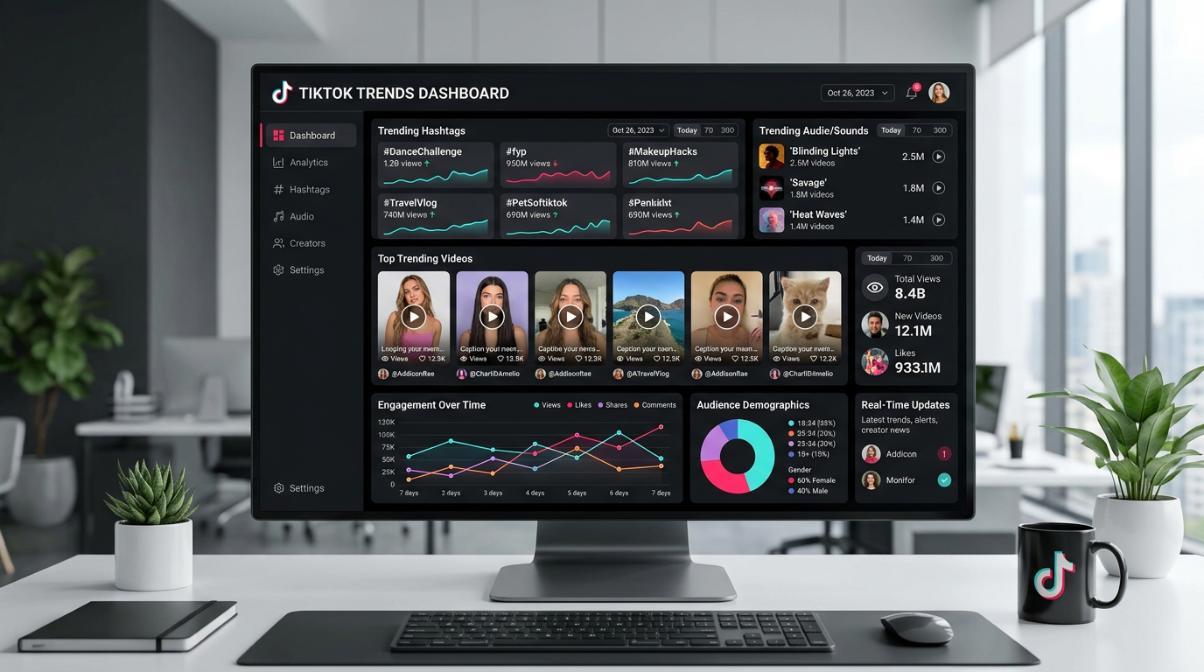
The Newport Beach takeover compressed what normally takes a brand weeks of campaign optimization into roughly 36 hours of pure organic escalation. It revealed, in the starkest possible terms, how TikTok's content-surfacing engine rewards momentum over money. Understanding that organic velocity curve — where it ignites, how it compounds, and when it crests — isn't a nice-to-have for advertisers. It is the foundation of smart timing. Because if you can read the same signals the algorithm reads, you can place your paid content inside the wave instead of chasing it from behind. The rest of this article is about learning to do exactly that.
TikTok's advertising infrastructure has matured far beyond the standard in-feed unit. In 2026, the platform offers a layered premium ad stack — Logo Takeover, Prime Time, TopReach, Pulse Mentions, and Pulse Tastemakers — each architecturally designed to let brands insert themselves into the precise cultural moments that drive outsized engagement. Understanding how these formats work is essential, but understanding when to deploy them is what separates brands that ride momentum from those who arrive after the crowd has already dispersed.
Start at the top of the funnel. Logo Takeover is TikTok's most visually dominant placement, appearing the instant a user opens the app. It's a full-screen brand moment with zero competition for attention — but it's also among the most expensive and supply-constrained options in the platform's inventory. Early performance data suggests Logo Takeover drives significant lifts in unaided brand recall, making it ideal for tentpole launches or cultural tie-ins where a brand needs to own the opening seconds of the TikTok experience. TopReach operates in a similar high-impact zone, guaranteeing that a brand's video is among the first pieces of content a user sees during a session, effectively functioning as a digital billboard with the behavioral depth of social video.
Prime Time, meanwhile, represents something more nuanced. Rather than simply securing a premium slot, Prime Time lets brands run sequential storytelling within windows of peak user engagement — those stretches of the day when platform activity surges around cultural conversations, live events, or trending narratives. It's an acknowledgment that attention isn't evenly distributed across a 24-hour cycle, and the brands that synchronize their messaging to those spikes earn disproportionate returns.
Then there's the Pulse suite. Pulse Mentions places brand ads directly adjacent to content where specific topics or brands are already being discussed organically, while Pulse Tastemakers positions ads alongside videos from the platform's most culturally influential creators. Both formats operate on the principle of contextual adjacency — the idea that appearing next to a trending conversation or a beloved creator transfers some of that cultural relevance to the brand. Given that TikTok users are 1.5 times more likely to purchase a product they discover on the platform compared to other channels, that adjacency carries real commercial weight.
Here's the catch that most media buyers underestimate: none of these formats are available on-demand in the way a self-serve in-feed campaign might be. As WordStream's guide to TikTok advertising makes clear, the platform's ad infrastructure follows a structured hierarchy — campaign, ad group, ad — but premium placements sit above that standard workflow. They require advance reservations, minimum spend commitments, and often direct relationships with TikTok's sales team. You can't wake up on a Tuesday morning, notice that a cultural moment is cresting, and snap your fingers to secure a Logo Takeover by noon.
This is the fundamental tension in TikTok's premium ad ecosystem. The formats are explicitly engineered for high-momentum moments — they reward proximity to cultural energy. But the procurement process demands that brands anticipate those moments days or weeks in advance. Prime Time's sequential storytelling is powerful, but it's useless if you activate it on the downslope of a trend. Pulse Mentions can place you inside the hottest conversation on the platform, but only if you identified that conversation before it peaked.
The formats are the vehicle. Timing intelligence — knowing which cultural waves are building, which creators are about to break through, which events will generate disproportionate attention — is the fuel. Without it, even the most premium placement becomes an expensive billboard on a road nobody's driving down anymore.
Most advertisers track TikTok's organic trending page like it's a crystal ball — watching hashtags spike, monitoring sounds as they climb, refreshing the Discover tab hoping to catch lightning before it strikes. But organic virality is a lagging indicator dressed up as a leading one. By the time a trend surfaces on the For You page at scale, the algorithmic distribution cycle is already well underway, and the window for brands to ride that wave with paid media has narrowed considerably. The real alpha isn't in watching what users are creating — it's in watching what advertisers are buying.
This is where the concept of trend velocity data becomes critical. Trend velocity measures the rate at which specific creative themes, audio clips, hashtags, and ad formats are scaling within TikTok's paid ecosystem. It answers a fundamentally different question than organic trend tracking: not "what are people talking about?" but "where are sophisticated marketers placing their bets right now?" When ad spend begins clustering around a cultural moment — a specific aesthetic, a narrative hook, a product demonstration style — that clustering signal tells you that performance teams with real budgets have already validated the theme through early testing and are now scaling into it.
Tools like Anstrex Instream make this kind of intelligence accessible. By monitoring competitor and adjacent-brand ad creatives in real time, Anstrex Instream lets you see which themes are attracting investment across categories, how quickly creative volume around a specific concept is accelerating, and whether the market has already reached saturation. Think of it as a paid-side seismograph: it doesn't predict earthquakes, but it tells you exactly how much the ground is moving and in which direction.
The practical framework for reading this data comes down to three signals. First, look at creative volume trajectory. If the number of distinct advertisers running creatives around a theme is climbing week over week but the total count remains relatively low, the trend is still ascending — this is your entry point. Second, assess creative diversity. Early in a trend's lifecycle, the ads riffing on it tend to be varied and experimental. When the ad library floods with near-identical copycat creatives, the window has closed; you're no longer riding a wave but drowning in noise. Third, evaluate hook sophistication. As MarTech has documented, TikTok's algorithm relies heavily on the first three seconds of a video to categorize and distribute content, meaning the opening hook is both a creative decision and a targeting signal. When early-mover ads around a trend feature sharp, qualifying hooks while latecomers default to generic openers, you can map exactly where a trend sits in its lifecycle by the quality gradient of its creative execution.
Speed matters because TikTok's content ecosystem operates on a fundamentally compressed timeline. As SilverPush has observed, narratives on the platform evolve in real time, with conversations scaling globally before traditional media can even react. That velocity applies equally to paid creative trends. A theme that looks like an emerging opportunity on Monday can be saturated by Thursday. The brands that consistently win in this environment aren't the ones with the biggest budgets — they're the ones with the fastest observational loops, using ad intelligence infrastructure to spot the curve while it's still bending upward and committing creative resources before the rest of the market piles in. Monitoring the paid side doesn't just give you a competitive edge. It gives you a fundamentally different — and more actionable — picture of where cultural momentum is actually heading.
Here's the uncomfortable truth about cultural-moment advertising on TikTok: the platform rewards content that feels like it belongs, but the moments worth capitalizing on don't wait for your creative team to finish a three-week review cycle. That tension — between authenticity and velocity — is the central paradox every brand must solve before a takeover-worthy opportunity even appears.
The authenticity imperative isn't negotiable. TikTok's $33.1 billion in ad revenue proves that native-feeling creative resonates even in premium placements, and the brands driving that number aren't repurposing polished television spots or cropping horizontal hero videos into vertical frames. They're producing content that mirrors the texture and cadence of organic posts — handheld camera angles, conversational voiceovers, trending audio, on-screen text that reads like a creator's caption rather than a copywriter's headline. That aesthetic isn't a nice-to-have; it's the entry fee for algorithmic distribution.
But authenticity alone doesn't capture a cultural moment. Speed does. And speed without a system produces chaos — rushed creative that misses the brand voice, compliance bottlenecks that kill momentum, or worse, content that arrives after the trend has already peaked and curdled into parody. The brands that consistently win this game aren't the ones with the biggest production budgets or the fastest agencies. They're the ones who've pre-built modular creative frameworks: templatized hooks, approved visual styles, pre-cleared audio libraries, and brand-voice guidelines tight enough to maintain consistency but flexible enough to absorb a trending reference in hours rather than days.
Think of it as creative infrastructure, not creative production. You're not building each ad from scratch when a moment hits. You're swapping components — a new hook line mapped to the trending topic, a fresh visual opener that mirrors the aesthetic of the moment, a call to action recalibrated for the audience the trend attracts — while the underlying structure stays stable and on-brand. This is how you collapse a two-week production timeline into a two-hour sprint without sacrificing the native feel that TikTok's ecosystem demands.
And those opening seconds carry more weight than most advertisers realize. As MarTech has reported, the first three seconds of a TikTok video determine not only whether a user keeps watching but also how the platform categorizes and distributes the content in the first place. That means your hook is doing double duty: it's qualifying the audience through self-selection — signaling immediately whether this content is relevant to the viewer — while simultaneously feeding TikTok's algorithm the behavioral data it needs to optimize delivery. A qualified viewer watches longer, engages more, and teaches the algorithm to find similar users. An unqualified viewer scrolls past, and that signal is just as valuable. The opening frame isn't just creative. It's targeting.
This is precisely why creative can no longer be treated as something that happens after strategy and targeting are finalized. In TikTok's automated delivery environment, creative is strategy. The hook determines the audience. The audience determines the distribution. The distribution determines whether your cultural-moment ad actually reaches people during the moment or arrives two days late as an expensive echo.
The solution isn't moving faster with the same process. It's rebuilding the process so that speed is structural. Map your modular templates to your brand's voice now. Pre-approve the visual and tonal boundaries your team can operate within under time pressure. Define what "on-brand" looks like at velocity. Then, when your trend-detection systems flash a signal — when the velocity curve says go — your creative team isn't starting from a blank canvas. They're assembling proven components around a live cultural moment, producing content that feels native because it was designed to be native from the beginning, not because someone got lucky under deadline pressure.
Not every viral moment is an invitation. Some are warnings.
The Newport Beach TikTok takeover illustrates this with uncomfortable clarity. What began as an electrifying cultural spectacle — thousands of people converging on a single location, driven by the platform's algorithmic amplification — shifted within the same news cycle into something far less brand-friendly: crowd control failures, public safety concerns, and a wave of negative coverage that reframed the entire event as a cautionary tale. Any brand that had rushed to align itself with the moment's early energy would have found its creative sitting adjacent to headlines about chaos, injuries, and municipal backlash. The velocity that made the moment exciting is the same velocity that made it dangerous.
This is the distinction that trend data alone cannot make. Real-time dashboards can tell you a sound is climbing, a hashtag is accelerating, or a location is generating millions of impressions per hour. What they cannot tell you is whether the sentiment surrounding that moment will hold. And on TikTok, where brand damage escalates instantly rather than unfolding slowly, the window between "this is exciting" and "this is a liability" can be measured in minutes rather than days.
The temptation to chase every high-velocity trend is understandable. With TikTok reaching more than 1.9 billion monthly active users and driving engagement rates that dwarf every other major social platform, the upside of catching a wave at the right moment is enormous. But the downside of catching the wrong wave — or catching the right wave at the wrong phase — is equally asymmetric. Industry research consistently shows that consumers lose trust when ads appear next to harmful or inappropriate content, and that erosion compounds over time. A single poorly timed adjacency doesn't just damage one campaign; it weakens the credibility infrastructure that makes all future campaigns work.
So how do you decide when to sit it out? A useful framework weighs four variables before any creative brief gets written.
Trend velocity confirms that a moment has enough momentum to justify the spend. Brand alignment asks whether the moment's subject matter, tone, and audience overlap meaningfully with your positioning — not aspirationally, but actually. Sentiment trajectory tracks where the conversation is heading, not just where it is now; a moment that is 80 percent positive and accelerating is fundamentally different from one that is 80 percent positive and fragmenting into controversy. Safety exposure evaluates the realistic downside: if this moment turns negative in four hours, what does your brand look like next to that coverage?
The Newport Beach situation would have failed at least two of those gates for most brands. Alignment was tenuous unless you were specifically targeting the hyper-local community already involved. And the sentiment trajectory was visibly unstable — the sheer scale of the gathering carried obvious risks that anyone monitoring the situation closely could have flagged before committing budget.
The smartest application of real-time ad intelligence isn't just identifying moments to ride. As Adweek's reporting on navigating sudden virality makes clear, the goal is to direct your brand toward the moments where consumer intent and product availability actually converge — not simply toward whatever is generating the most noise. Sometimes the highest-value decision your ad team makes in a given week is the campaign it chooses not to run. Restraint, informed by the same data that powers activation, is what separates brands that survive viral moments from those that get consumed by them.
Receive top converting landing pages in your inbox every week from us.
Must Read
Human curiosity becomes more powerful when paired with spy tools and AI-driven competitive intelligence. This guide shows how to turn competitor ad patterns into structured questions, testable hypotheses, and cross-channel experiments that uncover what audiences actually respond to.
Rachel Thompson
7 minSep 14, 2026
In-Depth
Emotional storytelling is becoming a powerful targeting signal as AI-driven platforms take over more audience selection and delivery. This guide shows performance marketers how to use spy data to reverse-engineer emotional arcs and build cross-channel sequences that move audiences from emotional hooks to solution moments, social proof, and conversion.
Liam O’Connor
7 minSep 13, 2026
Must Read
Performance marketers can stay aggressive without crossing ethical or compliance boundaries by turning competitive ad spying into a structured, defensible intelligence process. This guide covers AI-powered monitoring, ethical data practices, governance guardrails, and practical workflows for using competitor insights to drive smarter performance decisions.
Priya Kapoor
7 minSep 13, 2026