

9 minOctober 20, 2026

Our tools monitor millions of native, push, pop, and TikTok advertising campaigns.
Get StartedAI has quietly become the de facto operating system of modern ad ops—and that’s exactly why the next audit, outage, or investigation could turn into a crisis if your documentation isn’t ready.
For years, “automation” in media buying meant simple rules: cap a budget here, bump a bid there, swap out a tired creative. Now, AI systems are making thousands of micro‑decisions per second, ingesting signals you don’t see and rewriting the performance profile of campaigns in real time. As described in illumin’s overview of AI in AdTech, these systems evaluate millions of impressions, predict which ones are most likely to convert, and dynamically adjust bids to hit goals like ROAS or incremental sales. In practice, that means the logic of your media buying is increasingly encoded inside opaque models and agent workflows—not in the neat rows of a spreadsheet or a static media plan.
At the same time, expectations around “performance” have never been higher. CTV and video budgets now live or die on their ability to prove outcomes, with publishers layering AI into their offerings to tie impressions directly to sales, especially in retail media environments like Walmart and Amazon’s streaming plays. When AI optimizes which households see which creative at which frequency and then connects that exposure to in‑store or ecommerce transactions, the line from model output to business impact becomes very short—and very audit‑worthy. If a regulator, auditor, or skeptical CFO asks, “Why did these audiences get this treatment?” you need more than, “The system learned it worked.”
The industry is also pushing toward “agentic” workflows, where AI doesn’t just tune bids but orchestrates entire campaign lifecycles. illumin’s piece on AI advertising trends argues that marketers will soon oversee Anstrex.com/blog/your-competitors-best-ad-was-written-for-a-human-their-next-one-will-be-written-for-an-ai-agent" target="_blank" rel="noreferrer noopener">AI agents coordinating planning, creative generation, pacing, and reporting across platforms. In parallel, interactive formats are emerging where AI tailors creative in real time based on how people behave inside the ad itself; Flam’s “Flicks” tool, profiled by Adweek, can remix assets into responsive experiences that adapt mid‑spot to each viewer’s choices. These developments blur the boundary between “media” and “experience,” and they multiply the number of decision points an auditor could reasonably question.
Yet, for all this ambition, the industry’s own leaders acknowledge that fully autonomous buying isn’t ready for prime time. At AdExchanger’s Programmatic AI event, WPP’s Emily Lai estimated that 80–90% of campaigns are still too complex for an AI agent to run end‑to‑end, a view echoed by IAB Tech Lab’s Tony Katsur, who admitted that today’s tools handle “simple things” but that “there’s still a lot of work to do,” as reported by AdExchanger. That gap between marketing rhetoric (“autonomous agents!”) and operational reality (“please don’t break our healthcare account”) is exactly where risk creeps in. If your internal documentation doesn’t clearly spell out which parts of the stack are automated, which are supervised, and where human overrides live, any discrepancy between promise and practice becomes a liability in an audit room.
Legal expectations are tightening at the same time. In agency contracts, the rise of generative tools has already forced negotiators to grapple with questions of IP, indemnity, and acceptable AI use. As the law firm behind All About Advertising Law notes, brands increasingly want agencies to shoulder AI‑related infringement risks, while agencies insist absolute bans on AI are unrealistic. Similar tensions are emerging in media buying itself, where principal‑based programmatic models, rebates, and opaque fee structures already complicate audit rights. Layer AI onto that—black‑box optimization determining which pre‑bought impressions get served to whom—and you have a scenario regulators are primed to scrutinize.
In other words, AI has turned your media operation into a dense web of models, vendors, contracts, and decision policies that few people fully understand end‑to‑end. Performance pressures push you to let the machines run; legal, compliance, and brand‑safety pressures demand that you explain, justify, and, when necessary, reproduce what those machines did.
Without robust, human‑readable hand‑off documentation—what data the models use, what constraints they obey, who approves what, and how overrides are logged—you’re one privacy complaint, FTC inquiry, or client audit away from having to reconstruct your own decision‑making after the fact. That is the chaos this playbook is designed to help you avoid.
A modern handoff doc isn’t “where we put the UTMs and flight dates.” It’s the operating manual for an AI‑native system that is going to act on your behalf, at scale, in ways none of you will remember in six months—especially when Legal, Finance, or a regulator comes knocking.
To do that, it has to evolve from “campaign setup notes” into four things at once: a strategy spine, a control panel, an experiment log, and an audit trail.
First, it has to carry real strategy, not just surface‑level goals. As Omar Oakes noted in a review of the “Humans, Marketing and Machines” study, the industry’s biggest shortage isn’t media traders, it’s strategic thinking, which 72% of respondents flagged as the number‑one talent gap in advertising (“strategy is the number‑one talent shortage”). If your AI is making thousands of micro‑decisions a day, the only way to keep those decisions coherent is to give it a crisp upstream brief: what the brand stands for, what you’re willing to trade off, and which customers and outcomes matter most. A modern handoff doc must therefore make the strategy explicit in machine‑readable terms: prioritized objectives, ranked constraints, non‑negotiables for brand and compliance, and the hierarchy of “if forced to choose, optimize for X over Y.” That is what turns an AI agent into an execution engine for your actual strategy instead of just an optimizer of whatever metric is easiest to move.
Second, it has to define how autonomous systems are allowed to behave. Emerging “agentic” media platforms don’t just tweak bids—they continuously reallocate budget, switch audiences, and refine creative without a human in the loop (“self‑optimizing agents experiment continuously”). Handoff docs now need a section that looks less like a trafficking checklist and more like a governance spec. That includes:
This is exactly the kind of governance shift AI‑native advertising requires, where you “establish guardrails to balance performance with brand equity” and maintain meaningful human oversight (“governance for autonomous systems”). If those guardrails are not written down at handoff, they will be reinvented (or ignored) one platform toggle at a time.
Third, the doc has to standardize experimentation and creative logic. When interactive and generative formats can spin hundreds of variants in minutes, speed becomes a core KPI. In one Brandweek discussion, Flam’s team described producing interactive “Flicks” where audience behavior dynamically changes what the viewer sees next, with a ten‑second ad assembled in under half an hour (“a 10‑second ad can be built in 30 minutes or less”). That velocity is pointless if each campaign team reinvents naming conventions, test hierarchies, and measurement rules. A modern handoff doc should encode:
Without this, every “AI‑driven” campaign becomes bespoke craft, and learnings die inside each platform.
Finally, the handoff doc has to anticipate legal, contractual, and regulatory scrutiny. As programmatic and principal media buying models have grown more opaque, brands and agencies have clashed over transparency, rebates, and audit rights (“principal media buying means agencies purchase media space for their own account”). Add generative AI to the mix and questions multiply: which vendors are used, what indemnities apply, how prompts are governed, and who bears responsibility for infringing or misleading content. Modern handoff docs should therefore:
In other words, the handoff doc is no longer a static PDF that gets filed and forgotten. It’s the living contract between human strategy and autonomous execution—a document designed not just to get campaigns live, but to keep them defensible when those AI‑driven decisions eventually get questioned.
Think of this section as the wiring diagram for an AI‑native media operation: one handoff doc structure you can reuse across display, native, search, social, CTV, programmatic, even emerging “answer engine” and agentic AI channels.
Anstrex‑style workflows are a good anchor. You’re already deconstructing funnels, spying on competitive flows, tagging angles and hooks, and saving winning journeys. The handoff framework just makes that work explicit, portable, and governable so a human buyer, an AI agent, or a regulator can all reconstruct what happened.
Here’s the channel‑agnostic skeleton.
This isn’t a moodboard; it’s the minimum viable strategy that lets an autonomous system make trade‑offs without wandering off‑brief.
Document, in plain language:
The WFA/MediaSense survey highlighted that “strategic thinking” is the industry’s number‑one talent shortage, not more knobs to turn. Your doc has to hard‑code that missing spine so agentic systems aren’t improvising your strategy on the fly.
Fields to standardize (works the same for Meta, TikTok, Taboola, Google, programmatic, etc.):
If this section is clear, a future AI agent can simulate scenarios the way decision‑intelligence tools already are, and a future regulator can see your intent in black and white.
AI advertising is no longer single‑task automation; it’s end‑to‑end workflows spanning planning, creative generation, trafficking, optimization, and reporting. Industry analysts expect marketers to manage AI workflows instead of individual tasks, with agents coordinating activity across tools, as illumin’s trend analysis explains.
Your handoff doc needs a “wiring map” anyone can follow:
Represent this once, then instance it per channel: only the specific platforms and data schemas change.
Agentic AI brings performance gains, but it also demands guardrails. Best practice is to set boundaries for optimization and ensure transparency in decision logic, as MarTech’s guidance on AI‑native advertising emphasizes.
This section is your control overlay, consistent across channels:
This is the part a regulator will read first.
AI systems experiment continuously, but that doesn’t mean they’re learning what you care about. You need a channel‑agnostic experimentation schema that sits above platform‑level “A/B tests.”
Define:
Because AI is becoming a strategic partner that can model scenarios before spend, as AI‑planning research described by illumin shows, your test plan doubles as training curriculum: it tells tomorrow’s agents what questions they are allowed—and expected—to answer.
Finally, bolt a thin channel‑specific sheet onto this framework:
Everything else—strategy spine, system map, guardrails, and learning loop—remains identical. That’s what makes it a true, channel‑agnostic handoff your future media buyer, in‑house AI
Most handoff docs treat “competitive research” as a screenshot dump: one tab of spy‑tool exports, a few admired funnels, maybe a Slack thread of “this looks cool.” That’s not competitive intelligence; it’s a plagiarism trap.
If an AI agent is going to read those docs and spin out copy, audiences, and offers at scale, you have to assume it will happily remix what you feed it. When that source material is essentially copy‑pasted competitor assets, you’re not just risking weak strategy—you’re inviting IP fights and awkward conversations when Legal discovers your model has been trained on “inspiration” that looks suspiciously like infringement.
The fix is simple in concept and demanding in practice: separate what worked from how it looked. Your handoff needs to trace inspiration, not reproduce executions.
Start by banning asset‑level mimicry in the document itself. No pasting full scripts, full email bodies, or exact hero headlines into the “inspiration” section. Instead, encode what you learned in three abstracted layers:
That last layer is where you quietly protect yourself from both copy‑paste liability and lowest‑common‑denominator thinking. As Omar Oakes argues, most of the industry already hides from difficult strategic choices; AI just adds a turbocharger. If you hand your agent a folder of high‑performing lookalike ads with no interpretive layer, it will converge on generic, safe, legally risky sameness.
Instead, each competitor reference in the handoff should look more like a structured annotation than a swipe:
Note the last line. You’re not only steering the agent away from direct copy, you’re encoding the boundaries that future teams—and future models—might otherwise forget. That matters, because as All About Advertising Law’s event recap makes clear, the industry is already wrestling with how to draw lines between “ideas” and “executions,” especially in a generative AI context. Your handoff should make that distinction machine‑readable.
This is also where Anstrex‑style workflows shine. If you’re already reverse‑engineering funnels and tagging hooks, the next step is to codify those tags into a reusable taxonomy your AI can understand: problem archetype, promise archetype, proof archetype, and risk profile. Over time, that taxonomy becomes your library of permissible inspiration—a set of patterns, not templates, that your AI can safely recombine across channels.
Crucially, competitor intelligence has to be channel‑aware without being channel‑captive. A shoppable CTV ad that leans on interactive choice points may be using the same underlying persuasion pattern as a native advertorial—just rendered with different UI. As one AdExchanger analysis of streaming AI tools notes, buyers value AI that augments planning and optimization across formats, not tools that simply clone tactics per channel. Your handoff should reflect that by highlighting cross‑channel patterns (“branching paths,” “live customization,” “deferred call‑to‑action”) without hard‑coding any one platform’s execution.
The same logic applies to personalization and interactivity. AI‑driven formats like Flam’s responsive “Flicks” ads, discussed in an Adweek conversation on interactive AI content, promise 10‑second spots that adapt in real time based on user choice and existing customer data. If your agent sees those as “cool videos we should copy,” it will chase surface‑level gimmicks. If your handoff instead encodes them as “dynamic decision trees keyed to declared intent, gated by privacy and consent rules,” you give the model a pattern it can legally and creatively reinterpret in your own ecosystem.
Finally, you need one more unglamorous but vital field in every competitor entry: “Regulatory and contract risk notes.” That’s where you flag, in plain language, anything that would give a regulator or auditor pause if your AI imitated it: aggressive claim language, opaque pricing, dark‑pattern UX. As programmatic and principal‑based buying have made media relationships more opaque, industry lawyers have stressed the importance of transparency and auditability. Building that discipline into your inspiration log now means that when a regulator asks, “Why do your ads all look like theirs?” you can show a clear, documented trail: we studied patterns, we set boundaries, and our AI never saw a single line of competitor copy to plagiarize.
In other words, the job of this section of the handoff isn’t to celebrate what competitors are doing. It’s to turn their activity into structured, de‑risked fuel—so your AI can out‑think them without ever needing to look like them.
If AI is going to sit in the media cockpit with you, the first thing your hand‑off doc needs is a flight recorder.
Most teams today have a patchwork of prompt snippets in Notion, a few screenshots of “cool” agent workflows, and maybe a line in the deck that says “we use AI to accelerate creative.” That’s not even close to sufficient for an environment where, as industry analysts are already predicting, marketers will manage AI‑powered workflows that run across planning, creative, activation, and optimization. Once your stack looks like that, regulators, clients, and future team members will all ask the same question: who told the machine to do what it did?
Your hand‑off docs need to answer that question in three layers: prompts, agents, and guardrails.
1. Prompt logs: from “magic words” to reproducible recipes
In a world where a 10‑second interactive ad can be generated “in 30 minutes or less” by feeding guidelines, assets, and a prompt into a platform like Flam’s Flicks, as described in an Adweek Brandweek session, the exact wording of that prompt is no longer trivia. It is creative direction.
For every AI touchpoint in your acquisition stack, your hand‑off doc should capture:
Treat these like you’d treat a winning control: annotated, dated, and connected to performance results. When AI is acting as a strategic partner rather than a back‑office optimizer, as illumin notes is increasingly the case, those prompts and their variants become the historic record of your team’s judgment. If a regulator asks why an AI‑authored ad implied a health benefit, you want to show whether that came from your instructions, your data, or the vendor’s black box.
2. Agent runbooks: what the machine is allowed to decide
The next layer is agents: systems that chain multiple prompts and tools together and then make decisions—shifting budgets, rotating creative, tweaking bids—without a human hovering over every click.
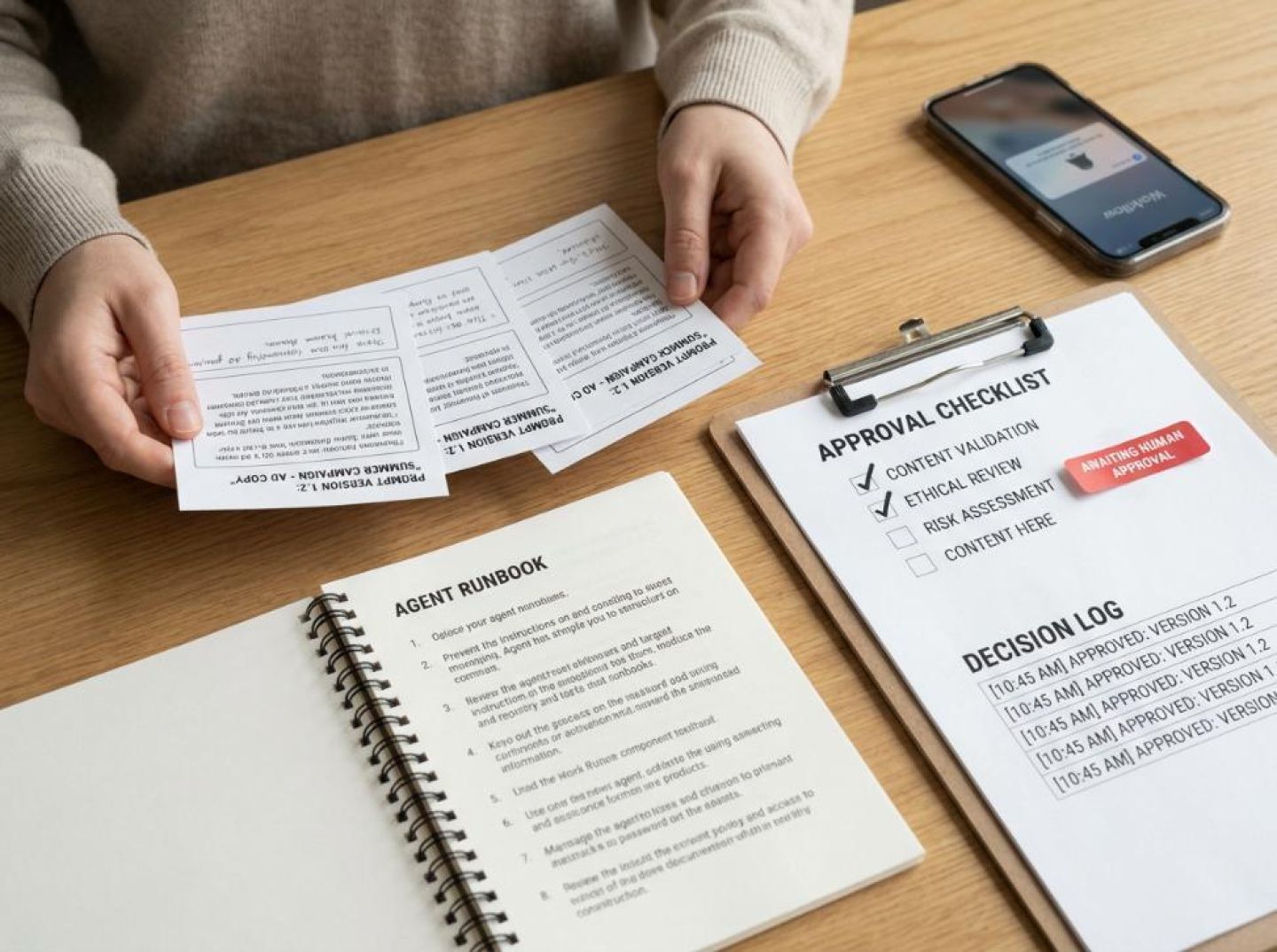
In your hand‑off docs, each AI agent should have a one‑page “runbook” that spells out:
As AI agents begin to orchestrate whole workflows rather than isolated tasks, mirroring the shift described in illumin’s analysis of AI‑managed marketing workflows, that runbook is how future teams understand the logic your current team baked into the machine. It’s also how you prove that “the AI” did not have carte blanche to do anything it wanted with someone’s budget or data.
3. Human guardrails: who stays accountable for what
The law is already drifting toward the view that brands and agencies can’t just shrug and blame the tools. AI use is now a bargaining point in contracts, with practical compromises like requiring reputable vendors, passing through indemnities, and holding agencies responsible for “intentional misuse or infringing prompts,” as an All About Advertising Law review of agency contracts explains.
Your hand‑off docs should reflect that reality with explicit, human‑readable guardrails:
Done well, this doesn’t slow you down; it’s how you build the “courage” to use AI strategically instead of hiding behind business‑as‑usual. As Omar Oakes argued in his reflection on the industry’s talent gaps and risk aversion for More About Advertising, the shortage isn’t ideas but the willingness to make hard, accountable choices. Logging prompts, agents, and guardrails in your hand‑off docs is how you make those choices legible—to yourself, your successor, and the people who may one day subpoena your ad account.
Compliance is not the section you write for fun. It’s the section you write so “future you” doesn’t spend Q4 on Zoom with lawyers, auditors, or a regulator who’s just discovered your AI stack.
In an AI‑driven media operation, compliance and contracts stop being back‑office hygiene and start becoming product design. The way you brief, log, and govern AI today is the evidence file that tomorrow’s media buyer, GC, or regulator will use to judge whether you acted responsibly.
Start with your contracts. Generative tools have blown up the old line between “ideas” and “executions.” When one prompt can spit out 50 variations of a concept, you need to be explicit about who owns what, and who eats the risk. As one review of agency agreements noted, brands increasingly want agencies to shoulder AI‑related infringement exposure, while agencies argue that clients are the ones banking the savings and speed gains from those tools, pushing both sides toward a middle ground of using reputable AI vendors, passing through their indemnities, and holding agencies responsible for intentional misuse or bad prompts rather than banning AI outright, which most lawyers now see as impractical in day‑to‑day production, according to an analysis of ad agency contracts.
Your hand‑off docs should make those positions unambiguous. Concretely, you want:
The more interactive and personalized your ads become, the more this matters. When AI‑driven formats let users “act inside” an ad and dynamically change what they see based on behavior and intent, as one AI content platform now does by blending brand guidelines, raw assets, and real‑time user choices into responsive creatives, brands inch closer to the “personalization at scale” promise that senior marketers have chased for twenty years, as one recent discussion of interactive AI ads put it. That’s exciting—and a compliance minefield.
Your documentation should therefore distinguish clearly between:
Regulators and industry bodies have already shown they care about transparency in media buying models and influencer deals; the same review of agency contracts highlighted how principal buying and opaque rebates have driven brands to demand broader audit rights and clearer disclosure of incentives in media agreements. Your AI hand‑off docs should assume that tomorrow’s scrutiny will extend from “how did you buy this impression?” to “how did the machine decide what to show, and on what basis?” and be ready to satisfy the same hunger for auditability and transparency.
Another reason to take this seriously: the industry is moving from automating isolated tasks to orchestrating whole workflows with AI. As one examination of omnichannel orchestration argued, the highest near‑term value isn’t just better bids or audiences; it’s coordinating complex planning, activation, and reporting across channels so teams can move faster and scale more effectively, which also means decisions that used to live in scattered spreadsheets are now embedded in models and agents, making your documentation the only way to reconstruct how they were made, according to a piece on AI orchestrating omnichannel advertising. If those orchestrators go wrong—say they over‑expose a vulnerable audience or misinterpret a consent flag—you will need a clear map of who configured what, when, and under which policy.
So “future you” proofing is partly about protecting against regulators, and partly about protecting against your own success. If AI lets a lean team spin up hundreds of campaigns and thousands of creative variants, the risk surface scales with the output. Hand‑off docs that align your contracts, compliance expectations, and technical guardrails turn that sprawl into something defensible: here is what we were allowed to do, the tools we used, the protections we relied on, and the evidence that we followed our own rules.
Receive top converting landing pages in your inbox every week from us.
Quick Read
Discover how AI watermarks, disclosure labels, and Content Credentials are changing competitive advertising intelligence. Learn how to build a responsible ad spy stack that identifies AI-generated creatives, evaluates competitor strategies ethically, protects brand trust, and supports transparent, bias-aware advertising decisions.
Rachel Thompson
7 minOct 20, 2026
In-Depth
Learn how to build AI advertising handoff documentation that keeps automated media buying transparent, accountable, and ready for audits. Discover how to standardize campaign strategy, AI governance, competitive intelligence, experiment tracking, prompt logs, and compliance safeguards across advertising channels.
David Kim
7 minOct 20, 2026
Recently Updated
Discover how competitive ad intelligence and creative performance data can help marketers build AI-powered advertising systems that stand out from generic, AI-generated content. Learn how to use Anstrex to identify proven creative patterns, develop a reusable creative genome, and combine data-driven optimization with distinctive human creativity to build campaigns that convert.
Marcus Chen
7 minOct 19, 2026











 Will Thank You For)