
Our tools monitor millions of native, push, pop, and TikTok advertising campaigns.
Get StartedFor the better part of a decade, competitor research in paid search followed a comfortingly predictable rhythm. You'd pull up the Anstrex.com/blog/google-ads-is-finally-catching-up-to-native-why-the-death-of-keywords-is-old-news-to-performance-marketers" target="_blank" rel="noreferrer noopener">Google Ads Transparency Center, screenshot a rival's latest creative, cross-reference it with keyword overlap data, and catalog any changes to their landing pages. Rinse, repeat — usually once a month. The process was manual, sometimes tedious, but it worked because the thing you were studying held still long enough for the picture to come into focus.
The underlying assumption was simple: ad copy changed at human speed. A copywriter drafted three headline variants. A manager approved them. They ran for weeks, sometimes months, before anyone revisited the account. That cadence meant a monthly creative review could genuinely capture the competitive landscape. You weren't chasing a moving target; you were studying a slow-turning carousel.
This is exactly the world that Semrush's recommended competitor intelligence framework was built for. Their guide lays out a structured cadence — weekly auction insights checks to catch shifts in competitor keyword positions, monthly reviews of ad creative and landing page messaging, and quarterly audits of negative keyword lists and Shopping ad strategies. It's methodical and rigorous, and for years it was genuinely sufficient. When your competitor updated their offer angle once a quarter, a quarterly audit caught it. When they tested a new headline, a monthly screenshot session surfaced it before it could run unchallenged for long.
What made the framework so effective wasn't just the cadence itself — it was the philosophy underneath. As Semrush explains in their step-by-step workflow, the advertisers who consistently outperform their market treat competitor analysis not as a one-time exercise but as "a repeating, ongoing system" that defines what to monitor, how often to check it, and how findings feed back into campaign decisions. That system worked because the inputs — keywords, ad copy, landing pages, spend levels — were stable enough between check-ins that you weren't missing critical shifts. A weekly glance at auction insights told you if a new entrant had appeared. A monthly creative review told you if a rival was testing urgency-based CTAs or undercutting your pricing. The data aged gracefully.
The reliability of this approach also depended on a kind of tacit legibility. When a human wrote an ad, you could reverse-engineer the strategy behind it. A competitor emphasizing "free shipping over $50" was clearly responding to cart abandonment data. A headline shift from "Best-Rated" to "Most Recommended by Experts" signaled a repositioning toward authority. You could read intent through copy because the copy carried the fingerprints of a deliberate strategic choice.
This legibility extended beyond any single ad. As HubSpot's marketing team has noted, competitive intelligence has traditionally relied on the ability to see which competitors appear alongside your brand for high-intent queries and to draw conclusions about their positioning from that visibility. In the old playbook, those conclusions were reliable because the creative behind each impression was crafted with a coherent strategy — one that persisted long enough for you to identify it, react to it, and outmaneuver it.
That stability was never a guarantee of the technology. It was a byproduct of human bottlenecks — the time it takes to brainstorm, draft, approve, and launch. And those bottlenecks are exactly what's disappearing.
That neat, repeatable workflow started breaking down the moment platforms handed the creative reins to machines. Today, the ad a competitor researcher sees in the wild is not the product of a copywriter agonizing over a single headline — it's one fleeting combination drawn from a pool of dozens, sometimes hundreds, of machine-generated components. And that distinction changes everything about what a "snapshot" is actually worth.
Start with the infrastructure. Google's responsive search ads allow advertisers to supply up to fifteen headlines and four descriptions, which the system then mixes, matches, and serves based on the query, the user's device, their location, and a constellation of other real-time signals. Automatically created assets go a step further, letting Google's own AI draft headlines and descriptions the advertiser never wrote. Performance Max campaigns collapse search, display, YouTube, and Discovery into a single black-box campaign type where Google controls not just which copy appears, but on which channel and to which audience segment. The advertiser sets objectives and feeds in raw materials; the platform does the rest. For a researcher on the outside, the result is the same: any single ad impression is one permutation of a combinatorial explosion, surfaced for reasons that are invisible to everyone except Google's auction algorithm.
Layer on top of that the pace at which teams now produce raw creative inputs. As Social Media Examiner reported, AI now writes roughly ninety percent of ad copy for sophisticated performance-marketing teams, with humans stepping in only to sharpen the final ten percent — a workflow one agency leader describes as "copy chiefing." When a single operator can generate in an afternoon what once took a full creative department a week, the volume of material feeding those responsive and automated campaign types multiplies accordingly. The old assumption — that a competitor's ad reflected a deliberate, stable strategic choice — collapses under the sheer throughput.
This isn't a niche trend. Research published in Industrial Marketing Management and analyzed by MarTech concluded that AI is commoditizing content production, making routine marketing assets faster and cheaper to create. One client interviewed for the study noted that a single person can now accomplish what once required a large organization and a team of content creators. If production is no longer a bottleneck, then the competitive moat shifts from what an ad says to the invisible inputs — audience signals, bid strategies, brand guidelines fed into AI prompts — that shaped it. Those inputs never appear in an ad library or a competitor-monitoring dashboard.
Here's the core conceptual shift researchers need to internalize: the ad you observe is a sample from a distribution, not a deliberate strategic artifact. It's the output of a system optimizing across variables you cannot see, served to a user profile you do not share, at a moment you cannot replicate. Screenshotting it tells you roughly as much about a competitor's strategy as photographing a single card tells you about the order of a shuffled deck. You have a data point, not a pattern — an anecdote, not intelligence.
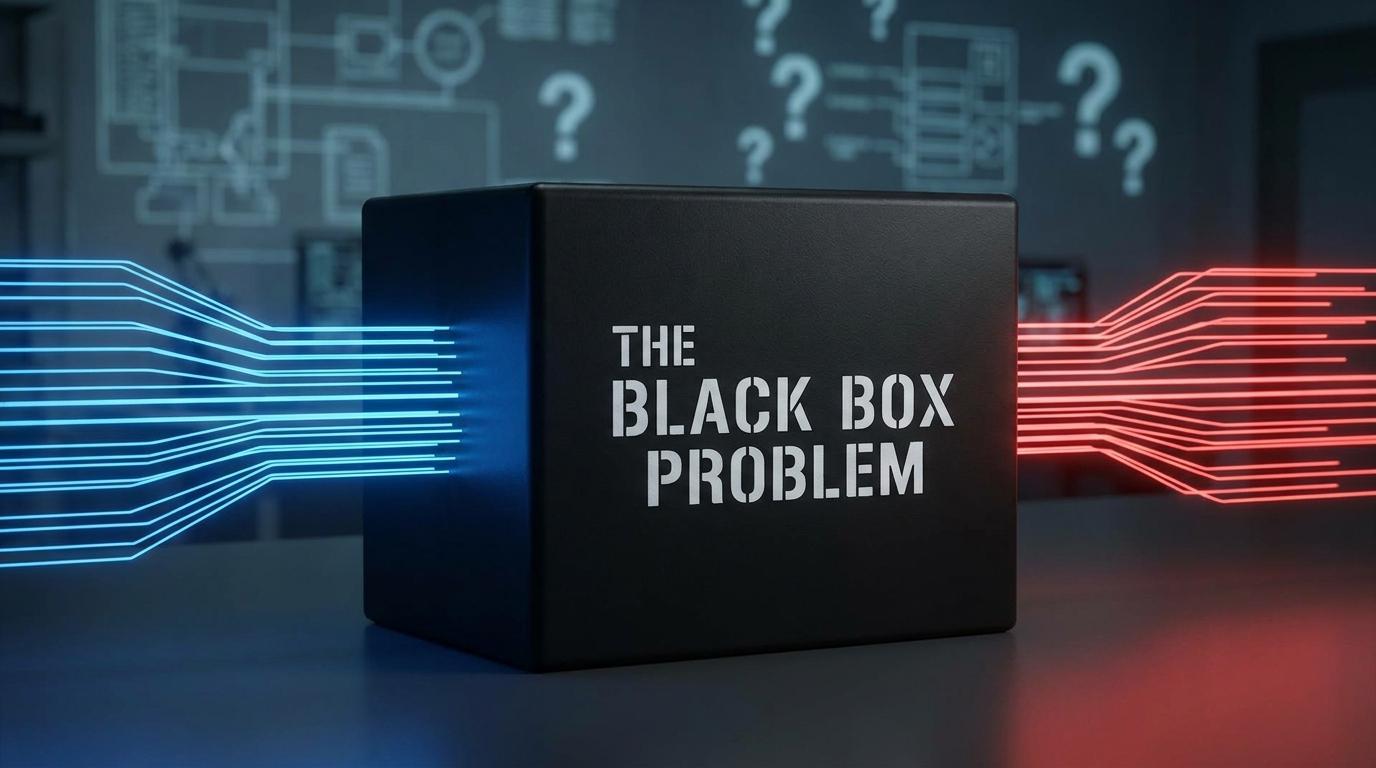
This is the black-box problem in its purest form. The inputs are hidden: the prompts, the audience segments, the conversion data feeding the algorithm's learning loop. The outputs are ephemeral: generated on the fly, rotated constantly, and retired the instant performance dips. And the middle layer — the model's optimization logic — is proprietary to the platform. For anyone still relying on periodic, manual snapshots to decode a rival's paid-media strategy, the method hasn't just become less accurate. It has become structurally incapable of capturing what's actually happening.
The instinct is understandable: if a competitor is now spinning up dozens of ad variants per week, the obvious countermove is to match their output — or exceed it. Fire up your own generative tools, produce a hundred headline combinations by lunch, and blanket every auction with fresh creative. On the intelligence side, the reflex looks similar — pull more screenshots, run more queries, catalog every single variant you can find. The logic feels airtight. More creative plus more monitoring equals competitive advantage. Except it doesn't.
This is the volume trap, and it catches advertisers on both sides of the equation simultaneously.
On the production side, the math breaks down faster than most teams realize. Nick Theriot, speaking on Social Media Examiner, pushed back hard on the trend of testing 100 to 200 creatives per week, arguing that AI amplifies you — and if your ideas are weak, AI just helps you produce more weak material faster. The distinction matters. Generative tools are extraordinarily good at iteration: give them a strong angle, and they'll spin useful variations all day. Give them nothing but vague direction, and they'll fill your ad account with polished mediocrity at industrial scale. More variants without a sharper underlying thesis doesn't improve performance. It just raises your production costs and muddies your signal-to-noise ratio inside your own campaigns, making it harder to identify what's actually working.
The same dynamic plays out on the competitive intelligence side. When a rival's ad library contains 200 variants instead of 20, the temptation is to track every single one — to build bigger spreadsheets, run more frequent pulls, and try to maintain the comprehensive snapshot that used to be possible. But comprehensive coverage of a vast, machine-generated creative library isn't insight. It's data hoarding. And it leads to the same analytical paralysis that MarTech documented on the content side: one client reported producing two or three times the amount of content in a single month, only to confront the reality that AI solves the production problem, not the attention problem. Swap "content" for "ad variants" or "competitive reports," and the lesson is identical. Volume without strategic intent doesn't earn attention from audiences, and it doesn't yield actionable intelligence from competitors, either.
There's a cautionary parallel in SEO that makes the point even sharper. The Ahrefs Blog describes what's become known as "Mount AI" — a pattern where sites flood search with lightly reviewed, AI-generated pages, enjoy a brief spike in organic traffic, and then watch rankings collapse after Google updates penalize the thin, repetitive output. The shape of the curve is instructive: rapid scale, brief euphoria, hard correction. Advertisers who respond to the black box problem by simply outproducing their competitors risk creating their own version of Mount AI inside paid media — ballooning creative libraries that dilute budget across untested angles, confuse platform algorithms trying to optimize delivery, and ultimately underperform a smaller, more intentional set of ads.
The reframe here is crucial. You don't need to see every ad variant a competitor launches. You need to detect the patterns underneath — the recurring value propositions, the audience segments they keep targeting, the landing page structures they converge on after weeks of testing. And you don't need to flood your own campaigns with a matching volume of creative. You need stronger hypotheses about what to say and to whom, so that every variant your AI tools produce carries genuine strategic weight. The advertisers gaining ground right now aren't the ones producing the most. They're the ones producing with the most intention — and reading competitive signals with enough discernment to separate the patterns that matter from the noise that doesn't.
If individual ad creatives have become disposable — machine-generated, rapidly rotated, and statistically interchangeable — then the question for competitive intelligence shifts from what is my competitor saying right now? to what have they kept saying for the last three months? That shift in framing is where durable strategic advantage lives.
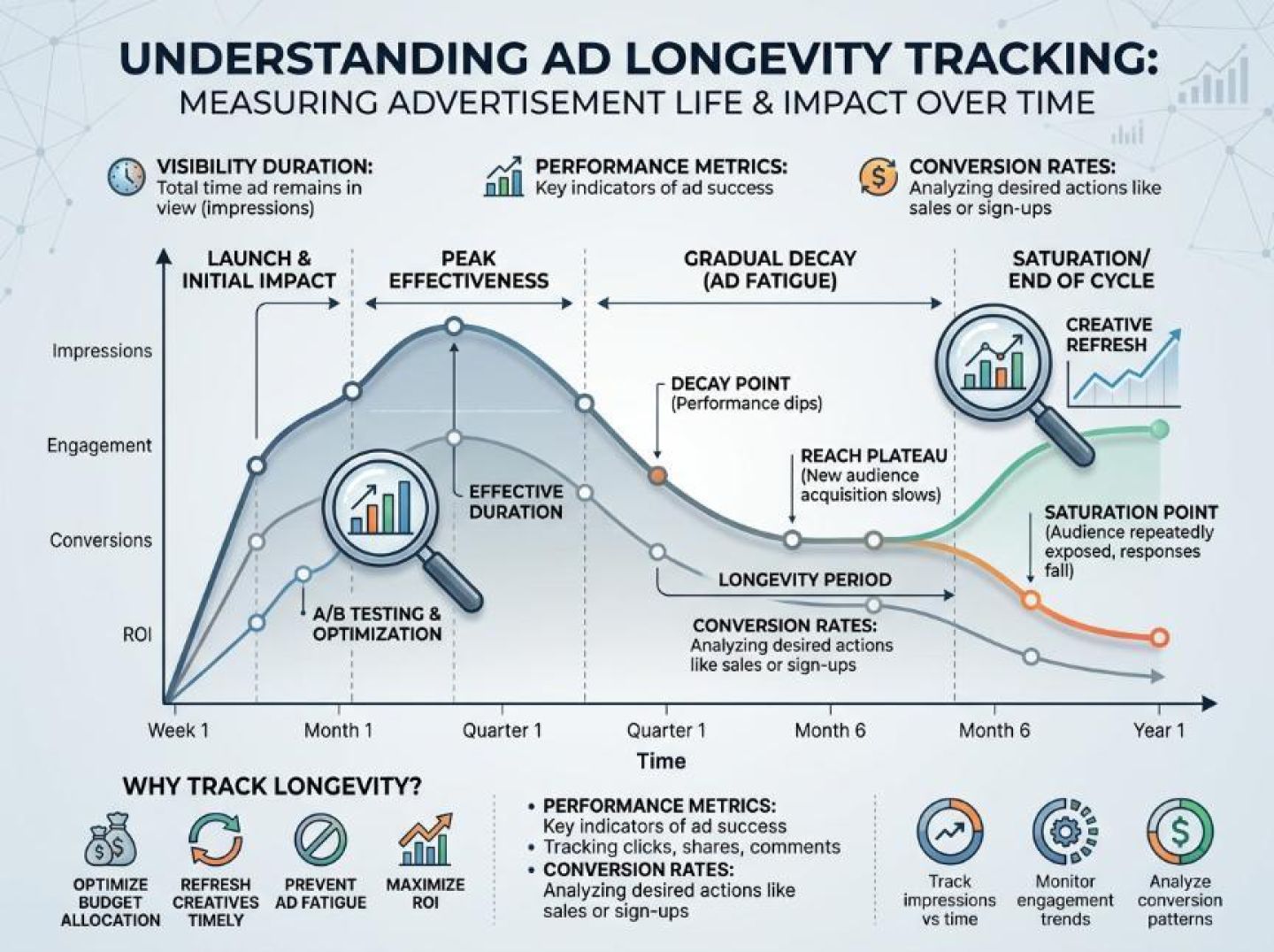
The logic is straightforward. When a brand can spin up fifty headline variants in an afternoon, any single ad you spot in the wild tells you almost nothing about intent or performance. It might be an experiment that runs for seventy-two hours and gets killed. It might be a control creative that has survived dozens of challengers. You cannot distinguish between the two from a screenshot. But you can distinguish between them by watching over time. An ad angle that persists — that keeps receiving budget week after week, that reappears across geographies, that survives multiple rounds of automated optimization — is an ad angle that works. Longevity becomes the most reliable proxy for performance in an environment where the advertiser's own AI is constantly trying to replace every creative with something better.
This is why Semrush's guidance on competitor analysis emphasizes running the same checks on a consistent cadence rather than treating competitive research as a one-off event. A single analysis gives you a snapshot; repeating it weekly or monthly reveals "how competitors move, what they test, and where they're investing over time." That distinction — snapshot versus pattern — has always mattered, but in an AI-saturated landscape it becomes existential. The snapshot is now polluted with noise. The pattern is where the signal concentrates.
The same principle operates on the optimization side of the equation. As AdExchanger has reported, AI-driven bidding and creative systems rely on historical performance signals accumulated over time to determine what gets scaled and what gets pruned. The machine is doing its own version of longevity analysis internally — rewarding creatives that sustain engagement and retiring those that don't. When you track which of your competitor's ads survive that internal Darwinian process, you are effectively reverse-engineering their algorithm's conclusions without ever needing access to their dashboard.
This reframes what a competitive intelligence tool needs to deliver. The old model — crawl ads, surface new creatives, let analysts compare copy — was built for a world where each creative represented a deliberate strategic choice. The new model has to track persistence, recurrence, and geographic spread. Which value propositions show up in a competitor's ads in January and in April? Which offer structures get tested once in a single market and quietly abandoned? Which creative angles keep returning after pauses, suggesting the brand circles back to proven territory?
This is precisely what trend and longevity tracking reveals, and it is the kind of intelligence that Anstrex's platform is purpose-built to surface. Rather than showing you a firehose of the latest creatives — a feed that, in an AI-saturated market, is mostly noise — Anstrex monitors how long ads run, tracks their presence across networks and regions, and highlights the angles competitors sustain over meaningful time horizons. A creative that has been live for ninety days across three countries is a strategic commitment. A creative that appeared Tuesday and vanished Thursday is a machine's discarded hypothesis. The ability to tell those two apart, at scale and without manual tracking, is what turns competitive research from a cataloging exercise into genuine strategic intelligence. In a world where any brand can generate infinite ad copy, the scarce resource is not creative volume — it is knowing which ideas actually survived contact with the market.
The frameworks that worked when competitor ads changed quarterly — screenshot, catalog, compare — collapse under the weight of AI-generated creative that rotates daily. What replaces them isn't a single tool or a cleverer spreadsheet. It's a layered system designed to separate signal from noise at scale, with each layer serving a distinct function.
Layer one: automated monitoring. The foundation of any AI-era competitive intelligence system is continuous, tool-driven tracking that removes the human bottleneck from data collection. Platforms like Anstrex, SpyFu, and the Google Ads Transparency Center let you capture what competitors are running across networks — display, native, search, social — without relying on manual screenshots that go stale within hours. The goal at this layer isn't analysis. It's coverage. You want to know what appeared, when it appeared, how long it ran, and where it was served. Set it up once, configure your competitor list, and let the system accumulate data in the background. This is the raw material the next two layers depend on.
Layer two: pattern extraction. With hundreds or thousands of competitor creatives flowing into your monitoring system every month, analyzing individual ads becomes pointless. Instead, analyze clusters. Which headline themes persist across rotations? Which offers recur month after month even as the surrounding copy shifts? Which landing page structures remain stable while surface-level elements like hero images and CTAs get swapped? Semrush recommends building a structured cadence — weekly checks on keyword position shifts and spend changes, monthly reviews of creative updates and landing page messaging, quarterly audits of broader strategy — and that rhythm works well as the scaffold for pattern extraction. But instead of treating each cadence cycle as a fresh snapshot, you're layering cycles on top of each other, looking for what survives the churn. A headline formula that appears in January and still appears in March, despite a competitor producing dozens of AI-generated variants in between, is telling you something about what's actually converting for them.
Layer three: strategic interpretation. This is the layer that justifies the salaries. Automated monitoring captures data, pattern extraction surfaces recurring themes, but only human judgment can determine which patterns represent genuine strategic bets versus noise. As research published in Industrial Marketing Management found — summarized well by MarTech's coverage of the study — AI has solved the production problem, not the attention problem. The same principle applies to intelligence: AI can gather and cluster competitor data at scale, but deciding what a pattern means for your own positioning requires the kind of contextual reasoning that no tool provides. Is a competitor's persistent free-trial offer a sign of confidence or desperation? Does their shift from benefit-driven to feature-driven headlines signal a new audience segment or a failed test they haven't cleaned up? These are judgment calls, and they're where competitive advantage actually lives.
Think of this three-layer structure the way a newsroom operates: automated feeds bring in raw information continuously, editors identify developing stories by spotting patterns across feeds, and senior journalists apply expertise to determine what's worth publishing and what it means. Let the machines handle the first ninety percent — the gathering, sorting, and clustering — and reserve human attention for the ten percent that actually shapes your strategy.
The temptation in an AI-saturated landscape is to fight volume with volume, matching your competitors' output with equally prolific monitoring. Resist it. The competitive moat isn't built by capturing more data. It's built by extracting better meaning from the data you already have, at a cadence disciplined enough to reveal what your competitors can't easily hide: the strategic commitments they keep making, no matter how many headlines their AI tools generate on top.
Receive top converting landing pages in your inbox every week from us.
Guide
Discover why relying solely on platform-native AI advertising tools can lead to wasted ad spend, biased optimization, and missed market opportunities. Learn how to build an independent intelligence stack that combines competitive ad research, independent measurement, creative analysis, and AI-powered insights to improve media buying decisions and long-term profitability.
Priya Kapoor
7 minOct 13, 2026
Must Read
Discover how virtual try-on technology, AI shopping assistants, and competitive ad intelligence are reshaping e-commerce advertising. Learn how to identify AI-native winning products with Anstrex, create conversational ad creatives, optimize landing pages for personalized shopping experiences, and measure the true impact of AI-driven customer journeys.
Marcus Chen
7 minOct 13, 2026
How-To
Learn how to connect out-of-home (OOH) advertising with digital performance campaigns to create measurable cross-channel funnels. Discover how to plan LED truck routes, coordinate search and social ads, optimize mobile landing pages, and track conversions so physical advertising drives measurable business results.
Samantha Reed
7 minOct 13, 2026