11 minSeptember 25, 2026

Our tools monitor millions of native, push, pop, and TikTok advertising campaigns.
Get StartedFor most of OOH’s history, “experience” has been the hiring trump card. If you’d walked the markets, knew the plant lists, and could rattle off which boards “always perform,” you were considered a safe bet. That logic made sense when out-of-home was a slow, mostly static medium. It’s dangerously outdated now.
OOH is being rewired into a data‑rich, dynamic, AI‑inflected channel. As Jawad Hassan points out, the medium’s capabilities have leapt ahead thanks to digital formats, data integrations, and automation, while the systems around it — especially measurement — are still stuck in a prior era. The result is a structural gap: OOH can now behave more like digital, but most teams are staffed as if it were still a static poster business.
That gap shows up most clearly in how operators and agencies hire.
Job descriptions in OOH still lean heavily on lineage: “10+ years in market,” “deep relationships with plant operators,” “proven track record selling transit and bulletin.” Those are signals of tenure, not intelligence. They tell you someone has been in the room; they don’t tell you whether they know how to interrogate data, stitch OOH into a cross‑channel plan, or reverse‑engineer a competitor’s footprint.
By contrast, adjacent disciplines are quietly retooling their hiring criteria. In search, for instance, analysis of 1,543 job listings on The Moz Blog shows that the single strongest signal employers screen for is measurement literacy, appearing in 79% of roles — far ahead of any flashy, platform‑specific skill. Hiring managers use measurement skills to qualify or disqualify candidates in the first 15 minutes of an interview. They assume you can “do SEO”; they need proof you can quantify cause and effect in a messy, multi‑touch environment.
That same shift has not fully landed in OOH. Many leaders still equate “senior” with “knows every board on I‑95,” even as clients demand digital‑grade reporting, cross‑channel incrementality, and defensible attribution. As Hassan notes, fragmented methodologies and legacy audience models now operate as a “strategic constraint on growth,” not just a technical nuisance. Yet most hiring scorecards don’t explicitly test whether a candidate can even describe that fragmentation, let alone navigate it.
You see a similar mismatch inside independent operators when they make their first non‑sales hire. Jonathan Graviss describes how many owners bring on a “marketing person” simply to relieve pressure: outdated website, dormant social channels, ugly proposals, events that need a warm body. The role is reactive, with no defined scope, baselines, or success metrics, so leadership quickly struggles to connect activity with revenue and begins doubting the investment, as Graviss warns. That’s not a talent problem; it’s a hiring brief rooted in tasks, not intelligence.
Meanwhile, the operational reality of OOH is morphing under everyone’s feet. The channel’s biggest barrier is no longer a lack of proof that it works; it’s the friction in planning, buying, and integrating it with the rest of the media mix. As one AdQuick case study argues, marketers already accept OOH’s effectiveness — the real blocker is that it still feels “more manual than digital channels,” so it gets sidelined in fast‑moving plans. Another overview of the space describes how OOH has historically been “a maze of RFPs,” with slow, opaque workflows and reporting that can take weeks to normalize, making campaign data hard to plug into multi‑channel models, according to their platform walkthrough.
Yet most hiring processes continue to privilege candidates who know how the old maze was built over those who know how to dismantle it.
This is the outdated OOH hiring playbook in a nutshell: stack the team with people who have logged years inside fragmented, manual systems, and barely ask whether they can think beyond them. In a channel racing toward automation, cross‑channel comparability, and a single source of truth, experience without intelligence is not just incomplete — it’s an active liability.
The medium has moved on; the résumé template hasn’t.
In most OOH organizations, the “ideal candidate” still looks like a time traveler from 2012: regional market pedigree, a thick mental Rolodex of plant owners, and a reputation for “hustle.” That profile worked when OOH was sold asset‑first and reported via PDF recaps. It is wildly mismatched to a channel that is now data‑integrated, digitally traded, and judged against cross‑channel performance.
Look at how the rest of marketing has evolved. In search, hiring managers are no longer impressed by people who can simply “do SEO.” They are screening for people who can interpret and act on complex data, with measurement skills appearing in 79% of job descriptions. AI‑search experience is requested at a broad level, while narrow “prompt engineering” is barely a blip. Employers are signaling that they want versatile thinkers who can translate messy, multi‑touch behavior into decision‑ready insight, not just technicians who know which buttons to push.
OOH is on the same trajectory—only its hiring practices haven’t caught up.
The modern OOH plan no longer lives in isolation. Digital formats, mobile location data, and AI‑driven optimization are turning what used to be a static buy into a living system that responds to conditions in near real time. As Jawad Hassan notes in his analysis of OOH’s transformation, the medium is now “closer in capability to digital media than at any point in its history,” yet its measurement systems and processes are still largely built for static posters and end‑of‑flight summaries. That disconnect isn’t only about data; it’s about people. You cannot operate a dynamic, data‑rich channel with talent selected primarily for tenure and territory familiarity.
The talent profile lags in two specific ways.
First, roles are still scoped around activity, not outcomes. Jonathan Graviss describes how independent operators often make their first marketing hire simply to “relieve pressure”—someone to fix the neglected website, post on social, dress up proposals, organize events. That person is then judged on visible output rather than their ability to connect OOH to revenue, which quickly leads leadership to question the investment, as his column makes painfully clear. The same pattern shows up on the media side: we hire people to “fill avails” and “keep clients happy,” not to architect cross‑channel systems and prove incremental value.
Second, “experience” is narrowly defined as years in OOH rather than fluency across channels. When programmatic buyers expect unified metrics and comparable currencies, OOH still speaks a different language. As one analysis of DSP/SSP convergence points out, OOH’s probabilistic audience models don’t easily plug into digital media mix models because there’s no “reliable translator” between how OOH counts exposures and how other channels count impressions and conversions, a gap highlighted in AdQuick’s discussion of convergence. That translator is not going to be a committee or a standard alone—it has to be a person in the room who understands both sides of the equation.
Yet typical job descriptions for OOH sales, planning, or marketing still read like legacy checklists: “5–7 years in out‑of‑home,” “strong local relationships,” “knowledge of production,” “ability to work in a fast‑paced environment.” You might get a throwaway line about “familiarity with digital channels” or “using data to tell a story,” but it’s rarely operationalized. There is almost never a hard requirement for skills like:
In other words, the market is hiring for “OOH people who can maybe learn digital,” rather than “cross‑channel strategists who can weaponize OOH.”
The rest of marketing is quietly standardizing on a different archetype. SEO teams are being filtered on their ability to measure and explain performance shifts in a world of zero‑click results and fragmented journeys, with hiring managers using those measurement conversations as a day‑one screen. OOH should be looking for the same: people who can articulate how a DOOH flight interacts with mobile retargeting, how probabilistic reach models should be interpreted next to deterministic impression logs, and how to make OOH legible to CFOs who live inside spreadsheets.
Until the industry updates its talent profile to reflect what OOH has actually become—a data‑driven, API‑connected, AI‑assisted channel—“years of experience” will keep acting as a comfort blanket. It will not, however, produce the cross‑channel spycraft that modern OOH buyers and advertisers now assume is table stakes.
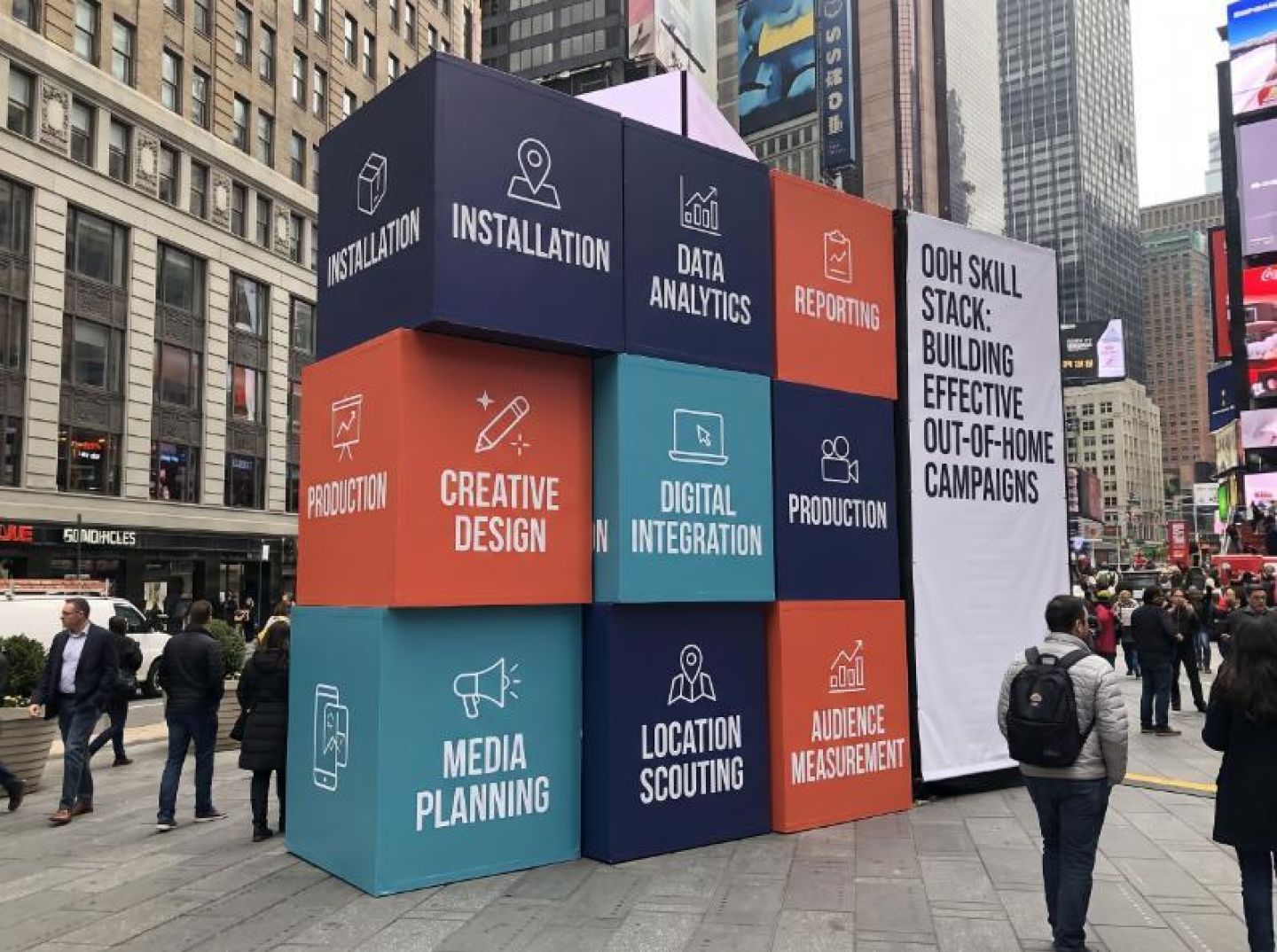
The modern OOH marketer isn’t “a billboard person” anymore. They’re a hybrid operator sitting at the intersection of media, data science, and investigative work. To thrive in a channel that’s now programmatic, AI‑assisted, and accountable, you need a skill stack that looks a lot less like “market rep with hustle” and a lot more like “cross‑channel spy with a P&L.”
At a minimum, that stack breaks into five layers.
1. Channel Fundamentals: Boards, Formats, Markets (Still Non‑Negotiable)
The old craft doesn’t disappear; it just moves from the foreground to the foundation. You still need to understand the realities of inventory: sightlines, clutter, seasonal demand, zoning quirks, landlord games. A planner who can’t tell a high‑impact bulletin from a cheap impression generator is a liability.
But those fundamentals are now table stakes. The differentiator is what you can do once that inventory is wired into a larger data and measurement ecosystem.
2. Data and Attribution Literacy: From PDF Recaps to Proof
Modern OOH is increasingly judged on the same terms as digital. Platforms like AdQuick are already delivering impression, movement, and performance data in real time, putting “unmeasurable” boards into parity with other performance channels. That means the baseline OOH skill is no longer “can I get a makegood if this underdelivers?” but “can I design and defend a measurement framework that will survive a CFO’s scrutiny?”
Industry leaders like Jawad Hassan argue that OOH’s biggest brake on growth is the gap between what the medium can do and how it’s measured and compared across channels. Your job as a modern OOH marketer is to bridge that gap at the campaign level: build clean test designs, align on a “single source of truth” with analytics, and translate movement or exposure data into credible business outcomes.
This mirrors what’s happening in adjacent disciplines. A recent analysis of 1,500+ SEO job descriptions found that “measurement” is the single strongest hiring signal, appearing in 79% of roles, well ahead of shiny AI buzzwords. Employers still want people who can build analytics, reporting, and dashboards that explain what happened and why. The same expectation is quietly arriving in OOH.
3. AI and Optimization Fluency: Beyond Tool Name‑Dropping
In an environment where platforms can analyze “trillions” of unit combinations with machine learning to determine the optimal mix of locations, timings, and formats, you don’t need to be the person coding the model. You do need to be the person who knows what questions to ask it.
Think of AI as a force multiplier for planning and optimization. The skill isn’t “prompt engineer”; it’s “scenario architect.” You should be able to frame hypotheses, feed the right constraints, and interpret what an AI‑driven planner is telling you about trade‑offs between cost, reach, and fit with other channels. That’s the same pattern visible in AI search hiring, where employers are asking for broad AI fluency and the ability to integrate it into strategy, not just someone who can name the latest tool or interface.
In OOH, that means using AI‑powered platforms to pressure‑test your instincts, identify non‑obvious placements, and optimize mid‑flight instead of rubber‑stamping a static plan.
4. Cross‑Channel “Spycraft”: Reading Signals Others Miss
This is where the job starts to look like intelligence work.
OOH doesn’t live in a vacuum anymore. A board’s value is no longer just what passes underneath it; it’s the “halo effect” it throws off into adjacent digital campaigns. Your real leverage comes from being able to quietly trace those effects and surface them before your client or your boss even knows to ask.
Cross‑channel spycraft looks like:
This requires comfort with analytics tools, cross‑channel reporting, and the political skill to tell a performance marketer, “We made your numbers better—here’s the evidence,” without triggering channel turf wars.
5. High‑Fidelity Communication and Dealcraft
Finally, none of this matters if you can’t sell it—inward and outward. Veteran OOH leaders have pointed out that the difference between top performers and merely “busy” reps is not their calendars but their behaviors in the room: they listen differently, ask better questions, and build trust over time. In a data‑driven environment, that communication layer has to evolve.
You need to translate complex data stories into simple narratives that make a CMO lean in instead of glaze over. You need to walk a skeptical procurement lead through why a programmatic DOOH buy belongs in the same optimization loop as their other biddable media. And you need to negotiate with plant operators and tech partners from a position of informed strength, not folklore and favors.
The through‑line across all five layers is this: “experience” with boards is now the floor, not the ceiling. The real advantage belongs to marketers who can see OOH as one node in a messy, AI‑accelerated ecosystem—and who have the spycraft to connect the dots the résumé‑driven hiring process still doesn’t know how to test for.
If you still describe OOH as a “branding play,” you’re already behind how your buyers think. To modern performance marketers, every line item in the media plan has to justify its existence in a dashboard. That means OOH can’t just be “boards up, awareness up.” It has to be “boards up, revenue up” — with a defensible line from one to the other.
The technology is finally there. Platforms like AdQuick position themselves as a “universal adapter,” piping in mobile location data, third‑party audiences, and conversion signals so planners can see the “halo effect” OOH has on adjacent digital campaigns in real time. As their team explains, this data infrastructure is moving OOH “from a world of intuition to a future defined by precision and performance,” putting it in near‑parity with channels that have been performance‑native for a decade.
But the tech is the easy part. The real gap is the humans using it.
Modern OOH hires need to be able to connect what happens on a board to what shows up in the CRM, the e‑commerce platform, or the bookings ledger. That starts with measurement fluency. When researchers at Moz analyzed 1,543 AI search and SEO job descriptions, “measurement” showed up in 79% of them — more than any other skill. Even in a space flooded with shiny AI language, hiring managers still screen for people who can define KPIs, build dashboards, and explain performance shifts.
That same mindset is now table stakes in OOH. You’re not hired to “get us up on some premium units.” You’re hired to:
This is exactly where the industry’s structural weaknesses show. As Jawad Hassan notes in his piece on “rethinking measurement in OOH toward a single source of truth”, most markets still run on fragmented methodologies, inconsistent metrics, and PDF‑style post‑campaign reports. That fragmentation doesn’t just annoy planners; it blocks OOH from integrating into the unified data ecosystems that power sophisticated media mixes.
A performance‑oriented OOH operator has to work against that fragmentation, not be defined by it. Concretely, that means:
This is where “spycraft” shows up as revenue, not theater. The best OOH marketers reverse‑engineer the customer journey: they track where exposed audiences go online, which queries spike near their sites, which SKUs move faster in stores within a certain radius, and how retargeting pools grow in OOH‑heavy markets versus controls. They aren’t satisfied proving that “people saw the board.” They’re obsessed with proving that the board changed what people did.
And internally, that measurement discipline is non‑negotiable. Jonathan Graviss describes how many independent operators make their first marketing hire reactively, then grow disillusioned when they can’t “connect it directly to revenue,” because there was no scope, baseline, or success framework in place. His argument in “Why the First Marketing Hire Is the Hardest Internal Sell in Independent OOH” is effectively a warning: if you can’t show how marketing turns into money, you won’t keep the seat you just fought for.
Translate that to today’s OOH roles, and the silent skill gap is obvious. We’re still over‑indexing on people whose superpower is “knowing every plant in the market,” and under‑hiring for people who instinctively think in attribution models, incrementality tests, and cross‑channel lift. Experience without that performance layer doesn’t cut it anymore.
OOH has finally become measurable enough to fight for real budget. The operators who win that fight will be the ones who can run the spycraft on the front end and walk a CFO, line by line, from a set of boards on a map to the revenue that hit the books.
Stop hiring for “billboard people.” Start hiring for translators.
If OOH is going to live in the same budget conversations as paid search, CTV, and retail media, employers have to overhaul both what they ask for and what they reward. The goal isn’t a unicorn. It’s a very specific hybrid: someone who can think like a performance marketer, work like an analyst, and negotiate like an operator.
Most OOH hiring mistakes start where Jonathan Graviss says most first marketing hires do: as pressure relief, not as a defined function. The role is created to “fix” neglected items — decks, social posts, one‑off reporting — and never anchored to how the business makes and keeps money. As Graviss points out in his breakdown of why the first marketing hire is such a hard internal sell, activity without a revenue framework is a setup for disappointment, not a strategy, especially in independent OOH shops that already run lean on headcount and patience for “soft” roles (OOH Today).
If OOH is now a performance channel, employers need to do three things before they ever post a role:
Jawad Hassan describes OOH’s current state as a fragmented measurement patchwork that lags behind the channel’s real capabilities, limiting integration into broader media plans and constraining growth (OOH Today). Your hire should explicitly be tasked with closing that gap for your company — not just “pulling reports.”
2. Hire for cross‑channel “spycraft,” not channel purity.
In AI search, employers are already signaling that broad, system‑level understanding matters more than any one interface; generic “AI search experience” appears far more than niche platform names like Perplexity or ChatGPT, and “prompt engineering” barely registers in 2.6% of listings (Moz’s report). The OOH parallel: don’t fetishize a specific DSP, CMS, or traffic system. Prioritize people who can:
This is the “spy” part of the role: pattern recognition across walled gardens, conflicting metrics, and incomplete logs.
3. Make commercial acumen non‑negotiable.
You’re not hiring for campaign babysitters; you’re hiring for mini P&L owners. That means:
Graviss’s warning about roles that inherit “all the neglected things” applies here: if you don’t tie the job to hard financial outcomes, your marketer becomes a catch‑all service desk and the first budget cut when times tighten (OOH Today).
If you want to be taken seriously as a cross‑channel OOH operator, you have to present yourself as the translator employers are finally realizing they need.
This echoes the way AI search candidates are now turning vague “SEO plus AI tools” into concrete outcomes and vocabulary aligned with how hiring managers think about measurement and attribution, as outlined in the.
2. Make your cross‑channel thinking explicit.
Show how you connected dots that weren’t supposed to connect:
3. Show that you can operate inside ambiguity.
Employers know OOH measurement is probabilistic and fragmented; Hassan’s call for a “single source of truth” highlights just how unresolved the ecosystem is (OOH Today). Your edge is the ability to:
Receive top converting landing pages in your inbox every week from us.
Must Read
Explore why traditional OOH experience is no longer enough as out-of-home advertising becomes more data-driven, measurable, and connected to digital channels. This guide outlines the cross-channel, measurement, AI, and competitive-intelligence skills modern OOH employers and candidates need.
David Kim
7 minSep 25, 2026
How-To
Learn how to measure whether sports-star and celebrity advertising actually delivers efficient CPC, CPA, search lift, and downstream conversions. This guide shows how to test celebrity creative against creator alternatives and use competitive intelligence and measurement to turn expensive star power into a measurable performance asset.
Elena Morales
7 minSep 25, 2026
Quick Read
Ad-spy tools and performance marketing are helping reshape OOH from a traditional media channel into a data-driven, programmable performance environment. This guide explores how competitive intelligence can influence OOH hiring, talent requirements, funnel strategy, measurement, and agentic AI workflows.
Dan Smith
7 minSep 23, 2026