7 minJuly 7, 2026

Our spy tools monitor millions of TikTok ads from over 55+ countries. Biggest TikTok Ad Library in E-commerce and Mobile Apps!
Try It FREEFor most of the digital advertising era, targeting and creative lived in separate rooms. Media buyers built audience segments in dashboards—layering demographics, behavioral signals, interest categories, and contextual keywords—while creative teams produced assets designed to perform once the right eyeballs had already been selected. The implicit assumption was clear: find the audience first, then show them something compelling. That sequence is now inverting, and TikTok is the platform that made the reversal impossible to ignore.
TikTok's recommendation engine doesn't begin with the advertiser's audience inputs. It begins with the content itself. When a video enters the ecosystem, the algorithm serves it to a small, semi-random cluster of users and watches what happens next. Watch-through rate, replays, shares, comments, saves—these engagement signals determine whether the content gets pushed to a broader audience or dies quietly after a few hundred impressions. As Neil Patel has noted, TikTok's algorithm rewards content quality over account size, meaning a brand-new account with a sharp fifteen-second video can outperform an established one running mediocre creative against a meticulously built lookalike audience. The creative is the qualification mechanism. Its performance characteristics tell the algorithm who should see it, not the other way around.
This is a structural departure from platforms like Meta and Google, where advertisers have historically exercised granular control over who enters their funnel. On TikTok, the content's early-audience resonance functions as a real-time targeting signal that no amount of dashboard tinkering can replicate. And the scale of the advantage is hard to dismiss: TikTok's engagement rates run roughly eight times higher than Instagram's, a gap that reflects not just user behavior but the platform's architectural commitment to surfacing content based on merit rather than social graph or spend.
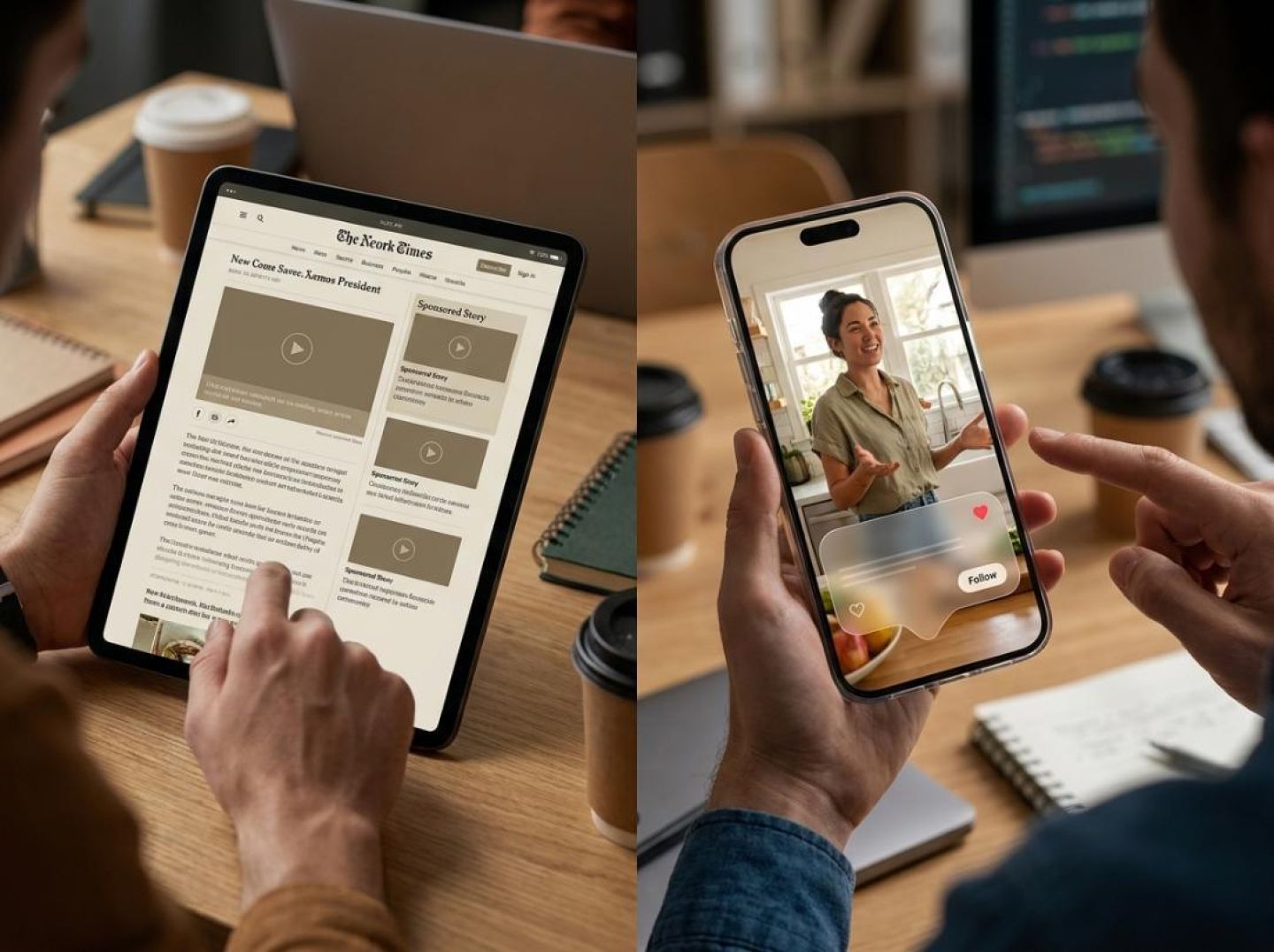
Native advertisers understood a piece of this puzzle before performance marketers did. The foundational principle of native advertising—that paid media should mimic the look, feel, and function of its editorial environment—was always an argument about creative relevance as a distribution advantage. When an ad blends seamlessly into a feed, users engage with it rather than scroll past, and that engagement generates downstream performance. Native ad spend now accounts for nearly sixty percent of total display spending in the United States precisely because this principle works. The approach proved that creative context matters for distribution, and that matching form and function to the platform isn't a nice-to-have—it's a prerequisite for attention.
But native advertising stopped at the threshold of the deeper insight. Blending in with the environment was treated as a design discipline, a way to reduce friction. It was rarely framed as a targeting discipline—a mechanism for signaling to an algorithm which audiences the content should reach. TikTok closed that gap. On its platform, the creative doesn't just earn attention within a pre-selected audience; the creative determines which audience materializes in the first place. The hook, the pacing, the visual language, the soundtrack, the emotional arc—every element sends algorithmic signals that function exactly the way a demographic filter or behavioral segment used to.
The implication for performance marketers is stark. Creative development and audience strategy are no longer adjacent workflows that sync up in a campaign brief. They are the same workflow. When the algorithm uses content performance as its primary sorting mechanism, every creative decision—from the first frame to the call to action—is simultaneously a targeting decision. The two disciplines haven't merged by choice; the infrastructure merged them by design.
TikTok's 2026 product roadmap is the clearest proof yet that the platform sees creative quality—not audience segmentation—as the primary lever advertisers should be pulling. Every major format unveiled at this year's IAB NewFronts hands brands a reach guarantee, but none of them let you coast on placement alone. The creative still has to earn its keep.
Start with Logo Takeover, the highest-impact unit in TikTok's new lineup. It plants your brand at the exact moment a user opens the app, co-branded with TikTok itself for an implicit trust signal. Early tests showed double-digit lifts in both brand awareness and purchase intent, which is the kind of benchmark that gets CFOs to pay attention. But the format's power comes with a constraint: it occupies the most scrutinized real estate on the platform, the first thing a user sees. If the creative feels like a banner ad that wandered in from a display network, those lift numbers collapse. TikTok-native creative authenticity remains essential even within these premium placements, because users who open the app expecting entertainment will scroll past anything that doesn't match the visual grammar they came for.
Prime Time works on a similar principle at a different timescale. The format sequences up to three ads from the same brand to the same user inside a 15-minute window, timed to peak engagement periods. That kind of sequential storytelling gives advertisers something television has offered for decades—narrative progression across multiple exposures—but in an environment where every individual frame competes against swipe-away behavior. The sequencing only works if each creative in the chain is compelling enough to survive the For You feed. The media buy delivers the distribution. The creative determines whether that distribution compounds or collapses.
Then there's the infrastructure that connects everything: Symphony AI and Search Hubs. As Social Media Examiner reported, TikTok is rebuilding the entire marketing funnel inside one app, and Symphony is the engine making that possible at the creative layer. The tool generates a fresh, auto-generated video option each day based on a brand's past activity and product catalog, then cycles out underperformers and scales winners automatically. That workflow—produce, test, kill, scale, repeat daily—is essentially automated creative-as-targeting optimization. It treats each new video variation as a targeting hypothesis, letting the algorithm discover which visual approaches, hooks, and narratives resonate with which pockets of the audience. The media buyer isn't selecting segments; the creative is finding them.
Search Hubs extend that logic to intent-based discovery. These paid placements sit at the top of TikTok search results, giving brands control over the search experience around their products using videos, banners, and creator content. But unlike a Google Shopping ad that succeeds on bid and relevance score alone, a Search Hub lives inside a content feed. The surrounding context is still video. The user's expectation is still entertainment. The creative still has to belong.
What makes TikTok's product strategy so revealing is the consistency of the underlying message across wildly different formats. Logo Takeover is a brand-awareness play. Prime Time is a storytelling play. Symphony is a performance play. Search Hubs are an intent-capture play. They span the entire funnel—yet every single one depends on the same thing: whether the creative is good enough to activate the distribution the platform is selling. TikTok isn't offering you audiences. It's offering you distribution that only fires when the creative earns it, which makes creative iteration the last targeting lever that actually scales.
Native advertising got the diagnosis right: ads perform better when they don't feel like ads. That insight alone was worth billions. As Basis has noted, native advertising is the "veritable chameleon of the digital marketing world," mimicking the look, feel, and function of its editorial environment so effectively that consumers sometimes don't even register they're engaging with paid media. The approach worked well enough that native ad spend grew to account for nearly 60% of total US display spending, and research identified native as the most impactful channel for brand favorability. By any measure, the format proved its thesis: blending in beats interrupting.
But proving a thesis and fully exploiting it are different things. Native advertising's infrastructure evolved almost entirely around the where—which publisher, which content vertical, which recommendation widget, which contextual signal. The optimization stack rewarded placement precision: get your branded article next to a relevant editorial piece, match the typeface, mirror the headline cadence, and let contextual alignment do the heavy lifting. Creative mattered, of course, but it mattered in the way a costume matters to a background extra—good enough to avoid breaking the illusion, rarely good enough to carry the scene.
This was surface-level mimicry dressed up as strategic sophistication. The chameleon metaphor that native advertisers loved to invoke actually reveals the limitation they overlooked. Real chameleons don't just match their surroundings to disappear. They shift color to regulate temperature, signal dominance, and attract mates. Camouflage is one function among many—and arguably not the most important one. Native advertising perfected the camouflage and then stopped evolving, building its entire optimization logic around blending into the right editorial habitat rather than asking a harder question: could the content itself determine who engages with it, regardless of where it lives?
TikTok answered that question by removing the variable entirely. Every ad on TikTok lives in the same environment—the For You feed. There's no premium publisher to ride, no contextual adjacency to lean on, no recommendation widget placement to optimize. As Neil Patel's analysis of TikTok's ad ecosystem explains, the platform's algorithm rewards content quality over account size, which means strong creative can reach audiences far beyond your existing follower base. The placement is uniform; the creative is the only differentiator. That constraint forced a revelation native advertisers should have arrived at years ago: when the content is genuinely good—when it entertains, educates, or provokes in the specific idiom its audience already speaks—it doesn't need contextual scaffolding to find the right people. The algorithm reads engagement signals and distributes accordingly. The creative selects its own audience.
This is the function that native advertising understood in theory but never operationalized. The founding principle was always that format harmony creates receptivity. What the industry missed was the next logical step: if matching the form of surrounding content improves performance, then matching the substance—the storytelling rhythms, the emotional texture, the cultural specificity that a particular audience craves—should improve it exponentially more. Native advertisers who still define their competitive advantage as contextual placement are working from an incomplete version of their own founding insight. They built the chameleon's skin but never gave it a brain. TikTok's native creative quality drives higher engagement and better conversion performance not because the ads blend into a feed visually—that's table stakes—but because the best-performing ads behave like the content their target audience already chooses to watch. The creative doesn't just match the background. It attracts exactly the right viewers through behavior, not camouflage alone.
If the previous sections establish that algorithms reward creative quality and that native advertising mastered form without fully leveraging function, the logical next move is to rethink what creative research actually is. Most performance marketers still treat competitive creative analysis as a source of inspiration—a swipe file to spark ideas for their next ad. That framing is dangerously incomplete. In a world where algorithms decide who sees what based on engagement signals, studying which creatives survive and scale isn't just a creative exercise. It's targeting research.
Consider the math. When 97% of all social network ad spending is native, the overwhelming majority of ads people encounter are algorithmically distributed based on predicted relevance, not manually placed in front of pre-selected demographics. The algorithm observes how users interact with a piece of creative—watch time, tap-through rate, saves, shares, comments—and then finds more people who behave similarly. The creative itself becomes the query the algorithm runs against its audience graph. A hook that opens with a vulnerable personal confession selects for a fundamentally different audience than one that opens with a bold product claim, even if both ads sell the same supplement. The headline is the targeting parameter. The visual tone is the lookalike signal. The narrative arc is the qualification funnel.
This is why competitive intelligence tools like Anstrex Instream and Anstrex Native need to be reframed. When you filter Anstrex's database to find the longest-running TikTok ads in a vertical—the creatives that have sustained spend across weeks or months—you're not browsing a mood board. You're looking at targeting hypotheses that survived contact with reality. Every element of those ads was pressure-tested by an algorithm distributing them to millions of users and measuring real-time response. The ones still running are the ones the algorithm kept rewarding, which means they found and held an audience segment that converts. You're seeing the revealed preferences of real humans, encoded in creative decisions.
The same logic applies on the native side. When you use Anstrex Native to analyze which headlines, thumbnail styles, and emotional registers dominate content recommendation networks like Taboola or Outbrain across specific geos and verticals, you're extracting audience intelligence that no keyword planner or interest-based panel can replicate. You're learning what language, imagery, and framing resonated deeply enough to sustain real ad budgets at scale.
TikTok's own infrastructure reinforces this principle. As Social Media Examiner has detailed, Symphony's approach involves generating fresh ad variations daily and then cycling out underperformers while scaling winners based on in-platform performance signals. The system doesn't ask who should see the ad—it watches what works and lets the creative do the sorting. A marketer studying the outputs of that system across thousands of advertisers isn't just gathering "inspiration." They're reverse-engineering what the algorithm has already validated as effective audience selection.
This is the strategic unlock most advertisers miss entirely. They invest in audience research tools, commission persona workshops, and build elaborate targeting matrices—then hand off a brief to a creative team that works from gut instinct and a handful of saved screenshots. The smarter move is to treat competitive creative intelligence as the primary source of targeting insight. Study what runs longest, at the highest spend, across which platforms and regions. Deconstruct the hooks, the emotional registers, the narrative structures. Map the patterns. What you'll find isn't a swipe file. It's a targeting map drawn by algorithms processing billions of real human decisions—and no focus group on earth can compete with that.
Knowing that creative is targeting only matters if you can turn that insight into a repeatable process. Theory without workflow is just a conference talk. Here is a practical framework—distilled from the principles above—that performance marketers can begin running this week.
Step 1: Mine the Algorithm's Own Signals for Creative Intelligence
Start every campaign cycle not with a brainstorm, but with competitive creative research. Use the ad libraries discussed in the previous section to identify winning patterns: hooks, pacing, visual formats, and narrative structures that the algorithm is already distributing at scale. Catalog these by vertical, audience archetype, and engagement signal. This isn't about copying—it's about understanding which creative variables the algorithm treats as proxy targeting signals. As the Voluum Blog has emphasized, the differentiator between you and every competitor is creativity, since you both get the same number of pixels. The research phase tells you which pixels are doing the most work.
Step 2: Generate Volume Through AI-Assisted Production
A single polished hero ad is no longer sufficient. The creative-as-targeting model demands volume, because each variation is essentially a separate targeting hypothesis. This is where TikTok's own tooling becomes a force multiplier. Symphony's daily video generation feature auto-produces a fresh, customized video option every day based on your brand's past activity in Symphony Creative Studio. That cadence—one new asset per day, minimum—should become your baseline, not your ceiling. Layer in manual variations (different hooks on the same body, alternate CTAs, new thumbnail frames) to multiply output without multiplying production hours. The goal is to produce ten to twenty creative variations per campaign sprint, each encoding a slightly different audience hypothesis in its format, language, tone, or visual style.
Step 3: Launch Wide and Let the Algorithm Sort
Resist the urge to pre-segment. Upload all variations into a single broad-targeted campaign and let algorithmic distribution do what it does best: match creative to receptive clusters in real time. The variations themselves will self-select their audiences based on early engagement patterns. Your job at this stage is restraint—give the system forty-eight to seventy-two hours of signal accumulation before making decisions.
Step 4: Read Performance as Audience Data
After the initial learning window, analyze which creatives the algorithm is distributing, to whom, and at what cost. Each winning variation reveals an audience segment you may not have anticipated. Export this data—demographic breakdowns, interest overlaps, engagement curves—and feed it back into your creative research repository. These are not just performance metrics; they are targeting discoveries.
Step 5: Cycle Ruthlessly
The system that Keenya Kelly described—one smart enough to cycle out underperformers and scale winners automatically—is the operational heartbeat of this framework. Kill any variation that fails to clear your cost-per-action threshold within the learning window. Promote winners by increasing budget allocation. Then immediately begin producing the next batch of variations, informed by the audience data extracted in Step 4. This loop—research, produce, distribute, read, cycle—should repeat on a weekly cadence at minimum.
The Underlying Discipline
What makes this framework different from standard creative testing is the mental model underneath it. You are not testing ads to find "the best one." You are deploying creative as a distributed targeting mechanism, where every variation is a probe sent into the algorithm's recommendation engine. As Neil Patel has noted, TikTok's algorithm rewards content quality over account size, meaning strong creative can reach audiences far beyond your existing follower base. That architectural reality is what makes creative-as-targeting not just viable but structurally superior to traditional audience segmentation on platforms built this way. The marketers who operationalize this loop fastest will compound their advantage with every cycle.
Receive top converting landing pages in your inbox every week from us.
Most Read
Discover how OOH teams can use Native, Push, and TikTok ad intelligence to move beyond location-first planning and build smarter, audience-driven campaigns. This guide shows how to translate digital creative, targeting, and performance signals into OOH ideas, test them in the physical world, and feed the results back into digital campaigns.
David Kim
7 minOct 4, 2026
Most Read
Learn how OOH employers can move beyond selling billboard inventory and start monetizing the full funnel impact of every outdoor impression. This guide shows how to connect OOH with Native and TikTok-style funnels using competitive intelligence, creative research, tracking, retargeting, and performance-focused roles.
Rachel Thompson
7 minSep 28, 2026
Must Read
Learn how to transform one powerful brand moment into scalable Native, Push, and Pop funnels instead of relying on a single hero ad. This guide covers modular creative, TikTok funnel thinking, competitive intelligence with Anstrex, cross-channel testing, and a repeatable creative supply chain.
Dan Smith
7 minSep 26, 2026