6 minJune 7, 2026

Our spy tools monitor millions of native ads from over 60+ countries and thousands of publishers.
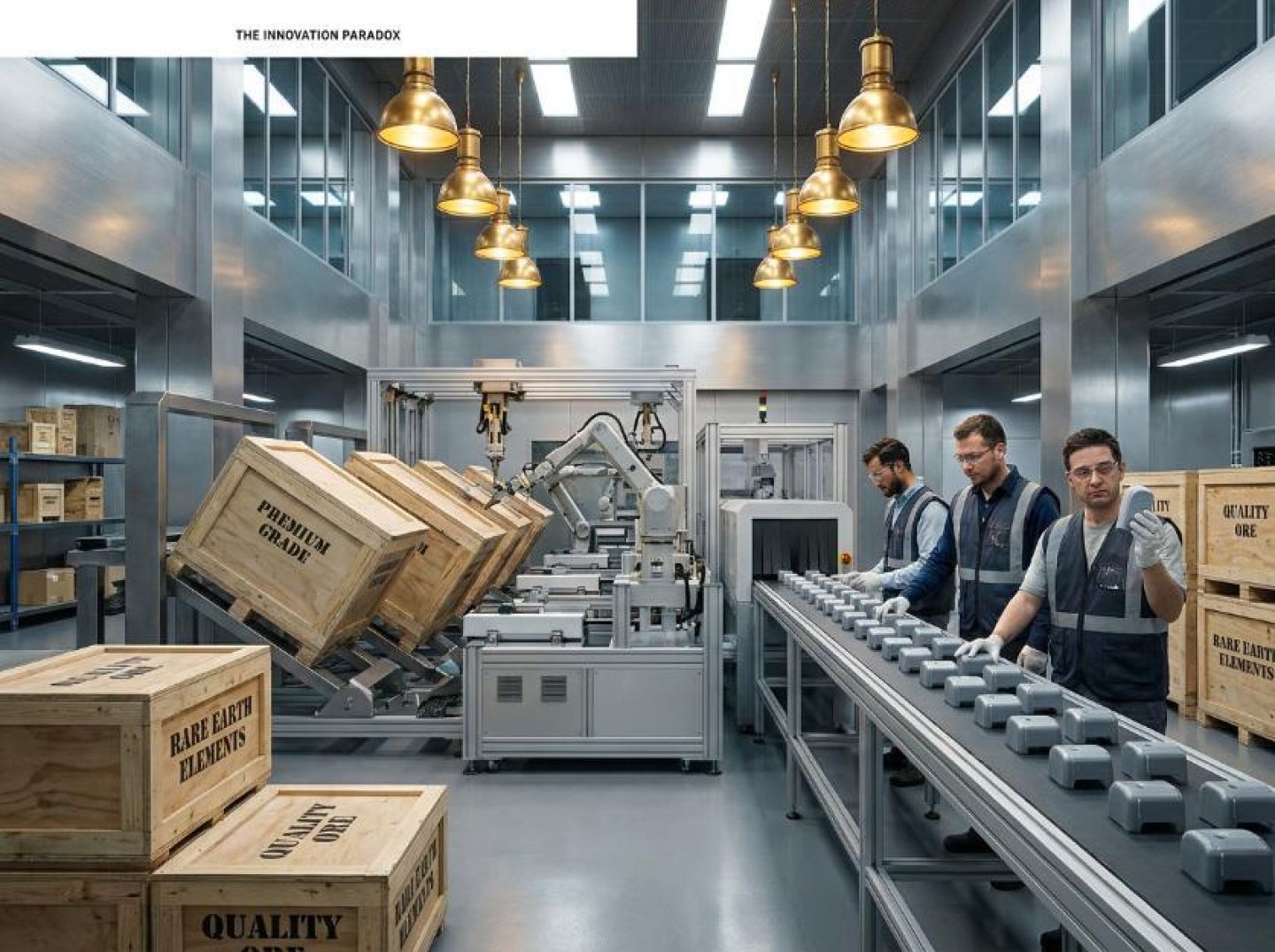
Get StartedThe tools have never been this good, this cheap, or this easy to use. Product images that once required a studio, a photographer, and a four-figure invoice can now be generated for pennies. Generative AI can create ad copy variations, resize images for different platforms, and adapt video creative at scale, compressing weeks of production into hours. U.S. businesses are expected to pour $57 billion into AI-powered advertising this year alone — roughly 12% of total ad spend. The creative gold rush is real, and for the first time, a two-person e-commerce brand can theoretically match the output volume of a mid-size agency.
But output volume and output quality are not the same thing, and this is where the gold rush has a garbage-in problem.
Most marketers adopting these tools skip straight to the generation step. They open a prompt window, type some version of "make it pop" or "create an eye-catching ad for our summer sale," and expect the AI to fill in the blanks. When the results come back looking generic — flat copy, stock-photo aesthetics, messaging that could belong to any brand in any category — they blame the tool. The tool isn't the problem. The input layer is.
As Fraser Cottrell explains in Social Media Examiner, getting AI to produce what you actually want requires significant effort — far more than most people assume. The common misconception that AI creative is lazy or low-quality misses the real bottleneck: AI is only as good as the context and instructions you give it. Current image models can produce visuals nearly indistinguishable from professional photography, but only when they're grounded in genuine brand knowledge — who your customers are, what your brand stands for, and what a great ad actually looks like for your specific audience. Without that foundation, you're just generating noise at scale.
And scale without signal is expensive. Meta's Andromeda update has made this lesson harder to ignore, because the platform now treats hundreds of slight variations of the same ad as a single creative. The old playbook of flooding the zone with near-identical assets and letting the algorithm sort it out is dead. Advertisers need genuinely different variations — different angles, different hooks, different emotional registers — and that kind of creative diversity can't come from a vague brief and a prayer.
This is the paradox at the center of the AI creative boom: the democratization of production has made the intelligence layer the scarcest resource. When everyone has access to the same tools, the competitive advantage shifts entirely upstream — to research, to audience understanding, to brand strategy, to the quality of the questions you ask before you ever hit "generate." The barrier to great AI ad creative is no longer cost, quality, or access. It's what you know before you start producing.
Yet most marketing teams are still structured around the old bottleneck. They invest in designers, copywriters, and production pipelines while treating strategy and audience intelligence as a one-time exercise — a brand brief written once and never revisited. In an era where creative strategy must shift upstream and continuous testing demands continuous learning, that approach is like buying a Formula 1 car and filling it with regular unleaded. The engine is capable of extraordinary things. But what you feed it determines whether you win or stall on the first lap.
Most marketing teams approach AI creative tools the same way they'd onboard a new junior designer: hand over the brand guidelines, share the mood board, point to a few past campaigns that performed well, and say "make something like this." The inputs feel substantial — logo usage rules, hex codes, tone-of-voice documents, buyer persona PDFs with stock-photo headshots and invented names like "Marketing Mary." But these are internal artifacts. They describe the brand as it wishes to be perceived, not the market as it actually behaves.
This is the default recipe: dump your brand brief into a generative tool, maybe paste in some product descriptions and a few bullet points about your ideal customer, then hit generate. The output looks polished. It sounds on-brand. And it's almost indistinguishable from what every competitor running the same playbook produces, because the inputs are structurally identical — brand-centric, inward-looking, and disconnected from what's actually winning attention right now.
To be fair, some practitioners have recognized this problem and tried to fix it. Fraser Cottrell's three-step system, outlined in Social Media Examiner, argues that the foundational step before any AI generation is building a deep brand knowledge base — training the model on who your customers are, what your brand stands for, and what a great ad looks like. That framework is a meaningful step up from the "paste your brand guidelines and pray" approach. It treats context-building as serious strategic work rather than an afterthought, and it correctly identifies that AI creative quality is bounded by the quality of the inputs you provide.
But even this more rigorous methodology has a blind spot. The knowledge base it constructs is still fundamentally internal. It asks: What does our brand believe? Who are our customers? What does our best creative look like? Those are necessary questions, but they're radically insufficient. Your brand brief tells AI what you want to say. It tells it nothing about what's actually working in your vertical right now — which competitor hooks are surviving ad platform algorithms, which visual styles are earning engagement in your category, which messaging angles audiences are responding to this week rather than last quarter.
This gap matters more than most marketers realize, because the external signal environment is deteriorating fast. When every team generates AI content quickly and repeatably without rigorous evaluation, the flood of competent-but-generic creative overwhelms the channels. The evaluation infrastructure that used to separate good creative decisions from bad ones — the experienced creative director's eye, the media buyer's pattern recognition, the slow feedback loop of quarterly brand studies — stops working at the speed and scale AI operates. The signal-to-noise ratio collapses, and "on-brand" becomes a synonym for "invisible."
Consider what's absent from every brand brief you've ever written: a real-time competitive creative audit. A structured analysis of which ad formats are earning disproportionate engagement in your category. An understanding of the messaging white space — the things your competitors aren't saying that your audience actually wants to hear. These external signals are the difference between creative that reflects your brand and creative that moves your market.
Internal brand knowledge gives AI the vocabulary. External market intelligence gives it the strategy. Without both, you're not generating ads — you're generating expensive mood boards that happen to have a call-to-action button attached.
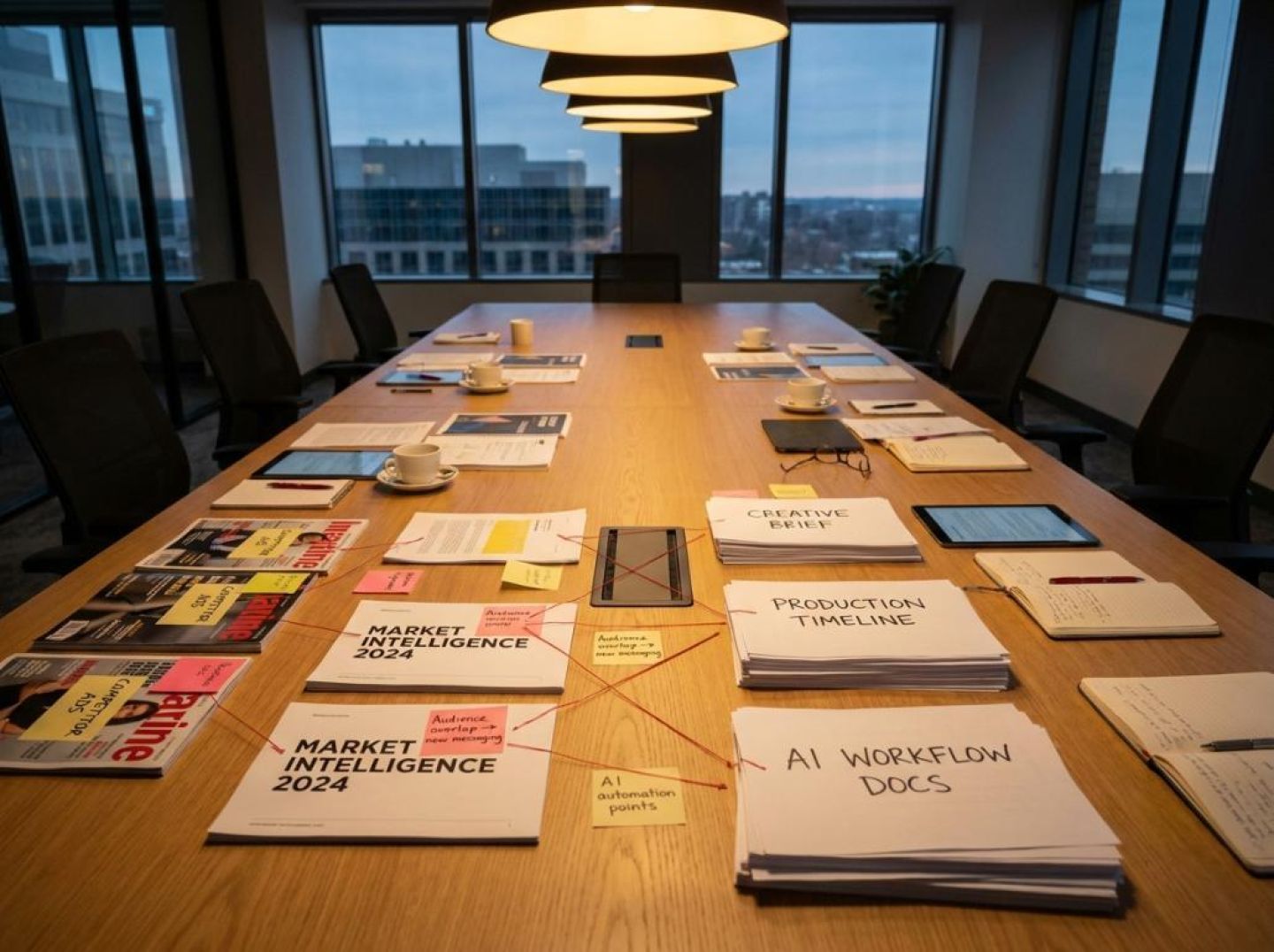
The industry talks about competitive intelligence and AI creative tools as if they occupy separate rooms in the marketing workflow. First, you research — pulling ads from spy tools, scanning competitor landing pages, noting which hooks and formats seem to be gaining traction. Then, you switch contexts entirely, open your generative AI tool, feed it your brand brief, and start producing. The research informs your thinking, sure, but it rarely informs the machine. That disconnect is where most teams lose the advantage they thought they'd gained.
Consider what's actually happening when a competitor's ad has been running for ninety days straight across multiple geos. That longevity isn't aesthetic preference — it's a market-validated performance signal. The ad is surviving daily budget scrutiny, platform algorithm shifts, and audience fatigue because it works. The hook structure, the visual approach, the format, the offer framing — all of it has been pressure-tested by real spend. Now multiply that signal across hundreds or thousands of active ads in your vertical, and you're looking at something far more valuable than a mood board: you're looking at a training set.
This is the reframe that matters. Platforms like Anstrex exist to surface exactly this kind of data — which creatives are actually running, how long they've been live, what networks they're scaling on, what angles are being tested across verticals. Most teams use that intelligence to inspire their next campaign. The smarter operators use it as structured input for their AI creative tools, treating proven ad patterns as the foundational data layer that tells the model what to produce before it generates a single image or headline.
The principle is already validated at scale. DAIVID's creative effectiveness models were trained on tens of millions of human ad responses to predict which creative will perform before it ever runs — establishing that AI creative intelligence improves dramatically when grounded in real-world performance data rather than assumptions or internal benchmarks. Their CEO, Ian Forrester, identified the core problem directly: creative has been "measured in isolation, disconnected from media results" for too long. The same logic applies upstream. If your AI is generating creative disconnected from what's actually winning in-market, you're building on the same isolation.
The workflow implications are significant. As MarTech has argued, creative strategy must shift upstream, with leading advertisers deploying continuous creative optimization loops where AI evaluates engagement signals and automatically evolves messaging. But most teams interpret "upstream" as earlier in the internal planning process — tighter briefs, faster approvals. The real upstream shift is external. It means feeding your AI the competitive landscape as structured data before production begins, then continuing to update that data as the landscape shifts.
When you combine competitive ad intelligence with AI generation in a single workflow — rather than treating them as sequential steps — the output changes fundamentally. Instead of asking your AI tool to create "a Facebook ad for our protein powder targeting fitness enthusiasts," you're asking it to create variations that incorporate the hook structures, visual compositions, and offer angles that have demonstrated traction across your category in the last thirty days. The AI isn't guessing. It's pattern-matching against market reality.
This is the workflow shift the industry hasn't clearly articulated yet: competitive intelligence isn't a research step that precedes AI creative generation. It's the most reliable training data your AI will ever get. The teams that collapse these two activities into one are producing creative that arrives pre-calibrated to market conditions — and they're iterating faster because every new wave of competitive data automatically updates what their AI knows about what works.
Enterprise brands have started calling it the "live loop" — a continuous cycle where creative intelligence informs what gets made, performance data from live campaigns reshapes what intelligence means, and the next round of creative is sharper because of everything that came before. Major publishers are already building infrastructure around this idea; as Marketing Dive reported, networks like WBD and Fox are rolling out dynamic creative systems that adapt headlines and visuals contextually in real time, powered by large-language models and scene-level targeting. But you don't need a custom-built enterprise platform or an upfront media deal with a streaming giant to operate this way. Any marketer with access to competitive intelligence and a capable AI generation tool can build their own version of the loop — and the practical workflow is more straightforward than most people assume.
It starts with structured observation, not inspiration browsing. A marketer using a competitive intelligence tool like Anstrex Native or Instream doesn't just scroll through ads looking for something that "feels right." They filter by vertical, geo, traffic source, and duration. Duration matters most. An ad that has been running for sixty or ninety days with consistent spend behind it isn't surviving on luck — it's surviving on performance. These durable creatives reveal the angles, emotional triggers, visual formats, and landing page architectures that are actually converting in a given market at a given moment. The marketer identifies patterns: maybe in the weight-loss supplement space, before-and-after editorial angles are fading while doctor-authority formats with clinical imagery are gaining traction. Maybe advertorial-style landing pages with embedded video testimonials are outperforming standard long-form sales letters. These aren't hunches. They're data extracted from what competitors are spending real money to run.
The next step is where most workflows break down. Traditionally, the marketer would take those observations, mentally summarize them, switch to a completely different tool — ChatGPT, Midjourney, a design platform — and try to translate what they noticed into a prompt. Context evaporates in the transfer. But when the intelligence layer and the generation layer live in the same environment, as they do with Anstrex's AI ad generation feature, those patterns flow directly into creative production as structured inputs rather than half-remembered impressions. The AI doesn't guess at what's working in the market. It already knows, because the data is right there.
This matters more than ever because of how platforms now evaluate creative. As Social Media Examiner explained, Meta's Andromeda update ended the old practice of running hundreds of slight variations of the same ad — the platform now treats near-duplicates as a single creative. Advertisers need genuinely different ad variations, not cosmetic swaps of button colors or headline synonyms. Intelligence-fed generation solves this because the competitive data itself contains multiple distinct angles, formats, and persuasion structures. When you feed an AI three fundamentally different winning patterns — say, a curiosity-gap headline with a stock lifestyle image, a news-style editorial angle with a clinical photo, and a first-person testimonial format with a UGC-style selfie — you get three genuinely distinct creatives, each grounded in proven market signals rather than invented from nothing.
Contrast this with blind generation. A marketer opens a generic AI tool, types "create a native ad for a keto supplement targeting women over 40," and receives something grammatically correct, visually competent, and strategically hollow. It doesn't know which angles are saturated, which formats audiences in that vertical have grown blind to, or which landing page structures are currently earning clicks. It produces creative in a vacuum — and vacuums don't convert.
The live loop closes when performance results from the ads you launched feed back into the next intelligence cycle. The creatives that earned the highest CTRs and lowest CPAs join the competitive landscape you're already monitoring. You spot which of your hypotheses held, which angles fatigued faster than expected, and which new competitor creatives have emerged since your last cycle. Then you generate again — not from scratch, but from an updated, richer foundation. Each rotation tightens the feedback between what the market rewards and what your AI produces, turning creative generation from a one-shot event into a compounding advantage.
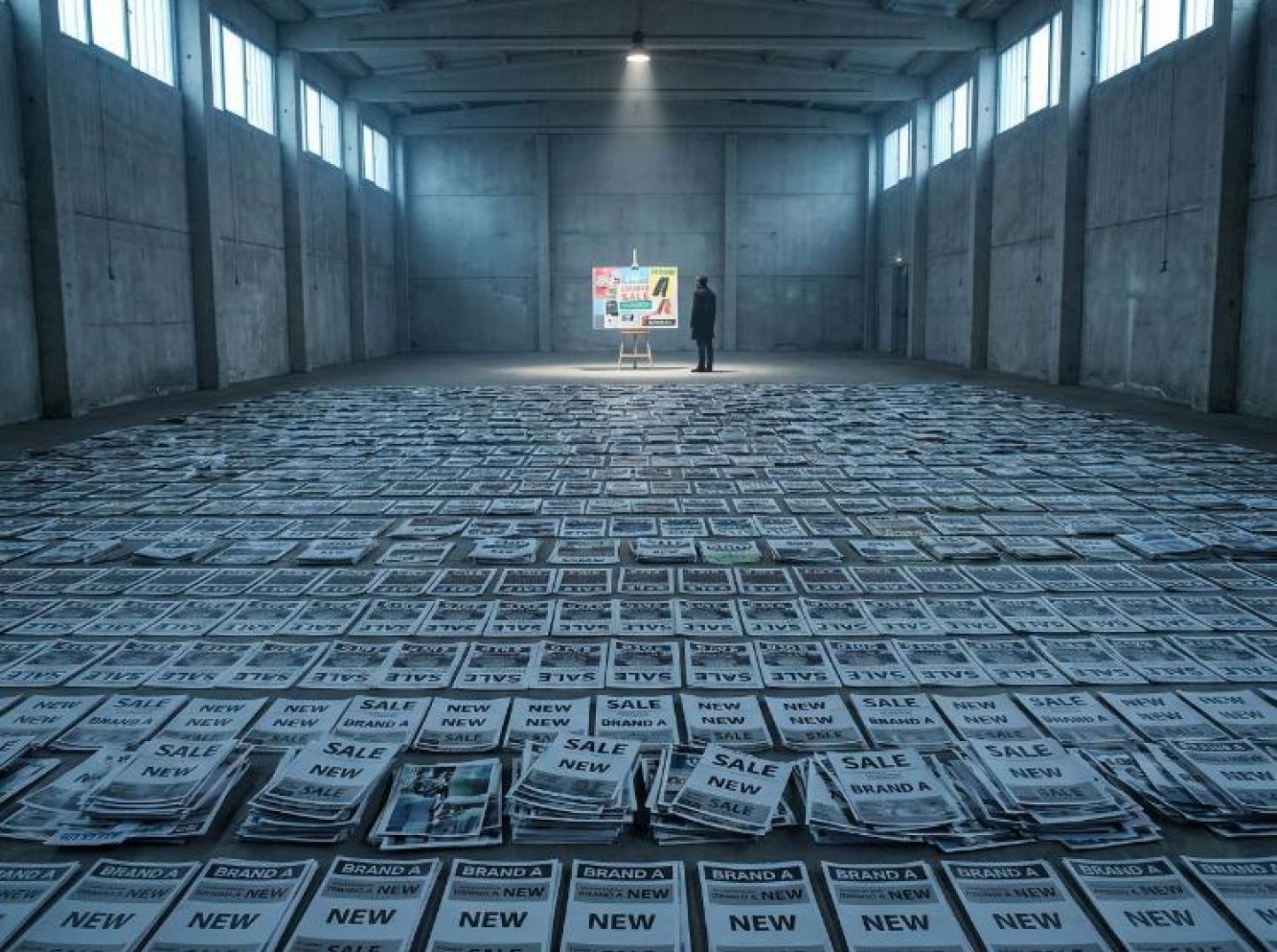
There's a seductive logic to the volume-first approach: if AI can generate hundreds of ad variations in minutes, why not let the platform algorithm figure out which ones work? Flood the zone, let the machine learning sort it out, and scale whatever sticks. On paper, it sounds like a legitimate testing strategy. In practice, it's one of the most expensive ways to learn nothing.
The first problem is structural. Platforms are getting smarter about recognizing when advertisers are gaming the system with superficial variation. As Social Media Examiner explained, Meta's Andromeda update ended the practice of running hundreds of slight variations of the same ad — the platform now treats those near-duplicates as a single creative. That means the old playbook of swapping a headline word here, tweaking a background color there, and calling each version a "new test" doesn't just fail to deliver incremental learnings. It actively collapses your creative distribution. Instead of getting meaningful reach across genuinely different concepts, your budget pools behind what the algorithm perceives as one idea wearing different outfits.
The second problem is economic. When you generate two hundred variations without a strategic thesis behind each one, you're not running two hundred tests. You're diluting spend across two hundred untested hypotheses, most of which are random permutations of the same weak brief. Each variation needs enough impressions to generate statistically significant results, and when budget is spread that thin, almost nothing clears the bar. You end up with a spreadsheet full of inconclusive data points and no clear direction for what to do next.
The third problem is strategic. Speed matters — but only when it's harnessed correctly. As MarTech noted, the brands deploying continuous creative optimization loops are gaining a genuine competitive advantage, but that advantage depends on creative strategy shifting upstream, before the generative tools are ever touched. Speed without strategic direction is just turbulence. You move fast, but you don't move forward.
This is where intelligence transforms the equation. When every variation is grounded in a distinct competitive insight — a specific angle a competitor is exploiting, an emotional trigger that's performing in a particular category, a format pattern that's gaining traction on a specific platform — then volume becomes a genuine testing advantage. Each creative isn't a random mutation. It's a deliberate hypothesis. One variation tests whether a competitor's social proof angle can be reframed around your product's unique claim. Another tests whether the long-form educational hook that's dominating your category on YouTube translates to a six-second Instagram placement. A third tests a price-anchoring strategy you spotted gaining traction in an adjacent vertical.
The difference isn't subtle. Intelligence-informed volume produces meaningfully different variations because the inputs are meaningfully different. Each brief carries its own strategic rationale, its own expected outcome, its own criteria for success or failure. When results come back, you're not staring at noise — you're reading signal. You know why something worked, not just that it worked, which means you can compound that insight into the next round of creative.
The marketers winning the AI creative race aren't the ones generating the most variations. They're the ones generating the most informed variations — where every asset represents a purposeful experiment drawn from real market intelligence. Intelligence is what prevents AI-generated volume from becoming expensive noise and turns it into the structured, scalable testing engine it was always supposed to be.
The old creative hierarchy was linear and familiar: Brief → Creative Production → Testing → Optimization. A team would receive a brief, produce a handful of assets, run them in market, measure results, and feed learnings back into the next campaign cycle. It was slow, sequential, and dependent on human intuition at every handoff point. But it worked well enough when the pace of media was measured in quarters rather than hours, and when "scale" meant adapting a hero spot for three screen sizes instead of three hundred audience segments.
That hierarchy is now obsolete. Not because any single step was wrong, but because the sequence itself creates a fatal bottleneck: intelligence arrives too late. In the old model, you don't truly learn what works until the optimization phase — by which point you've already spent the production budget, committed to a creative direction, and burned weeks of calendar time. The feedback loop exists, but it's so elongated that each cycle of learning is expensive and infrequent.
The new hierarchy inverts this. It places intelligence first, generation second, and optimization third: Intelligence → Generation → Optimization. In this model, the strategic understanding of audience, context, and messaging architecture precedes any creative production. Generation — whether human-led, AI-assisted, or fully automated — operates in service of that intelligence rather than in advance of it. And optimization becomes continuous rather than terminal, feeding real-time performance signals back into the intelligence layer so the entire system sharpens with each iteration.
This isn't a theoretical abstraction. The infrastructure to support it is already materializing. At the 2026 upfronts, publishers unveiled tools that embed intelligence directly into creative delivery — from WBD's Dynamic Creative that adapts ad headlines and visuals contextually to Fox's contextual engine powered by a large-language model for scene-level targeting. These systems assume that creative will be shaped by real-time context, not locked into a static brief weeks before launch.
On the brand side, the shift is just as pronounced. As MarTech outlined, competitive advantage is no longer emerging from investment in AI tools alone but from how organizations use AI across creative development, targeting, media buying, and conversational discovery. The brands pulling ahead are those building what the publication describes as AI-native creative and operating models — systems designed for continuous testing, learning, and optimization rather than campaign-based workflows. Critically, the same framework calls for strengthening strategic inputs like brand narrative, messaging architecture, and audience understanding, reinforcing that intelligence must sit upstream of everything else.
This reordering has profound implications for how teams are structured and where budgets flow. If intelligence is the bottleneck — not production — then the most valuable investment isn't a faster rendering engine or a larger asset library. It's the research, data infrastructure, and strategic clarity that ensure every generated asset starts from a position of informed intent. The creative strategist who can articulate why a particular message will resonate with a particular audience at a particular moment becomes more valuable than the tool that can produce a thousand variations of it.
Generation without intelligence is noise, as the previous section argued. But intelligence without a modern generation layer is just insight that never reaches the market. The new hierarchy works precisely because each layer enables the next: intelligence shapes what gets made, generation makes it real at speed, and optimization ensures the system learns faster than any human team could alone. The cycle is continuous, compounding, and — when properly architected — self-improving.
Receive top converting landing pages in your inbox every week from us.
Most Read
Discover how performance marketers can build cross-channel verification journeys that turn skeptical prospects into confident buyers across TikTok, native, push, and pop advertising. Learn how to coordinate creative messaging, reinforce trust at every touchpoint, and measure the hidden influence of fragmented customer journeys using competitive ad intelligence.
Elena Morales
7 minOct 20, 2026
Recently Updated
Discover how performance marketers can turn AI-generated answers into profitable creative opportunities for native, push, and TikTok advertising. Learn how to extract customer pain points, validate campaign angles with Anstrex and TikTok ad libraries, and build data-informed creative strategies that stand out from low-quality AI content.
Liam O’Connor
7 minOct 16, 2026
How-To
Learn how to turn big brand-building stunts into measurable performance funnels across Native, Push, Pop, and TikTok. This guide breaks down how to repurpose stunt assets, build channel-specific sequences, design story-led landers, and measure their impact on conversions and revenue.
Priya Kapoor
7 minOct 5, 2026