11 minJuly 9, 2026

Our spy tools monitor millions of native ads from over 60+ countries and thousands of publishers.
Get StartedIn early 2025, Unilever made a decision that sent tremors through the advertising industry: it began building a network of 300,000 creators to produce and distribute content across dozens of platforms in hundreds of markets simultaneously. That alone would have been disruptive. But the detail that transforms this from a bold staffing play into a structural inflection point is that 71% of those creators are using AI tools to produce content at speed, generating a volume of creative assets that no traditional agency model could match — or, critically, evaluate.
Unilever isn't an outlier. It's simply the most visible example of a flood that has already reshaped the economics of advertising production. U.S. businesses are expected to spend $57 billion on AI-powered advertising this year, roughly 12% of total ad spending, and that capital is flowing overwhelmingly toward generative tools that collapse the cost and timeline of creative development. Product images that once required a studio shoot and cost hundreds or thousands of dollars can now be generated for a couple of cents, as Fraser Cottrell, CEO of direct-to-consumer creative agency Fraggell, has detailed. For e-commerce brands operating on thin margins, that's not an incremental efficiency gain — it's a fundamental restructuring of what's possible.
The result is a creative landscape that would have been unrecognizable two years ago. Brands of every size can now produce genuinely different ad variations at volume without a massive team or a bloated production budget. As Cottrell explains, AI levels the playing field between scrappy startups and established players who once held an insurmountable advantage in production quality. Static-image ads generated by current models are nearly indistinguishable from professional photography. Video is catching up fast. The barriers that once separated a well-funded brand from a bootstrapped competitor — access to studios, photographers, post-production teams — have effectively dissolved.
But here is the paradox that defines 2026 advertising: when everyone can produce at scale, volume stops being a competitive advantage and starts being table stakes. The bottleneck hasn't disappeared; it has migrated. It has moved from the production floor to the evaluation layer — from "Can we make enough creative?" to "Can we figure out which of these thousands of assets is actually working before we've burned through our budget?"
This is not a theoretical concern. As Search Engine Journal noted in its analysis of the Unilever model, the sheer scale of AI-assisted content creation makes traditional test-and-learn frameworks difficult to apply cleanly. Human review panels are too slow. A/B testing individual assets across a 300,000-creator network is logistically impossible. Brand-tracking surveys tell you what happened last quarter, not what's converting right now. The evaluation infrastructure that advertising relied on for decades was built for a world where brands produced dozens of creatives per campaign, not thousands.
The democratization of creative production is real and irreversible. Your competitors — whether they're global conglomerates or two-person Shopify stores — are already generating ad creative at a pace and cost that would have been science fiction in 2023. The question is no longer whether you can keep up with their volume. The question is whether you can identify, from within that deluge, the small percentage of creatives that actually drive outcomes. That distinction — between producing at scale and evaluating at scale — is now the defining strategic challenge in performance advertising.
The advertising industry didn't just build its evaluation infrastructure for a different era — it built it for a fundamentally different physics of creative production. Human review panels, sequential A/B testing, quarterly brand-tracking surveys, and manual competitive analysis all assume a world where creative is scarce, expensive, and slow to produce. That world no longer exists. And the collision between legacy measurement and AI-speed output isn't merely inconvenient; it's an existential strategic risk that is quietly hemorrhaging ad budgets across the industry.
Consider the math. When a brand like Unilever deploys hundreds of thousands of creators across dozens of markets, the creative output isn't measured in dozens of variations per quarter — it's measured in thousands per week. A human review panel that takes 48 hours to evaluate a batch of concepts is functionally useless when the next batch has already been generated, deployed, tested, and replaced before the panel's notes arrive. Sequential A/B testing, the gold standard of the 2010s, becomes logistically impossible at this scale. You cannot run controlled experiments on 300,000 creative permutations one pair at a time and expect to surface winners before the cultural moment — or the algorithm's preference — has shifted beneath you.
The platforms themselves are buckling under this reality. As Social Media Examiner reported, Meta's Andromeda update effectively ended the strategy of running hundreds of slight variations of the same ad, because the platform now treats those near-duplicates as a single creative. That's a telling signal: even Meta's own infrastructure couldn't meaningfully differentiate or allocate delivery across a flood of undifferentiated assets. When the platform that serves the ads can't distinguish your variations from each other, the evaluation problem isn't downstream — it's structural.
This collapse exposes a deeper flaw that predates the AI era but is now magnified by it: creative has historically been measured in isolation, disconnected from media results. A brand might know that a particular visual scored well in a focus group, or that a headline variant lifted click-through rate by 0.3%, but those signals existed in separate systems, evaluated by separate teams, on separate timelines. The creative team celebrated engagement metrics while the media team optimized toward cost-per-acquisition, and neither had a shared framework for answering the only question that matters: which creative is actually driving business outcomes in the real auction environment?
That disconnect becomes lethal at AI speed. When brands are deploying continuous creative optimization loops in which AI evaluates engagement signals and automatically evolves messaging, the organizations still relying on quarterly brand-tracking surveys to assess creative effectiveness aren't just behind — they're operating on a different temporal plane entirely. They're reading last quarter's map while the terrain reshapes itself daily.
The most dangerous version of this problem is invisible. Marketers don't see the money they're wasting on undifferentiated creative because every individual asset looks plausible. The AI-generated ad isn't obviously bad — it's just not distinctly good. Multiply that marginal mediocrity across thousands of placements and hundreds of markets, and you get a budget that appears to be working but is actually subsidizing noise. Most organizations are still applying 2020-era evaluation methods to a 2026-era volume problem, and that gap — between the speed of creation and the speed of judgment — is precisely where ad spend goes to die.
If the evaluation crisis described above is the problem, the emerging category of "creative intelligence" infrastructure is the answer — and it's being built not by the generation tools themselves, but by a new class of systems designed to sit above them. The next competitive moat won't belong to whoever generates creative fastest. It will belong to whoever builds the most reliable intelligence layer between generation and deployment.
The clearest example of what this architecture looks like in practice is the partnership between DAIVID, a creative effectiveness measurement company, and ADIN.AI, a media optimization platform. By integrating DAIVID's creative effectiveness models directly into ADIN.AI's platform, the two companies have created what they describe as a live loop between creative intelligence and media execution — a system that doesn't just measure creative in isolation but wires those measurements directly into the machinery of media buying.
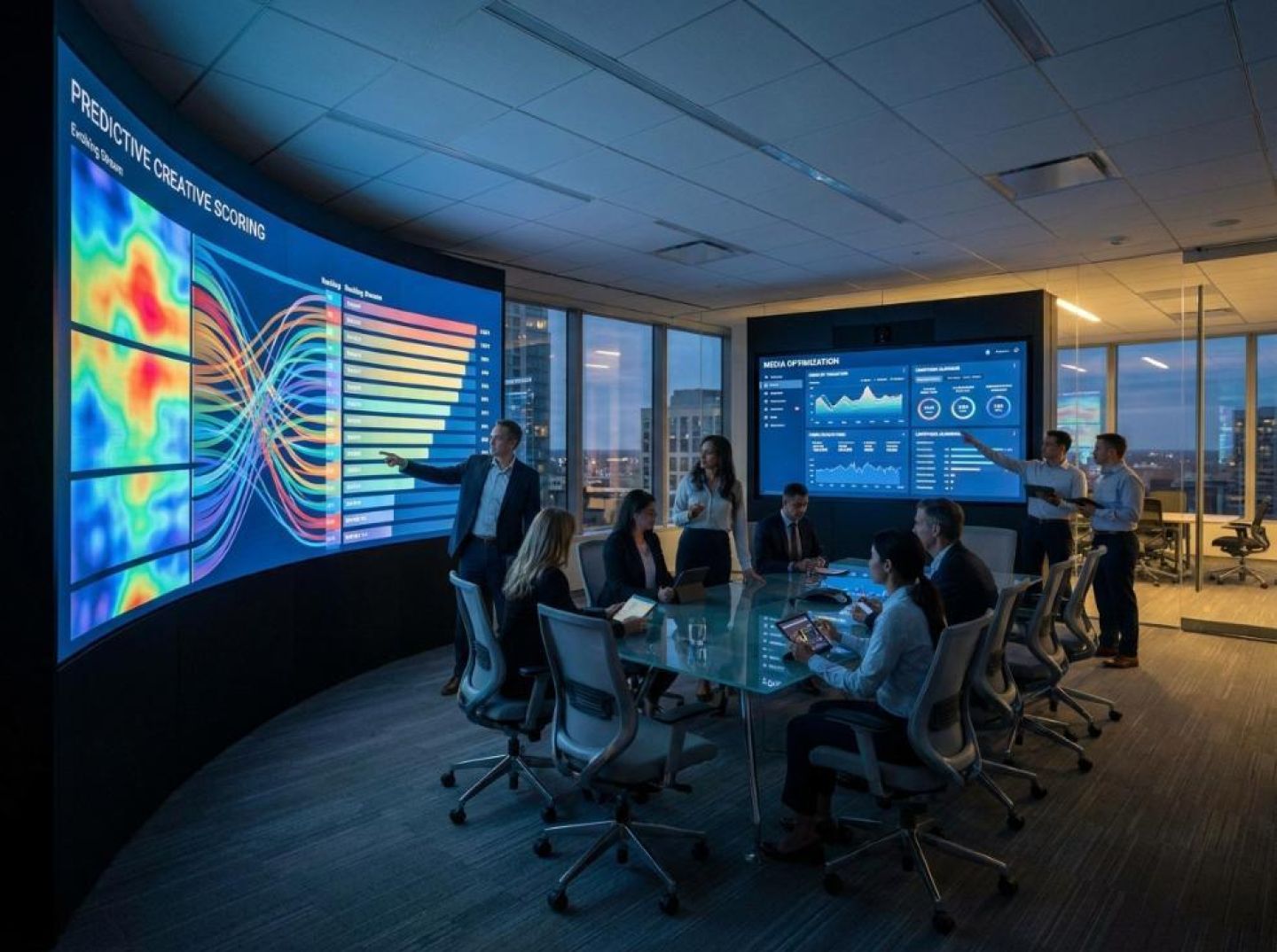
The architecture operates across three distinct phases. Before a campaign launches, marketers can score creative against 39 dimensions — predicting attention capture, emotional response, and memory encoding — to identify which assets are most likely to succeed and allocate budget accordingly. During flight, the system scales high-performing assets and pauses underperformers in real time, creating an active feedback loop between creative quality signals and media spend decisions. After campaigns close, historical performance data becomes the benchmark layer that guides future creative and media planning, feeding forward rather than simply reporting backward.
DAIVID CEO Ian Forrester framed the core problem this solves when he noted that "creative is a key driver of advertising outcomes, but for too long it has been measured in isolation, disconnected from media results." The partnership's first live client, Ajinomoto, is already operating inside this closed loop — a meaningful proof point that this isn't theoretical infrastructure but deployed capability.
What makes this approach structurally different from traditional creative testing is the compounding effect. Each campaign cycle doesn't just optimize that campaign; it refines the predictive models themselves. Over time, the system learns what actually converts in a brand's specific competitive context — not generic best practices, but the particular intersection of audience, message, format, and placement that drives results for that advertiser, in that category, against those competitors.
This aligns with what competitive intelligence platforms are building on the media side. Tools like Polaris AI are already tracking competitor creative performance metrics — including CTR, CPM, and spend efficiency — in real time, surfacing signals about why certain advertisers are winning before the rest of the market notices. When you combine that external competitive layer with internal creative scoring and optimization, you get something approaching a continuous creative optimization loop: AI evaluates engagement signals, automatically evolves messaging, and compounds learning across every campaign cycle.
The companies building this closed-loop infrastructure — predictive scoring before launch, real-time performance linking during flight, and pattern recognition after campaigns close — are creating an advantage that widens with every dollar spent. Their competitors, meanwhile, are still generating thousands of variants and hoping the right ones surface through brute-force testing. The gap between those two approaches isn't just operational efficiency. It's the difference between a system that learns and one that simply produces.
Even the most sophisticated internal creative intelligence loop — the kind described in the previous section — has a fundamental blind spot: it can only optimize within the universe of your own ideas. Your scoring models, your engagement predictors, your fatigue detectors all operate on a closed system. They tell you which of your creatives is best. They cannot tell you what's actually winning in the wild.
This distinction matters more than most marketers realize. When every competitor has access to the same generative AI tools, the same prompt engineering tactics, and increasingly the same internal evaluation infrastructure, the creative output across an entire category begins to converge. The result is exactly what IAS leadership described at Cannes — mass-produced, low-quality AI content drowning out genuine creative breakthroughs and fragmenting consumer attention. In that environment, optimizing internally is like tuning your instrument more precisely while the entire orchestra plays the same note. You get incrementally better at something that no longer differentiates you.
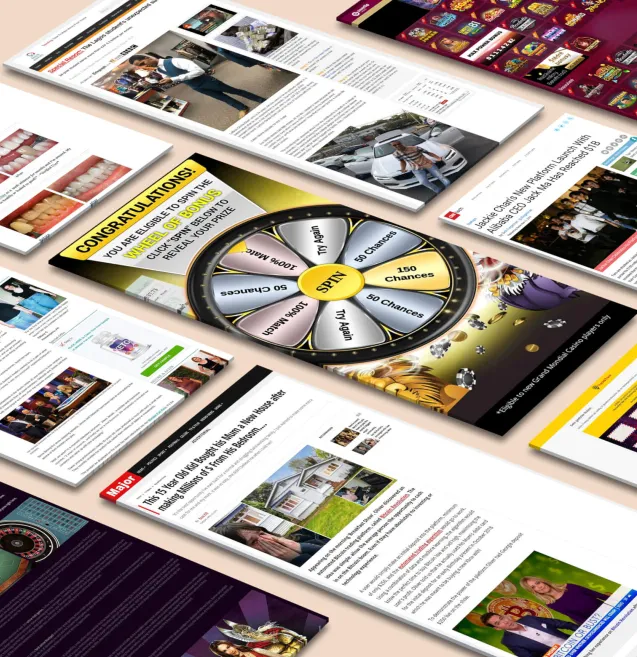
The marketers gaining an asymmetric advantage right now are the ones who've added an external input to their creative pipeline: competitive intelligence from live ad networks. Specifically, they're looking at what competitors are actually running across native and push channels, how long those creatives have been live, which hooks and angles keep getting renewed, and what landing page structures sit behind the ads that survive. Longevity is the signal. An ad that has been running across a network for three, four, or six months is almost certainly profitable. No media buyer keeps unprofitable creative alive that long. Duration becomes a proxy for conversion, and it's a proxy that requires no access to anyone's internal data.
This is where ad intelligence platforms like Anstrex become strategically essential — not as a "spying" gimmick, but as a foundational input into the creative strategy that feeds your entire AI generation and evaluation pipeline. Anstrex provides visibility into what's actually surviving and scaling across native and push networks, filterable by competitor, vertical, geography, and network. It surfaces the specific creatives, formats, and angles that have proven their profitability through sustained spend, giving marketers raw signal before they ever prompt an AI to generate anything.
The logic here mirrors a principle MarTech articulated about conversational AI discovery: if your product isn't included in the synthesized answer, you effectively don't exist at the point of intent. The same dynamic applies to native and push ad networks. If you can't see what's working across those ecosystems — which creative patterns are earning sustained placement, which competitors are scaling aggressively, which angles have emerged in verticals adjacent to yours — you're building your creative strategy on assumptions rather than evidence. You're generating thousands of variations of ideas that may already be losing to approaches you've never considered.
This isn't about replacing the intelligence layer described in the previous section. Internal creative scoring remains critical for evaluating what you produce. But competitive intelligence determines what you should produce. It sets the strategic starting coordinates — the hooks worth testing, the formats worth exploring, the structural patterns worth feeding into your generative pipeline. Without it, your AI generation loop is a sophisticated engine running on guesswork. With it, every creative brief, every prompt, every variation starts from a position of market awareness rather than internal assumption. The ceiling that internal optimization inevitably hits? Competitive intelligence is what breaks through it.
Receive top converting landing pages in your inbox every week from us.
In-Depth
Explore what Pure Leaf’s “Break Conference” reveals about the gap between polished brand marketing and measurable performance. This guide breaks down how Native, Push, TikTok, and affiliate-style funnels use creative testing, clear offers, first-party data, and hard performance metrics to turn cultural moments into revenue.
Rachel Thompson
7 minOct 1, 2026
Must Read
Explore why traditional OOH experience is no longer enough as out-of-home advertising becomes more data-driven, measurable, and connected to digital channels. This guide outlines the cross-channel, measurement, AI, and competitive-intelligence skills modern OOH employers and candidates need.
David Kim
7 minSep 25, 2026
How-To
Learn how to measure whether sports-star and celebrity advertising actually delivers efficient CPC, CPA, search lift, and downstream conversions. This guide shows how to test celebrity creative against creator alternatives and use competitive intelligence and measurement to turn expensive star power into a measurable performance asset.
Elena Morales
7 minSep 25, 2026