7 minMay 28, 2026

Our spy tools monitor millions of native ads from over 60+ countries and thousands of publishers.
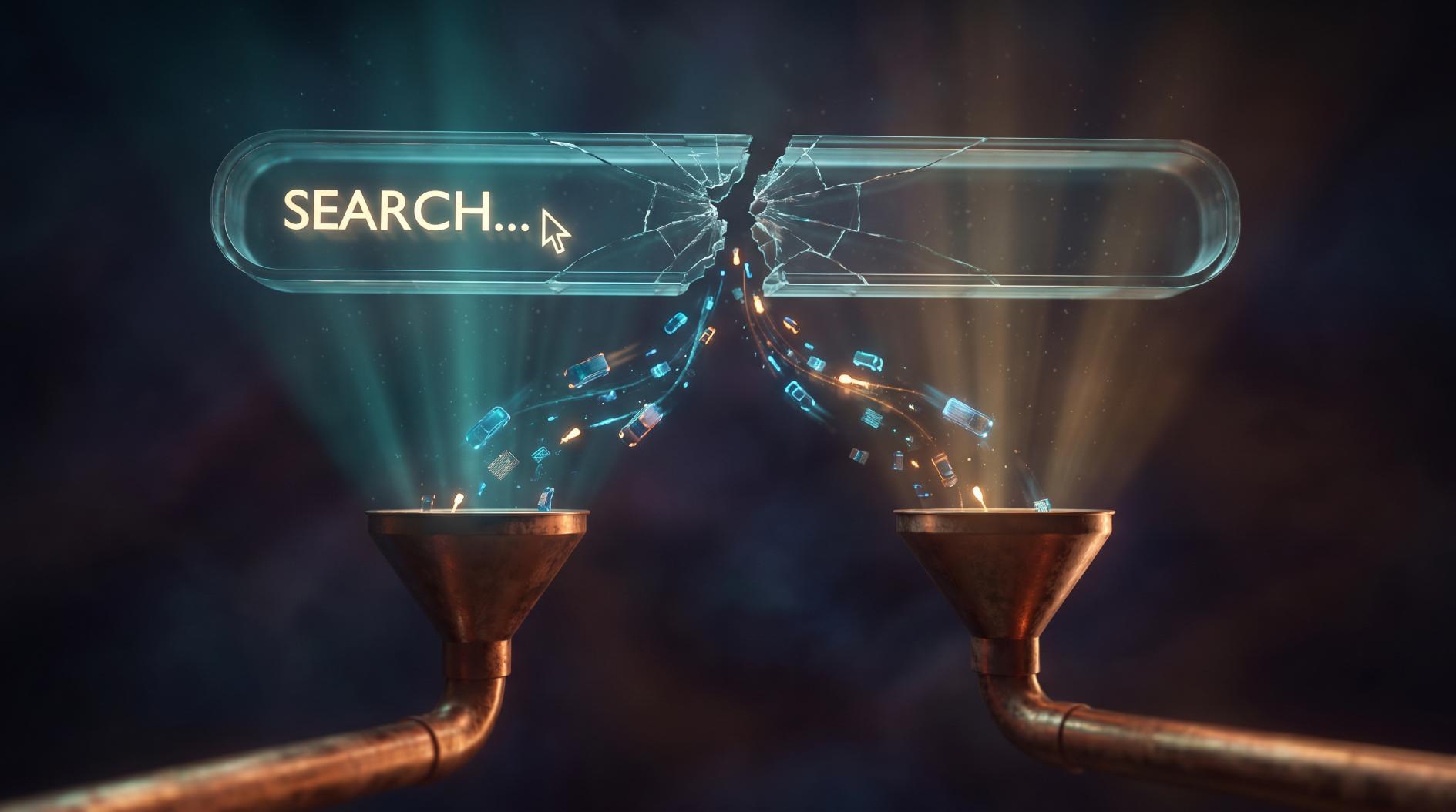
Get StartedLet's stop pretending this is a minor inconvenience. The zero-click problem isn't a temporary glitch in the algorithm or a seasonal dip you can ride out with better meta descriptions. It's the logical endpoint of a platform designed to keep users exactly where they are. A zero-click search occurs when a user finds their answer directly on the SERP — through AI Overviews, featured snippets, knowledge panels, or People Also Ask boxes — without ever visiting your site. The user gets what they need. Google gets the engagement. You get nothing except the vague consolation of having been "visible."
And the problem is accelerating. Search engines are no longer routing users to source websites — they're synthesizing answers from multiple sources and displaying them as finished products. AI search platforms like ChatGPT, Perplexity, and Gemini are doing the same thing, allowing users to get recommendations, comparisons, and purchasing guidance without visiting a single external page. As Real FiG Advertising + Marketing has noted, search engines are evolving into answer engines, and brands that continue relying on outdated SEO tactics without adapting will struggle to remain visible online. The funnel isn't leaking — the top of it has been paved over.
So what does the SEO industry prescribe? Adaptation, of course. The dominant advice goes something like this: stop measuring success by clicks and start measuring it by visibility. Track branded search growth. Monitor share-of-voice. Celebrate assisted conversions. Semrush's own framework for winning in a zero-click market makes the case plainly: "Zero-click searches might not drive direct traffic to your site, but they can still help your business grow by boosting visibility and brand awareness." The argument is that when your brand appears inside these SERP features, you become "part of the conversation your audience is already having."
That sounds reasonable until you interrogate what it actually means in practice. You're being asked to invest real resources — content teams, technical SEO, structured data implementation, ongoing optimization — for the privilege of having your brand name compressed into an AI-generated paragraph you didn't write, can't edit, and don't control. The best-case ROI is that someone might remember seeing you mentioned and might search for you later by name. The worst case — and the far more common one — is that Google extracts your expertise, delivers it to the user, and your brand name doesn't register at all.
When the industry tells you to track "brand awareness lift" from zero-click features, what they're really telling you is that organic search is no longer a traffic acquisition channel. It's a digital billboard — except you don't own it, you can't choose the placement, and you have no reliable way to measure whether anyone actually looked at it. Traditional billboards at least come with traffic count data.
None of this means visibility is worthless. Brand awareness has always mattered, and appearing in AI Overviews is better than not appearing at all. But let's be honest about the value proposition: you're optimizing for the chance that someone might eventually click, while the platform itself is explicitly designed to ensure they don't need to. Google's own incentive structure — keeping users on the SERP to increase ad exposure within its ecosystem — runs directly counter to your goal of earning traffic.
That's not a strategy. That's a coping mechanism. And while it may be the best play available within organic search, it exposes a glaring need for channels where the click isn't an afterthought — it's the entire point.
Google didn't invent the zero-click problem. It simply got there first. The real threat isn't that one search engine decided to hoard attention — it's that every major AI platform has independently arrived at the same architectural conclusion: the best user experience is one where the user never leaves. ChatGPT, Perplexity, Claude, and Gemini all synthesize answers from across the web, allowing users to get recommendations or explanations without visiting individual sites. This isn't a feature quirk unique to Google's AI Overviews. It's the foundational design philosophy of an entire generation of search-adjacent tools, and it means the zero-click crisis is no longer tethered to a single platform's algorithm updates. It's structural. It's permanent. And it's accelerating.
Consider the numbers that, on the surface, look like salvation. Adobe's Q2 2026 data revealed that AI-referred traffic surged 393% year-over-year while generating conversion rates 42% higher than traditional search traffic. Marketers rushed to celebrate this as proof that AI search could replace what Google's SERP features were eating. And yes, users arriving from ChatGPT or Perplexity do appear to land with clearer intent and stronger purchase signals. But zoom out from the conversion rate and look at who controls the pipeline. These AI platforms decide which brands get mentioned, which products get recommended, and which websites receive that high-intent traffic. You cannot bid on placement. You cannot A/B test your positioning. You cannot run a split test between your headline and a competitor's inside a Perplexity response. The 393% growth figure doesn't describe a channel you control — it describes a channel that, for now, happens to be sending traffic your way.
This dependency becomes even more precarious when you factor in the rise of agentic commerce. AI shopping assistants are now shortening the path from discovery to purchase by performing tasks such as product comparisons, inventory checks, and recommendation filtering automatically. In this model, the consumer doesn't browse your landing page, weigh your value proposition against a competitor, and then convert. The AI agent does all of that silently, behind a conversational interface, and delivers a final recommendation the user either accepts or rejects. Your carefully crafted product page, your optimized hero section, your social proof widgets — none of it matters if the AI agent never surfaces your brand in the first place. The entire discovery-to-purchase funnel gets compressed into an opaque algorithmic decision that happens before a human even sees your name.
This is the part most marketers haven't internalized yet. Traditional SEO at least offered a knowable game: you could study ranking factors, reverse-engineer competitors, audit your technical foundation. But as search engines evolve into answer engines across multiple platforms simultaneously, the rules become fragmented and illegible. Each AI platform has its own training data, its own retrieval methodology, its own undocumented preferences for which sources to cite and which to ignore. Optimizing for one doesn't guarantee visibility in another. And none of them offer a transparent feedback loop.
The zero-click problem isn't shrinking. It's metastasizing into every channel where consumers ask questions and expect synthesized answers. Any strategy built entirely on "being chosen by an algorithm" — whether that algorithm belongs to Google, OpenAI, or Anthropic — carries existential platform risk. The brands that survive this shift won't be the ones who crack the code on AI Overviews optimization. They'll be the ones who stopped waiting to be chosen altogether.
Every channel discussed so far — organic search, AI Overviews, featured snippets, knowledge panels — shares a single architectural dependency: the user must type a query into a search box. That query then passes through a system controlled entirely by someone else — Google, Perplexity, ChatGPT — before any brand gets a chance to appear. Push notification advertising and native ad networks don't operate on that plumbing at all. They are structurally disconnected from the search ecosystem, which is precisely why zero-click search is irrelevant to them.
Start with push ads. A push notification is delivered directly to a user's device — their phone's lock screen, their desktop browser, their tablet — via a browser-level or app-level opt-in. The user has previously granted permission to receive these notifications, which means the ad arrives without any search query, without any SERP, and without passing through any AI synthesis layer. There is no algorithmic middleman deciding whether your message deserves to appear. There is no AI Overview that can intercept a push notification and repackage its content into a zero-click answer. The notification simply appears, carrying your headline, your creative, and your call to action. When the user taps, they land on your page — not a cached summary, not a knowledge panel, not someone else's interpretation of your content. Your page.
Native ads work through different mechanics but arrive at the same structural independence. Native ad units are embedded within editorial content feeds on publisher websites — news sites, lifestyle blogs, content discovery platforms — where they match the look and feel of surrounding articles. They are triggered by publisher-side targeting parameters and user behavior signals: browsing history, content engagement patterns, demographic data. The critical distinction is that none of this targeting depends on search intent. A user reading an article about home renovation might see a native ad for a roofing company not because they searched for "roof repair near me" but because their behavioral profile suggests relevance. There is no featured snippet that can cannibalize that placement. The ad exists inside the publisher's feed, outside the search engine's jurisdiction entirely.
Contrast this with the prevailing advice for dealing with zero-click search. The Semrush Blog recommends that brands optimize to appear within AI Overviews and other SERP features — essentially positioning yourself as source material that search engines and AI platforms can extract, summarize, and display without ever sending the user to your site. That strategy has its place, but it fundamentally accepts the premise that someone else controls the distribution. You're optimizing to be quoted, not clicked. You're engineering your content to be digestible by an algorithm that has every incentive to keep the user where they are.
Push and native ads reject that premise entirely. In these channels, you control the message. You control the landing page. You control the CTA. And critically, you control whether a click happens at all — because the entire architecture is designed to generate one. Even as search engines evolve into answer engines and AI shopping assistants shorten the path from discovery to purchase on their own terms, push and native ads maintain a direct line to the user that no AI intermediary can intercept, summarize, or redirect.
This isn't a philosophical difference. It's an engineering one. Search-dependent channels route every interaction through a system designed to minimize outbound clicks. Push and native channels route every interaction through a system designed to maximize them. When the infrastructure itself is built to deliver users to your landing page rather than away from it, the zero-click problem doesn't require a workaround. It simply doesn't exist.
There's a quiet divergence happening in digital marketing strategy right now, and you can see it most clearly by looking not at what companies are saying but at what they're buying. While conference stages and LinkedIn feeds overflow with advice about schema markup, semantic authority, and prompt engineering for AI visibility, a different class of advertiser — typically larger, better-resourced, and operating in fiercely competitive verticals like finance, health supplements, and direct-to-consumer e-commerce — has been methodically scaling push and native ad campaigns. They haven't announced it. They haven't written thought leadership about it. But if you know where to look, the evidence is impossible to miss.
The gap comes down to resources and awareness. As Real FiG Advertising & Marketing has observed, enterprise brands often have dedicated development teams focused on AI integration, while regional companies struggle with fragmented systems and disconnected marketing data. That framing was aimed at AI search readiness, but it maps perfectly onto paid channel diversification. The same enterprises that can afford dedicated AI teams also have media buyers running competitive intelligence across ad networks that most SEO-focused marketers don't even know exist. They're using spy tools — Anstrex, AdPlexity, SpyPush — to reverse-engineer competitor creatives, landing pages, offer flows, and bid strategies on push notification networks and native platforms like Taboola, Outbrain, MGID, and PropellerAds. They're seeing what's converting and replicating the architecture before their mid-market competitors have finished debating whether to add FAQ schema to their blog posts.
Meanwhile, the mid-market SEO playbook keeps doubling down on the same shrinking surface area. As the Semrush Blog explains, zero-click searches happen because search engines and AI platforms are now designed to answer queries directly rather than routing users to source websites. The recommended response — optimizing for brand visibility within those answer boxes — can build awareness, but it produces uncertain and essentially unmeasurable ROI for companies that need actual clicks, actual leads, actual transactions. The competitive intelligence asymmetry isn't about who ranks better in AI Overviews. It's about who has realized the game has moved to a different field entirely.
If you suspect your competitors have already made that shift, here's a practical framework for finding out:
Step 1: Audit native ad activity in your vertical. Use a tool like Anstrex Native or AdPlexity to search for competitor brand names, product categories, and known offer keywords. Filter by geo and device. You're looking for active creatives, landing page URLs, and campaign duration — long-running campaigns signal profitability.
Step 2: Monitor push notification networks. Tools like SpyPush and Megaspy index push ad creatives across networks like PropellerAds, RichPush, and Zeropark. Search for your vertical's common angles and pain points. Note which landing page structures appear repeatedly — advertorial, quiz funnel, direct response — because those formats have been validated by spend.
Step 3: Reverse-engineer the landing pages. Don't just screenshot the creative. Visit the actual landing pages through the spy tool's cache or redirect chain. Document the offer flow: how many steps, what kind of lead capture, where the monetization event occurs. This is the intelligence that matters — not the ad image, but the conversion architecture behind it.
Step 4: Cross-reference against organic visibility. Check whether these same competitors are also investing in AI search optimization. Many are — but they're treating it as a brand play while treating push and native as their performance engine. That distinction tells you everything about where they expect measurable revenue to come from.
The brands that understand this aren't choosing between AI visibility and paid diversification. They're doing both — but they know which one pays the bills today and which one is a speculative hedge on tomorrow. If your competitive analysis starts and ends with keyword rankings and SERP features, you're only seeing half the board.
The framework here isn't complicated, but it does require you to be honest about what each channel can actually deliver in 2026 — and to fund accordingly.
Step 1: Reframe Your Organic Strategy as Brand Awareness, Not Traffic Acquisition
Stop measuring SEO success primarily by clicks. Semrush makes a reasonable case that you should measure and optimize for both clicks and visibility simultaneously, tracking branded search growth, assisted conversions, and share-of-voice trends alongside pipeline metrics. That's sound advice — but let's take it a step further. If zero-click visibility is what organic search now reliably delivers, then classify it accordingly in your budget: it's a top-of-funnel brand awareness channel, not a direct response engine. Your content still works as source material for AI platforms serving millions of users who never visit your site, and that exposure has value. But it's awareness value. Stop expecting it to fill your pipeline the way it did three years ago, and stop funding it like it does.
Step 3: Build Landing Pages That Earn the Click You Paid For
Since you control the destination — unlike organic search, where Google may never send the user at all — your landing page is the entire conversion event. Design pages specifically for push and native traffic: short-form, single-CTA, fast-loading, and editorially styled for native placements. These users didn't search for you. They were interrupted. Respect that by delivering immediate, specific value within the first scroll.
Step 4: Target Behavioral Signals, Not Just Demographics
Push and native networks increasingly support retargeting pixels, lookalike audiences, and interest-category targeting. Layer these with dayparting and frequency caps. The goal is to reach users during content consumption moments — not when they're searching, but when they're reading, scrolling, and open to discovery.
Step 5: Allocate Budget by Measurable Outcome, Not Channel Loyalty
Here's where most brands over-indexed on organic struggle: they keep pouring money into SEO because it used to work, even as returns decline. As Real FiG Advertising & Marketing argues, modern digital marketing demands both technical expertise and strategic execution — not just content creation in isolation. Apply that same rigor to budget allocation. Start by redirecting 15–20% of your organic content budget toward push and native testing. Measure cost-per-acquisition against your declining organic conversion rates. If paid interruption channels deliver lower CPAs than your "free" organic traffic — once you factor in the content production, technical optimization, and opportunity cost — the reallocation case makes itself.
The point isn't to abandon SEO. It's to stop treating a brand awareness channel like a direct response channel and to fill the conversion gap with formats that actually guarantee a destination click. Organic visibility builds the trust. Push and native close the visit.
Receive top converting landing pages in your inbox every week from us.
Featured
Discover how to turn brand-led stunts and viral marketing campaigns into high-ROI performance campaigns. Learn how to build hidden funnels with retargeting, landing pages, native ads, push ads, pop ads, and TikTok campaigns that transform brand awareness into measurable conversions and revenue.
Samantha Reed
7 minOct 10, 2026
Guide
Discover why celebrity endorsements and global intellectual property don’t automatically translate into advertising success. This guide uses ad spy intelligence to explore how audience relevance, placement context, creative testing, and post-click performance help advertisers build high-ROI campaigns without expensive celebrity partnerships.
Elena Morales
7 minOct 9, 2026
Guide
Discover how native advertisers can turn the psychology behind big brand stunts like “Break Conference” and “World Menu Heist” into measurable performance campaigns. Learn how to use scarcity, owned IP, fandom, participation, and cross-channel funnels to build native and TikTok campaigns that generate attention and conversions.
Marcus Chen
7 minOct 8, 2026