7 minOctober 12, 2026

Our tools monitor millions of native, push, pop, and TikTok advertising campaigns.
Get StartedPerformance marketers don’t set out to “break” out-of-home. They do it by applying the wrong mental model to the right channel.
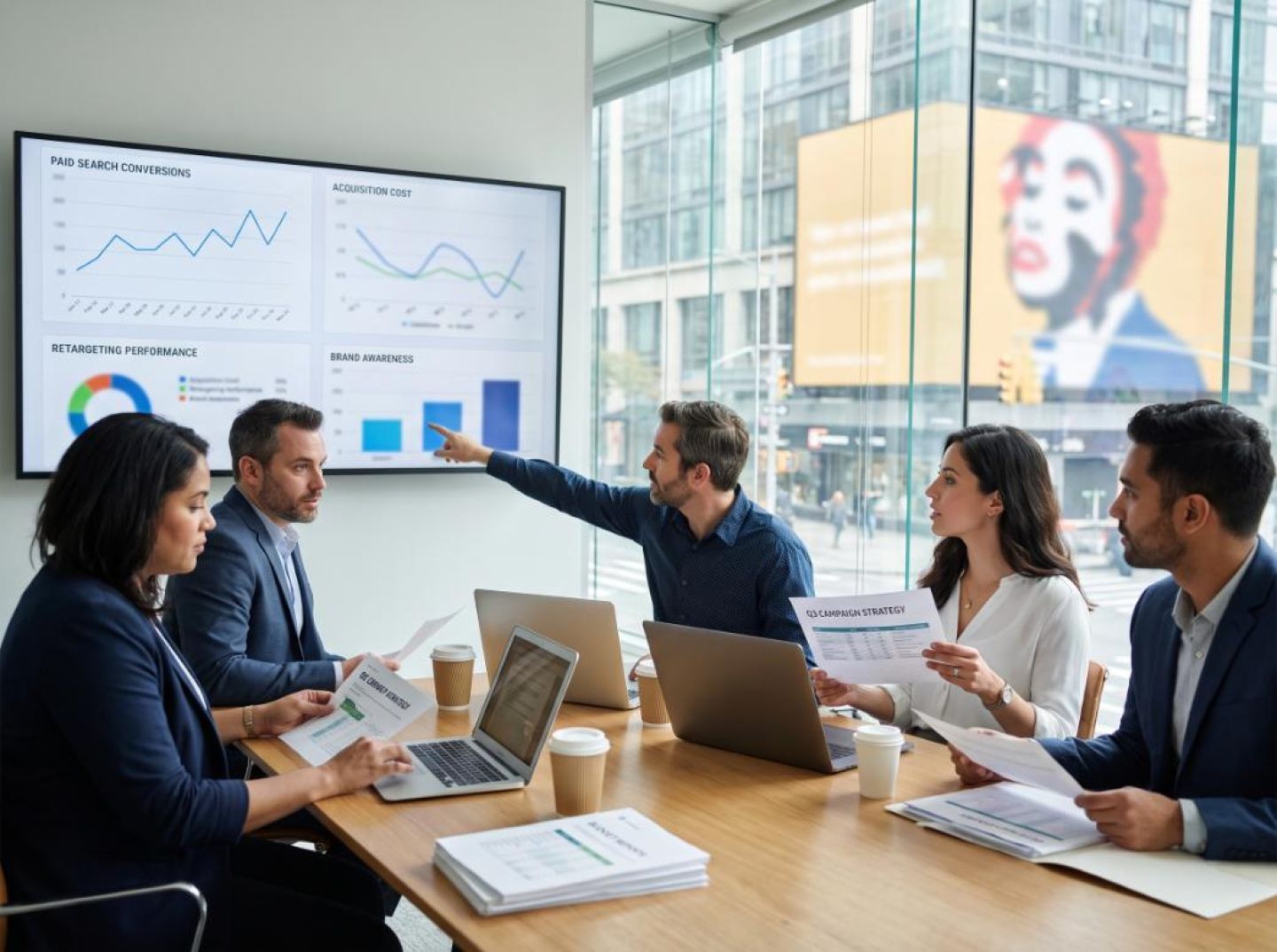
Inside a performance mindset, every dollar has to show its work. You pump spend into paid search, social, and retargeting, then watch dashboards light up with ROAS, CPA, and conversion curves. The feedback loop is fast, comforting, and brutally addictive. So when a CMO is asked to justify a line item that doesn’t immediately throw off last-click conversions, the instinct is to either starve it or force it to behave like another biddable media line.
That’s how OOH ends up on the chopping block—or, worse, misused.
Brand and effectiveness researchers have spent the past two decades showing that the healthiest companies invert that instinct. They follow a roughly 60/40 split: around 60% of budget into long-term brand building and 40% into short-term activation, a balance that’s particularly powerful when you look at how out-of-home contributes to mental availability and future demand. As one analysis of the 60/40 rule in modern OOH puts it, the brands that grow are the ones whose share of voice consistently exceeds their share of market.
Yet most digital-first organizations are running the exact opposite ratio. Eighty percent of their dollars are trapped in lower-funnel performance, with maybe 20% left over for brand—if that. For a while, the numbers reward the choice. Paid search scales, retargeting works, CPAs look enviable in a board deck.
Then the machine stalls.
Audiences saturate. You’ve harvested everyone who was already in-market and aware. Retargeting pools shrink. Cost per click rises as you fight harder over the same finite pool of intent. Conversion rates flatten. The reflex is to double down on optimization: new creatives, new bid strategies, incrementality tests. But the real issue isn’t inside the performance channels. It’s upstream. By starving the top of the funnel, the brand has been quietly burning through its future demand.
This is especially punishing in B2B, where cycles are long and buying committees are large. Running an 80/20 performance-to-brand ratio while complaining that pipeline is getting more expensive is a category-wide self-own. The problem isn’t that performance stopped working; it’s that there’s nothing left for performance to convert.
OOH gets “broken” when it’s asked to fix that problem while being bought and measured like another last-click channel. A flight of billboards is thrown in for a quarter, tagged with a vanity URL, and declared a failure when direct sessions don’t spike. In reality, OOH is doing what it has always done best: building memory structures, expanding reach beyond the walled gardens, and priming people to respond more readily when they do encounter a clickable ad later.
Modern platforms such as AdQuick’s “universal adapter” for OOH have made that halo effect far easier to see. By tying exposure data to downstream digital behaviors and enabling programmatic DOOH buying through a performance-style DSP, they’ve shown in real time how a well-placed OOH layer can lift search volume, click-through rates, and conversion efficiency across adjacent channels. But that doesn’t magically turn OOH into pure performance; it simply makes its brand-building value measurable in language a growth team will recognize.
What’s changed around the channel isn’t the physics of attention—it’s the shopper. Today’s “hybrid shopper” moves fluidly between physical and digital touchpoints, researching on their phone while standing in a store aisle, or discovering a brand on the street and purchasing later on a laptop. As one perspective on the hybrid shopper notes, OOH—and mobile OOH in particular—lives precisely in that in-between space where real-world presence shapes online decision-making.
Performance marketers trip over OOH when they insist on treating that liminal, cross-channel influence as if it were just another impression to feed an attribution model. The fault isn’t with the billboard, the truck, or the screen. It’s with a planning culture that believes every channel should behave like a clickable ad, even when its real value lies in making all the clickable ads work better.
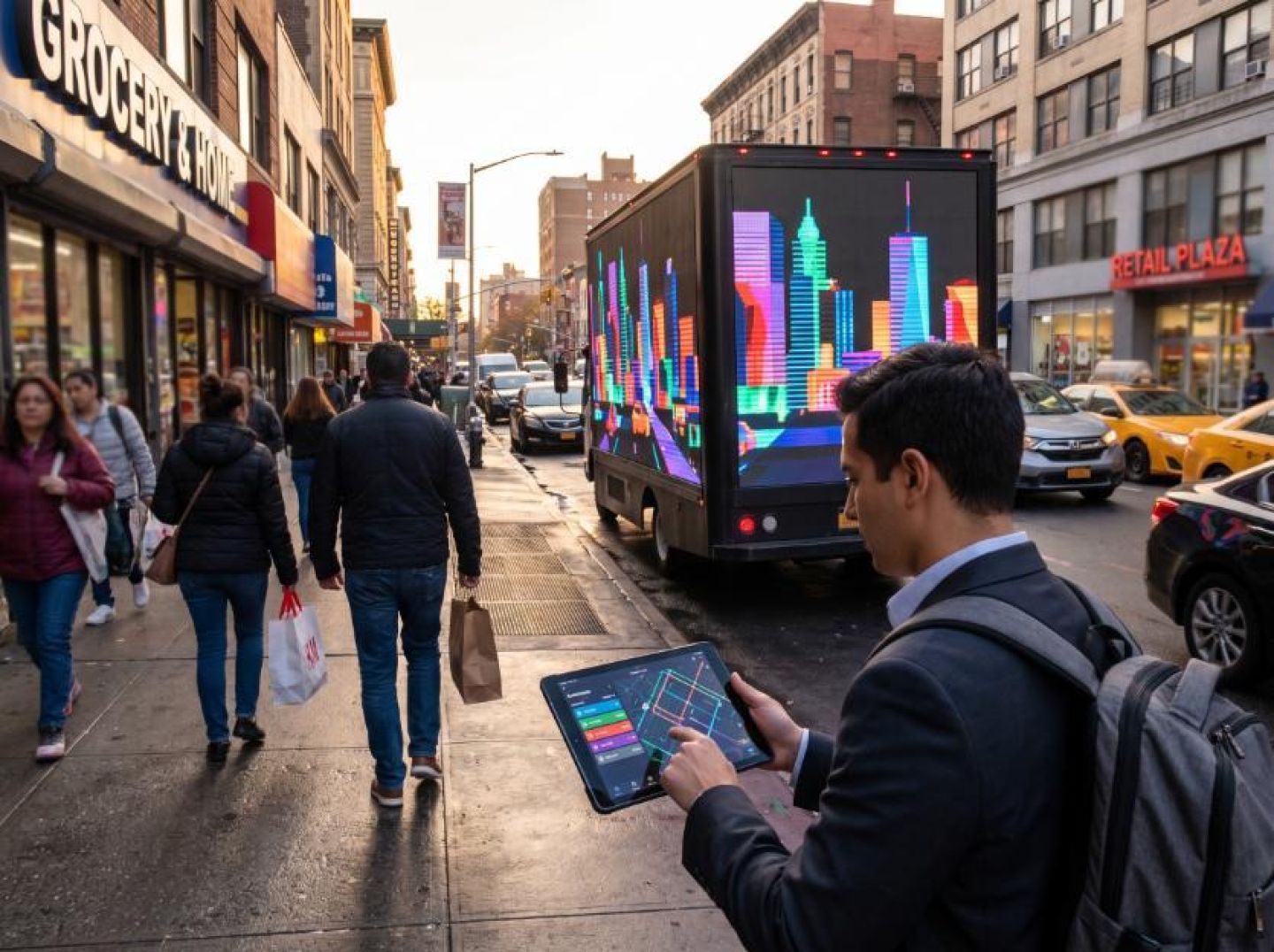
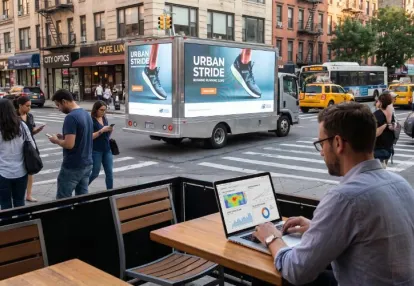
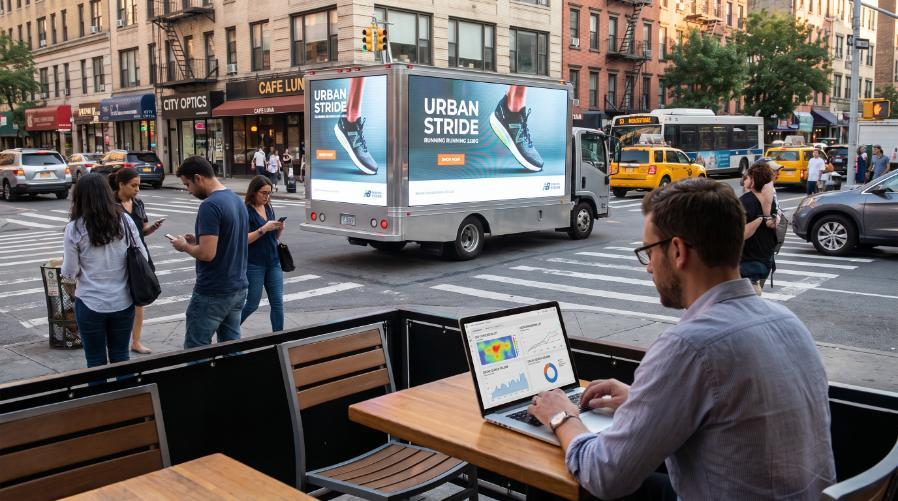
LED trucks only look like moving billboards from 50 feet away. Up close—in the media plan—they behave much closer to a hyper-targeted, high-impact reach and frequency tool that just happens to live in the real world instead of on a screen.
The critical mindset shift is this: static OOH targets geography; mobile OOH targets behavior. A fixed board buys you an audience defined by who passes one spot. A routed LED truck buys you an audience defined by where your buyers actually go, when they go there, and what they’re likely doing in that moment. Lime Media’s planning process builds routes around commute paths, competitor locations, retail clusters, and leisure zones tied to real consumer personas and behavioral data long before a truck ever rolls out. That’s not “we bought some impressions on Main Street.” That’s a precision media vehicle you can program like any other performance channel.
Treating trucks as precision media starts with how you brief them. You’re not just asking “How many hours can we drive?” You’re asking:
From there, you can layer the same kind of intelligence you expect from modern ad platforms. Tools like AdQuick have already reframed OOH as a “universal adapter” that stitches location, demographic, and behavioral data into smarter placements and programmatic DOOH buys, turning what used to be guesswork into a data-driven, AI-optimized channel. When you apply that same logic to mobile OOH routes—choosing dayparts, neighborhoods, and dwell-heavy zones based on modeled propensity—you stop buying “truck hours” and start buying strategically orchestrated exposure windows.
This is also where measurement stops being a hand-wavy brand exercise and starts looking a lot like performance. As one analysis in OOH Today argued, when you “measure it wrong, you kill your best channel” by forcing last-click expectations onto an upper- and mid-funnel driver that actually shows up as lift in search, site, and store behavior over time. LED trucks are squarely in that camp. Their impact rarely shows up as someone standing on a corner, typing your URL into their phone the instant they see the creative. It shows up as a coordinated halo: higher brand query volume, stronger click-through on prospecting ads, more direct traffic, and incremental store visits in the hours and days after the truck saturates a trade area.
This halo effect has been documented across OOH more broadly. AdQuick highlights how intelligent, data-powered out-of-home produces measurable “halo” lift in adjacent digital campaigns by priming awareness and consideration before someone ever lands in your retargeting pool. In practice, a routed LED truck around key retail corridors can function like a real-world lookalike audience: it increases the density of in-market, recently primed users who will later be “found” by your performance media with much less friction and waste.
The implication is simple but non-negotiable: if you treat LED trucks like moving billboards, you’ll under-buy, under-route, and under-measure them. If you treat them like precision media, you’ll brief against behaviors, use data to script routes the way you would a prospecting campaign, and track the blended outcomes—search lift, direct traffic, and store visitation—that actually reflect how hybrid shoppers move between physical prompts and digital decisions. As Lime Media’s own work at the intersection of experiential and mobile OOH shows, the brands winning with trucks don’t ask “How many eyeballs did we get?” They ask “Which journeys did we intercept, and what did that do to everything else we’re already paying for?”
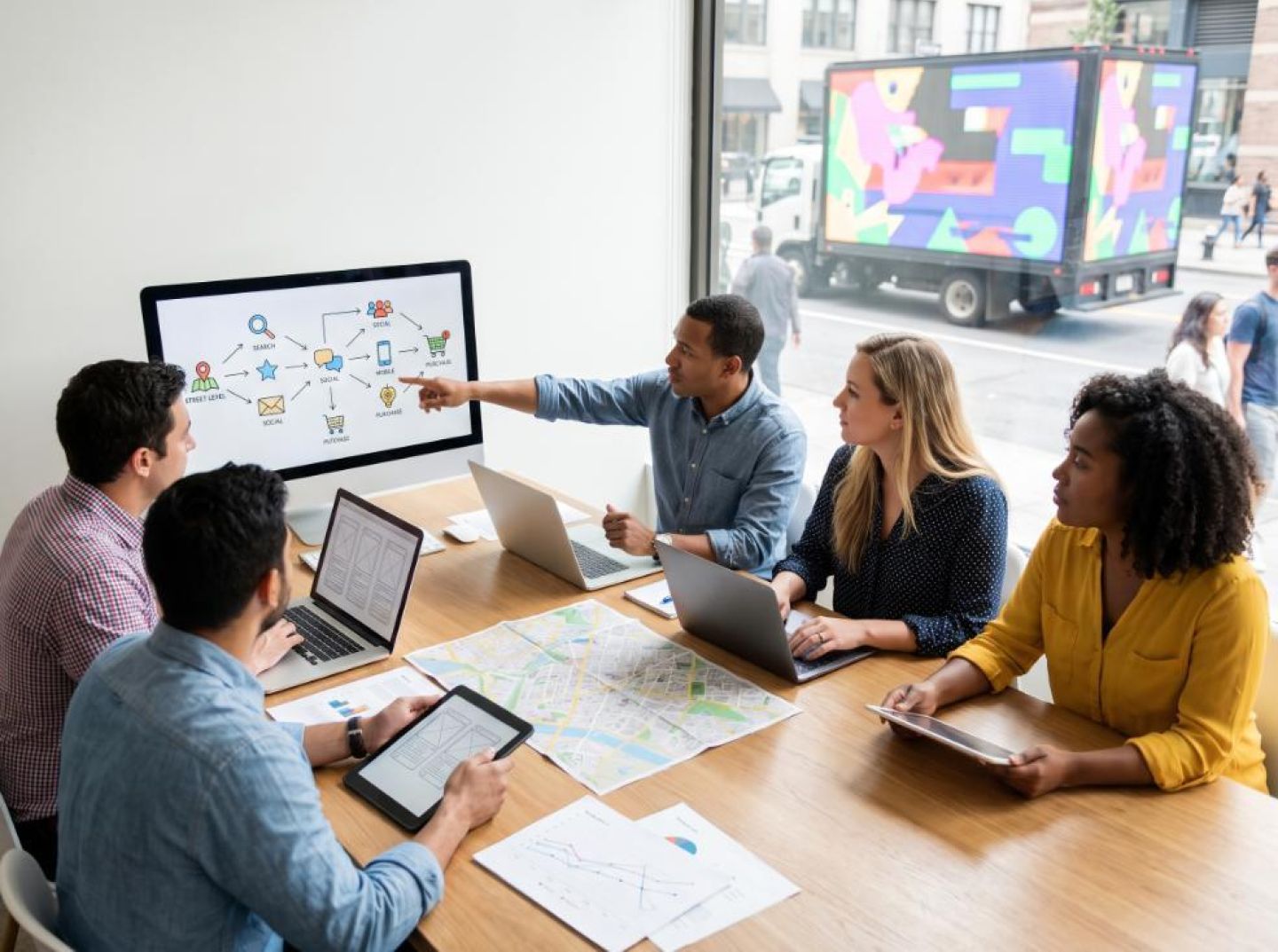
You don’t build a cross-channel funnel by hoping people “see the truck and later maybe search.” You build it by deciding, in advance, exactly how a street-level impression will echo through search queries, social feeds, and landing pages.
Think of LED trucks and other mobile OOH as your designed first touch in a system that ends in conversion, not as a wild-card awareness blast. Static roadside boards mostly buy geography. Mobile units buy you behavior and context: specific commutes, events, neighborhoods at certain hours, even store-adjacent loops that correlate tightly with shopping intent. That behavioral precision is what lets you architect a funnel instead of just “adding OOH to the mix.”
Start by mapping the real-world journey. Where will people physically be when they see you: stuck at an intersection near QSRs, outside a stadium pre-game, passing a competitor’s store, circling an airport pickup zone? Then layer on the likely digital behaviors that moment will trigger: searching “brand + near me,” scrolling TikTok or Instagram while waiting, opening maps, browsing Spotify or YouTube in the car. Your funnel design should explicitly connect those two planes—street and screen—so the OOH impression is the beginning of a deterministic sequence, not an offline shrug.
Practically, this means architecting three linked stages:
1. Street-level stimulus with built-in “capture paths.”
Creative on the truck is not just a billboard; it’s the front door to your performance system. Short, memorable brand cues and clear “search terms” (brand name, product line, even a distinctive tagline) make it easier to attribute the inevitable spike in branded search and direct traffic. And if the route targets environments where passengers are already on their phones—rideshares, autonomous test markets, pickup hubs—you can safely assume most responses will be digital, not in-person.
In a self-driving and screen-saturated future, those first touches will increasingly trigger in-car and mobile experiences by design. As one analysis of autonomous fleets notes, vehicles will soon deliver context-based advertising and instant conversion paths without anyone ever looking up from their device. Your OOH has to assume that reality and act as the “outside trigger” that kicks the digital layer into gear.
2. Mid-funnel digital echo that recognizes OOH as the opener.
Once you’ve defined where and when people see your trucks, tie that exposure window directly to paid search, social, and display. In practice, this looks like:
Modern OOH platforms make this orchestration easier by exposing the “halo effect” OOH has on adjacent digital campaigns. When planners can see, in near real time, how a given route is lifting search volume and on-site conversion, as one AdQuick overview explains, they can treat the truck like any other performance input and adjust channel weights accordingly. That’s how OOH stops being a mysterious top-of-funnel tax and starts behaving like a controllable lever in your CAC model.
3. Click-level conversion that closes the loop and feeds back into planning.
Finally, design landing experiences and offers that are tailored to OOH-primed traffic. If someone searched your brand name from a geo where you’re currently running trucks, assume they are reacting to that real-world impression. Shorten the path: pre-loaded promo codes mentioned on the truck, localized offers (“2 blocks from you”), and creative that visually mirrors the truck’s design to confirm, “Yes, you’re in the right place.”
Over time, the data exhaust from this system—impressions modeled from traffic and route data, lifts in branded search, geo-located site sessions, and attributed conversions—feeds back into smarter OOH planning. AI-driven tools that analyze trillions of OOH unit combinations to maximize performance, as described in AdQuick’s platform overview, let you shift from buying “coverage” to buying provable outcomes. Pair that with the coming wave of connected, sensor-rich vehicles and in-car screens that convert instantly, and the funnel you’re designing isn’t just cross-channel—it’s cross-environment.
The net effect is simple: people meet you on the street, recognize you in their feed, and convert with a click. The trucks don’t have to “speak performance” to participate in that system. Your funnel design does that job for them.
OOH exposure isn’t just “truck drives around town.” When you’re running LED trucks with GPS-verified routes, you’re effectively programming behavioral micro-moments in physical space. The route is your media plan; the streets are your inventory.
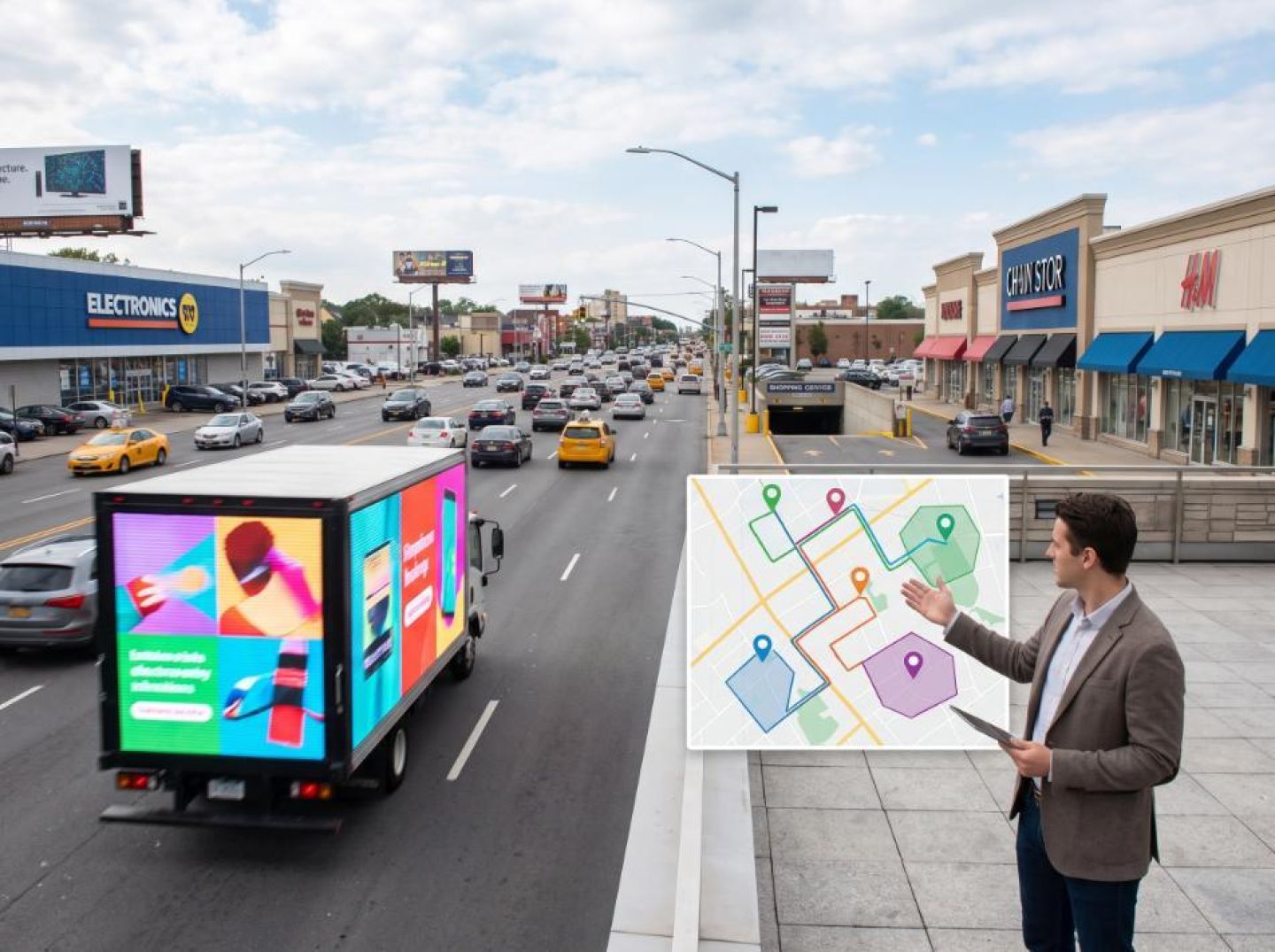
Start with intent-rich geography. A truck looping a generic downtown grid is branding. A truck orbiting big-box retail clusters from 5–8 p.m. is demand capture. When you cluster routes around grocery anchors, home improvement stores, or QSR corridors, you’re intercepting people in an active, purchase-primed mindset. That’s the offline equivalent of high-intent keywords: you’re renting attention at the exact moment someone is already in “buy” mode.
Competitor proximity is your conquesting layer. A truck parked on slow circulation around a rival’s flagship store is a movable, full-motion “search ad” sitting on top of their branded query. If your OOH partner can geofence the radius and provide impression estimates tied to mobile device densities, you can treat that exposure cohort as a distinct audience in your digital stack: “Saw us near Competitor X, now we’ll retarget you with Offer Y.”
This is where GPS-traced routing really matters. A modern OOH stack can log precise latitude, longitude, and timestamps for every second the creative is live. Platforms positioning themselves as a kind of “universal adapter” for OOH use these coordinates to map truck movement against anonymized device graphs and behavioral segments, turning what used to be “we drove around” into a scalable, queryable dataset that looks and behaves like a performance channel. When an LED unit enters a defined polygon around a retail cluster or competitor store, you’re not guessing; you’re firing a rule.
Those rules should be written in the same language you use for paid search and paid social. For example:
In other words, the truck’s GPS log becomes your real-world “ad schedule” that other channels key off.
Critically, this is also how you future-proof your OOH funnel. As autonomous mobility scales and windows start to behave like screens, out-of-home will increasingly act as a trigger layer for mobile and in-vehicle commerce, not just a passive awareness backdrop. Analysts looking at a self-driving world anticipate that a passerby who sees a physical ad will immediately interact through an in-car interface or phone: think a billboard for a restaurant auto-loading menus and reservations on the passenger’s display, or a movie ad pulling up local showtimes in-app as the car rolls by. To be ready for that, you need the discipline now of tying specific GPS-defined exposures to downstream actions.
Finally, don’t underestimate the halo. A disciplined, GPS-informed mobile OOH plan doesn’t just “add some reach”; it systematically grows the pool of people who will respond to your performance media. As OOH planners have argued in the context of the 60/40 brand-to-performance balance, mobile units like LED trucks are one of the rare investments that can grow mental availability at scale while still feeding measurable lift into your digital campaigns. When those trucks are running smart, repeatable routes through high-intent DMAs and your search, social, and site experiences are choreographed to that movement, you’re no longer hoping your OOH will show up in the dashboard. You’re designing a funnel where a street-level impression is the intentional first step in a performance journey.
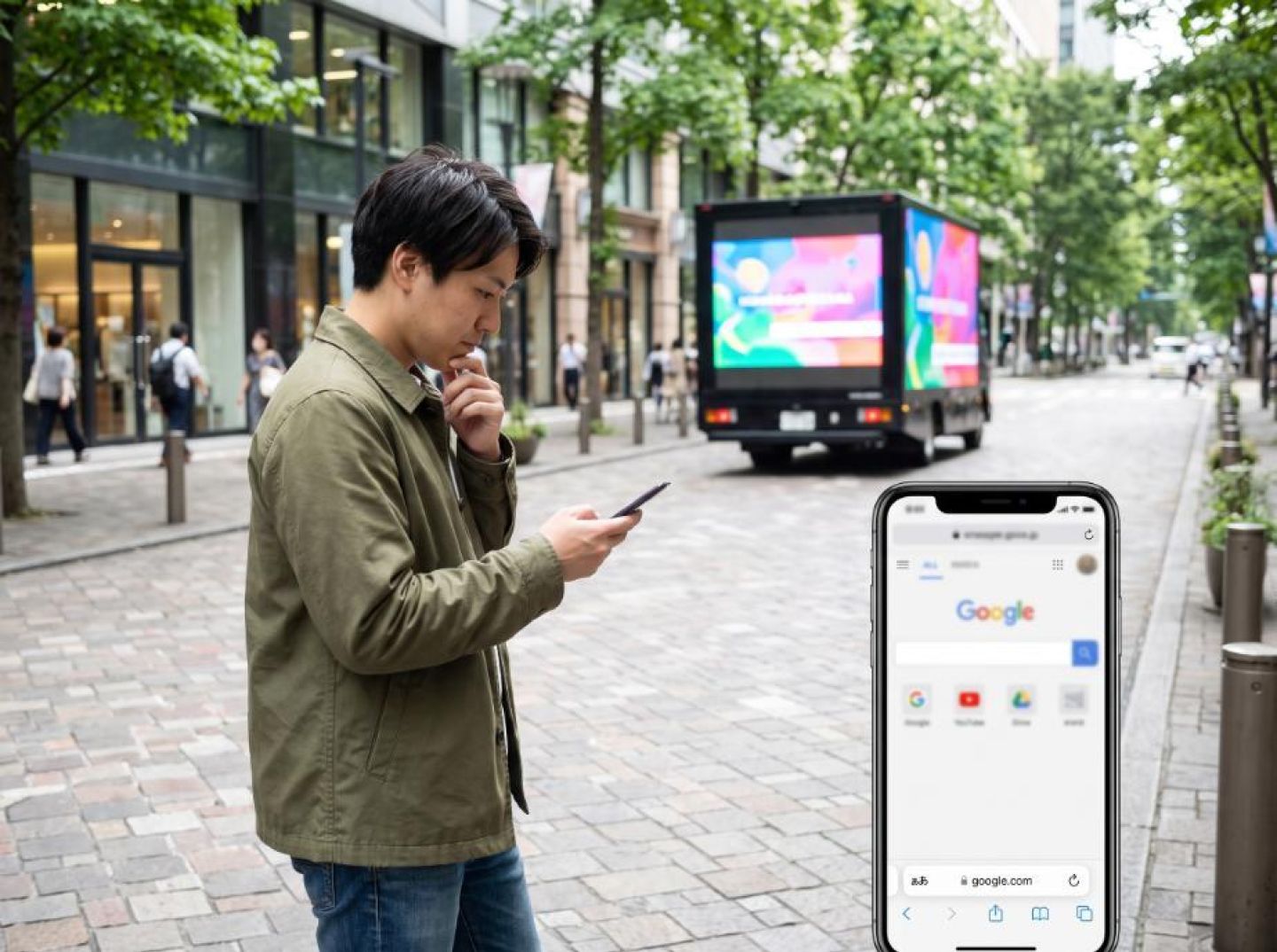
The moment someone reaches for their phone after seeing your truck isn’t a happy accident; it’s the most important handoff in your funnel. If LED routes are your “programmed” awareness, then the immediate mobile follow-up is your first performance channel. That means you can’t treat branded search, vanity URLs, and QR scans as generic response options. You have to design them like you’d design a paid search campaign or a high-intent landing page.
Start with the reality of behavior. People aren’t memorizing your entire offer as the truck rolls by. They retain fragments: your brand, one hook (“No fees”), maybe a promo code. Within minutes, they’ll either:
Each of those paths should feel like a continuation of the truck, not a separate campaign. Just as platforms like AdQuick position OOH as a data-connected performance channel rather than a black box, you need to architect this handoff so it looks and behaves like the rest of your acquisition engine.
For branded search, that means buying the query you’re deliberately seeding on the truck creative. If your LED unit says “Ditch ATM fees with DriftBank,” then “DriftBank,” “DriftBank ATM,” and “ditch ATM fees” should all trigger search ads with matching language and visual continuity: same hero color, same line, same benefit order. Think of this as an “OOH halo” campaign in reverse. Where brands usually talk about the “halo effect” OOH has on existing digital campaigns, here you’re building search and social assets that assume the OOH exposure already happened and are designed to catch that spillover demand in the first hour after a route passes.
Vanity URLs and QR codes are where mobile OOH’s measurability starts to look less like old-school billboards and more like performance media. A clean URL like DriftBank.com/NoFees or ShopHalo.com/Truck is easier to remember than your homepage and acts as a routing layer. Hit that URL, and you can:
QR codes compress that entire journey into a single action: see truck, scan, land. They’re also your bridge into the “screen-first commute” that OOH Today warns is coming, where in-car and mobile displays will dominate attention and capture conversions in real time. The more effortless you make that scan—high-contrast codes, clear “Scan to…” CTA, no tiny legal copy clutter—the closer your OOH unit behaves to a tappable ad inside a feed.
What matters next is what the user sees in the first two seconds after that tap or scan. Your landing experience should:
If your LED truck is promising a specific incentive (“Show this offer in-store,” “Get 20% off today”), resist the temptation to drop people on a generic homepage. That disconnect is where attribution dies. The LED impression created demand; the page should prove that the user is in the right place and help you track how many people complete the action you designed the route to spark.
None of this requires your OOH partner to suddenly become a performance agency. It just requires you to think of their hardware as the outermost node in your own stack. They handle routes and impressions. You handle everything that happens the second a passerby unlocks their phone. When those systems are tightly coupled—creative, query, URL, QR, and landing page all singing the same tune—you’re no longer gambling on “awareness.” You’re running a cross-channel funnel where the street is simply the first paid placement.
If the LED truck is your “moving billboard,” the landing page is your pop-up store. It’s where the hybrid shopper, phone in hand, decides whether that quick impulse turns into a qualified lead, a sale, or nothing at all.
The first rule: design this page as if it will only ever be experienced on a phone. The person who just saw your truck is standing in a parking lot, crossing a sidewalk, or half-watching their kids’ soccer practice. They are not on a 27-inch monitor. A mobile-first layout means single-column, thumb-friendly CTA placement, fast load times, and copy that gets to the point in a single scroll. Teams building data-driven OOH programs are already shifting to this kind of end‑to‑end workflow; when platforms like AdQuick and OUTFRONT talk about “closing the loop” in their OOH planning and measurement stack, this is the last mile they’re implicitly counting on you to own.
But mobile-first is the baseline. To turn OOH response into a true performance funnel, your landing page also has to be context-aware.
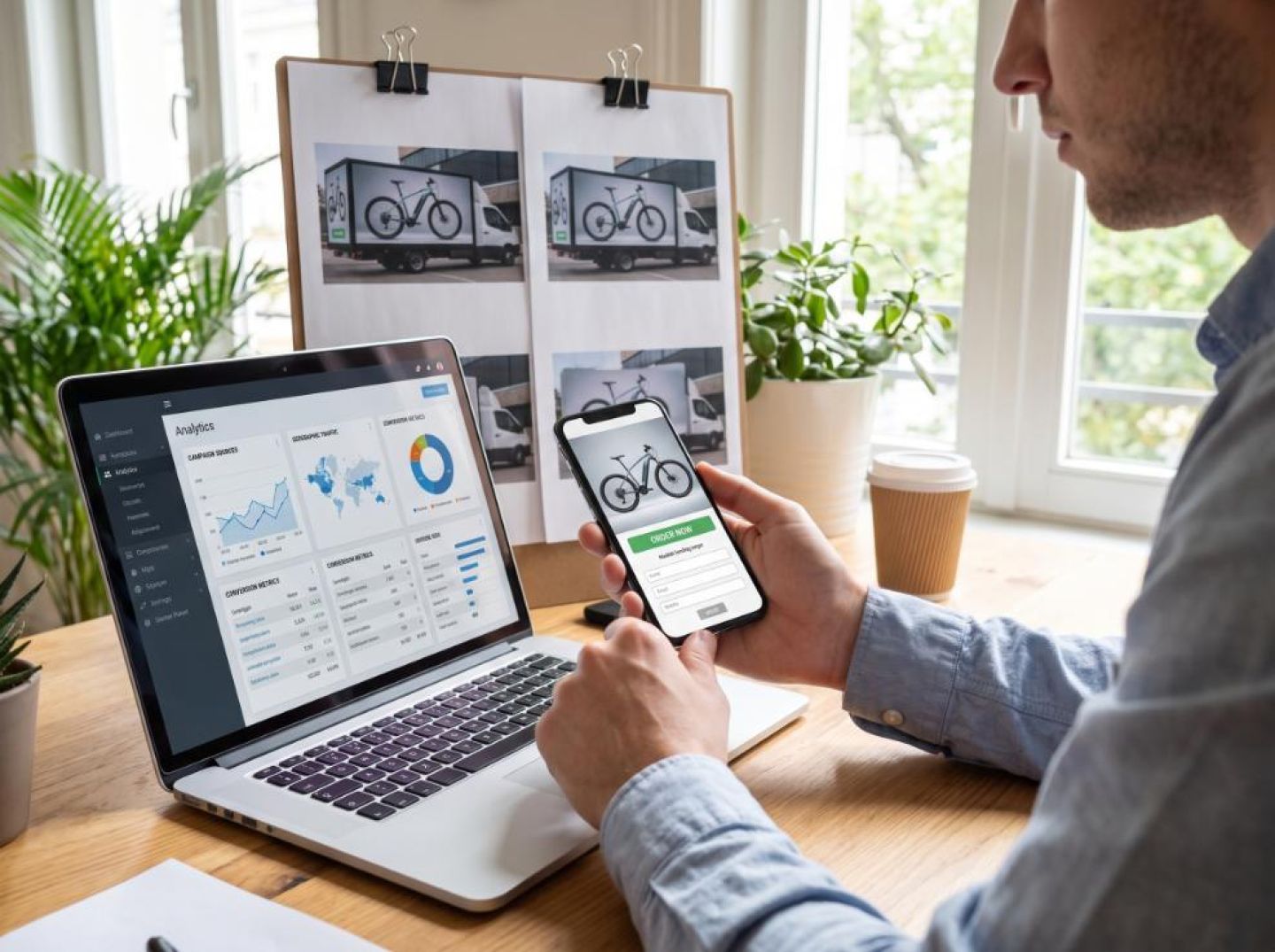
At minimum, every visit from your truck, billboard, or pop-up should arrive with a clue about where it came from: UTM parameters for vanity URLs, unique QR codes per route or creative variant, and, when possible, geo signals like city, neighborhood, or even proximity to a specific retail cluster. This is the connective tissue between “we ran trucks in Dallas retail corridors from 5–8 p.m.” and “conversion rate on that exact route’s QR traffic was 1.8x the downtown awareness loop.”
Your page should immediately interpret those signals and adapt:
This isn’t overkill; it’s the on-site equivalent of routing a truck based on behavioral personas rather than generic GRPs. When Lime Media talks about tailoring routes around real-world movement patterns and hybrid shopper behavior, your landing page should be doing the same tailoring on the screen.
The other half of context-awareness is visual continuity. If your truck headline reads “Swap Your Mattress, Not Your Weekend,” that exact line — typeface, color, even the hero image motif — should greet the user above the fold. If the creative uses a bold, high‑contrast color block and a specific product shot, mirror that treatment in your hero area. Continuity does two things at once: it reassures the user they’re in the right place, and it quietly carries over all the mental processing you just earned with your OOH impression. That matters because, as the Saatva case showed, the real impact of OOH often shows up downstream in branded search, direct visits, and assisted conversions that look “organic” if you measure the campaign the wrong way. The tighter your creative handoff, the easier it is to see and claim that value.
Now layer segmentation on top of that.
Don’t send every OOH responder to the same generic homepage. Use source data to fork them into distinct micro-funnels:
Behind the scenes, wire these segments into your analytics and CRM so you can study OOH-driven cohorts separately: how their AOV, time to purchase, and repeat behavior compare to pure digital-acquisition cohorts. This is precisely the kind of cross-channel visibility the new generation of OOH measurement platforms is trying to enable; if you’re not capturing and tagging this traffic correctly at the landing page, you’re cutting the loop in half.
In other words: treat the landing page not as a generic destination, but as a responsive interface between your physical routes and your digital funnel. Detect where the user came from, reflect what they just saw, and route them into the right next step — automatically.
Tags
Receive top converting landing pages in your inbox every week from us.
Featured
Learn how to connect out-of-home (OOH) advertising with digital performance campaigns to create measurable cross-channel funnels. Discover how to plan LED truck routes, coordinate search and social ads, optimize mobile landing pages, and track conversions so physical advertising drives measurable business results.
David Kim
7 minOct 12, 2026
Guide
Discover why out-of-home (OOH) talent pipelines overlook competitive intelligence and how smart affiliates can capitalize on this gap. Learn how to analyze competitor activity, interpret digital auction signals, build a cost-effective intelligence stack, and turn market insights into profitable advertising opportunities.
David Kim
7 minOct 9, 2026
Guide
Discover how OOH professionals can turn traditional billboard roles into high-ROI performance marketing careers. This guide shows how to reframe OOH work around measurable outcomes, competitor intelligence, landing-page optimization, and data-backed offers.
Liam O’Connor
7 minOct 8, 2026