9 minNovember 3, 2026

Our spy tools monitor millions of TikTok ads from over 55+ countries. Biggest TikTok Ad Library in E-commerce and Mobile Apps!
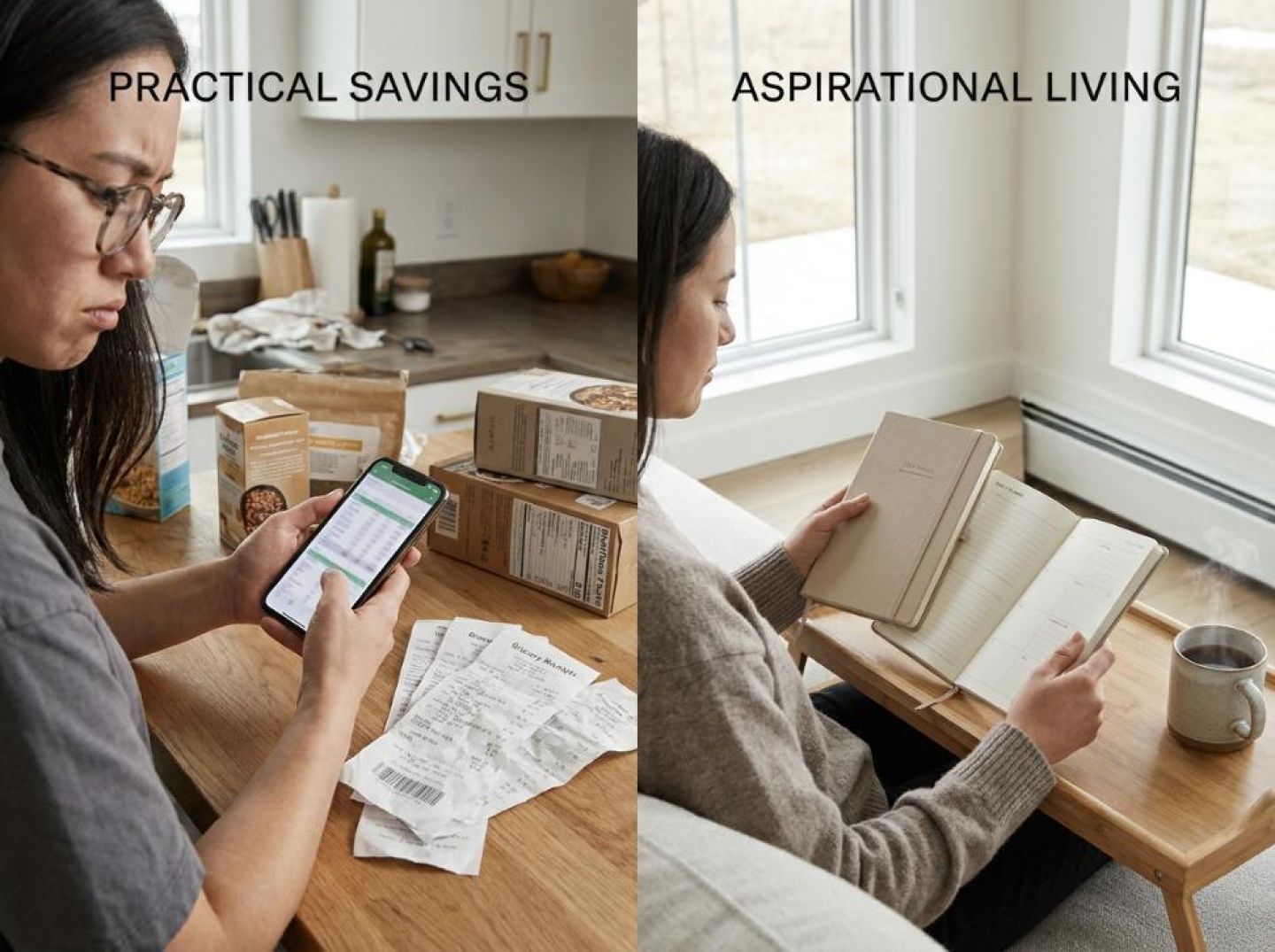
Try It FREEScroll through TikTok and you will encounter two very different versions of what people consider valuable.
One side of the feed is filled with coupon stackers, cashback tutorials, discount breakdowns, and shopping hacks. Creators screen-record every step, explain how they combine offers, and show viewers how to spend less on everyday purchases.
The other side presents a different kind of value. Aspirational routines, financial goal-setting, lifestyle transformations, habit trackers, and videos imagining a more comfortable future.
One narrative is about getting more for less. The other is about becoming more, having more, or living differently.
Both formats offer something viewers want. For performance marketers, however, they also reveal something important: how different creative narratives communicate value and attract attention.
Coupon-focused content makes its value proposition concrete.
It often relies on:
The viewer can immediately understand the promised benefit: spend less, receive more, or avoid paying full price.
Aspirational content uses a different approach.
It often communicates value through:
The benefit may be less immediately measurable, but the emotional appeal can be powerful.
These two approaches provide useful creative research categories: functional value and aspirational value.
TikTok's advertising ecosystem increasingly combines creative production, automated campaign optimization, and commerce-related tools.
For example, Marketing Dive's coverage of TikTok's agentic AI expansion discusses developments involving TikTok's advertising and commerce capabilities.
The broader implication is that marketers need to think beyond whether an advertisement looks attractive. They need to understand what kind of value it communicates, what response it invites, and how that message relates to the desired conversion.
A coupon tutorial may attract viewers interested in saving money. A lifestyle transformation may resonate with people interested in convenience, status, or personal improvement.
These are useful creative hypotheses, not verified descriptions of TikTok's internal audience-classification system.
The platform's recommendation and advertising systems use multiple signals. Creative can help communicate the intended audience and context, but it does not function as a guaranteed targeting instruction.
TikTok's AI-assisted creative tools also make it easier for advertisers to explore different concepts and formats. Social Media Examiner's discussion of AI and TikTok advertising examines how AI-supported workflows can help marketers develop and improve short-form video concepts.
Meanwhile, MarTech's analysis of creative becoming the new targeting explores the wider shift toward creative as an important signal in automated advertising environments.
For performance marketers, the takeaway is not to copy every coupon hack or aspirational trend.
It is to study the underlying value narratives and understand how they can inform original advertisements.
Traditional advertising workflows often treated targeting and creative as separate decisions.
A marketer selected an audience, chose a placement, and then developed an advertisement intended to appeal to that group.
Automated advertising has changed the relationship between those decisions.
On platforms that rely heavily on machine-learning delivery, advertisers may use broader audience settings while the platform's systems optimize delivery based on available signals and campaign objectives.
That makes creative an important part of how an advertiser communicates relevance.
Consider two advertisements promoting the same product.
The first opens with:
"Stop paying full price. Here's how to save on your next order."
The second opens with:
"Make your everyday routine feel a little more luxurious."
Both may promote the same product, but they communicate different reasons to buy.
The first emphasizes savings and price efficiency. The second emphasizes experience and lifestyle improvement.
Those messages may attract different responses, even if the product, audience settings, and destination page remain the same.
This is why creative testing should examine more than visual design. The underlying value proposition can influence who engages and what kind of customer response the campaign receives.
A video that attracts comments, shares, or repeat views is not necessarily the one that generates the most valuable customers.
A highly entertaining coupon tutorial might receive substantial engagement because viewers enjoy learning the trick. That does not automatically mean they will purchase the advertiser's product.
Similarly, an aspirational video may attract attention from people who like the lifestyle presented but have little intention of buying the promoted offer.
Marketers should distinguish between:
As Anny Havercroft's discussion of TikTok campaigns on the HubSpot Marketing Blog emphasizes, engagement becomes more meaningful when it connects to the quality of the audience and the business outcomes that follow.
A coupon-focused video might communicate:
An aspirational video might communicate:
These are interpretations of the creative message, not confirmed audience attributes.
The practical opportunity is to develop advertisements with a clear and relevant value proposition, then evaluate the response using campaign data.
A change in the opening line, visual demonstration, offer, or call to action can alter how viewers interpret the advertisement.
For example:
TikTok advertising guidance covered by WordStream provides a useful starting point for thinking about creative variation and testing.
The objective is not to assume that one hook will always work. It is to test which value narrative attracts the right response under defined campaign conditions.
TikTok can be a useful environment for studying how creators package value into short-form content.
Coupon tutorials, product comparisons, budget breakdowns, and lifestyle transformations offer examples of how people introduce a problem, demonstrate a benefit, and present a payoff.
For performance marketers, these videos can function as a creative research library.
The important task is to analyze their structure rather than simply copy their wording.
Short-form videos compete for attention quickly.
Creators often begin with a specific result, a surprising statement, or a question that makes the viewer want to continue.
Examples of hook structures include:
These examples illustrate different ways to introduce value. They are not verified winning scripts.
When researching videos, record:
The hook attracts attention, but the angle explains why the content matters.
A useful starting taxonomy includes:
Savings
The content focuses on reducing cost or getting more value from a purchase.
Convenience
The content promises to make a task faster, easier, or less complicated.
Smart upgrade
The content presents a better option that may justify a higher initial cost.
Insider knowledge
The content suggests that the viewer can learn something useful that is not widely understood.
Aspiration
The content connects the offer to a desired lifestyle, identity, or future outcome.
Emotional reward
The content emphasizes feelings such as confidence, relief, pride, or belonging.
These categories can be used to organize creative research across multiple products and industries.
A strong value narrative usually gives the viewer something concrete to understand.
Coupon videos may use:
Aspirational videos may use:
Other formats may rely on product demonstrations, expert explanations, or customer experiences.
The payoff should be relevant to the promise. If the advertisement claims to save time, the creative should help viewers understand how. If it promises a better experience, the demonstration should make that benefit clear.
A common mistake is copying the visible style of a successful video without understanding why it may have attracted attention.
For example, the phrase "They don't want you to know this" is only one way to introduce an insider-knowledge angle.
The underlying mechanism is curiosity about an overlooked opportunity.
A marketer can translate that mechanism into a new, original concept without copying the original creator's script or presentation.
Similarly, a split-screen transformation video is not valuable merely because it uses two panels. Its underlying mechanism is contrast between a current state and a desired result.
For each relevant video, record:
| Research field | What to capture |
|---|---|
| Creator or source | Publicly identifiable creator or account |
| Video topic | Product, problem, or category |
| Hook | Opening line and visual |
| Value angle | Savings, convenience, upgrade, aspiration, or other |
| Payoff | What result is demonstrated |
| Proof format | Receipt, demonstration, comparison, story, or testimonial |
| CTA | What the viewer is asked to do |
| Observed response | Available public engagement indicators |
| Research notes | What could be adapted into an original concept |
Public engagement indicators are useful context, but they do not establish sales, profitability, or conversion quality.
TikTok advertising guidance from WordStream provides additional context for testing creative elements such as hooks, visuals, captions, and calls to action.
For more on AI-assisted creative analysis, see Social Media Examiner's breakdown of TikTok campaign skills.
The goal is to turn casual scrolling into a repeatable creative research process.
The value narratives found on TikTok are not limited to TikTok.
Savings, convenience, smart upgrades, exclusivity, and emotional rewards can be communicated through native advertisements, in-stream video, social ads, search campaigns, and other formats.
The challenge is translating the underlying message into a format that fits the environment.
A short creator-style video may work naturally in a social feed. A native advertisement may need a stronger headline and a landing page that expands on the promise. An in-stream video may need a clear opening visual and a more deliberate explanation.
The format changes, but the underlying value proposition can remain consistent.
Start with the message rather than the placement.
For example, imagine a product that helps customers save time.
The same value narrative could become:
Each execution should fit its placement, audience, and viewing context.
The purpose is not to force one advertisement into every channel. It is to preserve the core message while adapting its presentation.
Value-focused content does not always need to look unpolished.
A practical demonstration can be visually refined. A premium production can still feel approachable and useful.
Consider two versions of the same product demonstration:
Both can communicate the same benefit.
The test is whether the additional production quality improves clarity and response without making the message feel less authentic or less relevant.
Neil Patel's discussion of TikTok premium ads provides context for the relationship between polished production and content that still feels appropriate to a social environment.
A value narrative can be adapted to different advertising formats.
| Value narrative | TikTok or Reels | Native advertising | In-stream video |
|---|---|---|---|
| Max savings | Shopping or price demonstration | Savings-focused headline and article | Product comparison and cost explanation |
| Smart upgrade | Before-and-after demonstration | Upgrade or comparison story | Product benefits and practical use case |
| Exclusive access | Creator announcement | Offer or membership-focused article | Invitation and explanation |
| Emotional reward | Lifestyle storytelling | Customer story or problem-solution article | Narrative-led brand video |
| Convenience | Quick tutorial | Time-saving problem and solution | Demonstration of a simpler process |
These are creative starting points. The right format depends on the product, audience, placement, and campaign objective.
A campaign should not be evaluated only by how many people watch or click.
Where possible, connect advertising data to downstream outcomes such as:
TikTok's advertising ecosystem includes integrations and measurement approaches designed to help advertisers connect campaign activity with business outcomes. The HubSpot Marketing Blog's TikTok campaign discussion is useful context for understanding the relationship between engagement and qualified leads.
The same principle applies across channels: measure whether the value narrative attracts the kind of customer the business actually wants.
A narrative that performs well on TikTok may not automatically work in native advertising or connected TV.
Different placements have different viewing contexts, creative expectations, and audience behavior.
Use successful ideas as hypotheses for new tests.
If a savings-focused hook performs well in one channel, explore whether the underlying price-comparison message can be adapted elsewhere. Then measure the new execution independently.
VideoWeek's coverage of advertising and streaming developments offers wider industry context for the changing mix of streaming, premium video, and advertising formats.
The opportunity is to build a consistent value strategy without assuming that every channel should use the same creative execution.
TikTok can provide inspiration for how creators communicate value. But performance marketers also need to investigate how similar narratives appear in other advertising environments.
This is where Anstrex Native and In-Stream can support a more structured research process.
Instead of copying TikTok videos and placing them into unrelated formats, use the research to identify the underlying value narratives that deserve further investigation.
The objective is to understand how advertisers in your vertical present savings, convenience, premium upgrades, exclusivity, and emotional benefits.
Avoid beginning with a vague instruction such as "Find ads that look like TikTok."
Define the value narrative you want to investigate.
For example:
Each comparison represents a different creative hypothesis.
Use Anstrex to explore relevant native and in-stream advertising examples based on the vertical, geography, and other supported search criteria.
Look for:
Where landing-page information is available, examine how the message continues after the click.
Does the page repeat the same promise? Does it introduce a calculator, comparison, demonstration, testimonial, or detailed explanation?
The goal is to understand the relationship between the advertisement and its destination.
A TikTok-style coupon demonstration might inspire a native advertisement about a product's cost-saving benefits.
A creator's product comparison might inspire an in-stream demonstration.
An aspirational lifestyle story might become a native article that explains how a product supports a desired routine.
The creative execution should be original and appropriate to the brand.
The useful information is the underlying mechanism: what problem is introduced, what benefit is promised, and how the advertisement makes that benefit understandable.
Organize your research into clearly defined value categories.
For example:
Max savings
Smart upgrade
Exclusive access
Emotional reward
Under each category, record the hooks, visual treatments, proof elements, and calls to action.
Do not stop at the advertisement.
Where the destination is accessible, examine:
This gives you a more complete view of how the advertiser communicates value.
Campaign duration, visible activity, and available spend indicators may help prioritize research, but they do not establish verified profitability or conversion performance.
Once you have identified useful patterns, create original variations around a single value narrative.
For example, a product that offers both cost savings and convenience could have three creative directions:
Keep the test design as consistent as practical so that the value narrative is the main difference being evaluated.
This makes it easier to understand which message deserves further development.
Once you understand the basic workflow, make it repeatable.
The goal is to turn advertising research into a structured process that can support creative planning and campaign testing.
Start with your chosen vertical and target market.
Use the relevant Anstrex Native and In-Stream search options to identify advertisements that communicate different types of value.
Depending on the information available, organize your research by:
Do not assume that a long-running advertisement is automatically profitable. Use duration and visible activity to prioritize examples for investigation.
Create a consistent tagging system.
| Value category | Typical messaging | Possible proof elements |
|---|---|---|
| Max savings | Save money, avoid overpaying, get more for less | Price comparison, discount breakdown, receipts |
| Smart upgrade | Better quality, longer-lasting, premium-for-less | Product demonstration, feature comparison |
| Exclusive access | Members-only, early access, special availability | Membership details, access explanation |
| Emotional reward | Confidence, comfort, pride, belonging | Customer stories, lifestyle demonstrations |
An advertisement may contain more than one value narrative. Record the primary message and any secondary message rather than forcing every creative into only one category.
For each selected advertisement, record the information needed to understand its creative and funnel structure.
Suggested fields include:
| Field | What to capture |
|---|---|
| Advertiser | Brand or advertiser name |
| Ad reference | Anstrex reference or captured URL |
| Geography | Relevant market |
| Format | Native or in-stream |
| Creative hook | Opening line or main message |
| Value narrative | Savings, upgrade, access, emotional reward |
| Proof element | Demonstration, comparison, testimonial, or other |
| Landing page | Destination URL, where accessible |
| Funnel type | Article, comparison page, product page, or other |
| CTA | Main requested action |
| Observation date | When the example was captured |
| Research notes | Important details and uncertainties |
Keep screenshots or original references connected to the record so the team can review the evidence later.
After collecting enough examples, compare the advertisements and their landing pages.
Ask:
The goal is to identify recurring creative structures, not declare a winner based on how frequently an advertisement appears.
Use the research to develop original advertisements.
For example, if your product has both a cost-saving benefit and a convenience benefit, test those messages separately.
A practical test might look like this:
| Test | Creative direction | Main variable |
|---|---|---|
| A | Save money | Savings-focused hook and proof |
| B | Save time | Convenience-focused hook and demonstration |
| C | Upgrade your routine | Aspirational benefit and lifestyle presentation |
Keep other campaign conditions as consistent as practical.
Use appropriate conversion measures to evaluate the results, such as qualified leads, purchases, conversion rate, CPA, revenue, or customer value.
If you change the creative, offer, landing page, and audience at the same time, it becomes difficult to determine which change influenced the result.
Once the tests have produced enough information, record the outcome.
Document:
Over time, the team develops a useful library of value narratives and the conditions under which they have performed.
A narrative that performs well in one environment may be worth adapting elsewhere.
For example, a strong savings-focused concept could inspire:
But each new execution should be evaluated independently.
The purpose of Anstrex research is to help identify and organize creative opportunities. Your own campaign data determines which ideas deserve further investment.
TikTok's coupon tutorials, product comparisons, lifestyle transformations, and aspirational videos reveal different ways creators communicate value.
Some promise immediate savings. Others emphasize convenience, better choices, or a more desirable future.
For performance marketers, these formats offer more than entertainment. They provide a useful source of creative inspiration and a way to study how different messages present benefits, demonstrate proof, and encourage action.
The opportunity is to move beyond simply saving interesting videos.
Study the hooks. Identify the value angles. Examine the payoff. Then investigate how similar messages appear in advertisements and landing pages across other channels.
Use Anstrex Native and In-Stream to research relevant advertising examples, organize them by value narrative, and develop original concepts worth testing.
Finally, validate those ideas with your own campaign data.
The strongest value narrative is not necessarily the one with the most views, the longest-running advertisement, or the most attractive creative.
It is the one that communicates a meaningful benefit to the right audience and produces business outcomes that can be measured.
TikTok shows you how value is presented. Ad intelligence helps you investigate the patterns. Your own testing tells you which stories are worth scaling.
Receive top converting landing pages in your inbox every week from us.
In-Depth
Discover how TikTok coupon hacks and aspirational content reveal valuable creative patterns. Learn to analyze value narratives and adapt them into native and in-stream advertising tests with Anstrex.
David Kim
7 minNov 3, 2026
Recently Updated
Advertising platforms are becoming more interconnected, creating new opportunities to study competitor creative, product promotions, and customer journeys. Learn how to combine TikTok, retail media, and native advertising intelligence to build a more complete picture of your competitors' strategies.
Marcus Chen
7 minOct 30, 2026
Must Read
Viral views alone do not create a sustainable performance marketing strategy. Learn how to research promising TikTok products, identify repeatable creative patterns, capture buyer intent, and adapt validated concepts for native advertising and pop traffic. Build a full-funnel process that measures qualified conversions and profitability rather than relying on short-lived viral spikes.
Marcus Chen
7 minOct 28, 2026