9 minNovember 16, 2026

Our spy tools monitor millions of native ads from over 60+ countries and thousands of publishers.
Get StartedGoogle’s AI Overviews do not care that you spent six weeks and three stakeholder reviews perfecting a blog post. Neither does ChatGPT’s browsing experience. Your hard-won insight may be summarized alongside information from several competitors, giving users an answer without requiring them to visit your website.
As Ryan Law argues in his article on headless content marketing, the old exchange—publish genuinely useful content and receive traffic in return—is changing. Your pages can become raw material for someone else’s interface. The more clearly your content communicates facts and explanations, the easier it may be for automated systems to extract and summarize those ideas.
That should clarify the game rather than discourage you.
In an AI-mediated environment, the words on the page are not your only competitive advantage. The advantage increasingly comes from what happens after the content is published: your funnel architecture, creative system, customer insights, and feedback loops. Content becomes an input into a larger performance system.
Performance advertisers have been moving in this direction for years. Meta advertisers increasingly rely on simplified campaign structures, broader automation, and ongoing creative testing. As one strategist explained to Social Media Examiner, the brands competing effectively are not necessarily those with the most complicated bidding structures. They are the ones that develop strong creative concepts and test them systematically.
AI can accelerate copy production and variation. Human judgment still matters when deciding which ideas deserve to be tested, whether the claims are accurate, and what the results actually mean.
E-commerce is also demonstrating that creative can be analyzed as a measurable business asset. Kroger and Vidmob, for example, used AI to analyze nearly 2,000 advertising creatives and identify visual and messaging attributes associated with e-commerce outcomes, as Marketing Dive reports. The broader lesson is that proprietary knowledge about what works with your customers can become a competitive advantage.
Content marketers face the same challenge. As Ahrefs explains in its discussion of content engineering, producing another article that repeats information already available online is becoming easier to automate. If your only strategy is publishing another well-written guide, an AI system may be able to summarize similar information without sending readers to your original page.
The opportunity is to treat each article as a reusable input:
AI systems may extract publicly available information, but they cannot automatically reproduce your private customer research, internal test results, conversion data, or the decisions your team makes from those results.
This article explains how to build that layer: combining structured content, competitive ad intelligence, creative testing, and conversion-focused landing pages so your marketing system can keep learning even when users encounter your ideas somewhere other than your website.
Your website is no longer just a destination. It is also a source of information that other products and platforms may retrieve, parse, summarize, and reuse.
Search engines, social platforms, shopping experiences, and AI assistants interact with website content in different ways. Some systems crawl and index pages. Others retrieve information in response to a user request. Some may use publicly available material in broader model-development processes, depending on their policies and technical arrangements.
The result is a more complicated content environment. Your blog and resource center are still important, but they may serve audiences who never see your original page.
Content strategist Karen McGrane describes the modern website as an extractable fact library for machines. Individual claims, statistics, and definitions can be separated from the context in which they originally appeared. This does not mean content marketing is dead. It means content must work for both human readers and systems that process information in smaller units.
Nate Holmes at Acquia pushes this idea further, describing the shift from a website as a brochure to a structured database. In the traditional model, visitors arrived through search, explored a few pages, and either converted or left. In a more machine-mediated environment, automated systems may consume information without displaying the original page layout.
That creates three overlapping surfaces to consider:
Traffic, time on page, and click-through rate still matter, but they do not describe the entire picture. You also need to understand whether your information is discoverable, whether your brand is represented accurately, and whether your content gives visitors a meaningful reason to choose you.
At the same time, the online information environment is becoming crowded with low-quality generated material. The Trade Desk’s Scott Pierce has discussed the problem of AI-generated low-value content and made-for-advertising websites. AdExchanger’s reporting cites estimates about the growing presence of AI-generated material across the web. These figures should be interpreted according to the studies’ definitions and sampling methods, rather than treated as a universal measurement of every website or article.
The practical concern is clear: when generic content becomes easier to produce, publishing more of it is not necessarily a durable advantage.
Platforms are also increasing their use of automation. Google’s AI Max and Performance Max products, for example, use combinations of advertiser assets, landing-page information, and automated matching to help deliver ads across eligible inventory. As a Search Engine Journal columnist explains, advertisers still need to maintain clear messaging and consistent landing-page information. Automation cannot compensate for an unclear offer or contradictory claims.
The same principle applies to content designed for AI discovery. Clearly structured, consistent information is easier to interpret than vague claims buried in long paragraphs.
The most defensible content is therefore not simply another generic guide. It is content built around original research, proprietary benchmarks, customer experience, and insights that competitors cannot easily reconstruct from public information.
The strategic question is no longer only, “How do we get more people to our blog?”
It is also:
“What do we want people—and the systems they use—to understand about our brand, and what evidence makes that understanding distinctive?”
If automated systems are going to extract information from your content, make the important information clear, consistent, and properly labeled.
Treat every article, comparison page, and case study as more than a scrolling essay. Think of it as a collection of facts, claims, examples, and calls to action that can be understood independently.
This is similar to how structured content platforms make information available to different applications. Vidmob’s work with Kroger, covered in Marketing Dive, illustrates how creative recommendations can be analyzed and made useful beyond a single report interface.
Your content can follow a similar principle: make the underlying information clear before worrying about how it appears in a particular page layout.
There are four practical layers.
Clear headings help readers understand a page and give automated systems useful context.
Instead of relying entirely on clever or metaphorical section titles, use descriptive headings that reflect the questions your audience is likely to ask:
When Content Marketing Institute describes the shift from a brochure website to a database, this is one practical implication: section labels should make the information beneath them easy to identify.
Avoid hiding important information inside vague sections such as “What We Do” or “Our Story.” If a reader cannot quickly identify the topic, a system processing the page may also struggle to associate the information with a specific question.
Long paragraphs that combine positioning, anecdotes, statistics, and product details can be difficult to reuse.
Break important information into smaller, self-contained blocks:
Think of each block as a piece of information that can stand on its own without losing its meaning.
This is consistent with the idea of websites functioning as knowledge bases for automated information systems. As Acquia’s Nate Holmes discusses through Content Marketing Institute, systems may consume individual pieces of a page rather than the entire narrative.
The same approach can help with creative analysis. Kroger’s work with Vidmob examined thousands of creative assets to identify attributes associated with e-commerce outcomes, as described in the Marketing Dive report. Breaking content into distinct ideas makes it easier for your own team to identify which messages and proof points deserve testing.
Ambiguous references make information harder to interpret.
Use consistent names and labels for:
For example, do not write “it improved results by 27%” without identifying what improved, for whom, and over what period.
A stronger statement would be:
“Among the customers included in this 90-day study, the revised onboarding process was associated with a 27% reduction in customer acquisition cost.”
Use that wording only if the study actually supports it.
Consistency matters across your website, advertisements, and product pages. When Search Engine Journal discusses the importance of alignment between ad copy and landing-page language, the same principle applies to your content library: inconsistent product names and conflicting claims make your positioning harder to understand.
Where appropriate, use structured data such as FAQ, HowTo, Product, and Review schema. Implement each type only when the page genuinely meets its requirements. Structured markup can clarify page information, but it does not guarantee that an AI system will extract, cite, or display it.
A button may be visually obvious to a person visiting your website, but the surrounding page information should also explain what action is available.
Pair visual calls to action with clear written descriptions:
Dynamic creative optimization systems also treat headlines, images, and calls to action as components that can be tested and recombined. Illumin’s overview of AI in AdTech discusses how AI-supported advertising systems can help adapt creative assets across placements and audiences.
Your content should make its intended next step equally clear. Do not rely exclusively on color, button placement, or visual styling to communicate what a visitor can do.
The goal is not to make your website robotic. It is to build a structured information layer beneath the design—one that keeps your claims, evidence, and actions clear for both people and systems.
As more information is consumed through search summaries and AI interfaces, the visitors who still click through may have a more specific reason to visit.
They might want to verify a claim, compare products, see a case study, understand pricing, or complete a purchase. Giving all of them the same generic blog experience may waste the intent that brought them to your website.
A click is not automatically a cold visit.
Someone arriving after seeing an AI summary of your pricing model may already understand the basic offer. A visitor coming from a native advertising advertorial may have already encountered the problem, the proposed solution, and the main selling point.
Your landing experience should continue the conversation rather than force every visitor to start from the beginning.
Build modular post-click experiences around four components:
Kroger’s creative-analysis work provides a useful example of why message and presentation deserve measurement. More than 1,900 assets were analyzed to identify attributes associated with e-commerce outcomes, according to Marketing Dive’s coverage of Vidmob’s predictive scoring work.
Apply the same discipline after the click. Measure how different headlines, proof modules, page layouts, and calls to action perform. Do not assume that a creative element associated with success in one campaign will produce the same result in every audience or channel.
A structured content library can make these experiences easier to assemble. As Acquia’s Nate Holmes explains in the Content Marketing Institute discussion, website information is increasingly consumed indirectly and repurposed as a reference source.
That same structured information can support different human experiences:
Dynamic Creative Optimization systems already test and rearrange message elements according to audience and context. Illumin’s overview of AI in AdTech describes how AI can help adapt creative combinations across advertising environments.
Your website can use a related approach, provided that the variations are based on legitimate audience needs and tested with reliable measurement.
For example:
Generative tools can help produce page and copy variations, but the results should be reviewed for accuracy, brand consistency, and unsupported claims. The team behind Voluum’s discussion of native advertising and advertorial branding highlights how content and advertising formats can be adapted to different purposes.
The important part is not producing the largest number of variants. It is designing a test that can tell you something useful.
For each traffic source, write down a hypothesis:
These are hypotheses, not universal rules. Test them against your own audience and conversion data.
AI may change how people discover your content. Your responsibility is to make the experience after the click relevant, credible, and easy to navigate.
Think of headless content as a parts warehouse for the advertising and conversion assets your business may need over the next 12–18 months.
You are not just publishing a blog post. You are creating structured information that can be adapted into:
The teams that build this well think like content engineers, not just content publishers.
At the center is a library of structured statements about your product, market, and customer outcomes. This reflects Ryan Law’s idea of headless content marketing: content should be organized so that information can be extracted and reused beyond its original page.
But there is an important distinction. Making content machine-readable for external systems is only one part of the opportunity. You should also organize it so your own team can reuse it in advertising, sales, and conversion experiments.
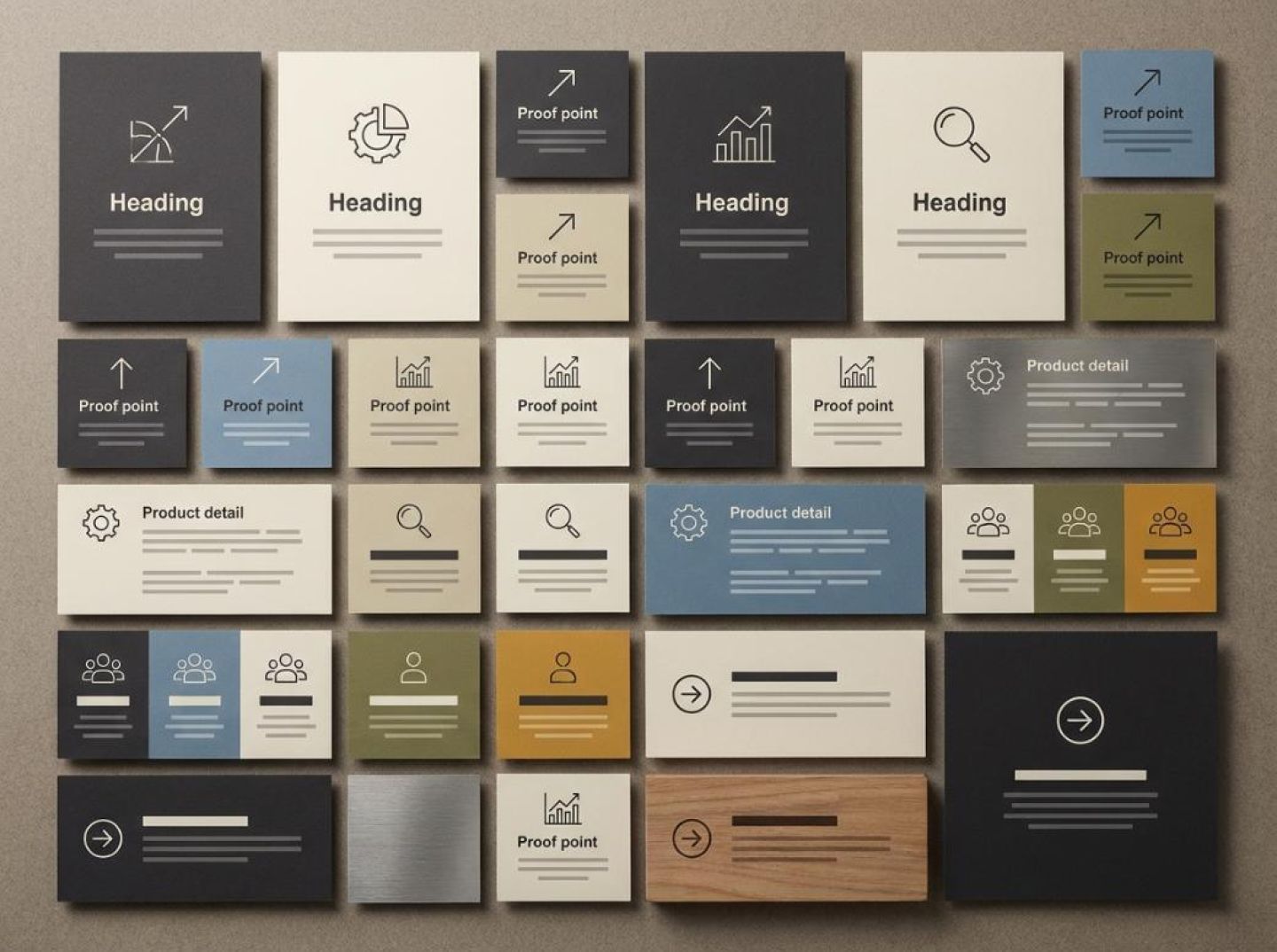
Every major content asset can be decomposed into reusable fields:
A traditional article may bury these elements in long paragraphs. A structured content object makes them easier to find, review, and reuse.
For example, a content record might contain:
Core benefit: Reduces onboarding time.
Evidence: A documented customer study.
Measurement period: The period covered by the study.
Audience: The customer segment included in the research.
Limitations: Conditions that affect whether the result can be replicated.
Approved message: The exact claim marketing is permitted to use.
This structure helps prevent an AI writing assistant from turning a qualified result into an exaggerated promise.
It also aligns with how advertising automation uses content assets. When Search Engine Journal discussed AI Max and Performance Max, the importance of clear and consistent underlying assets was a recurring theme. If your headlines, body copy, and landing page describe the same offer accurately, your team has a stronger foundation for testing and automation.
The raw material for your media is no longer limited to design files and finished landing pages. It also includes the labeled claims, explanations, evidence, and customer insights in your content repository.
As creative testing accelerates, that organization becomes increasingly useful. Social Media Examiner describes how advertisers are simplifying campaign structures and placing greater emphasis on creative development and testing.
That workflow scales more responsibly when AI tools draw from an organized library of approved product information rather than whatever happens to be on the homepage.
Kroger’s work with Vidmob provides another example. Its analysis of more than 1,900 creative assets aimed to identify visual and messaging attributes associated with e-commerce outcomes. As Marketing Dive reports, predictive creative recommendations can turn performance observations into information that helps guide future work.
Your internal content library can follow a similar principle: capture what you learn as discrete, labeled information that can guide the next wave of copy, visuals, and offers.
Once you see content as reusable raw material, two shifts follow.
1. Every AI discovery interaction becomes a possible upstream touchpoint.
If an AI answer summarizes a benefit your company published, that is a reason to consider whether the same benefit should be represented consistently in your advertising, sales material, and landing pages.
However, do not assume that every AI impression is measurable or that every mention represents a qualified prospect. Track only the visibility and referral signals your tools can actually observe.
2. Post-click experiences become modular combinations of the same information.
Visitors who do reach your website should encounter the same accurate benefit statements, proof points, and customer stories that support your wider messaging—arranged in a format designed to help them make a decision.
Headless content is not simply another SEO project. Done properly, it becomes a governed source of information for the persuasive messages your brand publishes across channels.
Performance marketers have been operating in a world where algorithms remix creative, media buying is increasingly automated, and campaign results depend heavily on the quality of the message.
As Meta advertisers have simplified parts of their campaign structures and relied more on automated delivery, creative testing has become an important way to improve performance. A strategist quoted by Social Media Examiner described a shift toward condensed campaigns, batches of creatives, and continuous testing.
The lesson is not that campaign structure no longer matters. It is that complicated account setups cannot compensate for weak creative or an unclear offer.
Automation has taken over more routine parts of media buying, including aspects of bidding, budget allocation, and audience matching. Google’s AI Max and Performance Max products also use advertiser assets and automation to support matching and creative delivery.
But automation still depends on the information and creative direction advertisers provide. As Search Engine Journal explains, marketers need clear assets and appropriate brand controls if they want automated systems to represent their offers accurately.
Performance teams have adapted in three important ways.
Kroger’s work with Vidmob is a useful example. By analyzing more than 1,900 video and image assets, the project sought to identify visual and messaging attributes associated with e-commerce conversion.
As an executive explained in Marketing Dive, it makes little sense to treat media as the only working investment when creative can materially influence campaign outcomes.
The broader lesson is that creative performance data can become proprietary business intelligence.
A company that knows which messages, visuals, offers, and proof points resonate with its customers has information that cannot be reconstructed simply by reading its public website.
Predictive analysis can help identify patterns, but correlation should not be mistaken for proof that a particular creative element caused a result. Teams still need to validate findings through appropriate tests.
AI makes it easier to generate dozens of headlines, thumbnails, and advertising angles. That does not mean every additional variation creates useful learning.
The stronger approach is to test meaningful differences.
Instead of producing 100 versions of the same headline, develop distinct concepts based on different customer problems, objections, motivations, or product benefits.
As the buyer quoted by Social Media Examiner suggests, generating large quantities of nearly identical creatives can simply scale mediocre ideas.
AI can accelerate production and adaptation. Human insight is still needed to identify a compelling customer problem, develop a differentiated angle, and decide which claims are worth testing.
Dynamic Creative Optimization systems can assemble different combinations of headlines, images, and calls to action for different placements or contexts.
As Illumin’s discussion of AI in AdTech describes, generative and optimization technologies can help adapt existing creative assets across channels.
This makes modular creative useful. Rather than treating every advertisement as an indivisible concept, teams can organize a library of:
Each component should remain accurate when used independently. A headline should not promise an outcome that the landing page cannot support. A visual should not imply a product feature that does not exist.
The goal is to make creative adaptable without losing the original promise.
AI systems can summarize public articles, reproduce common messaging patterns, and generate variations of existing creative concepts.
What they cannot automatically reconstruct is your private history of customer responses.
They do not gain access to your internal experiment results simply because they can read your public website. Your customer-level data, conversion records, test decisions, and internal performance analysis remain separate sources of information unless you share them with a system or make them publicly available.
This is where a real competitive advantage can develop: connecting creative decisions to reliable business outcomes.
Meanwhile, the internet is filling with low-value generated content. AdExchanger has reported on concerns about the growth of AI-generated content and made-for-advertising inventory.
In that environment, distinctive creative can help a brand communicate a clearer identity and give users a reason to pay attention. It does not automatically guarantee brand safety or better performance, but it can help distinguish a meaningful offer from generic advertising.
The lesson for content and performance teams is straightforward: when content production becomes easier to automate, the quality of your ideas, evidence, creative decisions, and feedback loops becomes more important.
A structured content library tells you what your brand can say. Competitive ad intelligence helps you understand how other advertisers are communicating, which angles appear repeatedly, and what kinds of funnels are visible in the market.
This is where ad spying becomes useful.
Tools such as Anstrex can help advertisers research visible advertising activity across supported ad formats and networks. Instead of starting every campaign with a blank page, you can examine competitor creatives, messaging approaches, landing-page experiences, and recurring promotional themes.
The purpose is not to copy another advertiser’s campaign. It is to develop better hypotheses.
Start with a specific product category, audience problem, or offer.
Look for patterns such as:
Repeated appearances can indicate that an angle is being used actively. They do not prove that the angle is profitable or that the advertiser is achieving a positive return.
Treat these observations as research signals.
An advertisement is only one part of a funnel.
When researching a visible campaign, examine the relationship between the creative and its destination:
This can reveal useful message-matching patterns and potential gaps in your own funnel.
Do not assume that a competitor's visible landing page reveals its entire campaign strategy. You may not see its retargeting paths, customer segmentation, testing history, or private conversion data.
A useful research note should explain what you observed and what you want to test.
For example:
Observation: Several advertisers in the category emphasize installation speed.
Hypothesis: A message focused on reducing installation effort may be more compelling to first-time buyers than a general product-quality message.
Test: Compare an installation-focused creative against a product-quality creative while keeping the offer, audience, and landing-page structure as consistent as practical.
Measurement: Evaluate qualified conversion rate, cost per acquisition, and downstream order quality.
This turns competitor research into a controlled experiment rather than a copying exercise.
When a test produces a useful result, record it.
Capture:
Keep the finding connected to its source. A winning headline in one audience should not automatically become a universal brand claim.
Over time, this creates a feedback loop:
Market research → Creative hypothesis → Content and ad production → Landing-page test → Performance analysis → Updated content library.
Anstrex can support the research stage by helping you explore visible advertising activity and destination experiences. Your own analytics and experimentation tools are still required to determine what converts for your business.
The strongest headless-content strategy does not depend on every reader visiting your website.
It depends on having a repeatable process for turning market information into better marketing decisions.
Use this five-part operating framework.
Store your most important product and marketing information in a structured format.
Include:
This repository should act as a source of truth for your writers, designers, media buyers, and AI tools.
Choose a defined market or product category. Use Anstrex to examine relevant advertisements, creative approaches, and destination pages available through its supported research features.
Record what is observable. Separate those observations from assumptions about competitor performance.
For example:
| What you can observe | What you should not assume |
|---|---|
| An ad has appeared repeatedly in the results | The ad is profitable |
| Several advertisers use the same benefit | The benefit is proven to convert |
| A landing page emphasizes a particular offer | The offer has the highest conversion rate |
| A creative uses a specific format | The advertiser has tested every alternative |
| An ad links to a particular destination | You know the full customer journey |
This distinction protects your research from becoming a collection of unsupported conclusions.
Do not simply replace a competitor’s brand name with yours.
Identify the underlying customer problem and develop an original approach based on your own product, evidence, and positioning.
For each concept, define:
Use AI to accelerate drafting and adaptation, but review every claim before publication.
Create landing-page variations that reflect different hypotheses.
For example:
Change a manageable number of variables at a time. Use appropriate experiment design, consistent tracking, and enough data to interpret results responsibly.
A higher click-through rate is not necessarily a better business outcome if the traffic does not convert or produces low-quality customers.
At the end of each test, document what happened.
Record the result even when the test loses. A failed hypothesis can prevent the team from repeating an unproductive idea.
Update the content repository with:
This is the part that creates a durable advantage. Competitors may see your advertisements, and AI systems may summarize your public articles, but your internal learning process is not automatically visible to them.
AI-driven discovery is changing the relationship between publishing content and receiving traffic. Your best ideas may be summarized, paraphrased, and presented through interfaces that do not require a visitor to click through to your website.
Trying to protect every useful sentence is not a sustainable strategy. Instead, build a system that turns your knowledge into reusable assets and turns campaign results into better decisions.
Structure your content so important information is clear. Use competitive ad intelligence to understand visible market activity. Develop original creative concepts rather than copying competitors. Build post-click experiences around the needs of different visitors. Finally, connect every meaningful test to a reliable measurement process.
Anstrex can help with the competitive research that informs this process. Your own content repository, analytics, and experimentation framework provide the internal learning that makes the research valuable.
The content may be visible. The system behind it is where your advantage can grow.
Receive top converting landing pages in your inbox every week from us.
Must Read
AI search can summarize your best content before visitors reach your website. Learn how to turn articles into structured creative assets, build conversion-focused post-click experiences, and use competitive ad intelligence to develop a stronger testing system.
Samantha Reed
7 minNov 16, 2026
Editor’s Pick
Tighter financial-advertising rules can change who is eligible to advertise, how competitors appear, and where risks emerge. Discover how to combine compliance monitoring, account security, and Anstrex competitive intelligence to make better decisions when platforms tighten enforcement.
Dan Smith
7 minNov 16, 2026
How-To
AI-driven advertising changes how campaigns are matched, delivered, and measured. Discover how to monitor those changes, build independent creative benchmarks, and use Anstrex research to develop better tests without assuming the platform's black box is always right.
Rachel Thompson
7 minNov 15, 2026